
The Conscience of the Scholar
Jonathan Spencer
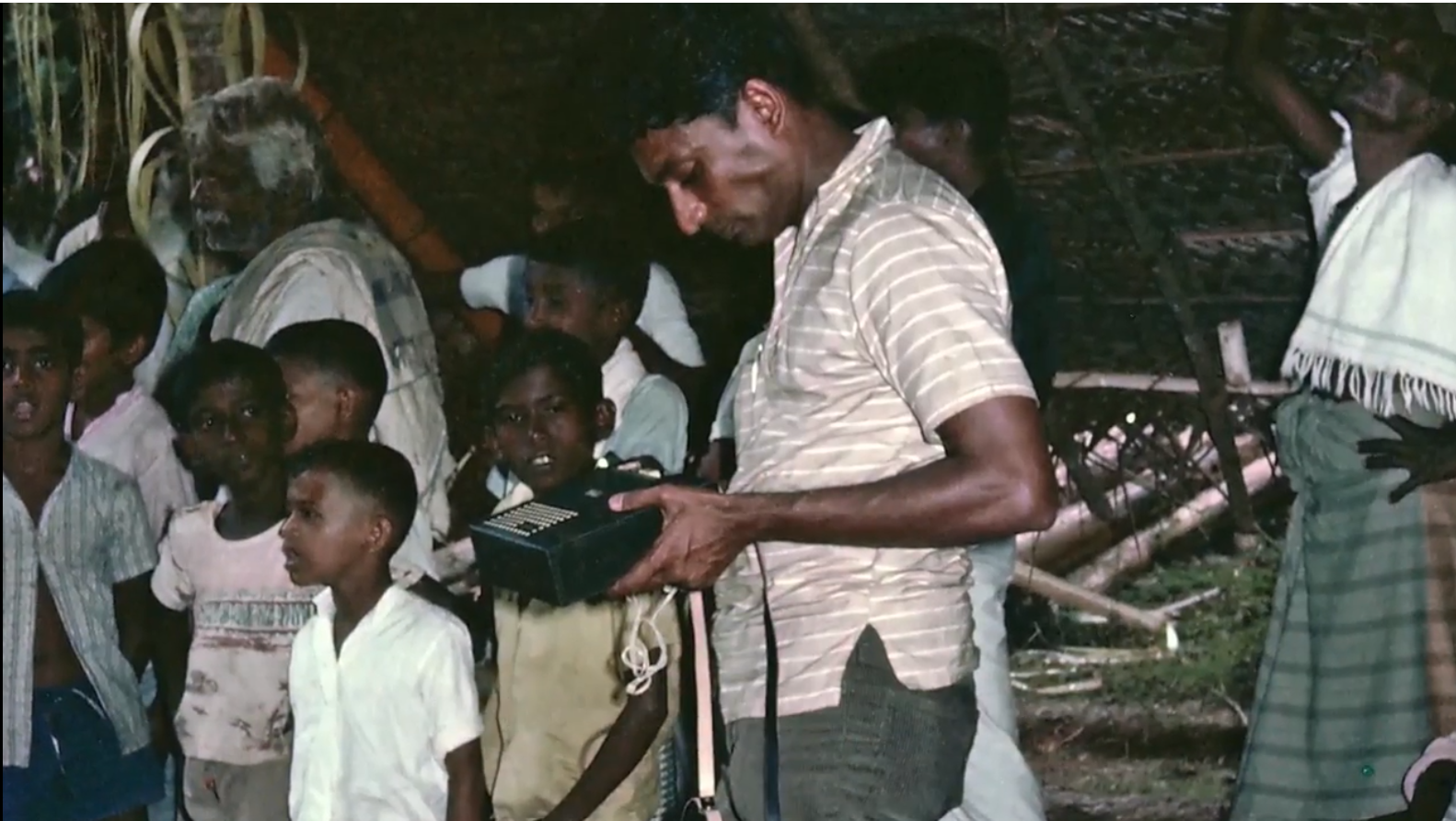
When news started to spread of the death of Gananath Obeyesekere, a younger colleague said to me, “Oh, you must have known him. What was he like?”. I paused before replying, “I think he may have been the most charismatic man I ever met.”
Reading the collection of wonderful pieces assembled by our friends at Polity to mark Gananath’s passing, I see nothing to alter that initial judgement, but I’m left with the puzzle of what it actually means to say someone like Gananath is charismatic.
Is this just a matter of appearance, for he was a remarkably good-looking human being, as the many photos from different stages of his life attest? Or is it a matter of demeanour, or maybe of voice—the timbre of his voice, the drawn-out vowels and dramatically rolled Rs, and the impeccable sense of timing? Certainly I know I will retain the memory of Gananath declaiming, long into the future.
Years ago, the anthropologist Tamara Gunasekera told me of the shock of listening to Gananath lecture at Peradeniya in her first year as an undergraduate, where she had been part of a stunned cohort of sheltered young women listening to him holding forth on phallic imagery in Sinhala folk rituals.
My first wife Julia never forgot her first encounter with Gananath. Having arrived after dark we were ushered into the upstairs living room of their Princeton house; adjusting to the splendid setting, Julia slowly became aware of a pair of eyes, apparently suspended in mid-air, looking in at her through the window. Catching her astonished expression, Gananath looked out and announced, full Rs rolling, “Ah, it’s the creature.” (It was in fact a raccoon which had taken to hanging out on the branch of a tree outside their window.)
It would be easy to add examples of this sort from all stages of Gananath’s career, but this may be missing the point. Gananath was clear that he did not want a big funeral, not least because he did not want to be the subject of any of those long, often pompous, speeches by which Sri Lanka honours its departed. In this piece, I want to find a way to celebrate Gananath’s intellectual charisma without recourse to the embarrassing hagiolatry he complained about in funeral orations.
Something by Gananath’s friend and Princeton colleague Clifford Geertz, might help here. It comes from an essay on “charisma” (Geertz 1983). Charisma, Geertz argues, is not a quirk of personality, or looks, or simply individual psychology; charisma implies the capacity to place oneself at the heart of things, to articulate the things that need to be said at any one time.
But occupying a “central” position in public discourse is not a matter of geography, important things can be said from the most unlikely of places. Gananath moved through the world like a chess-board knight, each obvious step forward being matched by an equally unobvious step to the side. He did not make directly for the centre of anything: instead, the centre followed him. That is one way to understand why we might think of Gananath as charismatic; and why so many things he said and wrote have stuck with us.
For example, just before I set off for Sri Lanka for the first time in 1981 I bought a copy of Medusa’s Hair (Obeyesekere 1981), which had only just been published. As it accompanied me across the island, occasional visitors would pick it up, look at the cover photo of a smiling elderly woman offering her matted locks to the camera, and put it back down, often with a comment along the lines of, “Why are you wasting time reading about such marginal, unimportant people? What can they tell you about Sri Lankan society?”.
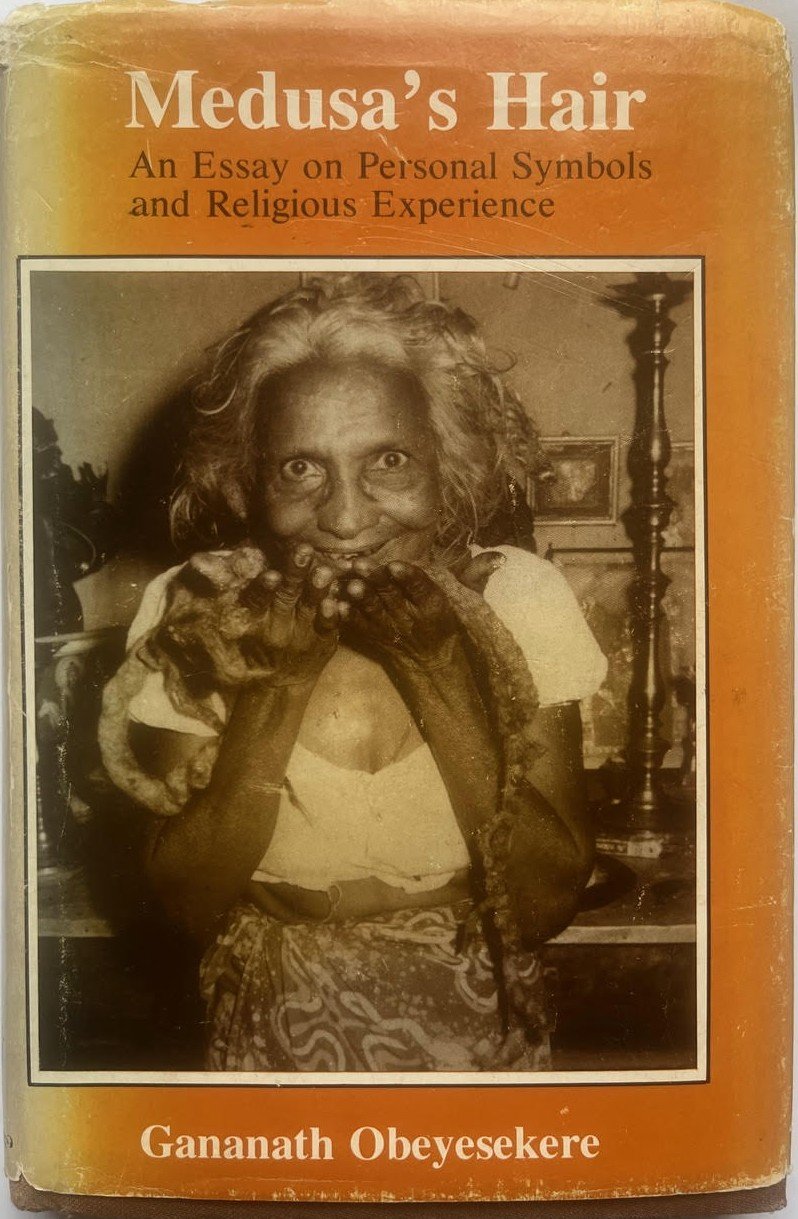
Author’s battered, much travelled, original copy of Medusa’s Hair
The answer might seem obvious enough now—they can teach us all a lot—but was not at all obvious at the time. Medusa’s Hair has endured as few academic books can be expected to endure, not least because it speaks of central human concerns: of how to build a liveable life; and of how new cultural things come about in people’s struggles with partners and families, through episodes of abandonment and loss; and it shows the reader how such concerns are as likely to find a resolution in the lives of the poor, as they are in the cultivated tomes of the educated classes.
This pattern, of stepping sideways out of the frame to find something of value in the most unlikely places, was set from the start. In her wonderful interview with Crystal Baines, Ranjini describes undergraduate Gananath as the student who was never there—always away from campus, observing rituals and collecting folk tales and kavi, at a time when his peers were busy with their lives and friends as students. Gananath even wooed his wife-to-be with poems brought back from the villages, sent anonymously until he was finally exposed by his own hubris, having published one of the anonymously delivered poems in a student magazine.
That copy of Medusa’s Hair had accompanied me for two years before I met its author. In the early summer of 1983, Mark Whitaker, in those days my friend, partner-in-crime, and occasional therapist, had become tired of having to listen to my never-ending rants about the dark direction Sri Lankan politics had taken in the previous year. Gananath was back in Colombo and was, Mark said, just as concerned about all of this. I should go and talk to him. I have no memory of that first meeting, but I do remember again going to see Gananath in Colombo, a few weeks after the July pogrom. It seemed important to me to connect with someone I was beginning to recognise as a moral compass in a world of seemingly complicit silence, in which the worst seemed “full of passionate intensity”. (Mark was as fond of quoting Yeats as Gananath.)
The Parable on Justice
July 1983 was a rare moment when Gananath found himself inadvertently at the very centre of events. He had temporarily rented an apartment by himself in Borella in the hope of catching up with his writing. On the 21st of July he gave a public lecture in Colombo on Pattini and “the parable on justice”.[1] Gananath used material from his Pattini research to tell the tale of two kings, one righteous, the other vain and thoughtless. The vain king ordered the construction of a new city with a sacred lake at the centre. The echoes of J.R. Jayewardene’s relocation of the capital to the new city of Sri Jayewardenepura were clearly deliberate, not least because of the lake that surrounded Geoffrey Bawa’s ostentatiously isolated Parliament building, which had been opened the year before. Three nights later, when the crowds spilled out of the cemetery on July 24th, they spilled down the street where Gananath was staying.
It’s worth reflecting on the ways Gananath responded to this terrifying experience because it gives a better idea of Gananath’s position as a public intellectual, not least through the oblique directions he took in order to try to make some kind of sense of what was happening to his home country. We might start with that lecture on justice in which Gananath drew on his Pattini research to deliver something of a moral warning about the excesses of unchallenged power, a warning all the more telling at that fraught political moment because it was steeped in the satiric humour of the original village rituals.
Gananath’s first response to the July events was much more conventionally social scientific in spirit. This took the form of an essay on the recent history of political violence which appeared, under slightly different names, in at least two edited collections published in 1984 (Obeyesekere 1984a, 1984b). The essay sketched the background to the July events in the medium and long term, added some sociological detail on the participants in the violence, especially the members of the UNP’s trade union wing, the Jathika Sevaka Sangamaya (JSS), and detailed various earlier incidents in which agents aligned with the government had seemed to overstep the mark.
The essay also included a short sketch of changes in Buddhist ideas and practice which might be thought of as a contributory factor in the violence. In the recent past, Gananath argued, key Buddhist values of compassion and kindness were transmitted across generations through the medium of folk tales, often based on Jataka stories. Modernists had turned middle-class Buddhists away from this part of their own tradition, while a coarsened sense of Buddhism as a monolithic political identity took hold. This process, Gananath argued, now manifested itself as a crisis of Buddhist “conscience”.
Gananath expanded upon this point in a lecture he gave in Madison in November 1984[2], which was eventually published by the Social Scientists’ Association (SSA) in 1988 as a pamphlet (Obeyesekere 1988). The SSA version of the lecture starts with the well-known moment in the Mahavamsa, when Dutthagamani is stricken by conscience for the deaths of so many in his wars against the Tamil King Elara; a group of arhats console him by saying, in effect, that there is no need to grieve for those who have not committed to Buddhism.
Gananath then contextualises this rather troubling story within the life of Dutthagamani himself, and within other versions of the story found outside the Mahavamasa. This takes him up to much more recent controversies between scholars of Buddhism who take a more or less critical view of the Mahavamsa account. The paper hinges again on Gananath’s delineation of the crisis of contemporary Buddhist conscience: in the absence of a sovereign deity, rewarding or punishing individual actions, central Buddhist values had been embedded in narratives, and those narratives were transmitted orally, and also acted out in village rituals. These stories and rituals had in recent times been belittled by would-be modernisers, concerned to present Buddhism as a properly rational and modern religion in a process Gananath characterises as ”the dismantling of the Buddhist conscience” (Obeyesekere 1988: 37).
Gananath continued to write and reflect on the theme of conscience through the 1980s—it weaves its way through the examples explored in The Work of Culture (1990), and there is a further reworking of the earlier pieces on Buddhist conscience, this time with more emphasis on modernisers like Dharmapala, in a 1991 essay in Daedalus (Obeyesekere 1991).
At the end of the SSA piece, Gananath asks, “What happened to the conscience of the scholar?” (Obeyesekere 1988: 51). He answers by setting out the need to take an ethical stand in the public argument of the moment, while also playfully blurring the boundary between the scholar as interpreter of myth and the scholar as maker of myths (Obeyesekere 1988: 53). This final gesture needs to be read in the context of an important earlier section of the paper in which he argues for an inherently pluralistic and contentious understanding of history:
I argue that the existence of a myth or story, particularly a culturally significant one, is a provocation that produces argument and counter-argument or “debate”. Debate is the discourse that the narrative unleashes, but this discourse is rarely recorded in ancient history (unlike in our own times owing to the existence of mass communications). These debates then produce alternative versions of the narrative; And it is from these alternative versions that we can infer, in hermeneutical fashion, the existence of “debate”. … I think that even contemporary historiography, in spite of its self consciousness regarding methodology, is not immune from the contentious nature of discourse or “debate”. (Obeyesekere 1988: 21)
This world of stories and counter-stories, in which the boundary between myth and history is necessarily ignored, is the world in which Gananath as a scholar with a conscience positioned himself. In his folkloristic wanderings in the 1950s, he collected, preserved, and eventually published many stories, and what could be called counter-stories, all tokens in a contentious intellectual landscape. As an author, Gananath might be thought of as a myth-maker in his own right, a teller of edifying tales, whether told in the voice of the village kapu mahattaya, or in the hermeneutic tones of the Princeton professor. (You can tell the difference by the presence or absence of Gadamer or Ricoeur in the story.)
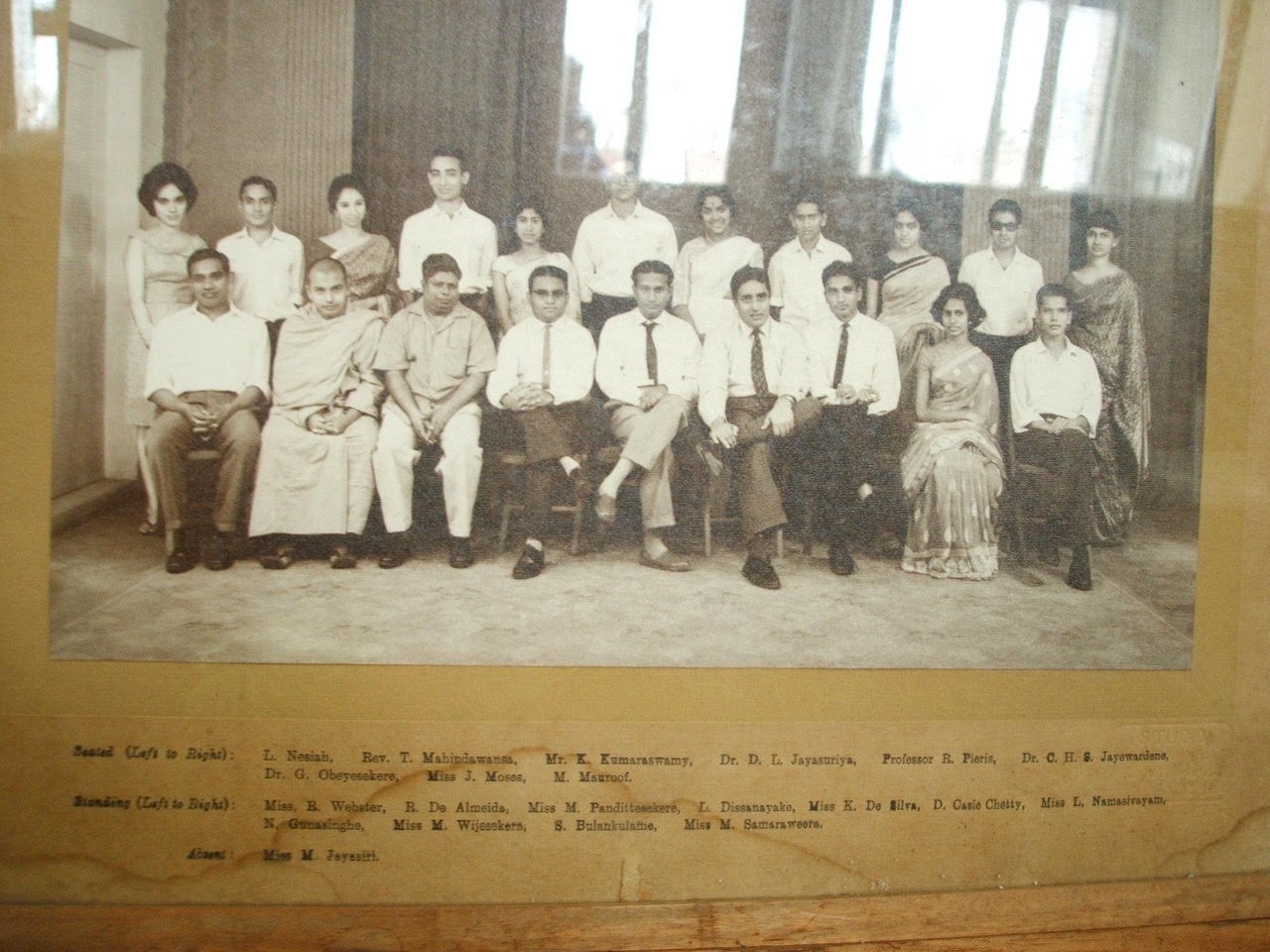
Peradeniya Sociology Department, late 1960s
An accidental educator
Like Selvy Thiruchandran, elsewhere in this collection, my first formal academic encounter with Gananath might be best filed away under “challenging”. Gananath appointed himself the discussant of my first public presentation as a researcher of Sri Lanka in Anuradhapura in 1984. I was told my piece was wrong but nevertheless somewhat intelligent, which was some comfort. Like Selvy, any intellectual frostiness soon dissipated in the warmth of Gananath’s subsequent hospitality. He and Ranjini welcomed me to Princeton while I was spending some months in Canada in 1988, which is how my wife and I encountered the creature suspended outside his window.
But it was during an extended stay in London in 1990 that I really got to know Gananath and Ranjini well. This was a year when I had a temporary post at the London School of Economics and Political Science (LSE), where Gananath and Ranjini were academic guests, while Charles Hallisey was a visitor just up the road at School of Oriental and African Studies (SOAS), where he was working with Professor G. D. Wijayawardhana. Charlie and I co-organised an informal seminar series on the anthropology of Buddhism in honour of the Obeyesekeres (part of which surfaced in a special issue, edited by David Gellner, of the Journal of the Anthropological Society of Oxford later that year.[3]) James and Judy Brow were also around, while Gananath and Ranjini spent much of their time with their old friends Jock Stirrat and Elizabeth Nissan.
Gananath was in an especially benign mood, away from the pressures of everyday life at Princeton, and also away from the darkness of Sri Lanka in those years of terror. He would often wryly refer to himself as “a sixty-year-old smiling public man” (a quote from Yeats’ ‘Among School Children’). His good humour also seemed to derive in part from the fact that he was working in the London archives on what he referred to as “the Cook book”—what would become The Apotheosis of Captain Cook (Obeyesekere 1997). That book, as Stirrat points out elsewhere in this collection, is presented in part as a book about “terror”, and in its introduction, Gananath reiterates his protest at the apparent suspension of public conscience in the face, this time, of a global culture of violence (with a local manifestation in the terror in Sri Lanka) (Obeyesekere 1997: xvi).
In the pieces assembled for this Polity collection, we get a very strong sense of Gananath’s importance as a friend and mentor. Starting back in the 1960s, Jock Stirrat, Richard Gombrich, and Dennis McGilvray all draw attention to Gananath’s generosity towards younger scholars. Gombrich describes himself as having been Gananath’s “first foreign student/disciple”. Mark Whitaker credits Gananath for the “accidental education” he received from his PhD supervisor. John Rogers starts with a characteristically generous gesture, when Gananath invited a very junior historian to lunch with him at the Princeton Faculty Club in 1984. Anne Blackburn remembers Gananath’s support of her early work on the Kandyan era. Victor de Munck vividly recalls the privilege of being able to join Gananath in the field in Kataragama. Sanmugeswaran Pathmanesan, like countless other gifted Sri Lankan students before and since, was supported and encouraged by Gananath as he set about his journey into a PhD.
Geethika Dharmasinghe and Anushka Kahandagamage provide compelling examples of Gananath’s enduring capacity to inspire younger scholars to ask new and fresh questions. Radhika Coomaraswamy evokes the conversations at ICES in the early 1990s, when Gananath and Ranjini might be joined by Regi Siriwardena (another great renaissance man, who like Gananath managed to be at once central to cultural arguments, and always one step to the side of them), and others. Sid Perinbanayagam, a near-contemporary who claimed to have read every book that Gananath had published, shows how Gananath’s late reflections on Vädda presence in the Sri Lankan cultural imagination, productively disrupt the projection of contemporary animosities back into a past that was clearly more fluid and pluralistic than we care to acknowledge. His sister, Selvy Thiruchandran, survives an ordeal by seminar and seals a long friendship over a succession of memorable meals. Her eventual reward is a foreword from Gananath for her book. Dennis McGilvray apparently annoys Gananath with his critique of an argument from the Pattini book, but wins a prize for his article, only to discover that Gananath was one of the judges.
A moveable centre, an oblique guru
The intellectual landscape in which Gananath situated himself, in his ruminations on story and history, this world of argument and counter-argument, in which story is the paramount vehicle for ethical reflection, all of which he called either “discourse” or “debate”, is very close to the idea of “tradition” first propounded by the philosopher Alasdair MacIntyre in After Virtue (MacIntyre 2013). MacIntyre’s argument is probably best-known, to anthropologists at least, through its use by Talal Asad in his writings on Islam (Asad 1986). Asad’s thoughts on tradition feature in Geethika Dharmasinghe’s piece in this collection, where she picks up threads from Gananath’s work on religious change in the 1970s and 1980s. MacIntyre argues against a conventional understanding of tradition as something static, conservative and unchallenged: for him “tradition” is a site of enduring and necessary argument, in which both the past and the future might be invoked.
Gananath’s work might plausibly be presented as his contribution to just such a conception of tradition, whether as collector and archivist of the oral tradition, as in the Pattini book, interpreter of the new and shocking, as in Medusa’s Hair, or moral commentator on the events of the present, as in the writings on conscience. It’s also worth recalling that MacIntyre’s idea of tradition was the backdrop to a broader argument, in which human striving for a good life is manifest through the ability to tell exemplary stories about any particular life, stories which are intelligible insofar as they are told within an ongoing, fluid and contentious, tradition.
MacIntyre, though, is ultimately pessimistic because as he sees it, the Enlightenment project has undermined the possibility of agreement on the contours of a tradition. With the loss of tradition as the background, any invocation of a good life is inevitably incomplete and incoherent. Here Gananath strikes a different path: even if the rationalist attack on traditional modes of ethical edification in Sinhala Buddhism has been damaging, those modes are not irretrievably lost. It is still possible to revive and rejuvenate them, to use them to provoke and argue, and in this way to enact your own version of a good life, and in doing so, in some small way to shift the centre of public discourse into a more congenial place.
Finally, a word about the future is visible in this wonderful collection of reflections. We might start with one of the younger contributors. Pathmanesan, as Mark Whitaker’s student, is a kind of second-generation progeny of Gananath’s, a grand-sisya if you will, and describes his own intellectual lineage in terms of classical models of guru-disciple relations. His account is compelling but nevertheless something of an outlier in this collection. For most of us, Gananath’s influence was far less direct than the idea of a “guru” might suggest.
At that seminar we convened in London, Gananath was a relatively quiet presence, always characteristically encouraging, but rarely if ever suggesting a particular direction that the presenter should take in their analysis. Even a direct student like Mark, who was gifted a full ethnographic package—complete with setting, topic, and a letter of introduction to a Tamil instructor—by Gananath, when his original fieldwork plan collapsed, was pretty much left on his own to get on with things once he’d set out.
This is not to say our intellectual journeys were not shaped by Gananath’s ideas and writing. I now realise that the copy of Medusa’s Hair I carried around Sri Lanka over 40 years ago opened my eyes to quite new ways of writing ethnography, and thus to an anthropology stripped of its more tediously “scientific” pretensions, and fully alert to the particularity of individual lives in all their idiosyncrasies. The kind of anthropology, as Jock observes, quoting Gananath quoting Edmund Leach, that might read more like a novel than a dry academic report.
At this point, perhaps we should go back to the very beginnings of Gananath’s intellectual journey, to Lyn Ludowyck’s classroom at the University of Ceylon. Ranjini, in her interview with Crystal Baines, points out how many superlative anthropologists and sociologists came out of that classroom, not only Gananath, but also Stanley Tambiah, Gehan Wijeyewardene and Kitsiri Malalgoda. Ludowyck, she recalls, was Gananath’s ideal of a great teacher. When Ludowyck realised that Gananath’s ambitions could not be contained within the boundaries of the conventional literary studies of the day, he petitioned his wealthy friends to raise money to support Gananath’s folkloristic adventures. Later it was Ludowyck who introduced the young Richard Gombrich to Gananath in London: having enabled Gananath’s sideways step into the field in which he would flourish, he enabled the young British orientalist to make a similarly oblique move.
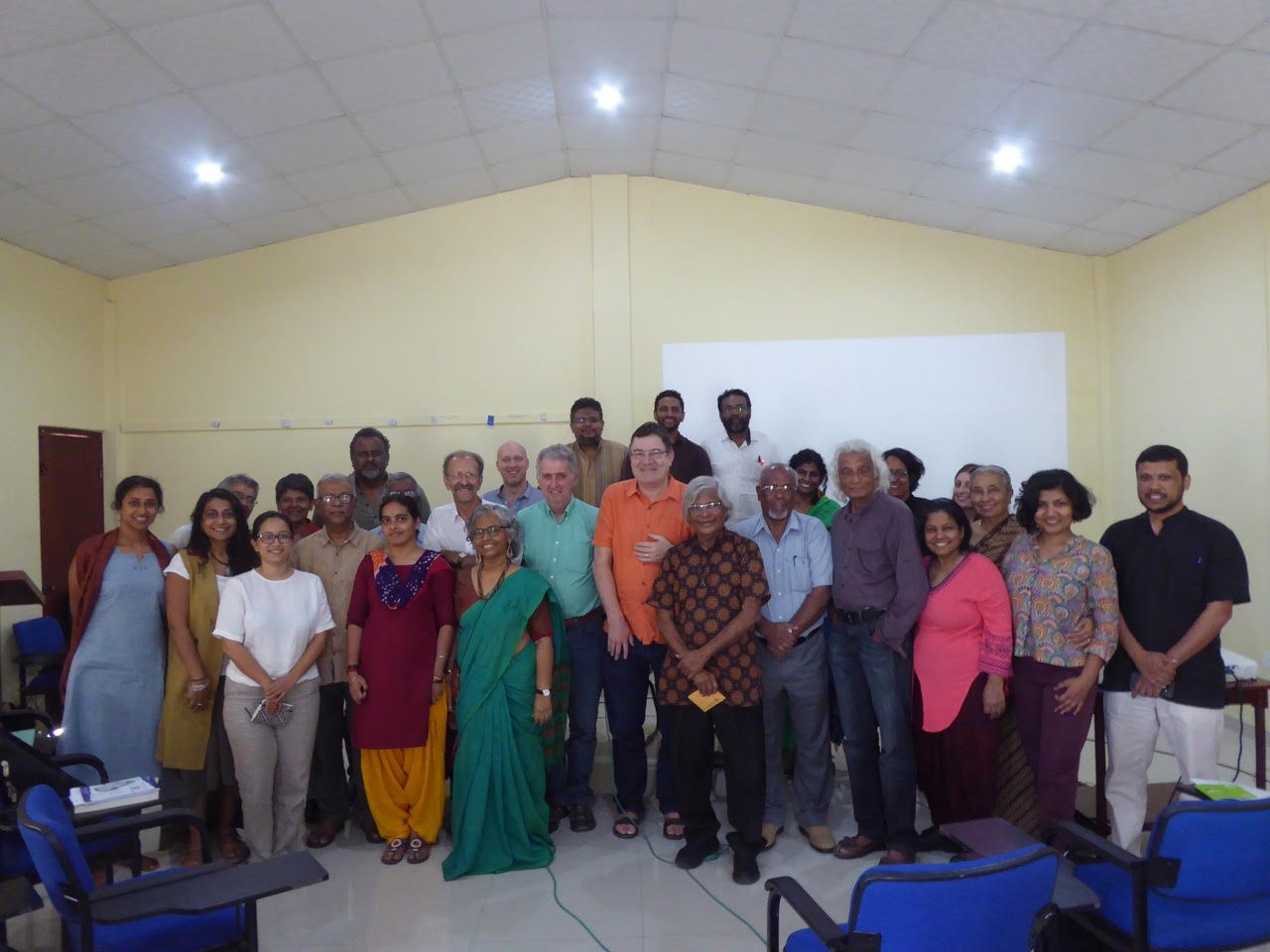
‘Translating Conscience’ workshop, Kandy 2019
Credit: American Institute for Sri Lankan Studies
If the rest is, as they say, history, it’s a history vastly enriched by Gananath’s refusal to be contained by disciplinary boundaries, and also by his encouragement to those who came after him, not to follow him, but to make their own moves, forward, sideways, as they found their own place as scholars and writers, and in many case, contributors to the public conscience. As Auden said of Freud, “able to approach the future as a friend without a wardrobe of excuses”.
Jonathan Spencer is Emeritus Professor of South Asian Language, Culture and Society at the University of Edinburgh; co-editor (with Harini Amarasuriya, Tobias Kelly, Sidharthan Mounaguru, and Galina Oustinova-Stjepanovic) of The Intimate Life of Dissent: Anthropological Perspectives (2020, London: UCL Press).
Lead image credit: Ranjini Obeyesekere
References
Asad, Talal. (1986). The Idea of an Anthropology of Islam. Occasional Papers Series, Center for Contemporary Arab Studies, Georgetown University, Washington DC.
Geertz, Clifford. (1983). “Centers, Kings, and Charisma: Reflections on the Symbolics of Power”. In Local Knowledge: Further Essays In Interpretive Anthropology (121-146). New York: Basic Books.
MacIntyre, Alasdair C. (2013). After Virtue: A Study in Moral Theory. London: Bloomsbury.
Obeyesekere, Gananath. (1981). Medusa’s Hair: An Essay on Personal Symbols and Religious Experience. Chicago: University of Chicago Press.
Obeyesekere, Gananath. (1984a). “Political Violence and the Future of Democracy in Sri Lanka”. In Committee for Rational Development (Ed.), Sri Lanka. The Ethnic Conflict: Myths, Realities and Perspectives. New Delhi: Navrang
Obeyesekere, Gananath. (1984b). “The Origins and Institutionalisation of Political Violence”. In James Manor (Ed.), Sri Lanka in Change and Crisis. London and Sydney: Croom Helm.
Obeyesekere, Gananath. (1988). A Meditation on Conscience. Colombo: Social Scientists’ Association.
Obeyesekere, Gananath. (1990). The Work of Culture: Symbolic Transformation in Psychoanalysis and Anthropology. The Lewis Henry Morgan Lectures 1982. Chicago: University of Chicago Press.
Obeyesekere, Gananath. (1991). “Buddhism and Conscience: An Exploratory Essay”. Daedalus, 12 (3): 219–239.
Obeyesekere, Gananath. (1997). The Apotheosis of Captain Cook: European Mythmaking in the Pacific. Princeton NJ: Princeton University Press.
Notes
[1] Editors’ Note: ‘The Goddess Pattini and the Parable on Justice’, July 21, 1983, Punitham Tiruchelvam Memorial Lecture, Tamil Women’s Union (Kalalaya), Colombo, 22pp.; Also published by the same title cum typo in Modern Sri Lanka Studies (Peradeniya), 1986, Vol. 1, No. 1: 01-14.
[2] Editors’ Note: Keynote at the 13th Annual Conference on South Asia, November 3, 1984, University of Wisconsin, Madison. Also published as ‘Duţţagāmaņī and the Buddhist Conscience’, in Allen, Douglas (ed.) (1992), Religion and Political Conflict in South Asia: India, Pakistan and Sri Lanka. Westport, Conn. and London: Greenwood Press.
[3] Journal of the Anthropological Society of Oxford, 1990, Volume 21 Issue 2
You May Also Like…
Gananath Obeyesekere: Dazzling Scholar with Integrity
Dennis B. McGilvray
Adding to the Polity conversations about Gananath Obeyesekere, I wish to mention a further dimension of his remarkable...

Laughter, Debate, and Dissent: Personal Glimpses of Gananath Obeyesekere
Selvy Thiruchandran
I first met Gananath at the International Centre for Ethnic Studies (ICES) in Colombo, when its Director, Radhika...
A Bridge Between East and West
Richard F. Gombrich
My love and admiration of Gananath are so rooted in my view of my own life that if I failed to respond to this...