

Polity aims to advance democratic consciousness, gender equality, state reform, and social change in Sri Lanka, while interested in South Asia and the World.
As its predecessor Pravada (1991-2002), Polity is published by the Social Scientists’ Association in Colombo, with critical content on politics, political economy, history, women, ethnicity, sexualities, religion, labour studies, agrarian relations, nationalisms, violence, ecology, and much more.

Made in Sri Lanka, Taxed in America, and Failed by the IMF
Taniya Silvapulle
Introduction On 2 April 2025, U.S. President Donald Trump announced the ‘Liberation Day’ tariffs, imposing trade...

The Revival of the JVP after 1989
Nirmal Ranjith Dewasiri
What follows is a brief account of the history of the Janatha Vimukthi Peramuna (JVP) from 1990 to the election...

Budget 2025: Playing A Bad Hand
B. Skanthakumar
Introduction ‘Budget 2025’ – delivered before parliament on 17 February by President Anura Kumara Dissanayake (AKD) in...

Contingence, Conjuncture and Structure: The Economic Crisis in Sri Lanka
Sumanasiri Liyanage
Prologue Vice-Chancellor; Deputy Vice-Chancellor; Dean, Faculty of Arts; Head, Department of Economics; members of...
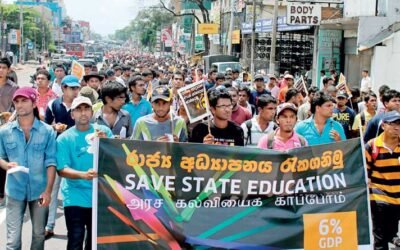
Unveiling ‘Privatisation’ in Higher Education in Sri Lanka
Kaushalya Perera and Hasini Lecamwasam
The public discourse on higher education in Sri Lanka cleaves along the false dichotomy of public versus private...

Rani: The Politics of Erasure and the Aesthetics of Forgetting
Prasanna Pitigala Liyanage and Malithi Liyanage
Cinema does not merely reflect history; it remakes itWhat appears on screen influences what is remembered and what is...
Current Issue

Out Now! Vol. 13 No. 2 (July – December 2025). 148 pages. #SriLanka. Politics. Cyclone Ditwah. Ecology. Feminism. Education. Justice. Domestic Violence Act. History. Culture. Work. Labour. Books. Cover Picture Sakuna M. Gamage. LKR1000 from the Social Scientists’ Association or Barefoot or SLBOOKS.lk.
Calls
Archive
Pravada (1991-2002) and Polity (2003-) back issues available here.

Social Scientists’ Association
The Social Scientists’ Association (SSA) was founded in 1977, at a turning point in Sri Lankan politics, economy, and society, marked by among other aspects: the ‘open economy’ market reforms; deepening ethnic conflict; and the growing concentration of executive power. Its initiators were academics from public universities, seeking an autonomous space to grapple with these shifts; and to promote progressive political, economic, and social change.