
Ditwah Relief Management: Politics and Perceptions in ‘Kolamba Gama’
Shashik Silva
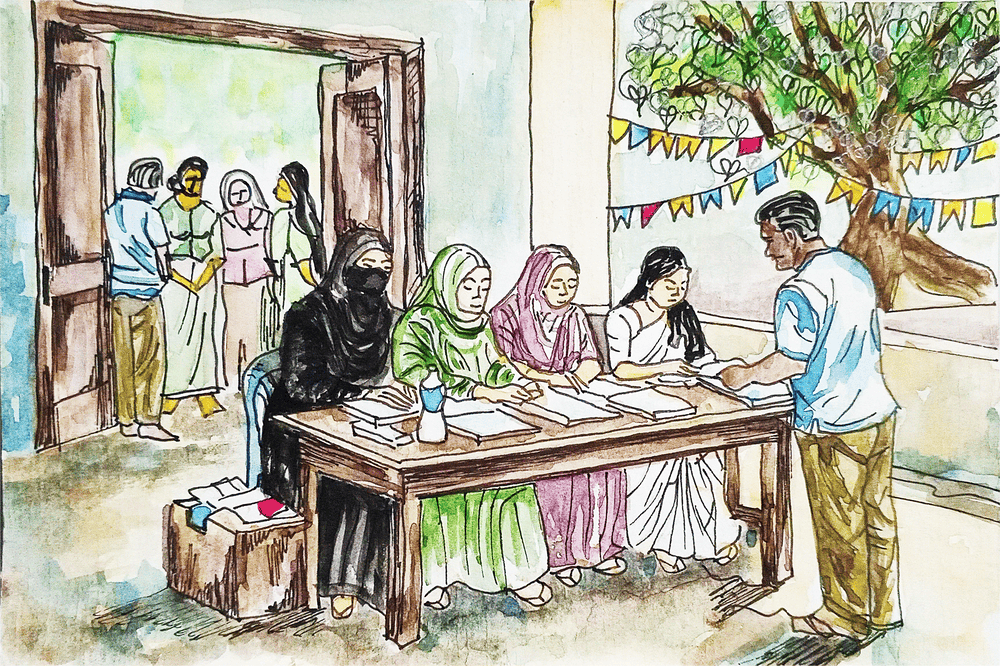
Behind the numbers of those affected by Cyclone Ditwah, the homes and businesses destroyed or damaged, and those still in temporary shelters, there are other stories about what disaster relief means to people, their response to government relief, and how their political identity shapes their responses. What people think about the relief they received is not simply a reflection of how much they got or how badly their homes were damaged. It is shaped just as much by how they receive the relief, who they voted for, what they remembered about how things worked under previous governments, and how the process of receiving relief under this government made them feel. This is the story of one such village, referred to here as “Kolamba Gama” to protect the identity of its residents, and what five hours inside a temporary relief centre and another three hours at a formal relief handover ceremony revealed about the way ordinary people make sense of what a government does for them.
Kolamba Gama is a village in the Colombo District that was severely affected by the flooding caused by the Ditwah disaster. The village has a history of supporting the Sri Lanka Freedom Party (SLFP) and later the Sri Lanka Podujana Peramuna (SLPP). People know the political identity of almost everyone around them, because that identity is not merely a choice made at elections, but something people carry openly in their social and community life.
Voter mobilisation has largely been driven by local politicians and their community-based organisers, many of whom are respected figures known for their social work. During the most recent election, a significant portion of that voter base shifted to the National People’s Power (NPP). A respected man in his late 60s, considered among the few educated figures in the village and a former SLPP supporter, was approached by NPP supporters to stand as their candidate in the local election and won. A smaller portion of the village supports the Samagi Jana Balawegaya (SJB), and there are a few who support Sarvajana Balaya.
The village is also home to a Sinhala Buddhist majority, though the Muslim population has been gradually growing over the years. This demographic shift has been a recurring theme in local political discussions, with some Sinhalese residents expressing concern about the implications for local power. In local elections, this has at times translated into calls among Sinhalese voters to unite behind a Sinhalese candidate regardless of party affiliation.
People from Kolamba Gama largely make their living as masons, carpenters, electricians, plumbers, mechanics, trishaw drivers, daily wage labourers, shop owners, and those running small and medium enterprises, though a few commute to the city for private sector and government employment.
The Grama Niladhari leading the Ditwah relief work in Kolamba Gama is Sinhalese, a young graduate appointed to the village approximately two years ago. During her time in the village, she has not been observed working closely with any political party, and the Ditwah relief distribution appeared to be her most significant public engagement since her appointment.
The temporary relief centre
The Grama Niladhari had chosen to use the hall of a temple on the edge of the village as the temporary relief centre. Rather than processing everyone at once, she had allocated three separate days for the work, dividing villagers into groups so that each had a dedicated day to come in, go through the application process, and document the damage to their homes.
What follows are the stories heard and observations made on that first day. It should be noted that the accounts recorded here reflect the perspectives of Sinhalese residents of the village. While Muslim volunteers and applicants were present at the centre, the author’s interactions were limited to Sinhalese villagers.
Motorbikes and three-wheelers were parked close to the entrance of the temple, giving it the busy look of a poya day. People were rushing into the temporary relief centre located there. They had been approached by the Grama Niladhari and informed the same day that they needed to come in as part of the application process for the government compensation for house repairs. It was a Saturday and the Grama Niladhari was hard at work.
The temporary relief centre was run by the young Grama Niladhari and five volunteers. Four of the five were young or early middle-aged Muslim women, three wearing abayas, one of them wearing a niqab. The only man among the volunteers was a Sinhalese man who appeared to be in his sixties. They worked efficiently, which was essential given the number of villagers arriving, rushed, excited, anxious, and often confused about what was expected of them. The excitement only grew as they got to know that every household was entitled to Rs.500,000 for house repairs.
One observation stood out. There were no local NPP politicians present, nor any of the party’s ground-level campaign workers. The young Grama Niladhari was running the show, making calls and managing the process. People stood in line, while the volunteers, for the most part, treated everyone equally, though they were visibly a little more attentive to villagers they personally knew, such as friends or relatives.
The application form itself was more like an agreement. The sections to be filled in were minimal, most of the document consisting of clauses the applicant was expected to agree to. There was also an affidavit to be completed and certified by a Justice of the Peace (JP). The Grama Niladhari’s team directed people to a house about 50 metres away, where a JP was available. Villagers were informed it would cost only Rs.150 in total, including Rs.50 for the stamp.
The queue outside the JP’s house did not seem to worry most people; it was the application that made them anxious. The JP would fill in and sign the affidavit without much fuss, but the agreement felt like serious business. Some went back home to get help from younger, educated family members. Others leaned on the volunteers. Out of the people who sought support, a few were illiterate or elderly and could not fill in the application alone. For many, this was something significant. They were being asked to sign and give a thumbprint on a government document, something that needed to be done carefully.
The form made clear that the Rs.500,000 would be released in two instalments, Rs.300,000 first, and then Rs.200,000. After receiving the first instalment, the work would be inspected, and if the promised repairs or construction had not been carried out, the money would have to be returned. Applicants also had to specify what repairs they intended to complete with the first instalment of Rs.300,000. The Grama Niladhari repeatedly reminded people not to include anything in that list that could not realistically be completed with that amount. She also made clear that mistakes and corrections on the forms should be avoided, and that if any corrections were made, villagers needed to sign next to each one. For most, this was not something they could navigate alone, and they began seeking help. Only a few handled it entirely on their own. However, many managed to get things done within a maximum of four to five hours, after considerable running around.
Stories heard
These are the stories and exchanges heard over five hours in and around the temporary relief centre and the queue outside the JP’s house. It was in that queue that most discussion happened, as villagers waited with their documents in hand, with little to do but talk until they reached the JP.
One man, in his fifties and an NPP supporter, was both delighted and sarcastically amused at the scale of relief being given. This amount was preceded by the Rs.25,000 people had received to clean their homes, another Rs.50,000 to replace lost and damaged household items, and Rs.25,000 for each school-going child. With a laugh, he said that people from other areas might start moving into the village once word got out that flood relief was this generous.
The relief amount was the same for everyone regardless of the extent of the damage. Those in smaller houses generally found that the payment covered and, in certain cases, even exceeded their losses, while those in larger homes with more possessions received comparatively less relative to what they had lost. The latter, however, were fewer than the former.
Another man, an NPP voter in his late forties, drew a direct comparison between the relief received after the last severe flood in 2016 and what was on offer now. He was proud of his vote. As he recalled, he had received no more than Rs.80,000 in 2016. He also referred to cases where people had suffered further losses and had gone chasing after politicians for additional help, only to come away empty-handed.
A woman in her late sixties, an NPP supporter who was visibly proud of her vote and delighted that the relief package had justified it, recounted a story with a laugh, to the amusement of those around her. According to her, another NPP voter she knew had four school-going children and had received Rs.100,000 from the government in child support alone. When his brother, a faithful SJB supporter with no school-going children, found out, he came and blamed his NPP-supporting brother, claiming that the reason for receiving such a large amount for his children was his affiliation with NPP. The woman telling the story dismissed this as a baseless complaint, rooted in an unwillingness to accept the generosity of the Ditwah relief. The argument between the two brothers, apparently, was enough to give the SJB brother chest pains, which created laughter among those listening.
Not everyone who visited the centre was an NPP supporter, and their stories are particularly revealing. There were those focused purely on obtaining relief with no interest in politics, and those who felt the need to mention unprompted that they were entitled to the relief regardless of who they had voted for, notable given that the centre itself made no such distinction. There were those who complained about the complexity of the process, and those whose remarks pointed to tensions that go well beyond the relief distribution itself.
One middle-aged woman, from a family with strong SLPP roots, was delighted with the government’s generosity and happy to share her plans. Her family had previously received government assistance to build their home, support that came through both their connections to SLPP networks and their eligibility as a low-income household. She had already received Rs.100,000 under the current Ditwah relief scheme—Rs.25,000 for cleaning the house, Rs.50,000 for household items, and another Rs.25,000 for her school-going son. She said she had not spent any of it, managing through the flood as best she could and putting the money aside. She lives in a small single-storey house and said that even a minor flood forces her to leave. Her plan was to combine her previous savings, some money set aside from the Rs.500,000 she was now expecting, and a small bank loan to build a second floor. That way, she reasoned, the next time the water rose she would not have to go anywhere. For her, the relief had nothing to do with political affiliation. It was simply an opportunity to improve her family’s situation with government support.
One young man, an SLPP supporter who appeared to be in his thirties, pointed out how much more involved the process was compared to 2016. His acceptance of the relief came with a complaint about efficiency. He recalled that receiving relief money back then was straightforward, no lengthy forms, no affidavits, no requirement to produce land deeds or photographic evidence of the damage. In his view, that made the current process an inefficient way of managing relief. What his comparison quietly overlooked, however, is that 2016 was not an SLPP government but the Yahapalanaya administration led by the UNP and a faction of the SLFP, the very parties he would not have supported, though in the current political context they find themselves united in opposition to the NPP.
Another SLPP supporter, in his early forties, found it hard to believe that villagers would actually receive such a large sum from the government, even as he went through the full process himself. When asked about it by a fellow villager, he replied in a low voice: “Who knows whether we will get this after all?”. His scepticism appeared less about genuine doubt and more about not wanting to be seen giving credit to an NPP government. Going through the process was one thing. Saying something positive about it was another.
It was also noted by others that one man, in his early fifties and a known SLPP supporter who regularly participates in important social events in the village, had sent his wife to the temporary relief centre rather than come himself. According to others present, he may have felt uncomfortable to be seen receiving relief from a government he had openly opposed and campaigned against. Going through the process was apparently something he chose to follow at a distance.
Another young male, a Sarvajana Balaya supporter, made a point of telling his friends who identified as NPP supporters that the money being distributed was foreign aid and that the current government had nothing to do with it. He appeared to be suggesting that people would have received this relief regardless of who was in power.
There was another notable comment, about the people around him, this time from a male SLPP supporter, in his mid-forties, who had made no remarks about the relief itself and was quietly getting on with his application. He pointed out to those nearby that the Grama Niladhari was surrounded by Muslim women volunteers, and that many of those present at the centre appeared to be Muslim. He took this as a sign, he said, that the Sinhalese were losing their grip on the village.
The relief handover ceremony
A relief handover ceremony was organised approximately three weeks after the application process, with significant differences from the first visit. Villagers were invited by the Grama Niladhari, though the ceremony itself appeared to have been organised by the NPP. Unlike the application day, bureaucrats and volunteers were less prominent, while politicians and their supporters took centre stage. The observations and stories from this event fill in some of the questions that remained unanswered during the first visit. However, compared to the application day, the scope for organic conversation was limited. People were seated according to pre-assigned numbers, the main task was to collect cheques, and the formal structure of the ceremony kept most exchanges to a minimum. What was heard and observed came largely from the speeches and from brief conversations between those seated nearby.
The political atmosphere of the ceremony was visible even before stepping inside. There was no rush at the entrance to the temple, and people walked in calmly, without the urgency of the first visit, but what was immediately noticeable was who was present this time. At the entrance stood a ground-level NPP campaign worker, one of those closest to the voters, smiling and directing people where to go. A little further in, around 50 metres ahead, stood another campaign worker, a businessman. He is an organiser who coordinates his fellow workers’ campaign visits to houses. He was well dressed, smiled at everyone who walked in, but did not direct anyone. Then at the entrance to the hall stood the local NPP politician that the majority of the village had voted for, busy with arrangements while greeting people as they arrived.
On the stage, a young NPP campaign worker from the village served as the moderator and announcer. Also on stage were the NPP deputy chairman of the local council and, arriving later, the NPP Member of Parliament for the area. The Grama Niladhari was seated alongside another Grama Niladhari who had come to assist, as well as the Divisional Secretary.
It was a simple ceremony, opening with the observing of pansil by Buddhist monks. The Muslim women volunteers who had been so visible during the application process were not on stage. They may have been among the beneficiaries seated in the audience.
Three NPP politicians spoke: the deputy chairman of the local council, the Member of Parliament, and the local politician. The Grama Niladhari and the Divisional Secretary also addressed the gathering. The cheques were distributed between the speeches, with people called up one by one to collect them.
Stories heard
Two NPP voters seated close to each other had drawn others into their conversation. One was a young man in his early thirties, the other in his early fifties. With a smile, they pointed out the mother of a well-known SLPP supporter sitting in the front row. Her son, popular in the village as a vocal critic of the NPP even before the party came to power, had nevertheless sent his mother to collect the cheque. The other added to this by naming a woman in the village known as a strong SJB supporter, pointing out that she had been among the first to walk into the temporary relief centre during the application process. Both found it quietly amusing that people who had not supported the party were rushing to collect its benefits just like those who had.
Another NPP supporter in his late forties remarked to those around him that it was good to see everyone receiving the same amount, unlike in 2016. Back then, he said, people always had suspicions that certain individuals received more than others. This time, no one could make that claim.
Non-NPP supporters were largely silent. The atmosphere of the ceremony left little room for dissent. The most visible form of quiet protest was simply choosing to clap less during the speeches delivered by the NPP politicians.
The political speeches addressed something that had been left unanswered after the first visit, the absence of NPP politicians and campaign workers during the application process. The politicians explained that they had deliberately left the process in the hands of the bureaucracy, arguing that their involvement would have made it appear politically influenced, and that those selected as eligible for the relief were determined by the bureaucrats alone.
Political identity and the experience of relief
The story of Kolamba Gama reveals how people engage with government relief schemes through the lens of their political identity. Observations and stories from the Ditwah relief distribution demonstrate the nature of a political culture where the political choices of voters are not merely choices made at elections, but an identity they carry throughout. Whether a party steps back from the relief process or places itself at the centre of it, people bring their political identity with them either way, even if the way they express it changes depending on whether they are benefiting from the party they voted for or from a party they were critical of. For some, receiving relief from a government they voted for felt like an entitlement, as they had made the right choice. For others, it was something taken quietly, without acknowledgement, and without credit given to the government. Receiving the same amount does not therefore create the same experience.
Political identity does not however express itself the same way in every situation. During the application process people felt relatively free to voice their scepticism and alternative interpretations. At the handover ceremony that space narrowed considerably. Non-NPP supporters fell largely silent. The setting itself shaped what could be said and what could not.
In Sri Lanka, traditional patronage-based networks play a significant role in voter mobilisation (Peiris 2022). Through these networks, party figures make a point of being visibly present even during relief distribution, with or without influencing the selection of beneficiaries, building an association between the party and the assistance people received. Their presence at such events also serve to legitimise and reinforce the same networks that would later be activated to mobilise voters at election time. For many in Kolamba Gama, this is the experience of relief they carry with them. Finding an application process run entirely by bureaucrats, with no familiar political faces around, was a new experience that people read in different ways. Yet three weeks later at the handover ceremony, those familiar figures were back: campaign workers at the entrance, local politicians at the door, party representatives on the stage. Even when the sequence is bureaucrats first and politicians later, the experience of receiving relief is never politically neutral.
In the end, what Kolamba Gama shows is that disaster relief is never just about the money or the process. It is about what people bring with them when they access relief, their memories, their political loyalties, and their sense of who they are in the community. All of that shapes what they see, what they say, and how they feel about what they receive.
Shashik Silva is Chief Operations Officer of the Social Scientists’ Association (SSA) and the Quantitative Research Lead for the SSA January 2026 survey on public perceptions of Cyclone Ditwah impact, response and recovery.
Image credit: K. B. Prasadini Madhurika
References
Peiris, Pradeep. (2022). Catch-All Parties and Party-Voter Nexus in Sri Lanka. Singapore: Palgrave Macmillan.
You May Also Like…
Mining Heavy Mineral Sands: Deepening Dependency, Not Enhancing Leverage
Amali Wedagedara
The decision to mine mineral sands along two-thirds of Sri Lanka’s coastline is fuelling anxiety and tension among...
The Art of Witness: Memory and Resistance in Sri Lanka
Yolanda Foster
When I first arrived in Colombo in the 1990s, I was in my twenties and had just begun a volunteer role with Peace...
‘Border villages’: Emergence, Salience, and implications for ‘Community’ in Sri Lanka
Viyanga Gunasekera
Despite Sri Lanka being an island and not sharing land borders with another country, the term ‘border villages’...