
Neutrality in the Face of Injustice
Editors
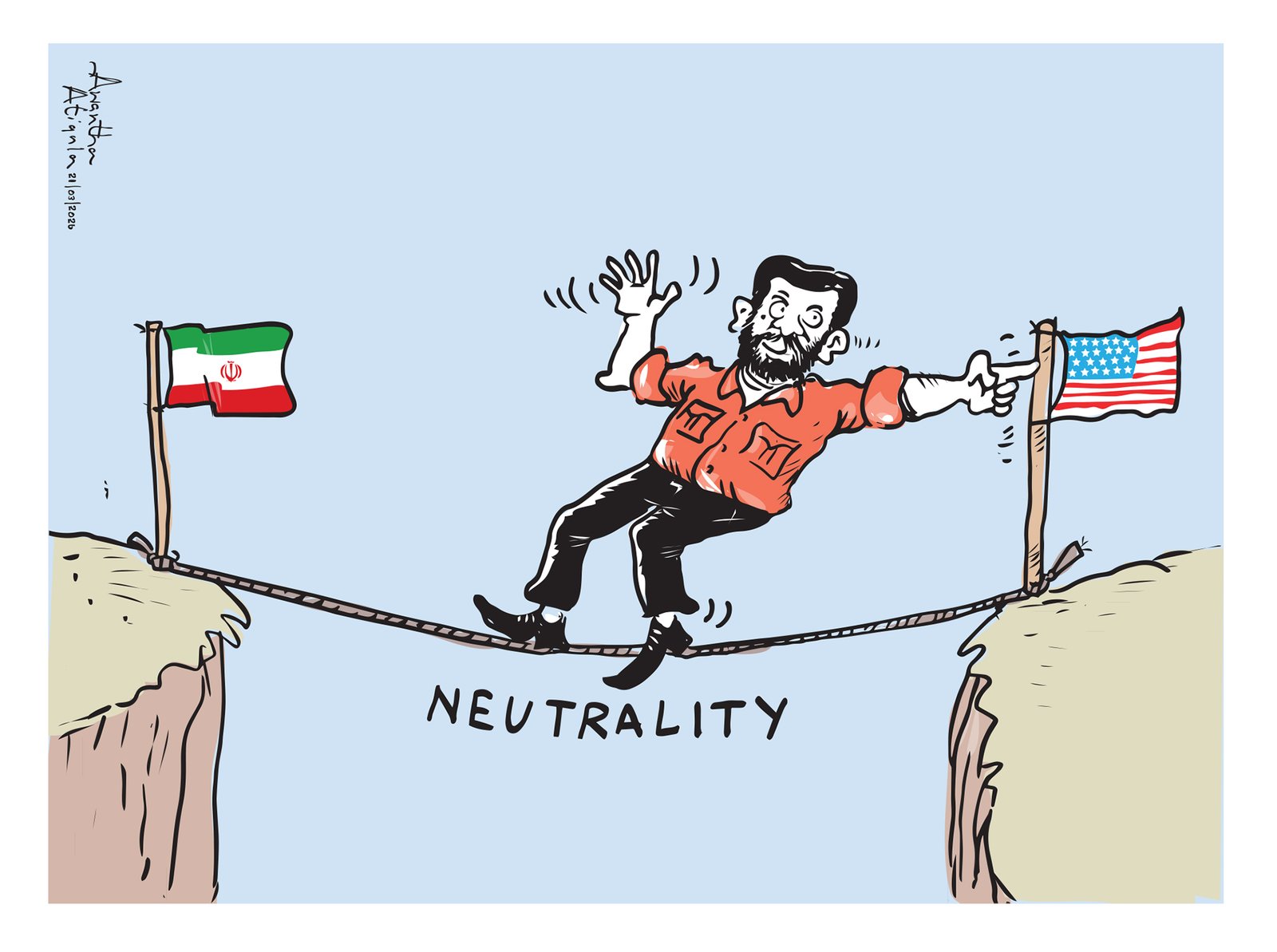
And maps can really point to places
Where life is evil now:
Iran. Lebanon. Palestine.
(with apologies to W. H. Auden)
When the nuclear-powered submarine USS Charlotte torpedoed and sank naval frigate the IRIS Dena in the early hours of 4 March, 19 nautical miles off the coast of Galle, the criminal enterprise that is the United States of Amerikkka, brought its criminal war on Iran to Sri Lanka.
The Iranian ship with around 130 crew on board had concluded goodwill visits in India between mid and late February. This was just before 28 February when Israel and the US began their unprovoked attack on Iran, sparking a larger conflagration across West Asia, with global spill-over. At no point was IRIS Dena engaged in hostilities with the US in the Indian Ocean.
“It’s more fun to sink them”, sniggered Donald J. Trump, repeating the US military command’s explanation for not capturing the vessel and crew instead. Whether or not this violated jus in bello and is a war crime, what it was, is mass murder pure and simple.
Atrocity upon atrocity
It was not the first atrocity of ‘Operation Epic Fury’. One hundred and sixty-five graves were dug for the children, staff, and parents of Shajareh Tayyebeh primary school in Minab, killed by the US on day one of the bombardment of Iran.
The 32 survivors of IRIS Dena were rescued by the Sri Lanka navy and air force, and 84 bodies recovered at sea. The following day, 204 personnel of another Iranian naval vessel, IRINS Bushehr, were safely evacuated to Sri Lanka, sparing them a fate similar to their compatriots.
The relief expressed at home and abroad in these responses by the National People’s Power (NPP) government underscores the debasement of the inter-state system. For a hunduwa like Sri Lanka (as the president justifiably likened the country’s tiny economic capacity), to save human life, is perceived as an act of bravado against the bully of the world.
The civilised West, confronted with the blatant breach of necessity and proportionality in the use of force, avoids even rhetorical condemnation of Israeli and US aggression and war crimes. The mask drops. These were never universal standards; only rules for the barbarous Rest. Equal treatment is as illusory as the self-determination and sovereign equality of states: large and small, rich and poor, western and non-western.
Western decampment from liberalism to authoritarianism is more than fright at the tantrums of the Caligula in the Oval Office. It is a capitulation to one of the tenets of the Dunroe Doctrine: “I don’t need international law. My own morality. My own mind. It’s the only thing that can stop me.”
‘Neutral but humanitarian’
From 4 March onwards, the parliamentary opposition alleged that the IRIS Dena was a sitting duck because of government inaction on an Iranian request of 26 February (two days before Israel and the US attacked Iran), that its three military ships in the region be permitted to enter Sri Lanka’s territorial waters.
Amidst rumour and conflicting information, and anxiety as to repercussions, President Anura Kumara Dissanayake explained his government’s stance in a media conference on 5 March. In conflicts between states, Sri Lanka is neutral. However, “… while safeguarding neutrality, we place humanity above all else. We will never hesitate to protect humanity.”
Except that this admirable respect by the state of Sri Lanka for protection of human life, has historically not extended to conflicts within. That, at least, is what the record shows from May 1958 up to May 2009; not forgetting the epidemic of ‘encounter killings’ thereafter, including since the NPP took office. In domestic policy, state responsibility is apparently on a different plane. But that is a subject for another day.
In a world order where since 2025 alone, US atrocities in Iraq, Syria, Yemen, Somalia, Nigeria, the Caribbean Sea, Venezuela, and Iran are writ large—not forgetting accessory, arms supplier, financier, and accomplice, to the Zionist terror entity; and whose leader has staked territorial claim to Canada, Kalaallit Nunaat and the Panama Canal—two questions arise: in an age of Bellum Americanum, what does “neutrality” amount to; and what is so right about it?
According to President Dissanayake, his government’s interpretation of neutrality is that, “… we shall not, under any circumstances, permit our land territory, maritime zones, or airspace to be utilised in a biased manner by any nation engaged in a conflict, nor in any manner that inflicts harm upon another nation.”
In an address to parliament two weeks later, on 20 March, the president explained his government’s application of neutrality, by revealing that on 26 February, both a US request for ground access at Mattala International Airport for two of its fighter planes; and an Iranian request for its three military vessels departing India to dock at Colombo Port, were received and denied.
These measures were taken in advance of the outbreak of war beginning 28 February, as “there were already indications of escalating military tensions”. To do so, “would have compromised our overall neutrality”, he explained.
Further, Sri Lanka rejected as “unbalanced” and therefore did not co-sponsor the Bahrain-led UN Security Council Resolution 2817 of 11 March, condemning Iran’s “egregious attacks” on the Gulf states and Jordan, after the Israeli-US aggression began. Its neighbours, Bangladesh, India, the Maldives, and Pakistan supported the resolution; while China and Russia—willed by some as challengers of US/Western hegemony—abstained.
The government’s stance of “neutrality” has been supported by the establishment and its media. Where liberal civil society stands can only be supposed to be the same, since it cannot find its tongue when it comes to western authoritarianism.
“Restraint” or “cowardice”?
An editorial in the Daily FT on 23 March commended the government’s “restraint” in adopting “an overly principled stance” on the wars in West Asia. (Apparently principles in foreign policy may be rationed and restricted; similarly to motor vehicle fuel since Iran’s closure of the Strait of Hormuz.)
Considering Sri Lanka’s “recent history, marked by economic crisis, debt distress, and dependency on external actors”, it cannot afford to “moralise and pontificate on the global stage”. To drive the realpolitik point home, the leader writer thundered that the “United States and Israel, wield enormous geopolitical and economic influence … antagonising such powers is not merely unwise but potentially devastating”.
“Principles” such as the peaceful settlement of disputes, respect for sovereignty, and the norms of international law governing relations between states, must not be abandoned altogether, we are soothed, but be subordinated to “safeguarding economic stability and protecting the livelihoods of Sri Lankan citizens”.
The allusion, presumably, is to further punitive tariffs being slapped by Trump on Sri Lanka’s ready-made-garment exports were he provoked; and Israel as country-of-destination for nearly 30,000 (and rising) Sri Lankan migrant workers whose jobs there and remittances back home are risked were its neo-fascist regime denounced.
Now exactly how or who within the government was engaged in any “posturing” and “moral signalling” on the origins of the present conflict and responsibility for it, is not disclosed. In fact, there has not been a squeak of indignation and protest from the foreign ministry at the dogs of war unleashed by the US and Israel and their actions since. Rather, this government’s policy conformism with its predecessors, and Foreign Minister Vijitha Herath’s particularly ineffectual leadership, veils timorousness as “neutrality”.
Herath did make his way to the Iranian embassy on 4 March to sign a book of condolence, expressing his sympathies on the “death” of Ayatollah Ali Khameini. Realist foreign policy means not calling something by its proper name. In this instance, killing by assassination; and naming Israel as assassin. Neither has his party or him ever expressed sadness in the past or present for those imprisoned and executed by the Islamic Republic for their political beliefs, including under cover of this grotesque war.
The first public statement of his government was a terse three-liner released almost at the end of 28 February, aimed at saying little and meaning less. It was cribbed from that of India’s Ministry of External Affairs. This explains its lateness, as the insipid bureaucrats in the Republic Building waited for South Block to string some catchphrases together, before echoing pieties of being “deeply concerned” and feeble appeals for “all sides to exercise restraint, avoid escalation…”.
The Government of Sri Lanka expresses deep concern over the rapid escalation of hostilities in the Middle East, which poses a serious threat to regional stability and to international peace and security.
Sri Lanka calls on all concerned parties to exercise maximum restraint and to take immediate and decisive action to de-escalate tensions. All parties must refrain from further provocative measures to prevent the risk of a wider regional conflict that would result in severe humanitarian and economic consequences.
The “concerned parties” are not named. There is no acknowledgment that it is the US and Israel that began this war; physically eliminating Iranian leaders, destroying command structures and state infrastructure, and killing civilians. False equivalence is drawn between the parties, suggesting that they are similarly culpable or responsible for the “rapid escalation of hostilities”. The advice to “exercise maximum restraint”, while hundreds of US and Israeli missiles, drones, rockets and bombs, rain on Iran and Lebanon, is like asking their state and people to turn the other cheek, by stoically bearing annihilation.
Clearly, it is not this government that needs counselling on diplomatic “restraint”. More likely, the editorial of 23 March is a rejoinder to an earlier leader in the same newspaper.
“Diplomacy cowardice” is how the Daily FT’s editorial of 5 March described the Ministry of Foreign Affairs statement. That leader writer began with reference to the IRIS Dena, noting that the government had refused to comment on the cause for its sinking, and its perpetrator; obviously not to arouse Trump’s ire. The president in his address to parliament on 4 March on this matter,
“refused to condemn the Israel/US attacks on Iran or at least go as far as some of the staunchest of US allies have done by stating that the attacks on Iran and the killing of Ayatollah Ali Khameini, Iran’s spiritual leader is a violation of international law.”
Whereas Iran had “stood by” Sri Lanka including at the UN Human Rights Council—where successive regimes in Colombo, up to and including the present, have resisted calls for truth, accountability, and justice for war crimes—Sri Lanka, it was implied, should now stand by Iran. Camaraderie among human rights abusers seems to be the underlying justification.
This is not our position. Our disappointment in the government’s diplomacy, is that it cannot on the one hand claim as its “principles” (see NPP election manifesto, p. 118) respect for the UN Charter, promoting international peace and security, peaceful coexistence, mutual respect for sovereignty and territorial integrity, mutual non-aggression etc.; and on the other hand behave like the three monkeys who neither see, nor hear, nor speak, when the same are torn to shreds in plain sight.
It is precisely because Israel is able to execute its final solution to the Palestinian question with no sanctions or repercussions, that its reign of terror now extends to Iran and Lebanon. It is the normalisation of brute force that allowed the US to invade Venezuela, kidnap its president and his spouse to Brooklyn, and subjugate its regime.
It is the example of the world’s most lethal rogue state, that emboldened Pakistan to bomb Afghanistan with impunity, killing hundreds in a drug rehabilitation centre in Kabul. It is also why the only superpower on this planet is able to freely strangle the sovereign state of Cuba, aiming to effect regime change. There is no end to this horrific race to the bottom in wickedness.
The US empire has recuperated the 17th century doctrine of ius gladii—“the right of the sword, or punishment”; that is, “the right to wage war on any peoples, even if they were not attacked by them, whose customs they regarded as barbarous, as retribution for their crimes against nature”.[1] In today’s lexicon, to stand in the way of US capitalism—be it in fossil fuel exploitation, or extraction of rare earth minerals, or preferential treatment for their investments and exports, or preservation of 750 military bases worldwide—is to be “barbarous” and commit “crimes against nature”.
The ostrich-like behaviour of this government is no guarantee of safety for Sri Lanka and its people from anarchy and chaos in the inter-state system. Our people—not forgetting hundreds of thousands of migrant workers in the Gulf and Levantine—already feel the ripple effects and are absorbing its shocks through higher prices for fuel, food, and fertiliser, and heightened insecurity in their personal and professional lives. “Neutrality” dodges principled action. And how to “protect humanity” as the president aspires, without principled action, as witnessed in the genocide in Gaza?
In an effectively unipolar moment, where US bellicosity rampages unchecked—the counterweight allegedly represented by the BRICS bloc being as hollow as a cement block—it is not “neutrality” but defiance of the US imperium that upholds the “principles” of foreign policy laid out by the NPP under two years ago. To recall the words of anti-apartheid leader Archbishop Desmond Tutu, “if you are neutral in situations of injustice, you have chosen the side of the oppressor”.
5 May 2026.
Image credit: Awantha Artigala (source: https://bit.ly/4d3ZTxU)
Notes
[1] Hugo Grotius in De Jure Belli Ac Pacis (1625), as quoted by Perry Anderson in “The Standard of Civilization”, New Left Review II/143 (Sep/Oct 2023): 5-28 at p. 7.
You May Also Like…
Mining Heavy Mineral Sands: Deepening Dependency, Not Enhancing Leverage
Amali Wedagedara
The decision to mine mineral sands along two-thirds of Sri Lanka’s coastline is fuelling anxiety and tension among...
The Art of Witness: Memory and Resistance in Sri Lanka
Yolanda Foster
When I first arrived in Colombo in the 1990s, I was in my twenties and had just begun a volunteer role with Peace...
‘Border villages’: Emergence, Salience, and implications for ‘Community’ in Sri Lanka
Viyanga Gunasekera
Despite Sri Lanka being an island and not sharing land borders with another country, the term ‘border villages’...