
Year One of the NPP Government: Some Heretical Thoughts
Jayadeva Uyangoda
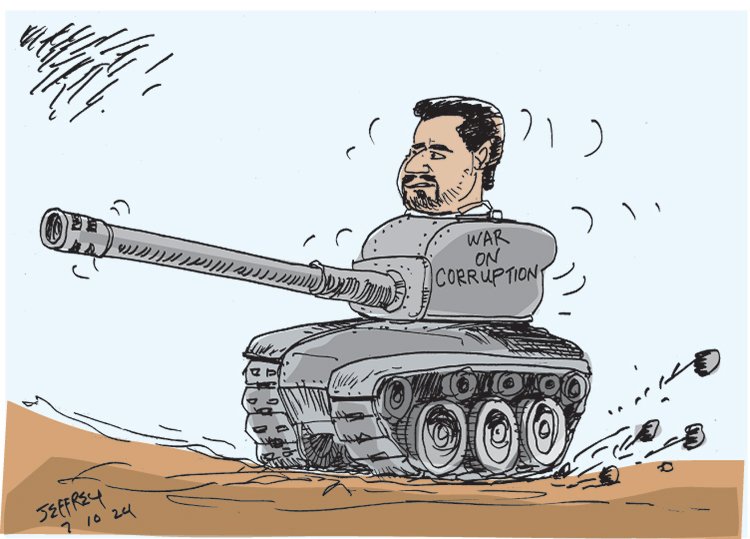
By the third week of November 2025, the National People’s Power (NPP) has completed its first year as Sri Lanka’s new government, generating mixed reactions. The media has been saturated with negative assessments of the NPP government’s record.
Two main trends of thought are evident in those responses. The first is from the parliamentary and other opposition groups that are still licking their wounds received in 2024’s electoral battles with the NPP.[1] The second is from those professional economists, ex-diplomats and policy pundits who share the ideological assumption that the NPP, with its inexperience in managing the affairs of government in general and handling economic and foreign policy choices in particular, needs some public caning and tutoring.
Meanwhile, the government’s responses to those criticisms have reflected the position that critics have failed to recognise the fact that the NPP’s policies and directions are not a continuation of the paths followed by the previous regimes—since they represent a new approach to politics, economic and social policies, development, democracy, governance, and reconciliation. Key figures in and spokespersons of the government are emphatic that their government’s approach to policymaking is shaped by a commitment to a vision of their own for transformations in the economic, social and political spheres spread over several years, requiring a timeline beyond one term in office.
The government’s leaders, from the president downwards, have also been keen to stress the point that what happened between September and November 2024 was not just a regime change, as had always been the case in the past, but a transfer of political power to the NPP through a popular mandate for a break from the past to effect systemic transformations.
The claim that the NPP is committed to initiating a break from the past suggests that the NPP government is not an ordinary government formed after an election. Rather, it views itself, and in fact is, a new kind of elected government seeking to change the goals and objectives of the exercise of political power; not just to maintain the status quo, but to transform it. In other words, the NPP claims to have transformative goals, agenda, and programmes.
Two factors seem to have contributed to the NPP’s compulsion for charting a ‘new beginning’ in 2024. The first is the longstanding insistence by the Janatha Vimukthi Peramuna (JVP), as well as the NPP, that their political goal would mark a radical departure from the governments of the traditional ruling elites who merely maintained the old order with superficial adjustments. The NPP’s election manifesto of 2024 showcases this. It is a carefully crafted document to articulate a vision and programme for democratic, modernising, and planned transformation of Sri Lanka, with an aura of youthful energy usually associated with new generations of idealist political activists.
The second is the impact of the Aragalaya/Pōrāttam, the citizens’ protest movement of 2022.[2] The slogan ‘system change’ that emerged from the protest movement reflected a newly sprung political consciousness among the citizens, embodying a fresh popular political will for a swift change in who governs the country and for whose interests. That implied the immediate necessity for implementing a transformative political programme by the NPP, whose quick transition to be Sri Lanka’s new ruling party in 2024 was made possible by the Aragalaya of 2022.
The NPP has not articulated an avowedly socialist commitment or intent. It presents itself as a democratic political movement with a deep commitment to changing the ways in which Sri Lanka is governed. There are critics who are not very convinced about the NPP’s democratic credentials because the JVP, the NPP’s ‘mother’ party, has a considerably long history of advancing radical and socialist goals. However, what is historically significant is how the NPP, without rejecting the revolutionary legacy of the JVP, has succeeded in channelling and mobilising the political hopes and energies of the citizens towards imagining and executing a project of re-construction through political power gained by democratic and peaceful means.
This backdrop explains, at least partly, why soon after the NPP became Sri Lanka’s new ruling party, the politics of Sri Lanka appears to have begun to move in the direction of an open confrontation between the new government and the established class of political elites. The NPP government’s determined drive against bribery and corruption has shaken the ousted political establishment which has for decades tolerated, promoted, and benefitted from political and bureaucratic corruption.
Shaking up the old order
In the second half of 2025, a low intensity ‘class war’ between the traditional ruling elites and the new ruling party with non-elite social/class backgrounds has begun to unfold in Sri Lanka.[3] At present, parliament has emerged as their main battleground. An inevitable clash between the ‘old world’ and a ‘new world’, that has been slowly maturing for decades, seems to be on the cusp of breaking out in the open.
Besides the unfolding clash between the old and the new rulers, there is also a continuing confusion among many critics and commentators. Initially, this confusion was about how to understand, interpret, and even make sense of the emergence of the NPP in 2024 as Sri Lanka’s new ruling party, pushing the traditional dominant parties into the status of insignificant small parties in a derelict opposition. This confusion continued even after the NPP completed one year as Sri Lanka’s new government.
The guardians of the old order as well as many political analysts and commentators also seem to have been taken by surprise by the scale of popular endorsement of the NPP at the two elections in September and November 2024. The electoral decimation of the United National Party (UNP), the Sri Lanka Freedom Party (SLFP), and the Sri Lanka Podujana Peramuna (SLPP)—the leading gate keepers of the old order—stunned many observers, local and foreign, who had not anticipated such a decisive verdict. That is perhaps why some foreign and local journalists’ reaction to the presidential election outcome was that a ‘Marxist’ revolution had taken place in Sri Lanka without prior warning.
However, the result of the parliamentary election held in November 2024, which gave the NPP a two-thirds majority in parliament with over 60% of popular votes, should also be viewed as the culmination of a long period of democratic will formation among the Sri Lankan citizens, the governed, to free themselves from the corrupt and self-serving rule of the dominant elites. It dramatically demonstrated how a new political trend had slowly evolved and then matured, quickly creating objective conditions for an extraordinary political change.
As the NPP approached the end of its first year in government, the true political meaning of that change became clearer. The 2024 elections inaugurated a shift in the social bases of political power in modern Sri Lanka from the established wealthy elites to non-elite social classes. Those elites had a peculiar worldview enabling them to believe that political power was their birthright and family inheritance. Thus, the shift of the social bases of power that occurred in 2024 carries the possibilities for continuing confrontation between the old and the new political classes.
The first year of the NPP government has ended with indications that the power struggle between the two camps representing antagonistic class and political interests is entering the phase of an ‘open war’. This has the potential to initiate a new era of tension in Sri Lankan politics in the months and years to come.
Recognising this political fact provides a useful starting point for assessing the record of the NPP during its first year in power. It also suggests the necessity to advance a reading of the NPP government, its achievements and failures, in a way fundamentally different from, and even alternative to, what we often encounter in the media, at dinner gatherings, and some civil society assessments. It will enable us to see the NPP government, not only from the perspectives of outsider critics driven by a sense of bewilderment and scepticism, but also of observers with some measure of insider insights into, and interpretative empathy towards, the politics, values, and generational expectations that the NPP embodies.
Such a reading can fruitfully begin with acknowledging something specific in the social character of the new government of 2024. As already noted above, the NPP is the first non-elite regime to have been formed in post-colonial Sri Lanka—a government of the non-elites, by the non-elites, for the non-elites. In other words, in class terms, the NPP government does not resemble any of its predecessors. It is also the only government to be organically linked to several generations of youth, men, and women, with aspirations for more just and egalitarian futures.
Therefore, the NPP government marks not continuity, but a decisive break from the past which had been characterised by the unbroken rule of the class of bourgeois and privileged elites, or the dominant political class that had been organised in three rival parliamentary parties: the UNP, the SLFP, and the SLPP.
There are two distinct characteristics, political and social, that set the NPP radically apart from the UNP, SLFP, SLPP and almost all the parties representing the Tamil and Muslim communities as well. Because of its association with the JVP, the NPP is a party with a default history in Marxist and revolutionary politics. It is also a party with social roots in a vast array of non-ruling-class social constituencies, representing the economic, social and political interests of a host of subordinated and under-privileged social groups—the working class, the urban and rural poor, peasants, and diverse strata of professional and middle classes.
It is in this political and social sense that the transfer of power from the UNP-SLPP coalition to the NPP in September 2024 should be seen as a unique example of the shift of political power from the ruling classes to a coalition of classes of the governed.
This unusual transfer of power has occurred not through a revolution, but by parliamentary and peaceful means. The one-year rule of the NPP government has been remarkable in the sense that it has not been overthrown, challenged, or threatened by any belated or any extra-constitutional resistance from the guardians of the ancien régime. That is a good reason to celebrate the completion of the NPP’s year one in office.
It also warrants being appreciated as a unique moment of the new wave of democratic revolution sweeping South Asia. The safe passage of the NPP’s first year as Sri Lanka’s new ruling party is also indicative of the strength of Sri Lanka’s democracy and the sheer power of the popular democratic will expressed through free and fair elections.
Whither constitutional reforms?
When the NPP government was formed there were some expectations, particularly from civil society groups and opposition parties of minority communities, that the government should have launched a constitutional reform programme without delay, focusing on the abolition of the executive presidential system and bringing the Westminster-style parliamentary government back. This enthusiasm among civil society groups reflected the spirit of the 2022 Aragalaya.
The initial optimism for constitutional reforms under an NPP government was rooted in the JVP’s long history of campaigning for the abolition of the presidential system since the early 1990s. Besides, the NPP has a two-thirds majority in parliament. If a referendum is required for a new constitution, the first year in office would have been the safest time for the government to secure the plebiscite, particularly since it had already received the popular vote at the parliamentary election. Yet, with a comfortable majority in parliament and guaranteed victory at a referendum, the NPP has not moved in that direction during its first year. This is a conundrum even many supporters and well-wishers of the government find hard to explain.
The outcome of the local government elections in May 2025 was a new reason for the opposition parties to bring back the constitutional reform agenda with a sense of urgency. Their expectations for a major electoral setback for the NPP, opening an early chance for the opposition parties to recover from the heavy losses suffered at the parliamentary election, did not materialise. Therefore, their renewal of the theme of abolishing the executive presidential system through constitutional reforms had an immediate mobilisational value.
In contrast, the renewal of the conversation about constitutional reform by civil society groups was a continuation of a considerably long history of agitating for democratisation. However, since the relationship between the NPP government and civil society groups still flounders, a fruitful dialogue between the two sides on constitutional reform has not yet taken place. In fact, many civil society groups who have been consistently active in democracy, constitutional reform, human rights, and women’s rights movements are unhappy that the NPP government, which some have even supported, has not shown much interest in initiating any engagement with them.
The government’s lukewarm response to the demand for constitutional change has prompted the opposition and some civil society critics to advance the warning that the NPP government might begin to move in the direction of setting up a ‘constitutional’ or ‘one-party’ dictatorship. According to this reading, maintaining the existing Constitution might be part of an overall political strategy of the government.
Despite such controversies and political posturing, it is also useful to speculate whether there are any substantive political reasons for the NPP government’s apparent disinclination towards constitutional reforms.
A key question here is whether the government with its absolute parliamentary majority is keen to undertake major constitutional changes during its early years in office. Given that it has just begun its programme of overhauling the existing institutions and practices of governance, the government may be wary of opening several fronts of reform at the same time. A positive response from the government for constitutional reform may also depend on its strategic calculations about the evolving balance of power amidst the re-grouping of the opposition forces.
Two obstacles to an early abolition of the executive presidential system can also be foreseen to potentially interfere with the NPP government’s reform trajectory.
The first is the possibility of a new wave of social unrest rising even amidst the NPP’s own electoral bases within a context of continuing economic hardship due to the on-going economic crisis. The government’s primary focus would be to address these concerns with the hope of keeping its public support intact.
The second obstacle is the likely intensification of the hostility between the NPP government and the opposition. Conditions are already set for a new wave of heightened enmity and confrontation between the two camps. The Bribery Commission’s inquiries into allegations of bribery and corruption against leading figures of opposition political parties and defeated opposition politicians will continue. New police inquiries into major cases of human rights violations such as abductions, forced disappearances, and political killings under previous regimes might lead to the arrest of, and litigation against, some powerful politicians and former officials. Inevitably, the clash between the new and old rulers may reach breaking point.
All indications at present suggest that politics in Sri Lanka in the new year and after will most likely be highly contentious and tense. That indeed is not very good news for any major constitutional reform. However, delaying promised constitutional reforms will also not bode well for the NPP’s own agenda and, more crucially, its credibility. If the NPP fails to abolish the executive presidential system and to bring parliamentary democracy, with safeguards necessary to prevent parliamentary-cabinet authoritarianism, the future of Sri Lanka’s democracy under a post-authoritarian constitution might require another citizens’ uprising.
Re-constituting the state reform agenda
The low priority that the NPP government has accorded to constitutional reform initiatives also suggests that the NPP government has its own approach to state reform, independent of those shared by some previous governments as well as civil society groups. This is another theme that marks the distinction between the NPP and its predecessors.
The NPP’s immediate focus at present appears to be on reforming the ‘internal structures’ of the state with the objective of freeing the administrative institutions and agencies of the state from entrenched practices and cultures of bribery, corruption, inefficiency, partisan political control, bureaucratic decay, and state capture by political-business coalitions. These have been fundamental to an unending process of ‘state decay’ in Sri Lanka. The present government’s state reform agenda is directly linked to the NPP’s insistence that it has taken seriously the popular clamour for ending the ‘corrupt political culture’, a key element of the popular imaginary of democratisation in Sri Lanka. The long history of state decay has also distorted state-citizen relations to such an extent that it has become an integral dimension of the crisis of the state, which has gone unnoticed for far too long.
The promise of ending political corruption, as a first step towards creating a new democratic political culture, came to be introduced to the state reform agenda in the early 1990s by the SLFP-led People’s Alliance (PA) as a component of its reform-oriented election pledges. Although this pledge, which effectively captured the popular imagination for democratic revival, was renewed during subsequent election campaigns, no government had the political will to free politics and the public service from the practices and cultures of corruption. Soon, corruption became entrenched and normalised in electoral and party politics, political and administrative cultures, economic management, bureaucratic life, the public service, and state-society relations.
It began to develop a corroding and destructive effect on the bridges between the state, rulers, and the citizens. This phenomenon of multilevel corruption within the state has had a disabling effect on the Sri Lankan state’s capacity for executing its public duties and responsibilities to citizens. In fact, accumulated public frustration over the continuing disregard for the need to revitalise the state’s capacity to serve citizens without bribery, corruption or political interference was a key causal factor of citizens’ protests against the ‘system’ during the Aragalaya.
One pernicious consequence of the decaying of the public sector and the public service through political and bureaucratic corruption is the loss of public trust in the state, its institutions, and the quality and speed of the services they offer to citizens. This constituted a double failure of the Sri Lankan state: loss of citizens’ confidence in the state and its institutions; as well as the erosion of state capacity to serve citizens in a democratic society.
Rebuilding state capacity to restore estranged state-citizen relations has remained an unrecognised and un-conceptualised domain in Sri Lanka’s dominant constitutionalist state reform discourse framed by the liberal constitutionalist legal community. Since the 1990s, the emphasis has been confined to re-defining the ‘nature of the state’, and not on how the state functions vis-a-vis the citizens on a day-to-day basis. This constitutes the backdrop against which the present NPP government has launched a programme to rebuild state capacity through the direct approach of fighting political, bureaucratic, and administrative corruption. One of the points the NPP seems to stress in its current state reform agenda is the urgency of rebuilding state institutions by freeing them from their entrenched cultures of corruption, partisan political control, clientelism, and bureaucratic indifference to citizens.
The discussion above suggests the following speculative proposition as an answer to the question why the NPP government has not taken steps towards constitutional reforms leading to the abolition of the executive presidency during its first year in power. Sri Lanka’s overall agenda for state reform has two levels of intervention: (a) reconstituting the external, that is constitutional, structures of the state; and (b) reinventing the internal structures of the state that embody the institutional cultures, modes of conduct, habits, and practices, that mediate between the state and its citizens.
The NPP government’s focus in the first year seems to be on reforming the internal structures of the state which has not been a component of the liberal constitutionalist state reform discourse. The internal reform project is likely to continue in the coming year too. This is also an initiative that can cause much political tension and administrative instability. Thus, from the point of view of the state reform discourse, what seems to be necessary at the moment is a synthesis of the two levels of state reform, external and internal, or constitutional and structural. Separating the two, at conceptual as well as practical levels, may only add confusion to interpreting how the NPP government is handling the fundamental question of reforming the Sri Lankan state which is integral to its democratic transformation project.
At present, it is the NPP government leadership that is best equipped to take responsibility for forging such a synthesis of the two levels of state reform and thereby change and deepen Sri Lanka’s contemporary state reform discourse. Such an imaginative synthesis will also demonstrate that Sri Lanka needs to transcend the limits of the state reform discourse of the 1990s which focused only on reforming the external structures of the state through constitutional reform alone.
Hostile dynamics in government-opposition relations
One notable feature of the NPP’s experience in the first year as the ruling party in parliament has been the extreme hostility in the relationship between the government and the opposition in parliament after the initial months of tolerated civility, with not-so-unpleasant banter and soft aggression. The deterioration of this cordial relationship towards open enmity seems to have evolved through three stages: the local government election campaign from late March to early May; the parliamentary debate on the Batalanda Commission’s inquiry report during the same period; and the government’s launching of the anti-corruption campaign and the crackdown on drug cartels.
During the local government election campaign, the government sought to repeat its winning streak. In contrast, the opposition parties sought not only to win a majority of local government bodies but also set in motion a new political dynamic that might, it was hoped, mark the beginning of the end of the NPP’s dominance in electoral politics. The strategy of all the opposition parties was to employ, in an unforgiving fashion, a campaign rhetoric of extreme hostility, targeting the NPP’s inexperience in governance.
More disturbingly, the opposition MPs, even veterans with years of experience in parliamentary conduct, intimidated and insulted NPP MPs, particularly young women parliamentarians. This hostile behaviour appeared to be a deliberate strategy by opposition MPs to establish a new equilibrium of power and authority for themselves over the inexperienced NPP MPs who heavily outnumbered them. The opposition’s aggression towards the ruling party with a two-thirds majority seemed to have an element of defensive group psychology too. The incessant hostility and the unguarded sexist aggression employed by most of the male MPs of the opposition appeared to veil a deep-seated sense of vulnerability and insecurity shared by all of them.
The NPP government’s anti-corruption campaign and the ‘war’ against drug lords had the misfortune of being politicised by the deeply polarised government-opposition relations. It was largely due to the Police and Bribery Commission that inquiries commenced against several politicians belonging to the opposition parties, in some instances resulting in arrests and court proceedings. However, the government’s aggressive and high- profile publicity campaigns on its two new initiatives put the already weakened opposition into a mood of defensive aggression.
The enmity between the government and the opposition reached a crescendo when Ranil Wickremesinghe, UNP leader and former president, was arrested by the Bribery Commission and remanded on 22 August 2025 on charges of misusing public funds for personal needs. Wickremesinghe is the leader of Sri Lanka’s dominant political class of elites which had earlier enjoyed the privilege of impunity, particularly in relation to corruption, misuse of public property, economic crimes, and serious human rights violations.
Feeling the heat of the changed circumstances and being acutely aware of the shared threat emanating from the government’s anti-corruption offensive and the end of the elite privilege of impunity, the opposition parties rallied together, in and out of parliament, to form a united front. When the growing enmity between Sri Lanka’s ousted political elites and the newly emerged political class of non-elites began to break out in the open, parliament was transformed into a site of class war by other means. Heated parliamentary debates, energised by mutual enmity and disdain, sometimes comes closer to a war minus the shooting. An openly fought out class war in the legislative chamber can hardly stay within the venerated rulebook of Erskine May.
Why no dialogue with ‘minority’ parties?
A notable feature in the NPP’s first year in government is the lack of publicly acknowledged initiatives for dialogue with the established and traditional leaderships of the ethnic ‘minority’ parties representing the Sri Lankan Tamil, Malaiyaha Tamil, and Muslim communities. A notable exception are the two meetings, one informal and the other formal, that took place towards the end of the first year of NPP in power. Both meetings are reported to have ended with bon homie and smiles all around, yet with no dramatic breakthrough. These are obviously ice-breaking engagements that warrant appreciation even by sceptics.
Nevertheless, the question remains as to why the NPP government and the Tamil and Muslim political leaderships have been shy to initiate an open dialogue to advance joint initiatives for peacebuilding, reconciliation and state reforms, for a period of one full year. This is a question that can be answered only through conjecture.
One such speculative explanation can be formulated as follows: In the absence of a history of personal friendship or political engagement between the NPP and ‘minority’ leaderships, except occasional personal encounters in the lobby of Parliament, a political dialogue between the two sides anew requires patient preparation and a series of confidence-building steps.
This difficulty of political dialogue between the NPP government and ethnic ‘minority’ parties is also linked to a few political and class factors.
Key among the political reasons is the personal and political closeness that the North-East Tamil, Malaiyaha Tamil, and Muslim political leaders have maintained with the leaderships of the UNP, SLFP and SLPP amidst occasional tension. Therefore, the NPP leadership appears to look at the Tamil and Muslim leaders through a lens of suspicion arising from a deep sense of political puritanism.
This sense of mistrust seems to have been aggravated by the political developments of last year. All major ‘minority’ political parties have had close associations, and even electoral understandings, with Sinhala-led parties that considered the NPP as their foremost adversary.
In September 2024, Anura Kumara Dissanayake, could not get 50% of the votes to win the election in the first round. This was partly due to the support extended to SJB’s presidential candidate Sajith Premadasa by the Ilankai Tamil Arasu Katchi (ITAK), the Sri Lanka Muslim Congress (SLMC), and the Tamil Progressive Alliance (TPA). In fact, the support the NPP got from the Tamil- and Muslim-majority areas during the presidential election was entirely due to its own efforts of mobilisation. Then, at the subsequent parliamentary election held in November, large numbers of Tamil and Muslim voters in the Northern, Eastern, Central, and Uva Provinces as well as other provinces voted for the NPP. The local government elections held in May 2025 only saw the intensification of the NPP’s independent entry into districts with majorities of minority communities.
The ‘minority’ parties perceived the NPP’s unexpected political presence in the ethnic ‘minority’ constituencies as an unwelcome and threatening intrusion into their protected domains by a ‘Sinhala’ party from the ‘South’. The fear among those parties was further aggravated by the likelihood that the ethnic balance of representation and electoral politics might be decisively altered in a manner seriously unfavourable to ‘minority’ communities.
In light of this suspicion on both sides, and because of the fact that the leading Tamil and Muslim parties are still disposed favourably towards the SJB, the main opposition party in parliament, it is quite likely that the cold war between the minority parties and the NPP will continue in the period ahead as well.
The second political factor emanates from the JVP’s long political history of opposing minority rights and advancing a radical Sinhala nationalist ideology in the past. During the late 1980s and early 1990s, the JVP vehemently opposed the Indo-Lanka Accord, the 13th Amendment, and the provincial council system. The JVP’s unconditional support of the Sri Lankan state’s war against Tamil insurgencies continues to haunt the memories of Tamil politicians and the senior generation of Tamil political activists, particularly in the North and East. The fact that the JVP later began to shift its ‘communalist’ stand towards ethnic and cultural minorities and minority rights after Anura Kumara Dissanayake became leader of the JVP, and later of the NPP, does not seem to have registered in the memories of the Tamil and Muslim political class in any significant way.
Overcoming these historical and ideological barriers is an essential pre-condition for initiating dialogue between the NPP government and Tamil and Muslim political parties on issues such as constitutional reform, enhanced power-sharing, post-war reconciliation, reparations for war victims, transitional justice, and also the recurring issue of unfinished inquiries into mass graves in the north.
There is another hidden, yet formidable, barrier to a conciliatory dialogue between the NPP government and the minority parties. It is built on the class identity of the NPP and the leaders of Tamil and Muslim parties. As already noted above, even before the NPP came into power and formed a government, none of the ethnic minority party leaders had close personal or political contacts with the NPP leadership.
Besides the ideological separation, the class-based social and cultural distance, if not prejudices, between the two sides of political leaders needs to be overcome. If that is not a realisable goal, all minority parties with upper caste or upper-class leaderships will remain isolated from Sri Lanka’s new ruling party. In turn, they will continue to maintain alliances with and back the opposition SJB at the next presidential and parliamentary elections in 2029.
The inability of Tamil political leaders and the NPP government to initiate an early political dialogue is not good news, particularly for Tamil citizens who have been waiting for justice and the realisation of their claims to human rights since the war ended in 2009. The continuing dilemma is that searching for such accommodation, the Tamil and Muslim leaders cannot always find governments in Colombo led by parties or leaders of their choice. Required from both camps is the capacity and will to find fresh imaginations, and even a fresh political language, to construct a post-war, post-secession, and post-ethnonational political accommodationist paradigm for Sri Lanka.
On the ‘national question’
A new dimension of the difficulty of dialogue between the NPP and Tamil political parties on issues such as devolution, post-war justice, and reconciliation has become apparent. It is rooted in the NPP’s new approach to chart its own path to reconciliation and the ‘national question’, without any dialogue with ‘minority’ parties.
Outlines of this approach were evident in the NPP’s 2024 election manifesto and Anura Kumara Dissanayake’s public addresses in the north during the presidential and parliamentary election campaigns. It avoids the JVP’s hardline nationalist approach as well as the ‘liberal peace’ discourse of conflict resolution, reconciliation, and peacebuilding identified with and promoted by UN agencies and global and local civil society movements. It also shuns the devolution discourse introduced to Sri Lanka by the Indian government. It is quite clear that the JVP/NPP are wary of the old liberal conceptual framework that has not led to ‘national unity’.
Moreover, the NPP government appears to want to leave its own imprint on the reconciliation process it conceptualises, initiates, and takes forward. In other words, the NPP does not seem to want its agenda for inter-ethnic peace and reconciliation in Sri Lanka to be seen as a continuation or a copy of what it sees as ‘failed’ past attempts.
What are the contours of the NPP’s own programme for resolving the ‘national question’ and advancing reconciliation in Sri Lanka? The NPP’s election manifesto, called A Thriving Nation – A Beautiful Life issued in September 2024, as well as occasional statements made by its leaders, contain the basic framework of the NPP’s approach. The JVP/NPP leaders have stressed many times that they will not abolish the 13th Amendment without a replacement since it is the only institutional framework available to the Tamil people at present. However, there are no indications about the exact nature or conceptual identity of the replacement being contemplated.
Although the JVP in the past opposed devolution and the provincial council system, it later participated in the provincial councils. The NPP’s position, building on later JVP positions, is an advance from the JVP’s orthodox view. Without directly referring to the 13th Amendment, the manifesto makes the commitment that the NPP government will “guarantee equality and democracy and the devolution of political and administrative power to every local government, district and province” (NPP 2024: 127). This formulation implies that a fusion of devolution and decentralisation is envisaged as a means to democratising the state and governance. The constitutionalist thinking implicit in the NPP’s reform commitments indicates that democracy and equality of all citizens constitute the basic normative framework of the NPP’s approach to a peace and reconciliation agenda.
The manifesto also contains an action plan for establishing what it calls “national unity for the rebuilding of the Sri Lankan nation”. Making a clear break from the Sinhala ethno-nationalist ideology which the JVP earlier upheld, the NPP acknowledges the multi-ethnic, multi-religious, and pluralist character of the “country”. This concept of national unity implies a goal as well as a condition in which the Sri Lankan nation is “not divided on the basis of ethnicity, language, religion, caste or gender” (NPP 2024: 126-127). Moreover, it advances a conception of national unity built on “respecting the diversity of identities and ensuring their survival and protection” (ibid). In brief, the NPP’s manifesto envisions a goal of pluralising the ethnic foundations of the Sri Lankan state.
A hopeful reading of this commitment suggests that the JVP’s/NPP’s constitutionalist thinking has slowly shifted away from the unitarist model of state. The manifesto gives the impression that the NPP is exploring a form of co-existence between a moderate Sri Lankan nationalism and other ethnic nationalisms in order to construct a post-ethnic nationalism. If that is the case, that project should also advance an ethic of not only unity in diversity, but also diversity in unity.
If implemented by the NPP government, it would be a unique experiment in charting a ‘civic nationalist’ future for Sri Lanka. Civic nationalism gives primacy to the membership of the political community, that is equal citizenship of the multi-ethnic nation state with diverse cultural belongings among all identity communities with no differentiation or discrimination. It can also celebrate different cultural and community identities and group belongings of citizens as a source of positive energy to all citizens of the national-political community.
Against the backdrop of all the difficulties and complexities in relations between the NPP and minority parties, what seems to be needed to promote a new initiative for peace building and reconciliation in Sri Lanka at present is a dialogue between the two, or several, imaginations and a compromise for a constructive engagement among all sides concerned. That may most likely require the assistance of some mediatory effort, domestic or external.
AKD’s handling of foreign policy
One theme that has aroused much interest and curiosity among political observers as well as critics is the direction which the NPP government would take in its foreign policy. Because of the JVP’s left history, some speculated that the NPP government might take an avowedly pro-China foreign policy stance. China’s close economic relations with Sri Lanka and its economic strength to support Sri Lanka to be free from obligations to the International Monetary Fund (IMF) were in the background of this assumption. There was also much speculation as to how the ‘inexperienced’ President Dissanayake, with no personal ties with any foreign leader, would handle the highly complex India-China equation. Some anticipated the NPP to take a pro-India foreign policy stance.
The most important achievement of the NPP government in the domain of foreign policy under President Dissanayake is the laying down of a stance of pragmatism in foreign relations, free from ideological constraints. Two key examples of its success are the establishment of an equidistant friendship with China and India and handling the tariff talks with the US government under President Trump while staying away from global political tensions.
An elitist anxiety also came to be shared by some opponents as well as well-wishers of the government about how a president and a foreign minister not known for polished English-speaking skills would handle talks and negotiations with other countries in a world language. Some breathed a sigh of relief that the NPP government has a prime minister with “excellent” English-speaking talents! However, under a president and a foreign minister with rural, peasant and vernacular backgrounds, the NPP government has taken first steps towards a decolonial transformation in Sri Lanka’s foreign office.
In fact, while demonstrating his pragmatic astuteness and commonsensical flexibility in charting a foreign policy path which may be described as an updated version of non-alignment, President Dissanayake has also shown that he had a lot to benefit from the legacies of great statesman from the Global South such as Jawaharlal Nehru, Chou En-Lai, Nelson Mandela, and U Thant. These were some of the African and Asian leaders who developed a vision of foreign policy for the Global South during a time of global turmoil. The world once again is in a new phase of turmoil with unpredictable consequences. In his 2025 speech to the UN General Assembly, if President Dissanayake had quoted India’s Nehru, instead of Harry Truman of America, it would have been a memorable debut on the world stage for Sri Lanka’s pro-Global South president.
A year of learning, gaining experience, and consolidation
The NPP’s first year in government has inevitably been one of learning, experimentation, and consolidation. This is an unusual phase of the JVP’s/NPP’s history too. The JVP has been an oppositionist political movement that had an underground and extra-legal life, initially from the mid-1960s to 1971, and then from 1983 to the early 1990s. It had its first tryst with electoral democracy from 1978 to 1983. After a tragically eventful break between 1983 and 1989, the JVP joined parliamentary politics in 1994.
From then onwards, the JVP has continued as a parliamentary party committed to democratic politics, often as a relatively small yet influential opposition party. Joining democratic politics meant transforming itself into a formal political party, functioning in the open and embracing electoral and parliamentary options. The JVP won one seat in the 1994 parliament, and then indirectly supported Chandrika Kumaratunga at the presidential election that same year. It won 10 seats in the 2000 parliament, 16 in 2001, six in 2015, and three in 2020. At the presidential election of 2004, the JVP supported Mahinda Rajapaksa; in 2010 it supported Sarath Fonseka; and in 2015 it supported Maithripala Sirisena.
The NPP, the JVP’s new avatar, gained 159 seats in the 225-member parliament in 2024. No critic or adversary of the NPP government has yet begun to predict a fall for the NPP in 2029 when the next elections are due. Instead, opposition parties are expressing the fear that the NPP, encouraged by the JVP, has plans to stay in power for more than one parliamentary term, or until overthrown.
The NPP government is unique in that it has been propelled from the position of a tiny little opposition party with just three seats into the status of Sri Lanka’s newest ruling party, gaining control over both the executive and legislative branches of government, the latter with a two-thirds majority. A vast majority of its MPs and ministers are not only newcomers to parliament or government, but also to competitive electoral and parliamentary politics. It is this inexperience in parliamentary politics as well as in running a government that seems to have triggered mercilessly hostile reactions from some sections of the media and even of the opposition in parliament.
This experience of the NPP in its first year has close parallels with the extreme hostility with which the Indian National Congress (INC) and the Bharatiya Janata Party (BJP) responded to the victory of the Aam Aadmi Party (AAP), led by political newcomer Arvind Kejriwal, in the 2013 Delhi assembly elections in India. In both instances, the dominant elites and their media treated the newcomer as an illegitimate intruder, a usurper. The NPP in Sri Lanka needs to draw lessons from the positive and negative experiences of the AAP’s experiment on corruption-free political and social transformation. One key lesson is that the old ‘system’ tends to strike back with great determination and anger when its right to rule is challenged by an outsider-newcomer.
Sri Lanka in a wave of new democratic revolutions
The NPP’s experiment in Sri Lanka should not be treated as an isolated event, or an aberration. One way to make meaningful sense of what has happened in Sri Lanka in 2022-2025 is to connect it with the new wave of democratisation sweeping across South Asia and elsewhere.
After decades of elite-led corrupt misrule, accumulated social injustices and discontent, economic and social inequalities, democratic reversals, and political decay, new generations of young citizens, along with their elders, have been seeking systemic transformations. They want the old world and its guardians to give way to a new world and a new generation of rulers with a capacity for imagining their futures anew. That is the spirit that seems to drive the new wave of democratic revolutions in the Global South. In this history-making global trend, Sri Lanka is an exception. It is the only society in Asia so far to have enabled an organised political agency to step into the political vacuum caused by the popular uprisings against the decadent ruling elites.
The new democratic revolutions through protests led by young citizens in Bangladesh, Nepal, Indonesia, the Philippines, Tanzania, and Madagascar, to name only a few, have just begun. It is spreading in many societies on the Asian and African continents, sometimes producing existential ambiguities. In many such instances, the first phase of the democratic revolution remains deadlocked in uncertainty. They await the next stage of people’s protests, led by an organised political agency embodying the popular democratic will, and the capacity for taking over political power by replacing the old guard.
In this wave of new democratic revolutions in the Global South, Sri Lanka is an exception. Whether one likes it or not, it is the presence and continuity of the NPP government, with all its capacities as well as initial limitations and inadequacies, that defines Sri Lanka’s democratic exceptionalism.
18 November 2025.
Postscript post-Cyclone Ditwah: Political and economic storms in 2026
Less than two weeks after completing my essay above, Cyclone Ditwah and its accompanying gales of wind, torrents of rain, and waves of flood devastated Sri Lanka in a manner truly unprecedented. Its immense destructive impact on people’s lives and livelihoods, and the survival of communities, environment, economy, infrastructure, etc., is still being measured.
Paradoxically, while even the mountains were shaken within the space of just a few hours, the only entity that seems to remain stable is the NPP government and its hold on power. Yet, natural/unnatural disasters of this magnitude are not without political consequence although their gravity may remain invisible in the short run. The dialectic of nature has a political equation as well.
Two significant trends with political consequences began to appear within days of the cyclone’s unwelcome landing in Sri Lanka.
Firstly, the optimistic preparations that President Dissanayake and his NPP government had made and expectations they had entertained for the year 2026 as a year of economic and social stability have come under severe strain. The government has been forced, literally overnight, to divert its attention, priorities, and resources towards rescue operations, resettlement, and providing relief to affected families and communities—hundreds of thousands in number, spread over almost all provinces of the country.
This is the biggest disaster relief and reconstruction operation to ever have been undertaken by any government in Sri Lanka. The NPP government’s ambitious plans for rapid economic recovery and sustained growth momentum, optimistically mapped out in the annual Budget for 2026, are certain to face a crisis of relevance and sustainability.
Meanwhile, the good news for the government is the instantaneous international response, solidarity, and support it received in dollars and goods, along with pledges for long-term commitment from a few economically powerful states in the neighbourhood and beyond. It reinforced the view that the international community has trust in the NPP government and its commitment to corruption-free utilisation of international aid.
It also coincided with the outpouring of domestic public confidence in the government. President Dissanayake’s personal involvement in directing rescue and recovery operations, visiting disaster affected communities, meeting and consoling victim families, and giving leadership to the bureaucratic machinery even at the local level, raised his standing among the citizens as a caring and compassionate leader of the people.
The greatest challenge the NPP government will have to manage with utmost vigilance lies in the economic domain. Ensuring economic stability amidst the massively destructive effect of rain, floods and widespread earth slips on agriculture, small and medium industries, as well as businesses, infrastructure, and supply chains, will be doubly challenging when coupled with the hurried diversion of large volumes of public funds for social protection. The NPP government should be careful not to allow another severe economic downturn to occur, as happened in the early years of this decade, with unmanageable social and political consequences.
Secondly, on the political front, the NPP government and its leadership has very little to worry about the government’s hold on power, since it has effective control over both the executive and legislative branches of the state.
Yet, what is most likely to escalate, is the open confrontation between the government and the opposition. The enmity between the two camps has been intensified particularly by the opposition’s combined efforts to accelerate their bid to capture power in the aftermath of Ditwah.
The opposition launched a two-part campaign to advance its ‘power grab’ offensive.
The first was to start a media campaign that the government had ignored early warnings of the cyclone and rains due to its incompetence and neglect, thereby failing to save many lives. Its aim was to attribute criminal liability to the government for its failure to save the lives of flood victims and on that account promote public discontent against the government. It was linked to the opposition’s belief that the only way to bring down the NPP government was to organise mass protests to force the government to resign, in a repeat of the citizens’ protest in 2022.
The second part of the strategy was to make a public call for an interim government, transferring the president’s powers to parliament. The proposed ‘interim government’ was to be guided by an advisory council composed of Buddhist, Catholic, Hindu, and Islamic religious leaders. The opposition’s plans for a power grab through deceptively legitimate means did not go down well with many citizens because of its transparent opportunism at a time of a massive public tragedy.
Cyclone Ditwah contains a double warning for Sri Lanka which should not be ignored by the government, its officials and bureaucracy, experts in and outside the academia, as well as all political actors.
The first is that existing disaster vulnerabilities, so dramatically highlighted and even exacerbated by Ditwah, are so grave that formulating sustainable corrective policy measures and their prompt implementation can be postponed only at huge human and social cost.
The second warning comes from the likelihood of unpredictable consequences of global warming that cannot be handled by Sri Lanka alone. Disasters caused by global warming have become a new ‘natural’ feature in parts of South, South-East, and East Asia. This calls for regional efforts and cooperation at many levels.
The time has come for Sri Lanka’s political actors to re-consider and abandon their Hobbesian political fights in the years ahead.
However, all indications at present are that, in the year 2026, Sri Lanka is likely to experience a period of renewed political storms in which political confrontations between the government and the opposition are most likely to be heightened.
A trajectory of possible economic uncertainties and continuing attempts by the opposition to force the government to resign through means other than electoral, is likely to test the NPP government’s democratic restraint vis-à-vis the opposition.
Jayadeva Uyangoda is emeritus professor of political science and public policy at the University of Colombo; and editor of the two-volume Democracy and Democratisation in Sri Lanka: Paths, Trends and Imaginations (Bandaranaike Centre for International Studies, Colombo 2023).
Image source: http://bit.ly/4aOJvCa
References
National People’s Power. (2024). A Thriving Nation – A Beautiful Life. Battaramulla: NPP Sri Lanka.
[1] The presidential election held in September gave only a marginal victory to the NPP. Among the three main candidates, Anura Kumara Dissanayake of the NPP polled 42.31%; Sajith Premadasa of the Samagi Jana Balawegaya (SJB) 32.76%; and Ranil Wickremasinghe of the New Democratic Front (NDF)/United National Party (UNP) 17.27%. There was a dramatic shift in favour of the NPP at the parliamentary election held barely two months later, on 14 November. The NPP’s vote share went up to 61.56%, enabling it to secure 159 seats of the 225-seat legislature. The SJB’s vote share was reduced to 17.66% gaining it 41 parliamentary seats. The UNP/NDF could secure only two seats with a vote percentage of 4.17. The Sri Lanka Podujana Peramuna (SLPP), the powerful former ruling party, managed to secure only two seats with a very low percentage of 3.14% of votes.
[2] Aragalaya/Pōrāttam, meaning ‘struggle’ in Sinhala/Tamil, is a term that represents a new democratic imaginary that encompasses protest, defiance, resistance, and citizens activism through mobilisation of citizens against corrupt and unjust governments run by authoritarian political elites and their bureaucratic allies.
[3] Although unrecognised by many political commentators and observers, the evolving confrontation between the NPP and the guardians of the ‘old order’ has an unmistakably social, or class, dimension. Over a considerably long time, Sri Lankan society and polity have been polarised and sharply divided along the axis of elites vs. non-elite social classes. It is an expression of the same social polarisation between the rulers and the ruled or those who govern and the governed. This is a specific kind of polarisation that transcends the division between capitalists and the working class, enabling us to account for the division of many societies in the Global South into two antagonistic camps: one, the ruling capitalists with its allies from the business, bureaucratic, intellectual, and professional strata, and the other, a vast collective of the governed, ranging from the poor, working-class, peasant, lower and middle layers of middle professional and intellectual social strata. The Gramscian term ‘subaltern’ can be employed, with appropriate adjustments, to conceptualise this congeries of social groups of the ‘non-elites’.
You May Also Like…

Laughter, Debate, and Dissent: Personal Glimpses of Gananath Obeyesekere
Selvy Thiruchandran
I first met Gananath at the International Centre for Ethnic Studies (ICES) in Colombo, when its Director, Radhika...
A Bridge Between East and West
Richard F. Gombrich
My love and admiration of Gananath are so rooted in my view of my own life that if I failed to respond to this...

‘A literary man interested in anthropology’
Ranjini Obeyesekere interviewed by Crystal Baines
Dr. Ranjini (Ellepola) Obeyesekere is one of Sri Lanka’s leading translators, and among its first female theatre...