
Iran: Solidarity with popular struggles against poverty, unemployment, discrimination, and repression
Editors and Vahed
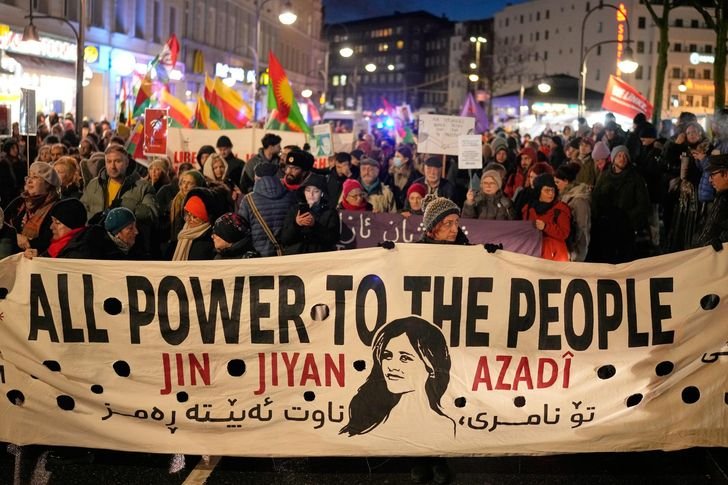
Once again, the Iranian people are on the streets against their repressive rulers. Once again, the Islamic Republic has retaliated with extreme violence. The death toll so far is estimated at 2,571 people, according to the US-based Human Rights Activists News Agency (HRANA); with more than 18,000 in detention. Initially, the regime vowed to expedite trials and execute prisoners, but has since backed down. In 2025 alone, over 1000 were executed: for their political views, for criticising the government, as members of suspect Afghan, Baluchi, and Kurdish minorities, or for drug-related offences.
The shock troops of the theocracy, the Islamic Revolutionary Guard Corps and its Basij militia, have fired directly into crowds and at the heads and genitals of demonstrators, overwhelming hospitals with casualties, many hundreds of whom are now blinded. These acts to cause mutilation and permanent disability, are intended to terrify and intimidate those described by the government as “rioters and saboteurs”, charged with Moharebeh or “waging war against God”.
In a pathetic attempt to stop the growth of protests through reducing the flow and spread of news, there is an ongoing internet clampdown since the night of 8 January. What we do know from a variety of sources is that the true number of fatalities and arrests exceeds many times the information available to the authors of the statement from Tehran presented below.
The spark that lit the tinderbox was the action on 28 December 2025 of the bazaaris in Tehran who shuttered their stores in anger at the further devaluation of the rial, now half its value from a year ago. These merchants have been steadfast supporters of the clerics and their rule—up till now. Their demands for shutdown of trade spread beyond their class to other sections of Iran’s 90 million population overwhelmed by inflation of 40%, food inflation of 72%, sharp increases in fuel prices, mass unemployment, and daily stoppages of water and electricity, amidst unbearable heat and diminishing rainfall caused by climate change.
The cumulative consequences of harsh US sanctions since 2018 on Iranian oil exports and neoliberal policies have decimated the living standards of common people. The US president has since the breakout of protests, ratcheted up the pressure by threatening 25% tariffs on exports to the US for “any country doing business” with Iran. This includes Sri Lanka which runs a trade surplus with Iran, mostly exporting bulk tea and coconut and rubber products, while importing pharmaceuticals and fertilisers. Meanwhile, last year’s bombardment by Israel and its patron the United States, which killed over 1000 people, has weakened the absolute authority of the Iranian state in the eyes of many.
What began in late December as a cry against the household economic and energy crisis rapidly turned into a national movement against authoritarianism, corruption, and the repression of women and national minorities. The demonstrators on the streets began adopting political demands, pinpointing the Masoud Pezeshkian government and ‘Supreme Leader’ Ayatollah Ali Khamenei, who is Iran’s highest religious and political authority, for their problems. Chants such as “Death to the dictator” and “Cannons, tanks, fireworks, mullahs must go”, were voiced in demonstrations.
In one university, a feminist chant from the 2022 Jin, Jiyan, Azadi (‘Women, Life, Freedom’) movement resounded, “You’re the lecher; you’re the whore; I am a free woman”. In response to widespread slogans for the return of the Pahlavi dynasty, overthrown and exiled in the 1979 revolution, students from another university countered: “Neither Pahlavi nor the Supreme Leader; freedom and equality”.
As an unnamed Iranian analyst explained to The Guardian:
“The monarchist slogan is not a declaration of love for Pahlavi: it is a declaration of disgust for the Islamic Republic. It is a cry of ‘no’ when no ‘yes’ is available … Everyone is stuck in the past or in empty promises. When the horizon is empty, society looks back because it sees nothing ahead.”
In what has been an organic, spontaneous, movement from below, opportunists such as Reza Pahlavi, and war criminals such as Benjamin Netanyahu and Donald Trump, are of course trying to meddle and manoeuvre to maximum advantage. There can be no doubt in the minds of Iranians, who have witnessed the genocide in Gaza, and been at the receiving end of Western missiles, that the Zionist and imperialist entities care nothing for their human and democratic rights. These malignant powers’ intention is that Iran become like their client Arab states; with or without a puppet despot in the shape of a new Shah.
US-Israeli hands-off Iran! Neither Turban nor Crown! For a future “free from the domination of capital—one grounded in freedom, equality, social justice, and human dignity”.
In solidarity with the uprising, and to amplify progressive voices from within Iran, Polity reproduces a message by an independent trade union, undated but probably around 7 January 2026, rendered into English by Sepideh Jodeyri, an exiled Iranian poet, literary critic, and translator, as published by Counterpunch in the US.
***
Statement by the Syndicate of Workers of Tehran and Suburbs Bus Company (Vahed)
Popular protests and strikes across cities throughout the country have now entered their eleventh day. Despite an intensified security crackdown, the heavy deployment of police and security forces, and widespread violence against protesters, the movement remains broad, dynamic, and diverse. According to reports, protests have taken place at no fewer than 174 locations in 60 cities across 25 provinces, with hundreds of demonstrators arrested. Tragically, at least 35 protesters—including children—have been killed during this period.
From December 2017 to November 2019, and again in September 2022, Iran’s oppressed people have repeatedly taken to the streets to demonstrate their rejection of the prevailing political and economic order and its structures of exploitation and inequality. These movements are not driven by nostalgia for the past, but by the determination to build a future free from the domination of capital—one grounded in freedom, equality, social justice, and human dignity.
While expressing our solidarity with popular struggles against poverty, unemployment, discrimination, and repression, we categorically oppose any return to a past marked by inequality, corruption, and injustice. We believe that genuine liberation can only be achieved through the conscious, organised leadership and participation of the working class and oppressed people themselves—not through the revival of outdated and authoritarian forms of power.
Workers, teachers, retirees, nurses, students, women, and especially young people—despite mass repression, arrests, dismissals, and relentless economic hardship—continue to stand at the forefront of these struggles. In this context, the Syndicate of Workers of Tehran and Suburbs Bus Company (Vahed) stresses the necessity of sustaining independent, conscious, and organised forms of protest.
We have stated repeatedly, and we reaffirm once again: the path to liberation for workers and the oppressed does not lie in the imposition of leaders from above, nor in reliance on foreign powers, nor through factions within the ruling establishment. It lies in unity, solidarity, and the building of independent organisations in workplaces, communities, and at the national level. We must not allow ourselves to once again become victims of power struggles and the interests of the ruling classes.
The Syndicate also strongly condemns any promotion, justification, or support for military intervention by foreign governments, including the United States and Israel. Such interventions lead not only to the destruction of civil society and the killing of civilians, but also provide further pretexts for repression and violence by the state. Past experience has shown that Western hegemonic powers place no value whatsoever on the freedom, livelihoods, or rights of the Iranian people.
We demand the immediate and unconditional release of all detainees and insist on the identification and prosecution of those responsible for ordering and carrying out the killing of protesters.
Long live freedom, equality, and class solidarity.
The path forward for workers and the oppressed is unity and organisation.
The Syndicate of Workers of Tehran and Suburbs Bus Company (Vahed), established in 1958, represents thousands of bus drivers in the Greater Tehran area.
Image caption : Berlin solidarity march with Iranian uprising, 14 January 2026
Image source: https://bit.ly/4qxb7kg
You May Also Like…
Mining Heavy Mineral Sands: Deepening Dependency, Not Enhancing Leverage
Amali Wedagedara
The decision to mine mineral sands along two-thirds of Sri Lanka’s coastline is fuelling anxiety and tension among...
The Art of Witness: Memory and Resistance in Sri Lanka
Yolanda Foster
When I first arrived in Colombo in the 1990s, I was in my twenties and had just begun a volunteer role with Peace...
‘Border villages’: Emergence, Salience, and implications for ‘Community’ in Sri Lanka
Viyanga Gunasekera
Despite Sri Lanka being an island and not sharing land borders with another country, the term ‘border villages’...