
Dear Children, Sincerely: Seven Decades of Sri Lanka. Stages Theatre Group. Colombo. 2026.
Shannon Constantine
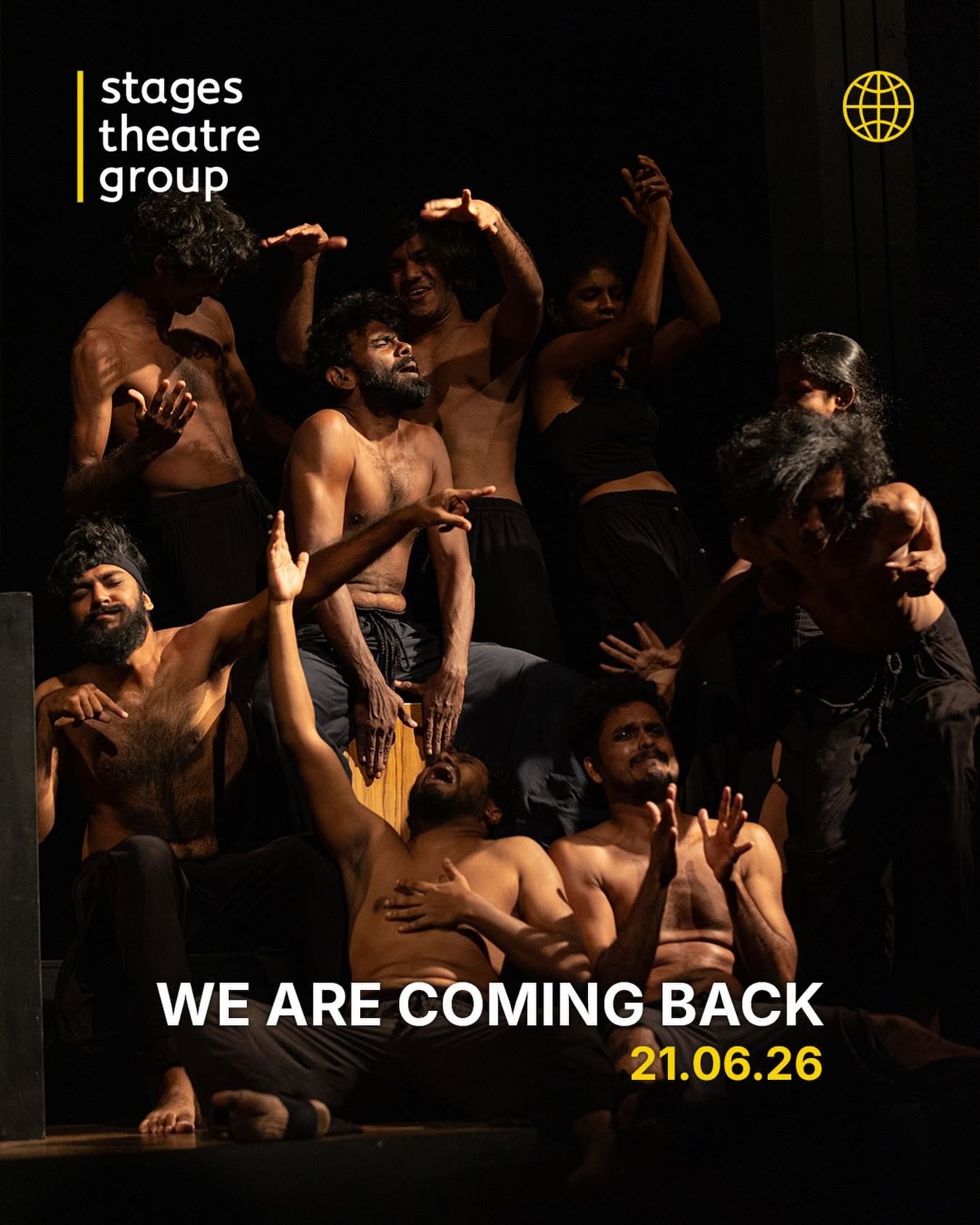
An ensemble mimes bus passengers and their conductor: some have their arms raised as if grasping bus rails, while their driver bends over an imaginary wheel, arms extended across its radius. Some passengers wear green shawls, others red. As the bus gets off to a wheezing start, driver and passengers chatter: the sounds of the words Sinhala and Demala ricochet around the stage. As the scene proceeds, bodies list right and left, faces contort in silent yells, different drivers take over, and the green-shawled passengers hit and push the red-shawled ones around. The scene ends with beatific smiles and relieved sighs of “Sinhala” from the green-shawled passengers and driver, as the red-shawled ones slowly slide away from the bus on their stomachs.
This is a brief outline of the second scene of Dear Children Sincerely: Seven Decades of Sri Lanka (hereafter DCS7), staged on 21 June 2026 at the Lionel Wendt Theatre in Colombo. It highlights two of the production’s strengths: its ensemble cast and embodied performance techniques. Both these serve to illuminate key moments in each decade of Sri Lanka’s history post-independence: in this case, the notorious ‘Sinhala Only’ Act of 1956.
DCS7 is a Stages Theatre Group production directed by Ruwanthie de Chickera. A devised work that has been in development since 2015, it is a play of shapes and sounds, of shadow and light, words and language, and always-moving bodies. History moves across the stage in seven scenes (one for each decade from the 1940s to the 2000s), and history moves the audience as well. The company’s website emphasises that DCS7 is part of the broader DCS research creation project aimed at collecting and sharing the memories of elders born during the 1930s who grew up alongside the new country, Ceylon /Sri Lanka.
This particular iteration has received many accolades, and travelled to Germany in June 2026. It previously toured across several international locations. Significantly, DCS has inspired similar projects in Ireland, Rwanda, the DRC, Belgium, Burundi, the UK, Serbia, and Palestine, making it a transnational exercise in memory and storytelling.
Storytelling is a key part of the project and particularly of this iteration. Representing seven decades of a country’s history is no easy feat, especially in the case of a country as fractured and divided as Sri Lanka. It is a monumental task that demands a high level of creativity, risk, and talent—requirements that this production not only meets but exceeds. Choosing to represent history through theatre allows storytelling to take the helm. Theatre’s embodied nature and its ability to address audiences in a collective encounter allows for a shared experience: shared moments of levity, of shock, and of suspense. This is not to romanticise theatre as the ideal form for portraying history and sharing memory, but to acknowledge its affective pull and capaciousness for producing meaning.
For those of us familiar with Sri Lanka’s history, the scenes, incidents, names, and memories were familiar. For others, the scene titles and brief narrative at the outset of each scene provided context. A screen downstage provided subtitles throughout, for the most part in all three languages. This screen is a vital tool in a production that frequently switches between English, Tamil, and Sinhala dialogue (although all the framing narratives, the elders’ stories, are in English). Given how complex our history and this production are, and the work that went into DCS7, the resource pack and other details provided on Stages’ website give further helpful context on the project as a whole and on the individual stories in each scene.
The play touches on many key historical incidents and memories, using both physicality and narration to convey the realities of Sri Lanka’s political landscape. This commentary is sometimes overt and sometimes subtle, as in the opening scene in the dawn of Sri Lanka’s independence. The ensemble—in the guise of a group of people from the 1940s—tells us one by one that they do not remember there being a flag. Ongoing debates over Sinhalese nationalism and the flag immediately come to mind. Independence in the ’40s scene is overshadowed (both visually on stage and in people’s memories, as the resources on the company’s website note) by the Duke of Gloucester’s visit. Longstanding Stages member Akalanka Prabashwara cuts a humorous figure as the Duke, sniffing flowers and being stung by insects while touring the Peradeniya botanical gardens—portrayed beautifully by members of the ensemble, who create the ‘garden’ through their jutting hips, tilted bodies, and uplifted hands.
The performers’ endurance and skill were especially evident in the ’70s scene, where the entire ensemble portrays the story of the JVP insurrection through dance. The powerful leaps, yells, and springs form part of two distinct dance traditions: the Rwandan gumboot dance and the Vaahala dance (a Sri Lankan low country dance tradition), and are backgrounded by a rousing beat played onstage (Stages Theatre Group 2020). The sharing and melding of these two movement vocabularies reflects how performance can function as a site of cross-cultural encounter and the passing down of bodily knowledge—what Diana Taylor (2003) writes of as the repertoire. It is also a testament to DCS’ work in community building and partnership on the international stage: the DCS Rwanda-Sri Lanka collaboration, for example, entwines Rwandan and Sri Lankan histories and performers.
While taking its audience through painful and serious memories, DCS7 makes pointed use of humour, highlighting the absurdity of some of Sri Lanka’s political episodes. At the same time, its humorous and often light-hearted tone does not preclude portraying the realities of history’s stark truths. During the ’80s scene, for instance, we hear and see the words of J. R. Jayewardene, shortly before the ’83 riots:
I am not worried about the opinion of the Jaffna people… now we cannot think of them, not about their lives or their opinion… the more you put pressure in the north, the happier the Sinhala people will be here… Really if I starve the Tamils out, the Sinhala people will be happy.[1] (Navaratnam 2023)
The DCS project as a whole necessarily tackles difficult questions: how does a theatre company depict a war that extended across three decades? How can actors convey the multiple angles and casualties of a conflict while keeping to their chosen framework? The ’90s scene is arguably the most challenging and intricate to portray, given the number of attacks, external influences, and political manoeuvring that were unfolding simultaneously during the escalation of open armed conflict. De Chickera and her cast chose to do this through a cricket match framework.
The scene is an impactful exercise in layering: the excitement of the 1996 World Cup, the spectacle of war, and the war economy all intersect thoughtfully with news reporting. The language and atmosphere of cricket melds with the back and forth of cricket commentary and TV newscasting, making for an entertaining scene that is always framed by sobering statistics: people killed in attack, international military aid procured. The play embraces absurdity here too, such as when the ensemble as an enthusiastic papare band rushes across the stage while the ‘newscasters’ are presenting their statistics, but it does not descend into pure farce.
The cricket match and news commentary framework (there is even a Ranil joke!) do not in any way diminish the horrors of the war. Instead, it provides a vehicle through which audiences can grasp figures and exchanges that are often just words on a page or screen, following a chronology and using a widely understood metaphor. Audible gasps issued from the audience as the casualty numbers piled up, highlighting the moments that the numbers landed. The scene’s framing also functions as a larger commentary on the trading of hostilities and the economic forces that constitute war’s theatre: the numbers and tallies go back and forth like cricket scores to show how one group inflicted death on another.
The final 2000s scene is on the “Menik Farm” IDP (internally displaced persons) camp. The scene relies on the collective story of the camp’s inhabitants that is narrated by Shenali Rajkumar, who plays an older inhabitant of the camp. As we listen, the ensemble enacts parts of the narration (we see, for instance, a group of young people staring uncomprehendingly at their flexed fists, and hear a mother’s piercing scream as she stares at something unseen).
This allows the audience to picture the soap that well-meaning foreign visitors handed out to the camp’s inhabitants—forgetting that they had no water for bathing, and the heartbreaking image of children falling into the camp’s open latrines. These images contrast with that of jasmine flowers that devotees reverently offered in temples before their internment in the camp: a description that the narrator repeats several times during the scene. This repetition, along with soft lighting on the ensemble, an occasional mournful vocal run, and gentle percussive notes from instruments played by the ensemble, serve to amplify the continuous narration.
This scene and the ’60s attempted coup scene are the only two that lean heavily on narration. Unlike the ’60s scene, this one is a monologue. Taken together, the two scenes have key differences in tone, structure, and language that make this 2000s scene stand out. Its departure from the humorous tone of many of the other scenes makes it seem closer somehow to the physicality of the other heavier, more serious scenes such as the ’70s and ’80s ones, painting a sobering picture of the past.
As an audience, we are called upon to witness history embodied in the moment: the production reminds us that Sri Lanka’s painful and tangled histories have shaped our present, and that they will continue to influence the future. Ending with the stories of “Menik Farm”—which, in a macabre twist, is once again an agricultural site run by the army, crops and cows expanding over the space where humans were once imprisoned—is a powerful choice, one that brings to light a horror that is hidden by the triumphant ending of the war touted by the Rajapaksas. Closing the play on the note of the 2009 ‘victory’ and the massacre at Mullivaikkal instead would have taken the production in another direction, perhaps giving a false sense of closure. And perhaps the horrors of Mullivaikkal cannot be contained within any theatrical framework.
The production’s success lies partly in its minimal use of props: stage cubes are the main props used across each scene. The costumes, likewise, are simple: the ensemble wears black clothing that allows the actors to access their full range of movement, with the colour ensuring that the audience focus on their facial expressions and movements rather than on any intricate costumes. The costumes’ simplicity also allows the actors to switch seamlessly from scene to scene, transitioning from embodying an angry crowd to a papare band as the moment demands. On the few occasions when extra pieces of costuming do appear, they are used sparingly: as cravats and shawls for an urbanised elite in the ’60s scene, or to denote ethnicity as in the aforementioned bus scene. This bare-bones approach to staging allows the acting and narration to be the focus, and no doubt makes for smoother travel and setup.
Furthermore, for a production that depends so much on movement and sound, the moments of stillness and silence stand out even more. The ’70s scene, for instance, ends with a stage littered with prone bodies, demonstrating the carnage of the times, while freeze-frames in the ’50s scene where the red-shawled passengers are symbolically attacked and thrown off the bus are reminiscent of a many-headed Hydra of Sinhalese nationalism, with minoritised bodies violated and ejected from the social body.
The research and devising process that went into DCS from its commencement highlights the co-creativeness of devised theatre as a form. Devised theatre emerged from a deconstruction of representational theatre conventions and linear narratives to embrace “the multiple voices and interwoven stories of collaborative play building” (Perry 2011: 64). Devised theatre serves important teaching and learning functions, both within the Stages team itself and on the part of the audience. It also reinforces the sociocultural work that Stages’ work performs (two recent productions in solidarity with Palestine, Patterns of Our Genocides and Children of the Little Olive Park, testify to this).
In a video interview, de Chickera remarked that working with her first DCS ensemble involved teaching the cast about the histories and narratives that they were to represent together (No Names Collective 2024). Throughout, the actors learn and internalise as they perform. The entire process, then, enacts what Alison Landsberg (2004) calls ‘prosthetic memory”, an embodied form of public cultural memory resulting from individuals’ encounters with historical narratives outside their own lived experience. The devising process highlights, for both actors and audiences, that memory is not simply recalled but is held, lived, and enacted within and through the body.
Adding to this is the complexity of representing an identity that is not your own, and taking on the task of channelling an alternate identity through your own physicality. What does it mean for a Sinhalese actor to take on the identity of a displaced Tamil person, for instance? Likewise, what might it mean for a Muslim actor to take on the role of a member of an anti-Tamil Sinhalese mob? What internal reflections, gestural work, and emotional and physical expressiveness did these portrayals demand? These are just a few of the questions that a challenging production like this generates and that go into its devising and performance.
One task that any production attempting a broad review of a country’s history must confront is that of choice, or selectivity. In choosing to tell some stories or to interview some people, you inevitably leave out other, sometimes important, voices across caste and class spectrums. The DCS project as a whole consists of scenes that can be put together, left to stand alone, and combined and recombined to different effects. It also contains a separate series of monologues. Together, these elements do some of the work of allowing for a range of perspectives, truths, and memories. In this performance, the DCS7 scenes take on the shape of ordinary citizens’ views: an exchange between the unnamed society lady and her aide Wijesoma in the ’60s scene, for example, represents an attempt to tell two sides (across class, ethnicity, gender, and language) of the story of the attempted 1962 coup.
Watching the play again several years after my first viewing, the bus scene made me wonder why the actors said “Sinhala Demala”, rather than “Sinhala Thamizh”. On the one hand, this choice might reflect the exclusionary language policies being formed at the time (and that extend to this day). On the other, the auditory dominance risks (at worst) re-inscribing the very oppression that the scene seeks to critique, and at best, failing to engage with this hegemony through the production’s languages and sounds themselves. Either way, this was a curious choice in a production of this nature. Elsewhere in the production, I found myself noting that Sinhala took a much more prominent role than Tamil—and that English dominated even more, with subtitles occasionally not appearing in the other two languages. Taking on a trilingual approach to storytelling is complex, and Stages did a painstaking job. These momentary lapses point to the difficulty of such a task, as well as to the lacks and glitches in Sri Lanka’s official languages policy.
Given the numerous barriers to entry that come with theatre (such as ticket costs and assumptions around theatre as an elitist art form), it would be interesting to see the production travel to other parts of the country outside Colombo and the Western province, and to ponder on the language changes and production shifts that this might entail, as well as the additional work that might be required for audience talkbacks, interpretation, and discussion. All of this would be part of the work that this production is already doing as a pedagogical and cultural tool. In the context of ongoing absences of justice and a broad lack of awareness of tragic episodes of Sri Lanka’s history (especially among younger generations), the stage becomes a vital platform, and plays like DCS7 are important mirrors and repertoires of embodied memory and pedagogy.
Shannon Constantine is a PhD. candidate in the Department of Theatre Arts and Performance Studies at Brown University.
Image source: https://bit.ly/4wxwSmz
References
De Chickera, Ruwanthie. (n.d.). “Dear Children…Sincerely: Seven Decades of Sri Lanka”. Colombo: Stages Theatre Group. Available at https://static1.squarespace.com/static/6458fc889e3dd85a050810d8/t/6463abc8fad5f05b4ca37920/1684253643086/STG_DCS+Seven+Decades_Full+Script.pdf
Landsberg, Alison. (2004). Prosthetic Memory: The Transformation of American Remembrance in the Age of Mass Culture. New York: Columbia University Press.
Navaratnam, Karikalan S. (2023). “40th Anniversary Of ‘Black July’ 1983”. Colombo Telegraph (27 July): https://www.colombotelegraph.com/index.php/40th-anniversary-of-black-july-1983/.
No Names Collective. (2024). “Dear Children Sincerely | Drama Highlights & Audience Reactions | Harmony Center 14th Event”. YouTube (18 September). Available at https://www.youtube.com/watch?v=QZwVc23KeQk.
Perry, Mia. (2011). “Theatre and Knowing: Considering the Pedagogical Spaces in Devised Theatre”. Youth Theatre Journal, 25 (1): 63–74.
Stages Theatre Group. (2020). Resource Pack: Dear Children…Sincerely: Seven Decades of Sri Lanka. Colombo: Stages Theatre Group. Available at https://static1.squarespace.com/static/6458fc889e3dd85a050810d8/t/6463ad5f6315e46221a1f8ea/1684254062315/DCS_Seven+Decades+of+Sri+Lanka_ResourcePack_English.pdf
Stages Theatre Group. (2026). DEAR CHILDREN, SINCERELY… Seven Decades of Sri Lanka [souvenir]. Colombo: Stages Theatre Group.
Stages Theatre Group. (n.d.). Dear Children, Sincerely…a conversation across generations. Colombo: Stages Theatre Group. Available at https://www.empathyandrisk.com/wp-content/uploads/2021/01/DCS_Project_EarlyStages.pdf
Taylor, Diana. (2003). The Archive and the Repertoire. Durham: Duke University Press.
Notes
[1] Reported by London’s Daily Telegraph and quoted in the Sunday Observer on 17 July 1983.
You May Also Like…

Mining Heavy Mineral Sands: Deepening Dependency, Not Enhancing Leverage
Amali Wedagedara
The decision to mine mineral sands along two-thirds of Sri Lanka’s coastline is fuelling anxiety and tension among...
The Art of Witness: Memory and Resistance in Sri Lanka
Yolanda Foster
When I first arrived in Colombo in the 1990s, I was in my twenties and had just begun a volunteer role with Peace...

‘Border villages’: Emergence, Salience, and implications for ‘Community’ in Sri Lanka
Viyanga Gunasekera
Despite Sri Lanka being an island and not sharing land borders with another country, the term ‘border villages’...