
“Peasant Politics” and the War in Sri Lanka
Benedikt Korf
Agrarian relations can tell us something fundamental about politics.[1] This is what I have learned from the work of James Brow, Mick Moore, Tudor Silva, and Serena Tennekoon. “Peasant politics” is about more than “peasantry”—it is about politics tout court.
However, as will become clear in the following discussion, “peasant politics” in Sri Lanka is not about peasant agency and the politics of peasant struggles; but about an ideology to appease and seduce the peasantry to loyalty to the Sinhala-Buddhist state. The term “peasant politics” thus has a particular connotation in Sri Lanka studies.
Indeed, in his famous book The State and Peasant Politics in Sri Lanka (1985), Mick Moore used the term “peasant politics” to explain the absence of peasant revolt and uprising in Sri Lanka. He decentred class and caste struggle as a primary mechanism of agrarian relations. In Moore’s coinage, “peasant politics” became the descriptor of a particular rural policy dispositif in post-independence Sri Lanka.
Moore was concerned with the question of why rural small-holders in Sri Lanka, despite their potential electoral power, did not manage to bring demands for higher output prices on the policy agenda. He claimed, state patronage toward the peasantry; state land alienation to small-holders; and the provision of welfare packages, did the job to appease the “peasant” and to tie rural small-holders into the remit of state patronage. But even more, Moore claims that the political impotence of the smallholder was at least partially due to the conflict between the main ethnic groups.
In Moore’s argument, “peasant politics” is a category of practice in Sri Lankan politics, which he calls “peasant ideology”. This “peasant ideology” noted Moore, had entangled agrarian policy with the politics of Sinhala-Buddhist majoritarianism: “[The] Sri Lankan nationalist elite became ‘locked-in’ to a particular interpretation … of society [that] has involved the notion of a ‘peasantry’ as the historical and moral core of Sinhalese (as opposed to Sri Lankan) society” (Moore 1989: 180). That “interpretation” has continued to haunt not only “peasant politics”, but politics more proper in Sri Lanka.
Studying this “peasant ideology” as a populism subsequently tainted with a Sinhala-Buddhist nationalist territorialism has been the subject of numerous studies on Sri Lanka’s rural society and politics. The work of Sunil Bastian (1995), James Brow (1981, 1996), Patrick Peebles (1990), Stanley Tambiah (1986) and—most notably—Serena Tennakoon (1988) may come to mind. And there are certainly many more. They all in one way or other have shown how rural policy has been built around a myth of Sinhala-Buddhist “culture” as an ancient hydraulic civilisation with tank (weva), temple (dagoba), and paddy field (yaya) as the “holy trinity” of the moral package that Moore alluded to. Irrigation and dry zone colonisation have been the terrain where this peasant ideology was most forcefully implemented.
Thick with politics
The resonances with Karl Wittfogel’s classic notion of hydraulic societies (Wittfogel 1957) and the potential despotism engrained in it are loud and clear. In his work on engineering and nationalism Dileepa Witharana shows how the Accelerated Mahaweli Development Project (AMDP)—that dammed the Mahaweli river to produce electricity and provide water for a large irrigation network—was put into the service of Sinhala-Buddhist majoritarianism.
It was designed to benefit primarily the Sinhalese population, and it was narrated—as Serena Tennakoon (1988) has vividly described—as a rejuvenation of an old, heroic past of Sinhala-Buddhist hydraulic civilisation (Wittfogel’s despotism part being silenced in those celebrations). Sinhala-Buddhist nationalists, writes Witharana, “perceived the Mahaweli as a Sinhala property carrying ‘Sinhala water’ that should be used for the benefit of the Sinhalese” (Witharana 2022: 114). Engineering, Witharana writes, is “thick with politics” (a term he borrows from Bijker 2007).
Witharana quotes Carl Schmitt and his famous definition of the political as the distinction between friend and enemy to make sense of this politicisation of engineering (Witharana 2022: 106). It can, indeed, be argued that such Schmittian politics culminated in a particular “package” of peasant ideology—of irrigation and colonisation as frontier of the Sinhala-Buddhist state, nation and territory.
The ADMP was the high-modernist incarnation of that frontier—making it technically feasible to territorialise the Sinhala-Buddhist nation in the vast dry zone planes of central, northern and eastern Sri Lanka; but it was not the start of that “peasant ideology”, only its point of culmination.
The idea of dry zone frontier colonisation has a much longer genealogy and history, dating back to the geographical imaginations and hydraulic dreams of British-era colonial officers such as R. L. Brohier, and lived on in the imaginations of the political elites of early independent Sri Lanka.
Indeed, dry zone frontier colonisation was a key concern for post-independence Sri Lanka’s first prime minister, D. S. Senanayake, who had been minister for agriculture during the last British administration. B. H. Farmer who knew D. S. Senanayake personally, recalled the latter’s personal knowledge of the dry zone, and noted “his simple dislike of seeing land lying idle …, and the romantic appeal of recreating the glories of Raja Rata, the King’s country of old” (1984: 228).
In the first decades of independent Sri Lanka, frontier colonisation was part of a developmental discourse of food self-sufficiency, river valley development and agrarian modernisation that was a common policy worldwide. It is not surprising that many of the colonisation schemes of this era received funding from international donors (Bastian 2018).
The “ideology” in the colonisation came from the claim that the dry zone was a property for the Sinhala-Buddhists only. As a result, the minorities were denied a fair share of the land distributed in these schemes. The blame is not only on J. R. Jayawardene and his clique who were behind the ADMP. But the ADMP accelerated the colonisation of the dry zone and intensified the “peasant ideology” of Sinhala-Buddhist nationalism, making settler colonisation into a political, and subsequently, military weapon against the Tamil and Muslim minority. Land colonisation was, alongside access to education, the major grievance of Tamil politicians since the 1950s.
Indeed, state and “peasant politics” is intimately linked to the geographical imagination of the dry zone frontier: the frontier zone in the Northern and Eastern Provinces, where in a number of hydraulic engineering and irrigation works the “ethnic question” was being “territorialised”—as a claim to land: first Gal Oya in the newly founded Ampara District (on this: Hasbullah and Geiser 2019; Thangarajah 2003), and most prominently, Weli Oya at the borderland between the Northern and Eastern Provinces (or ‘System L’ of the ADMP) (Geiser and Korf 2026; Kelegama 2026). In the shadow of these two large schemes, a number of smaller ones, such as the Kantale Tank and the Allai Extension Scheme in the Trincomalee District, were also implicated in the peasant ideology of Sinhala-Buddhist majoritarianism.
The haunting of that geographical imagination of the “peasant ideology” came home to me when I started my fieldwork in Trincomalee for my Ph.D. on land and conflict more than 25 years ago. Talking to some elderly Tamil government officials in the provincial, district or local administration, who were running the province’s rump administration during the war and in the absence of an elected provincial government (see Klem 2012), they would start our conversation or interview with that old story of Gal Oya: that is, they told me, when it all started. “All” meant the land colonisation of Sinhalese settlers in the hinterland of “Tamil Eelam” that was seen as an instrument to engineer the “electoral politics” of the Eastern Province (Thangarajah 2003).
Weak politics
There is also a connection between the war and peasant politics. Undoubtedly, peasant politics of this ideological brand breeds multiple antagonisms, and there are multiple profiteers and perpetrators of antagonistic politics—politicians, military, militants—that reap those grievances for their political tactics and cultivate a Sinhala-Buddhist “hydraulic” nationalism.
Manipulation of water flows also ignited the last phase of the civil war. On 21 July 2006, the Liberation Tigers of Tamil Eelam (LTTE) closed the Mavil Aru anicut’s sluice gates to block the water flow to Sinhalese settlements, which instigated a military offensive against the LTTE. On 11 August 2006, the military conquered the area from the LTTE and re-opened the sluice gate.
But—and this is an important but—I could also see another type of “hydraulic politics” at work, and another layer of state at work in the war-affected regions. I call this type: a “weak” politics—“weak” not because it is ineffective, but because it is not pursued in the open arena of “strong” politics of hardening antagonisms. Rather, it operates silently, and in hiding, to diffuse antagonisms in the everyday operation of irrigation management.
“Weak” politics diffuses the political in the Schmittian sense out of everyday peasant politics. This became clear to me in my own Ph.D. fieldwork in Trincomalee District before, during and after the ceasefire agreement in 2002. Some of that fieldwork was conducted in villages—Muslim, Tamil and Sinhalese—in Muthur and Seruwila Divisional Secretariat (DS) divisions in southern Trincomalee District whose inhabitants had fields in the tail end of the Allai Extension Scheme. The Allai Extension Scheme received water from a diversion work of the lower Mahaweli river and the Kantale Tank. And in the middle of these struggles were engineers.
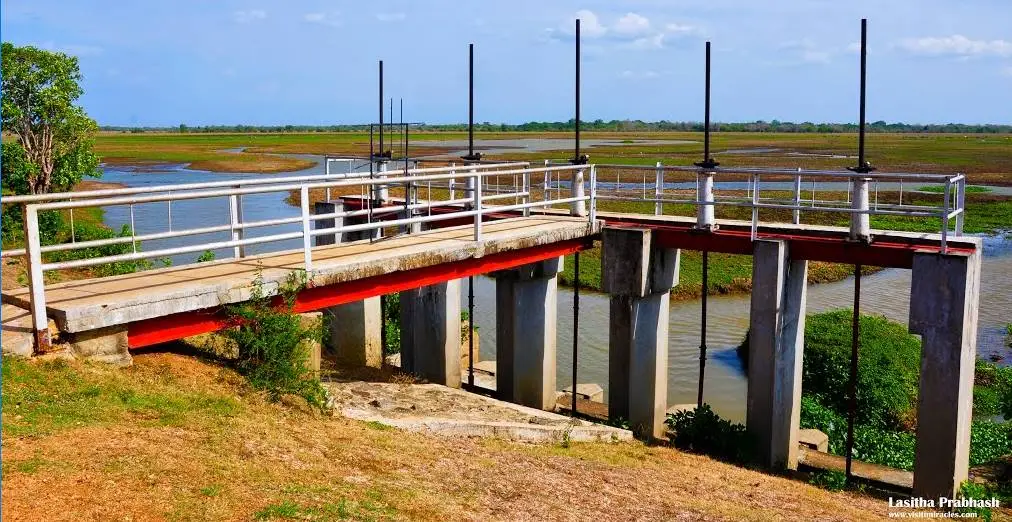
I was interested to understand how it was possible that this scheme continued to operate during and after the war, despite the violence and conflicts that shaped that region. Engineering is not confined to design and planning (the story of Witharana’s analysis). Engineers are also involved in the daily operation of a hydraulic system. The flow of water to different segments of the schemes’ fields needs to be planned, discussed and implemented. Sluices need to be opened and closed, irrigation channels cleaned up, hydraulic works rehabilitated, and so on. That engineering work of operation is also “thick with politics”. “Hydraulic” politics about who receives water when, about shortages at the tail end of the scheme, and so on, are overwritten by the ethnic politics of the war.
Politics “thickens” around the everyday operation of engineering products. Everyday hydraulic nationalisms shine through as “preference in resource allocation for the true members of a nation” (Witharana 2022: 115). This “preference” becomes apparent not only in the design of schemes, but in the everyday allocation of irrigation water. This “everyday” thickening of politics around the operation of engineering artifacts intensified during times of the war and raised the stakes of water disputes.
Allai Extension Scheme
While it is common to find conflicts over water allocation between upstream and downstream slot holders in irrigation schemes, in the Allai Extension, this struggle became overshadowed by the ethno-nationalist politics of the war. The Allai Extension Scheme is an interesting case study, because three ethnic groups—Sinhalese, Tamils, and Muslims—have been allocated land plots, and the politics of irrigation evolved around different antagonistic faultlines.
From 2000-2002, before and after the ceasefire agreement, I talked to several of the engineers in the local section of the Department of Irrigation who were tasked to uphold the everyday management of the system throughout the years of war.[2]
Opening and closing sluice gates to engineer the flow of water to different segments of the scheme was the most delicate task for the irrigation engineers, because the fields were largely clustered along ethnic lines—tailenders were mainly Muslim and Tamil (in Muthur); and upstream farmers were Sinhalese (in Seruwila).
When there was a water shortage, Sinhalese farmers blamed irrigation engineers, who were mostly Tamils, for disfavouring them because they, the farmers, were Sinhalese. Tamils complained the Tamil engineers would give in to pressures from the military to divert the water to “Sinhalese” fields, leaving them with a shortage of water. The engineers thus operated in a highly charged terrain, and whatever they did to manage the irrigation system could be held against them by either side.
Farmers were also not shy to mobilise powerful patrons to intimidate engineers. Engineers recalled that Sinhalese farmers had threatened to ask powerful politicians to transfer them to difficult locations, e.g. in the Vanni, should they fail to make sure the farmers would have enough water. These farmers were also under the protection of the military. Because their quarters were in a Sinhalese village, engineers were delicately exposed, given that most of them were Tamils. On the other end of the spectrum, the LTTE abducted, intimidated and interrogated them on why they failed to deliver water to Tamil farmers.
Engineers had to become skilful negotiators and diplomats to juggle an almost impossible task and to navigate all its pitfalls as a matter of survival if they wished to keep the irrigation system operational.
A story from a small village tank, called Menkamam, illustrates how water management was “thick with politics”.[3] It is a story of encroachment and conflict over water retention in the reservoir.
Sinhalese farmers from Dehiwatte, a Sinhalese colony in the Allai Extension Scheme, had encroached on land in the tank bed, which would be submerged when the tank stored water at full capacity. During the rainy season, some Sinhalese farmers therefore came to destroy parts of the tank bund to lower the tank’s capacity and the spread of the water to avoid their land plots being submerged in the tank water. They did so with the protection of the army; which also made sure that Tamil farmers whose fields now suffered water shortage would not restore the tank bund. That caused resentment among the Tamil farmers whose cultivation land was dependent on the water from the tank and now experienced water stress. In the wake of the war, sentiments heated up.
In my fieldwork, that case was often relayed to me as a typical situation of how “the Tamils” were being suppressed by “the army” and “the Sinhalese”. Although the acreage of land encroached was rather small, the conflict emerged as a “big issue”: clothed in antagonistic “hydraulic nationalisms”, it was seen in the light of the violent history of the region.
And violent has this history been indeed. On June 3 and 4 in 1985, Menkamam alongside many other villages located close to Sinhalese colonies in the Allai Extension Scheme, were plundered and looted by Sinhalese soldiers, policemen, home guards, and ordinary civilians; and a number of Tamil civilians were killed and houses destroyed. This “orgy of violence … was repeated on a smaller scale in 1987 and 1990”, notes Gaasbeek (2010: 11).
When Timmo Gaasbeek came to the area to work as a volunteer for ZOA, a Dutch NGO, he noticed the tense relations between Tamils and Sinhalese in the region (Gaasbeek 2010: 144ff.). Tamil civilians in the area experienced everyday threats and harassment from the military and police, but they were also pressured by the LTTE to pay taxes and give one of their children to the movement. At the same time, inhabitants of Dehiwatte had been killed by Tamil militant groups since 1985, and Sinhalese farmers were also “taxed” by the LTTE. Sinhalese farmers also suspected Tamil civilians of supporting and collaborating with the LTTE.
It is interesting to see how the irrigation department responded to the situation. Gaasbeek reports that the irrigation engineers “solved” that dispute by digging a new feeder channel to bring water to the fields of the Tamil farmers. This technical fix made the problem that had caused such heated antagonisms largely redundant: encroachers could still cultivate their fields, and most of the farmers from Menkamam had enough water for cultivation. In this way, engineers provided technical fixes without exposing themselves in the politics of antagonism.
Similarly, Gaasbeek noted, irrigation engineers had intervened with technical fixes in other water conflicts. For example, they made a sluice gate dysfunctional, that Sinhalese farmers had previously blocked to prevent the flow of water to downstream (Tamil and Muslim) farmers. Water flow could not be regulated anymore, but also not deliberately blocked.
Wattai Vidane
Gaasbeek has another interesting narrative, told to him by a wattai vidane—a local community water manager. That story is about the practice of blocking channels to prevent water flows to downstream segments of the scheme during the war (and also during the ceasefire agreement, as I recorded in my fieldwork). The wattai vidane, a Tamil, told him:
During the war, channels were sometimes blocked to prevent water from going to the downstream villages. … If a channel was blocked, the DO [Divisional Officer of the Agrarian Services Department] would call a meeting of the wattai vidanes in the area, and we would talk about the problem. I know all the wattai vidanes for a long time already, and we had good relations before the war. Nobody else was present at the DO meeting, so we could safely interact and come to agreements with our fellow wattai vidanes. If I saw a Muslim wattai vidane on the market in Muthur, I would not speak to him because someone might think either of us was a traitor and get him or me killed. But in this meeting, there was no security risk. At night then, the wattai vidane of the area where the channel was blocked would open the channel and close it again before morning. In this way, water would go to the other village, and nobody would know who did it. Had some people from this wattai vidane’s village found out that he had done it, they would surely have attacked him, but now he could say ‘it was dark, somebody must have come from the next village and stolen the water’. (Gaasbeek 2010: 247)
This story is significant for several reasons: Here we have a “peasant politics” that operates clandestinely, invisibly, in the shadow of the loud politics of ethnic antagonism. The wattai vidane who told his story to Gaasbeek is clear on this point: such a politics of collaboration could not be conducted in the open—it placed those sharing this community of secret peers at a high risk should their clandestine hydraulic politics be detected. To keep this secrecy, the wattai vidane even had to lie to his own community.
The wattai vidane operated in a highly politically charged environment. In the downstream sections of the Allai Extension Scheme, Tamils and Muslims had traditionally cultivated fields alongside each other. Relations deteriorated during the war and even further after the ceasefire agreement.
One reason was that the LTTE did not allow Muslim farmers to cultivate their land in the LTTE-controlled areas and continued to “tax” Muslims. In fact, throughout the war, the LTTE had not allowed Muslims to cultivate their fields in the territories they controlled. That they continued to do so after the ceasefire agreement caused deep resentment among Muslims.
Tensions between Muslims and Tamils therefore occurred frequently in the aftermath of the ceasefire, and blocking of feeder channels to presumably harm the ethnic other were reported and talked about a lot. Gaasbeek (2010: 246) doubts that it happened often, but the issue of channel blockage was “in the air” as a grievance issue among local communities.
These stories about engineers and wattai vidane show how dams and dikes are “thick with politics”—Schmittian politics. Water management conflicts become a “big issue” if they map on the antagonism of ethnic grievances. But alongside those antagonisms of hydraulic nationalisms, pragmatic politics emerged clandestinely to provide “technical” fixes to diffuse ethnic antagonisms.
These technical fixes involved risks for their protagonists. The wattai vidane was clear on the fact that his work could only succeed if all involved could be trusted not to reveal it. Similarly, front-line engineers were very exposed—to intimidation and harassment by the army or the LTTE. Stakes may have been lower for engineers who designed, planned and oversaw the construction of the extra feeder channel from their office desks in Trincomalee town, but not for their engineering colleagues who were in the field for the everyday operations.
Politics and violence
Antagonism is often seen as the quintessential property of politics in Sri Lanka (and South Asia more broadly). Anthropologists Thomas Blom Hansen (for India) and Jonathan Spencer (for Sri Lanka) both emphasise the blurred boundaries between politics and violence. Spencer paraphrases Clausewitz’s famous dictum that war is the continuation of politics by other means and writes that violence is “a heightened and intensified continuation of normal politics” (Spencer 2007: 120). Hansen goes even further to claim that “violence is no longer politics by other means but the heart of political life itself” (Hansen 2019: 35). This antagonism raises the spectre of political (and electoral) violence, as Sudipta Kaviraj notes: “Under the attractive picture of voting and counting, victories and defeats, there is a steady, but unnoticed trickle of blood” (Kaviraj 2011: 20). Violence is politics. Full stop.
Whether we like it or not, Hansen, Kaviraj, and Spencer seem to suggest, politics is a dirty and rough business, driven by antagonisms; and we need to acknowledge that ethnographically, even if we do not approve of it morally. The argument is about ontology—the nature of politics, not wishful thinking about what politics ought to be in an ideal situation. Ontology, not utopia. In the background looms Schmitt’s cold-blooded definition of the political: “The specific political distinctions … is that between friend and enemy” (Schmitt [1932]1963: 23; my translation). For Schmitt, antagonism is politics.
As anthropologist, Spencer does not appeal to ontology, but ethnography. Schmitt’s conception had appealed to him to explain “some very specific processes in one very particular location: the Sri Lanka of the 1980s and after” (Spencer 2012: 730). In the terrain of “peasant politics”, the ethnographic account is not that clear. Sure, the stories from Weli Oya that the University Teachers for Human Rights (Jaffna), Kelegama, and Hasbullah, have assembled show us the antagonistic picture of a civilisational hydraulic politics that breeds an escalation of violence—or the complete dispossession of the weaker party (Geiser and Korf 2026; Kelegama 2026; UTHR-J 1993): Schmitt’s ontology of the political in full operation.
A space outside the political
But there is—Spencer concedes this—“a space outside the political” (Spencer 2012: 730). The tactics of the wattai vidane or of the irrigation engineers in the field provide a vivid example that antagonism is not the only game in town—even during the war. The stories of peasant politics in the Allai Extension Scheme point to another form of politics: a politics that is pragmatic, collaborative, accommodative, but also more tentative and—most importantly—“invisible” or only “technical”. And a “peasant politics” that is not “peasant ideology” but operates in a “structure of feeling” that was characterised by that ideology and its incipient antagonisms. What is the ontology of this politics, if it is not antagonism, not ideology, not identity?
This politics can be understood “as a form of activity concerned with addressing problems of living together in a shared world of plurality and difference” (Barnett 2012: 679). How can we capture the properties of this style of politics? It is certainly more than simply bureaucratic rationality in the sense of Max Weber, even if it at times involved “technical fixes”. This rendering technical was itself political, though not in a Schmittian sense either. It is also not an associational politics in Hannah Arendt’s sense, where people assemble to discuss politics, because these politics are not taking place in a shared public space, but rather clandestinely, secretly, and pragmatically.
One possibility to capture its properties is through the work of Italian philosopher Gianni Vattimo and what he calls “weak thought” (Vattimo 2012). Weak thought is not about politics, but about the ontology of knowledge. Weak thought, claims Vattimo, is driven by an ethics of deeds—it places caritas and pietas as prime imperatives of action. We can use Vattimo’s weak thought to exorcise the demons of Schmitt’s political thought. It eschews metaphysics or the question of truth—and the analogy for that in the field of politics would be ideology, identity and enmity. If we translate Vattimo’s thinking onto the plane of politics, a “weak politics” would be characterised by care and pragmatic action rather than self-righteousness, identity politics and antagonism.
I would propose to call the work of the wattai vidane or of the irrigation engineers a “weak” politics—a politics of pragmatic acts that does not insist on identity, but on addressing problems of everyday life across identitarian boundaries. “Weak” does not mean ineffective, or not forceful. Indeed, the many small acts of “weak” politics kept the irrigation system running and the life of many people ongoing in the war zones. It attenuated—“weakened”—the antagonistic forcefulness of the political, but it could not fundamentally disrupt or reverse it. It is politics because it is concerned with collective life in an ethnically plural society.
Is there a message in the story of the wattai vidane—a message hopeful and yet ambivalent—for politics in Sri Lanka more than 15 years after the end of the war?
Benedikt Korf is Professor of Political Geography in the Department of Geography at the University of Zurich and initially trained as a civil engineer. He is co-author, among many publications, of Checkpoint, Temple, Church and Mosque. A Collaborative Ethnography of War and Peace (London and Colombo, Pluto and Social Scientists’ Association, 2015).
Image source: https://bit.ly/4gyy3gT
References
Barnett, Clive. (2012). “Situating the geographies of injustice in democratic theory”. Geoforum, 43: 677-686.
Bastian, Sunil. (1995). Control of state land: the devolution debate. Colombo: International Centre for Ethnic Studies.
Bastian, Sunil. (2018). Sustaining a State in Conflict: Politics of foreign aid in Sri Lanka. Colombo: International Centre for Ethnic Studies.
Bijker, Wiebe. (2007). “Dikes and Dams, Thick with Politics”. Isis, 98: 109-123.
Brow, James. (1981). “Class Formation and Ideological Practice: A Case From Sri Lanka”. Journal of Asian Studies, XL (4): 703-718.
Brow, James. (1996). Demons and Development: the Struggle for Community in a Sri Lankan Village. Tucson, AZ: University of Arizona Press.
Farmer, Bertram Hughes. (1984). “The Origins of Agricultural Colonisation in the Dry Zone of Sri Lanka”. John Farrington, Frederick Abeyratne, and Gerard J. Gill (Eds), Farm Power and Employment in Asia (223-238). Bangkok: Agricultural Development Council.
Gaasbeek, Timmo. (2010). Bridging Troubled Waters? Everyday inter-ethnic interaction in a context of violent conflict in Kottiyar Pattu, Trincomalee, Sri Lanka. Ph.D. Thesis, University of Wageningen.
Geiser, Urs, and Benedikt Korf. (2026). Manal Aru / Weli Oya: The Violent History of River Valley Development, Frontier Colonisation and Ethnic Territorialization. Colombo: Social Scientists’ Association.
Hasbullah, S. H., and Urs Geiser. (2019). Negotiating access to land in eastern Sri Lanka – social mobilisation of livelihood concerns and everyday encounters with an ambiguous state. Colombo: International Centre for Ethnic Studies.
Hansen, Thomas Blom. (2019). “Democracy Against the Law: Reflections on India’s illiberal democracy”. In A. P. Chatterji (Ed.), Majoritarian State: How Hindu Nationalism is Changing India (19-40). Oxford and Delhi: Oxford University Press.
Kaviraj, Sudipta. (2011). The Enchantment of Democracy and India: Politics and Ideas. Ranikhet, India: Permanent Black.
Kelegama, Thiruni. (2026, forthcoming). Central Margins: Sri Lanka’s violent frontier. Cambridge and Delhi: Cambridge University Press.
Klem, Bart. (2012). “In the eye of the storm: Sri Lanka’s front-line civil servants in transition”. Development and Change, 43 (3): 695-717.
Korf, Benedikt. (2005). “Rethinking the Greed-Grievance Nexus: Property Rights and the Political Economy of War in Sri Lanka”. Journal of Peace Research, 42 (2): 201-217.
Moore, Mick. (1985), The State and Peasant Politics in Sri Lanka. Cambridge: Cambridge University Press.
Moore, Mick. (1989). “The ideological history of the Sri Lankan ‘peasantry’”. Modern Asian Studies, 23: 179-207.
Peebles, Patrick. (1990). “Colonization and ethnic conflict in the Dry Zone of Sri Lanka”. The Journal of Asian Studies, 49 (1): 30–55.
Schmitt, Carl. ([1932] 1963). Der Begriff des Politischen. Berlin: Duncker & Humblot. Spencer, Jonathan. (2007). Anthropology, Politics and the State: Democracy and Violence in South Asia. Cambridge: Cambridge University Press.
Spencer, Jonathan (2012). “Performing democracy and violence, antagonism and community, politics and not politics in Sri Lanka”. Geoforum, 43: 725-731.
Tambiah, Stanley. (1986). Sri Lanka: Ethnic Fratricide and the Dismantling of Democracy. London: I. B. Tauris.
Tennakoon, N. Serena. (1988). “Rituals of development: The accelerated Mahaväli Development Program of Sri Lanka”. American Ethnologist, 15 (82): 294–310.
Thangarajah, Yuvaraj. (2003). “Ethnicization of the devolution debate and the militarization of civil society in North-Eastern Sri Lanka”. In Markus Mayer, Darini Rajasingam-Senanayake, and Yuvaraj Thangarajah (Eds.), Building local capacities for peace: Rethinking conflict and development in Sri Lanka (15–36). Delhi: Macmillan.
UTHR (Jaffna). (1993). From Manal Aru to Weli Oya and the spirit of July 1983. UTHR Special Report No. 5. Thirunelvely: University Teachers for Human Rights (Jaffna).
Vattimo, Gianni. (2012). “Dialectics, Difference, Weak Thought”. In Gianni Vattimo and Pier Aldo Rovattiu (Eds), Weak Thought (39-42). Albany, NY: SUNY Press.
Witharana, Bandura Dileepa. (2022). Negotiating Power and Constructing the Nation: Engineering in Sri Lanka. Colombo: Tambapanni Academic Publisher.
Wittfogel, Karl A. (1957). Oriental Despotism: A Comparative Study of Total Power. New Haven, CT: Yale University Press.
Notes
[1] This text in memory of Shahul H. Hasbullah is the revised and shortened version of a talk that I gave in the Critical Agrarian Studies seminar at the Social Scientists’ Association (SSA) in Colombo on 18 August 2023 thanks to the kind invitation of Pradeep Peiris and Balasingham Skanthakumar. Numerous people in the audience gave thoughtful comments, among them I remember those from the late Harshana Rambukwella, Neloufer de Mel, Mohammed Faslan, Sharika Thiranagama, Mythri Jegathesan, Sujit Sivasundaram, Amali Wedagedera, and Darshi Thoradeniya. The following friends and colleagues commented on a more substantive draft: Urs Geiser, Thiruni Kelegama, Hasini Lecamwasam, and Rajesh Venugopal.
[2] In the notebooks from my fieldwork in 2000-2002 in Allai Extension Scheme I recorded numerous statements of government officials, both stationed at headquarters and those on the frontline in the field about such situations, which they confided in me.
[3] For details on this case, see Korf (2005: 210ff.).
You May Also Like…
Mining Heavy Mineral Sands: Deepening Dependency, Not Enhancing Leverage
Amali Wedagedara
The decision to mine mineral sands along two-thirds of Sri Lanka’s coastline is fuelling anxiety and tension among...
The Art of Witness: Memory and Resistance in Sri Lanka
Yolanda Foster
When I first arrived in Colombo in the 1990s, I was in my twenties and had just begun a volunteer role with Peace...
‘Border villages’: Emergence, Salience, and implications for ‘Community’ in Sri Lanka
Viyanga Gunasekera
Despite Sri Lanka being an island and not sharing land borders with another country, the term ‘border villages’...