
Gather Up Your World in One Long Breath. S. Shakthidharan. Sydney: Powerhouse, 2025.
Suvendrini Kanagasabai Perera
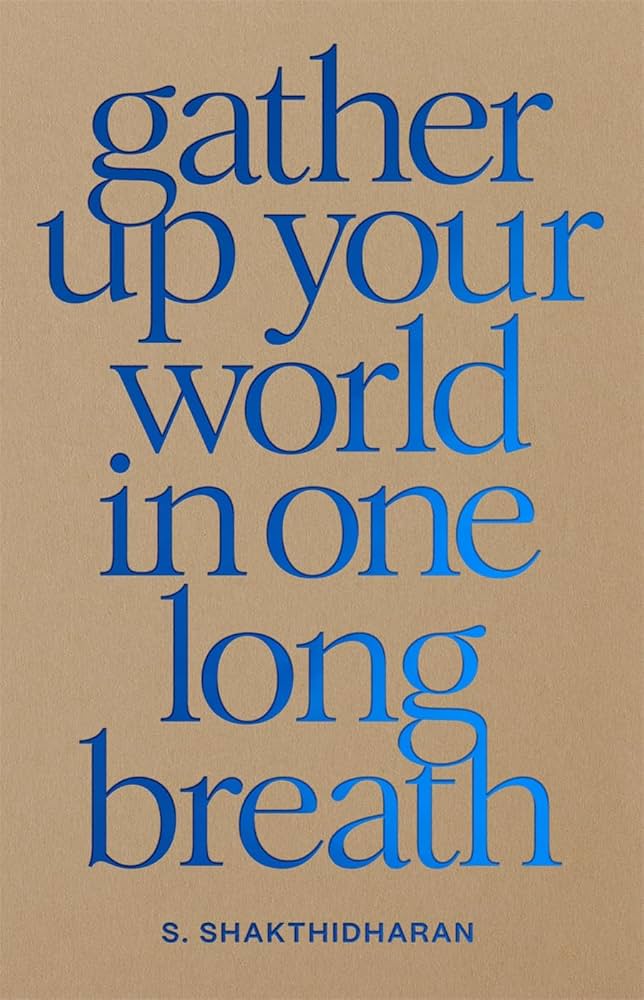
Some years ago, I contributed a foreword to A Sense of Viidu, an anthology of writing on Tamil diasporic re-creations of home (viidu) edited by Niro Kandasamy, Nirukshi Perera and Charisma Ratnam. The collection includes a brief recollection by S. Shakthidharan[1] titled “Bittersweet”. The piece describes the determination of the author’s grandmother to reassemble the dismantled components of her Colombo home in Sydney, following the family’s displacement after the Black July pogroms:
My grandmother could not bring the land with her. She could not bring the community to which she belonged … But no one can deny that she brought whatever else she could.
Her homeland that she adored had become a place where she no longer felt welcome. But her house, the actual physical components that made up her house, was hers. And damn the world if she wouldn’t bring those with her and re-manifest them somehow in this new land… It was, and still is, an act of defiance. Of pride. A bittersweet act, for in building us a home she was acknowledging where we were not going back to, even as she unleashed new possibilities for the future, built fresh hope into the very foundations … It was not an act of kindness. Or generosity. It was an act of willpower. Of steadfastly maintaining control, when all other choices had been taken from her. (Shakthidharan in Kandasamy et al. 2019: 156)
This brief memory of the ancestral family house transplanted from Colombo to Sydney is the kernel of Shakthidharan’s 2025 autobiography, Gather Up Your World in One Long Breath. His grandmother’s reconstituted house is the heart of the narrative: at once location, character and metaphor, it gathers into itself the fragmented elements of self and history.
In this sense the book takes its place alongside other postcolonial narratives centred on a house as core to identity—V.S. Naipaul’s A House for Mr Biswas comes to mind. An Australian predecessor is David Malouf’s classic memoir, 12 Edmonstone Street. While Gather Up Your World is more concerned with questions of diaspora and migration than Malouf’s essentially assimilationist writing (at least in this phase of his career), in both texts the zones of a distinctly Australian house correspond to its subject’s psychic dimensions: inside, outside, underneath.
In Gather Up Your World, the house is divided into separate spaces: the mother’s realm downstairs, her son (and later his family) upstairs. Inside the house, everyday household objects form bridges in time and space between the affluent old days in Colombo and the drab suburbia of Sydney’s outer west in the 1990s. Outside in the backyard, one of the key sites of White Australian family life, instead of a barbecue, the central feature is the hollowed-out shape of an unfinished pool, slowly turning into a swamp for weeds and unwanted objects.
Gather Up Your World takes the form of a succession of closely narrated exchanges with a cast of interlocutors all addressed in turn (at times confusingly) as “you”: grandmother, mother, father, partner, sons. Primary among these interlocutors is the house itself, after it has been re-membered piece by piece like a patient on an operating table:
Your broken spine is straightened, installed as a staircase towards the back. Your separated bones are attached anew. … Gloriously, your elephant head is detached … from the walls of the old house and connected to this new one—you still have a Tamil soul… [T]he ornate furniture of our plentiful past is carefully set on the cheap carpet of our ill-resourced present … It must be disorienting. You are coming into being again, but in a new way. (2025: 44)
Fully embodied, personified and endowed with a soul, the house is the book’s most compelling character. For the narrator, the house represents both gift and burden, cocoon and prison, and the arc of his life story is the movement from refusal to acceptance, and even embrace, of its complex legacies. Other relationships follow the same trajectory from experiences of pain, loss, rage and rejection to reconstitution, acceptance and contentment.
Yet the human relationships in the text, with the exception of the narrator’s fraught relationship with his mother, do not bear the same symbolic weight or emotional complexity. In the later sections of Gather Up Your World the narrative seems to meander, lacking the layered texture and psychic intensity that characterised its telling of an old woman’s act of willed re-membering and re-creation.
Reclaiming a past
Gather Up Your World follows the structure of conventional autobiographical narrative, from childhood experiences of adversity and isolation to success and happiness. At times these experiences run parallel to those of the wider community. A climactic point in the narrative is the triumph of Shakthidharan’s play Counting and Cracking in Sydney in 2019. The play centres the stories of his mother, the acclaimed dancer, Anandavalli. For the narrator, the success of Counting and Cracking is a turning point, not only for himself and his mother, but collectively, for the Lankan diasporic population of the city:
You came to the show many, many times: meeting the pain you had buried, just as hundreds of other Sri Lankans did alongside you, for those three weeks we took over the Sydney Town Hall. And in doing so, you found a deeper belonging to this new country. You found that you did not need to discard parts of yourself to fit in here …You found that you could bring your full self to this place, and help expand our idea of what this country could be. We realised over those three weeks that only a public belonging is real belonging. To belong in secret means your safety is still up for grabs, it can still be taken away. Only when we are vulnerable in the blinding light of society, can we become invincible again. This is what the play was for you, for all of us: a way to feel safe again. (120-121)
The shifting pronouns “you”, “we”, “our”, mark this as a collective cathartic moment for Lankans in the community, ten years after the end of the war. In Gather Up Your World the production of Counting and Cracking functions as an inflection point where the personal, private and familial converge with the collective and historical: a moment that reclaims the violence, shame and pain that constitute the unspeakable underside of refugee and migrant experience.
These are the most powerful and fully realised sections of the text. Later chapters are less compelling. The pages devoted to the narrator’s relationship with his father and the latter’s prolonged illness and death are narrated in lengthy (and at times gratuitous) detail. In the latter half of the text, the focus is almost exclusively on the personal. Surprisingly, the author’s pioneering work of establishing CuriousWorks, his highly successful arts organisation devoted to First Nations, migrant and refugee artists in Sydney’s outer west, is only mentioned in passing.
Between histories
Gather Up Your World is unusual among autobiographies in that none of its characters are named within the text, mostly addressed as “you”. At the same time, they are clearly identified as historical characters in the various accompanying materials (photographs, interviews, TV and newspaper profiles, the author’s prior plays and other published work). I find this narrative choice somewhat perplexing: while the absence of names may be seen to emphasise the commonality of refugee/migrant experiences of remaking, the specificity and individuality of this family is very much a focus of the autobiography. The narrator repeatedly emphasises the family’s social status, public achievements and contributions to Lankan culture and politics.
The author’s mother, a powerful, imperious, and frequently infuriating figure in the narrative, is at the same time the source of his creative energies. In 1970s Colombo, Anandavalli was a public figure who regularly featured in newspapers of the day as a child prodigy of bharatha natyam who had staged her arangetram at the age of nine and became an accomplished international performer while still in her early teens. After the family’s displacement she continued a public career as a dancer, teacher and actor in Australia. (I remember Anandavalli well from my schooldays, where no special occasion was complete without one of her spectacular performances. I don’t remember any personal exchanges between us, but inevitably in the small and enclosed world of our school, there were mutual friends and connections.)
The other essential figure in the autobiography is Shakthidharan’s great-grandfather, C. Suntharalingam, who appears both as the family’s most influential ancestor and a founding figure of independent Ceylon. A phrase from one of his published letters provided the title of Shakthidharan’s hit play, Counting and Cracking. In Gather Up Your World the great grandfather’s house, later to be recreated in Sydney by the narrator’s grandmother, is invoked as a kind of model of civic life before the war. The porch of the original Colombo house is envisioned as a meeting ground for an inclusive, multiethnic sociality that runs counter to the virulent ethnopolitics of the late 1970s and early 1980s:
My great grandfather sat on your front porch and held court with the whole nation. In you, the fates of families and the country were sealed. Your neighbours on one side were Muslim. On the final night of Ramadan, they would bring over a cauldron of biryani and a huge pot of vatilappam … Everyone gathered: not just Arif and Salawa, but also the Kandasamys, Goonetillekes, Van Landenbergs, the fruit sellers and the servants and the beggars, too. Immediately upon being born you were proof that everyone and everything on this island could one day be equal. (31)
The autobiography’s account of Colombo’s various ethnicities and classes gathered for a convivial Ramadan feast on the front porch of his great grandfather’s house is repeated almost word for word in a speech by the character Radha in Counting and Cracking. However, two new names, to which I will return, appear in this speech by the fictionalised character Radha in the play: “Kunthavi from down the street” and “Even Bala, the fruit seller from Jaffna” (121).
As a conjuration of a bygone multiethnic polity, the vision of the Ramadan feast on the porch can’t but beguile those of us who hold a stake in a Lanka that no longer exists—and perhaps never did. Yet the insertion of the historical figure of C. Sunthararalingam into this literary conjuration is one that complicates the picture.
The rise of Sinhala-Buddhist ultranationalism of the decades before the war did not overwrite, but rather seemed to reinvigorate, the minute differentiations of caste, religion, denomination, province, region and other forms of hyper-segmentation that were always characteristic of this small island.
Although all but forgotten in the conflagration of the war, one of these divides erupted in the 1968 conflict over the entry of “lower castes” into the Maviddapuram temple in Jaffna. A group of men who styled themselves the “Defenders of Saivism” decided to physically block the temple entrance. Foremost among the blockaders was C. Suntharalingam. The confrontation featured on all the front pages. At school we discussed in hushed tones (another granddaughter was a classmate) a news photograph that we made sense of in terms of the desegregation and civil rights struggles we were hearing about from the U.S. It showed Suntharalingam standing at the temple entry, one foot extended against the encroaching “lower castes”.
In light of this history, the insertions of “Kunthavi from down the street” and “Even Bala, the fruit seller from Jaffna” into the egalitarian company on the front porch in Radha’s speech takes on new shades of meaning.
In his later reflections on the temple entry blockade Suntharalingam cited the role of Sinhala politicians from the south stirring up “Minority Tamil” discontent in Jaffna as partly responsible for his opposition to the democratisation of temple entry (Wickramasinghe 2006: 275-6). At the same time, scholars have identified the rise of 1970s Tamil nationalism as an attempt to subsume or deflect internal class and caste divisions into the binarised opposition of Tamil vs Sinhala (Pfaffenberger 1990).
Gather Up Your World tells how, in his final years, disillusioned by the rise of Sinhala ethno-supremacism, the narrator’s great grandfather turned to a politics of separatism: “My great grandfather gave it a name: Tamil Eelam. The Tamil homeland… Amongst those listening were the boys. Their name became the Liberation Tigers of Tamil Eelam” (2025: 38).
How do we measure the distance from the Ramadan feast on the porch of the family house to the LTTE’s eviction of Muslims from the heartland of Jaffna? The term “Tamil Eelam” has now hardened into inevitability, but in the 1980s it was a point of contention between “left” and “right” strains of Tamil nationalism. R. Cheran writes that groups such as the Eelam People’s Revolutionary Liberation Front (EPRLF) and the Eelam Revolutionary Organisation of Students (EROS) were “against the use of the term Tamil Eelam because it excludes Muslims” and that “EROS further argued that the concept of Tamil Eelam … connotes Saivaite Hinduism and upper caste dominance” (Cheran 2009: xxxviii). What identities and histories are erased when the story of Tamil nationalism is reflected through a singular biographical focus?
To burden Gather Up Your World with such questions is perhaps to remove it too far from its intended readership and context. In Australia the book has received high praise from all quarters, and it was awarded the prestigious Multicultural NSW Award in May 2026. Placed in the category of “Multicultural Literature” the text perhaps responds to a different set of needs and concerns than the ones I raise here. It is rightly praised for its quality of writing, its unflinching rendering of familial relationships, its bridging of generations and places, and its writing of Tamil stories into the mainstream of Australian literary multiculturalism.
Hybrid edifices, after all, sit comfortably in the suburban landscape of Western Sydney, where migrants and refugees from many lands create new homes that incorporate and reimagine elements of the old: the stone lions of the Mediterranean south stand guard at many an entry portal. Precious shards and remnants from old shrines are built into new walls where they both preserve memories of old places and defy the assimilationist pressures of the new.
But in many of these backyards, too, may be traced the outlines of a hollowed-out pool or pond, the repository of unserviceable memories and pasts that will not bear rehabilitation. Among this cast away baggage, my questions sprout like weeds: Where does the prerogative of an autobiographer to reimagine his own and his family’s stories meet a responsibility to the historical record? How is this responsibility complicated or qualified when his primary readership is unfamiliar with that history?
Suvendrini Kanagasabai Perera is John Curtin Distinguished Professor Emerita at Curtin University. Among other books, she is the author of Survival Media: The Politics and Poetics of Mobility and the War in Sri Lanka (2016).
References
Cheran, R. (Ed.) (2009). Pathways of Dissent Tamil Nationalism in Sri Lanka. New Delhi: Sage.
Kandasamy, Niro, Nirukshi Perera, and Charisma Ratnam (Eds.). (2019). A Sense of Viidu: The (Re)Creation of Home by the Sri Lankan Tamil Diaspora in Australia. London: Palgrave Macmillan.
Pfaffenberger, Bryan. (1990). “The Political Construction of Defensive Nationalism: The 1968 Temple-Entry Crisis in Northern Sri Lanka”. Journal of Asian Studies 49 (1): 78-96.
Wickramasinghe, Nira. (2006). Sri Lanka in the Modern Age. Colombo: Vijitha Yapa.
Notes
[1] Throughout this review I follow the spelling Shakthidharan as it appears in the autobiography, rather than variant spellings that appear in the author’s work published elsewhere.
You May Also Like…
Mining Heavy Mineral Sands: Deepening Dependency, Not Enhancing Leverage
Amali Wedagedara
The decision to mine mineral sands along two-thirds of Sri Lanka’s coastline is fuelling anxiety and tension among...
The Art of Witness: Memory and Resistance in Sri Lanka
Yolanda Foster
When I first arrived in Colombo in the 1990s, I was in my twenties and had just begun a volunteer role with Peace...
‘Border villages’: Emergence, Salience, and implications for ‘Community’ in Sri Lanka
Viyanga Gunasekera
Despite Sri Lanka being an island and not sharing land borders with another country, the term ‘border villages’...