
தாயகம் (𝘵𝘩𝘢𝘺𝘢𝘬𝘢𝘮 / motherland). Amita Arudpragasam. Harvest Moon, 2026. 76 mins.
Thiruni Kelegama
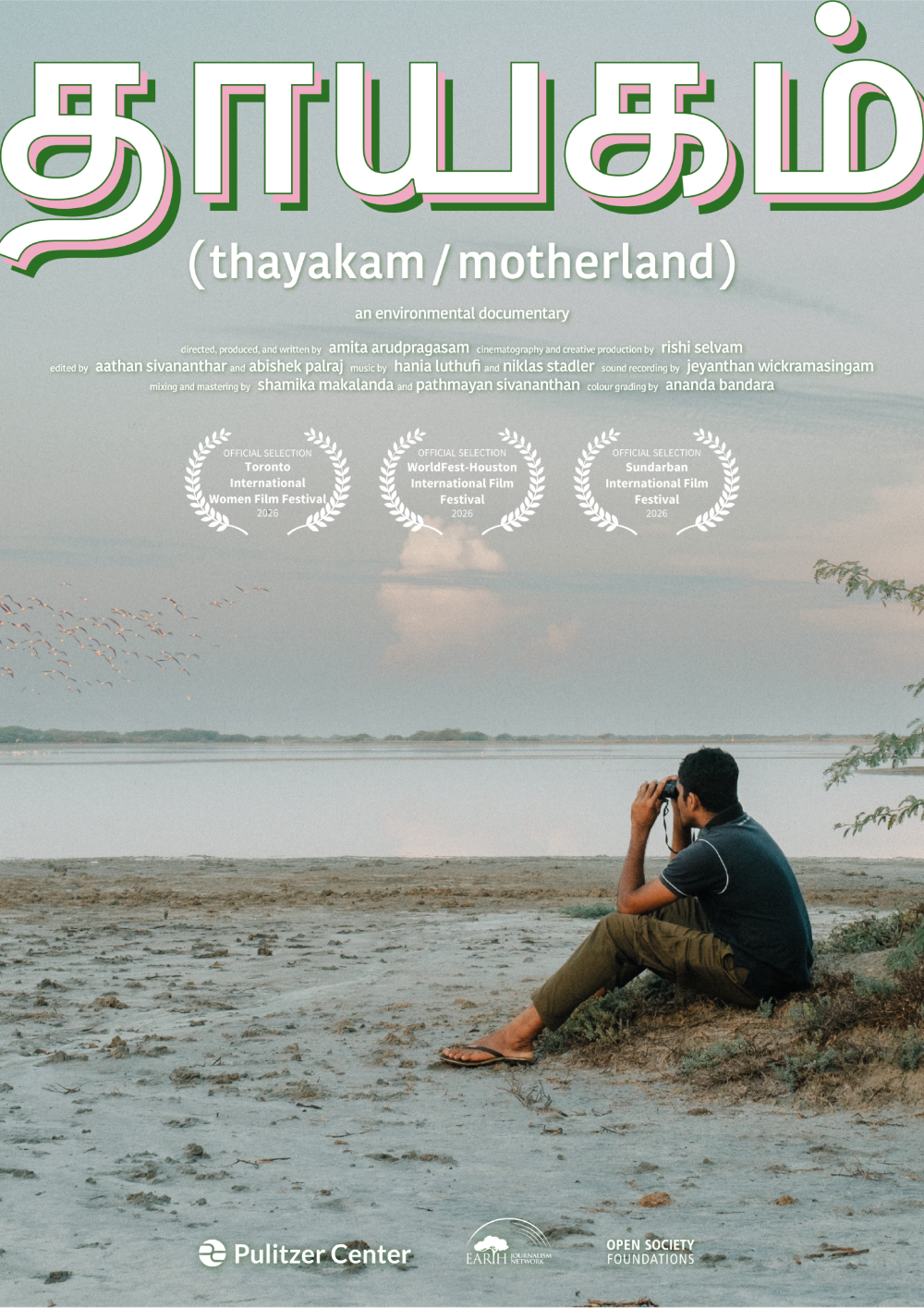
Thayakam begins with a date: 26 September 2025. The footage that follows is of a crowd, the police somewhere inside it, and voices over the images, subtitled from the Tamil. “It is not right to kick women.” “What justice is this?” And then the line that stays with you: “Oh my god, I think they broke his skull.” The film does not explain the scene. Nor does it tell us who is being beaten or for what. Soon after it withdraws from the violence altogether and begins elsewhere.
Where it begins is with beauty. Writer, director, and executive producer, Amita Arudpragasam, calls Thayakam (‘motherland’) a visual ethnography of “land, belonging and climate” in a region shaped by war. The film opens on a flock of pink flamingos lifting off the water in a single spectacular movement. Edison Marynathan—an environmentalist—takes us to them and tells us that ten years ago there were fifteen or twenty thousand of these birds. There are far fewer now, we learn: ‘maybe 500 or 800’.
The image of what Mannar holds is also an image of what it is losing. This is the register the film keeps. And in doing so, it refuses the images of melting glaciers and time-lapsed fires, and the grammar of an appeal to humanity as a single body under a single sky, in favour of one man walking a particular coastline, whilst asking what is happening to it and to the people who live there.
What the land holds
Early on, Edison gives the film its central claim: “The war ended … and the lands which we had during the fighting, and long before the fighting, no longer belong to us. In empty land, we cannot have the art, culture, and life we had before.” He names the second time his community has been emptied from ground it never left: once by three decades of civil war, and now by what has come after it. This emptiness is not a condition the land was found in. Instead, it is how a coast like Mannar’s becomes available in the first place.
Former National People’s Power (NPP) government Energy Minister (Engineer) Kumara Jayakody described Mannar as “a stale land” with no ecological value (Rodrigo 2025). State planning documents identified the area as an ideal site for wind power, citing consistent wind speeds and a sparse population (UDA 2019). Instead of describing what was actually there, what was produced was a description converting a peopled and cultivated littoral into a blank territory awaiting its productive use.
But the land Edison speaks of is not merely an economic surface. Arudpragasam establishes this very early on. When Edison takes us out on the boat, with his older brother Qunson, through the mangroves that thread the island to the sea, he says that the forest and the sea cannot be separated and that both are part of their lives. His family is from Vidattaltivu, which holds Sri Lanka’s second largest protected marine area. The previous government moved in May 2024 to strip it of its protected status, by extraordinary gazette, to promote shrimp farming. This is also where Edison used to fish and dive for sea cucumbers, and where he now grows red onions, manioc, and bananas. This land, however, is not simply for livelihood. For Edison, Qunson, and everyone we meet, it is memory, kinship, inheritance, and political aspiration that three decades of war and displacement have sharpened.
This brings us to the first insight the film makes available to the viewer: climate change does not arrive at an empty, vacated landscape. It arrives where there has already been a long accumulation of loss and compounds it rather than beginning afresh. And through bodies, rather than figures, we learn that this burden is not evenly shared.
An ornamental fisherman points to a starfish on Edison’s open palm and tells us that the catches are changing: the sea that was calm in January is rough now, and the corals have turned white and died as the water is too hot. Qunson’s daughter had her head shaved because the heat was raising pimples on her scalp. In the salterns, Indrajothi and Saroja speak of failing eyesight, cramps, and of not eating but drinking water constantly. The same heat that raises salt production is taking it back out of their bodies in the same motion. Cattle farmer, P. J. Julian, describes floods unlike anything from ten years ago, cattle dying of heatstroke, and the quiet arithmetic that next season 20 of the district’s 40 cattle farmers will likely sell their herds.
What each of them is describing is a single condition unevenly distributed and borne by people who contribute almost nothing to the carbon now unmaking their coast. More importantly, they have no say in the development that follows. The atmosphere may be a commons. Vulnerability is not. And to speak of the climate as a fate met together is to perform the very abstraction by which that unevenness is allowed to pass.
But if this very abstraction is what allows the coast to be written off, the film is also clear about what made it available in the first place. The most vivid statement comes from one of its witnesses. Nadarajah Sriskandarajah, a professor of agriculture from the Swedish University of Agricultural Sciences, firmly believes that “war was conserving nature”, and that “development is now going to damage [it]”. “This is what I am experiencing today in the post-war Northern Province”, he adds. Whilst the remark sounds counterintuitive, it is also the crux of the matter. The war which came to a brutal end in 2009, held the coast in suspension. And instead of recovery, peace has ushered in availability.
The wind turbines on the shore are the first sign of it. For Edison, building them “is like driving a nail into the heart”. There are 30 of them already. This is the Thambapavani Wind Farm—a 100-megawatt project built with a USD200 million loan from the Asian Development Bank—commissioned in 2020 as Sri Lanka’s flagship contribution to the global energy transition. This initiative was also the first of many yet to come. A larger second phase was awarded in 2024 to Adani Green Energy—the renewables arm of the Indian conglomerate owned by Gautam Adani. It would add another 250 megawatts along the same coast. When the newly elected NPP government moved to renegotiate the tariff, Adani withdrew, but the project continued under the Ceylon Electricity Board. The company changed; the plan did not.
“Mannar will be full of them”, declares Edison. Against this, the official story is the familiar one: “They say birds will come, that we can improve tourism and develop the country.”
The emptiness made
There is a name for what is happening on the Mannar coast. Scholars of land and power call it the frontier which is usually imagined as a wild edge that expansion pushes into. Frederick Jackson Turner (1893) defined it as an advancing line of settlement moving across supposedly empty land. But its real work is quieter and more deliberate. A frontier produces the emptiness it claims to find. Anna Tsing (2003, 2005) describes it as a zone where the appearance of emptiness is actively maintained against the presence of those who already live there. Tania Li (2014) shows how this is done through the classifications and statistical pictures that render a lived landscape unreadable as life. The result is that land which is fished, farmed, and known, gets reclassified as marginal or idle, because the categories through which the state reads it cannot register what is already there.
This is exactly how the post-colonial state remade the north and east of the island. The vision began with D. S. Senanayake, the first prime minister of Ceylon (1947–52), who set out to resettle the dry zone. Through vast irrigation and settlement schemes, the state moved Sinhalese families into regions long inhabited by Tamil and Muslim communities, consolidating an ethno-nationalist Sinhala-Buddhist nation (Kelegama 2026; Muggah 2008; Tennekoon 1988). The oldest and largest of these projects, the Mahaweli Development Programme, dammed the island’s longest river and carried that settlement deepest into the contested north and east. The war did not halt it. When the fighting ended in 2009, resettlement resumed under military escort (Kelegama 2024; 2026). Only in 2025, after more than half a century, was the Authority that ran it finally marked for closure—an end that is yet to arrive (Bandara 2025).
The Mannar wind farm is the same operation in a new form. But what has changed is the language. Whilst the Mahaweli Development Programme spoke of self-sufficiency and of becoming a rice-growing nation (Pfaffenberger 1990), the wind farm project speaks of the country, and of the planet—so that the project consuming the coast becomes the one that claims to save it. This shift in language is not incidental. As Jean-Baptiste Fressoz (2024) has argued, energy sources have never succeeded one another in the orderly sequence the transition story assumes; they accumulate.
The real picture, as Thayakam shows, is one in which the wind that has crossed the Mannar coast for centuries is reclassified as an underused asset for the ground to become available, and the people who lived on it are asked to bear, as their contribution to a global good, a loss they were never in a position to decline.
Their refusal is not absent from the film. Its clearest voice is the cuttlefish fisherman, S. A. Fernando. When asked by Edison whether he knows what the turbines do, he replies, “foreign countries use them—at least, that’s what people say.” Moments later, he arrives at the judgment the film has been circling: “No, we don’t want a windmill. Go to where they are built and ask people.” But he is not alone.
This same refusal has been spoken and written down for years without registering. Father Marcus, chairman of the Mannar Citizens’ Committee, is filmed behind a pile of letters he has been writing against the windmills and against the Adani company building them. For the Adani project alone, we learn, 8,000 palmyrah trees would be cut to put the wind turbines down. The letters are the record of refusals lodged through the proper channels, again and again.
For what became of those refusals, we have to turn to Melani Gunathilaka’s (2025) reporting on Konniyan Kudiyirippu, the village beneath the turbines. Before any construction started, two consultation meetings were held in the village, where residents plainly said that they did not want the project. They were told that a government project could not be stopped. Sometime later, a third party working alongside the local Grama Niladhari—the lowest tier of state administration—distributed food rations to families whose post-war poverty had made the rations necessary and collected signatures and national identity-card numbers as a record of the distribution.
Three years later residents discovered that those same signatures had been entered into the project record as evidence of their consent. What we learn is that the village was never overlooked. It was consulted, its objections were noted, and from the same encounter a record of consent was produced. And this is more troubling than oversight. It is the frontier in a new form, turning the refusal recorded in the film, into the consent that authorised the project.
Refusal in the open
Through all of this, Edison is our guide, walking the coast, naming what is being taken from it, and speaking to people. One question makes him pause. A youth activist, Selvaratnam Dilaxan, presses him on why a man who cares this much has not entered politics. Whether caring for this coast is already a political act is answered by the poet P. Ahilan, senior lecturer at the University of Jaffna, who gives the film its underlying sentence: “Land and climate, in Tamil literature, are interconnected, interdependent. One shapes the other.” By that account, to care for this coast is already a political act, and Edison has been in politics all along.
We watch him make it formal. He gets a haircut, asks whether he needs a shirt, and stands for a small Tamil party in the general elections held in November 2024—the first since the country’s bankruptcy in 2022. It is also the election in which a southern party swept the north for the first time. The ruling National People’s Power (NPP), led by President Anura Kumara Dissanayake, took seats the region had long withheld from Colombo. Edison loses.
With the electoral road closed, the film returns us to Mannar town in August 2025. A large crowd has gathered, and a march is under way. People walk with placards reading ‘Save Mannar Island’ and ‘Government don’t play with the lives of Mannar people’. Edison is among them, ‘engaging in politics in a different way’.
This protest is where Thayakam leaves us. We do, however, already know where it leads, because the film began there. Its closing card records that “the Sri Lankan state continues to intimidate journalists, protesters and minorities”; that “bottom trawling, sand mining and deforestation and windmill construction continue”; and that “the climate emergency remains a threat”.
The film’s final words tell us that “a northern environmental movement grows in strength” and we have heard Edison’s own: “Even if there are threats, the protests will continue”. The threats were not idle. The beating we heard in the opening seconds was the state’s answer to that movement, and we understand by now why the answer was a baton. The project had never, from the first survey, left room for a no.
Amitav Ghosh (2016) calls our failure to grasp the ecological crisis “a derangement”, or a blindness in the categories through which the modern world describes itself. Mannar is not a failure of sight. The state saw the coast clearly, and recorded it as empty. The voices from the first minutes never return and the film does not need to. Its achievement is to leave us where it began: at a gathering shadowed by the violence we were made to hear first, watching a people refuse, in the open, on ground they have never stopped knowing, and in a language the state, bent on its destruction, has heard all along and still has no way to receive.
Thiruni Kelegama (PhD., University of Zurich) is a lecturer in modern South Asian studies at the Oxford School of Global and Area Studies in the University of Oxford, and author of Central Margins: Sri Lanka’s Violent Frontier (Cambridge: Cambridge University Press, 2026).
Image credit: Helene Leuzinger
References
Bandara, Kelum. (2025). “A dozen state institutions earmarked for closure”. Daily Mirror (29 March): https://www.dailymirror.lk/print/main_image/A-dozen-state-institutions-earmarked-for-closure/346-30551
Fressoz, Jean-Baptiste. (2024). More and more and more: An all-consuming history of energy. London: Allen Lane.
Ghosh, Amitav. (2016). The Great Derangement: Climate Change and the Unthinkable. Chicago, IL: University of Chicago Press.
Gunathilaka, Melani. (2026). “Land, body and consent: Women and the climate of extraction in Mannar”. Groundviews (27 March): https://groundviews.org/2026/03/27/land-body-and-consent-women-and-the-climate-of-extraction-in-mannar/
Kelegama, Thiruni. (2024). “Militarized Development in Post-war Sri Lanka: Consolidating Control”. Development and Change, 55: 965-992
Kelegama, Thiruni. (2026). Central Margins: Sri Lanka’s Violent Frontier. Cambridge: Cambridge University Press.
Li, Tania Murray (2014). Land’s end: Capitalist relations on an indigenous frontier. Durham, NC: Duke University Press.
Muggah, Robert. (2008). Relocation failures in Sri Lanka: A short history of internal displacement and resettlement. London and New York: Zed Books.
Pfaffenberger, Bryan. (1990). “The harsh facts of hydraulics: technology and society in Sri Lanka’s colonization schemes”. Technology and Culture, 31 (3): 361-397.
Rodrigo, Malaka. (2025). “Respite for now for bird migration hotspot at heart of Sri Lanka’s wind power dispute”. Mongabay (20 August): https://news.mongabay.com/2025/08/respite-for-now-for-bird-migration-hotspot-at-heart-of-sri-lankas-wind-power-dispute/
Tennekoon, N. Serena. (1988). “Rituals of development: The accelerated Mahaweli Development Program of Sri Lanka”. American Ethnologist, 15 (2): 294–310.
Tsing, Anna Lowenhaupt. (2003). “Natural resources and capitalist frontiers”. Economic and Political Weekly, 38 (48): 5100–5106.
Tsing, Anna Lowenhaupt. (2005). Friction: An ethnography of global connection. Princeton, NJ: Princeton University Press.
Turner, Frederick Jackson. (1893). The significance of the frontier in American history. Indianapolis: Bobbs-Merril.
Urban Development Authority (UDA). (2019). Mannar Island Development Plan 2019–2030: Volume I. Battaramulla, Sri Lanka: Urban Development Authority. Available at https://www.uda.gov.lk/attachments/devplan_detailed/Development%20Plans%202019-2030/Mannar/English.pdf
You May Also Like…
Mining Heavy Mineral Sands: Deepening Dependency, Not Enhancing Leverage
Amali Wedagedara
The decision to mine mineral sands along two-thirds of Sri Lanka’s coastline is fuelling anxiety and tension among...
The Art of Witness: Memory and Resistance in Sri Lanka
Yolanda Foster
When I first arrived in Colombo in the 1990s, I was in my twenties and had just begun a volunteer role with Peace...
‘Border villages’: Emergence, Salience, and implications for ‘Community’ in Sri Lanka
Viyanga Gunasekera
Despite Sri Lanka being an island and not sharing land borders with another country, the term ‘border villages’...