
This Government, That Opposition, and the Work Still Ours
Lionel Bopage
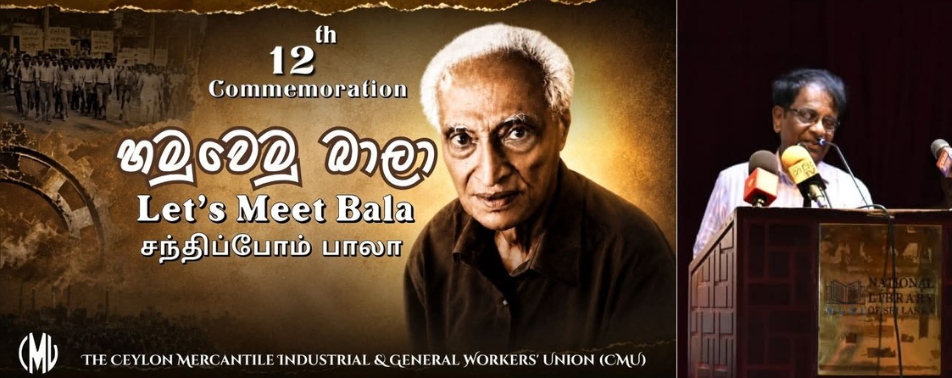
For sixty-six years, until his death in 2014, the legendary comrade Bala Tampoe led the Ceylon Mercantile Union (CMU)—and turned a clerks’ association into a militant, multi-ethnic vanguard of the working class.[1]
He commanded the Port Strike of 1963 that forced a government to lift a state of emergency.
When his own party joined the elite class it was formed to fight, he walked out of it.
He never confused an ally in Parliament with an ally on the shop floor.
So let us ask honestly what that uncompromising comrade would say about Sri Lanka today.
I believe he would call it a change of managers, not a change of the system.
He would look at Parliament—what he called the political complement to capitalist rule—and remind us that a red flag over a chamber does not change what the chamber is for.
Then he would turn to the household budget.
This government promised an alternative to austerity.
Fuel, gas and electricity prices are up and all those are defended as “cost-recovery pricing”. And comrade Bala would ask the only question that matters: recovering whose costs, and from whom?
He would read the promised labour code, the amendments to the Employees Provident Fund Act, the breakup of the Electricity Board—and recognise the pattern of a lifetime he experienced: commercialisation dressed as modernisation.
And he would also insist on independence of the CMU.
He told his own members: First, you are a human being.
Second, you are an employee.
Third, you are a CMU member.
A party card came nowhere on that list…
And then—of this I am most certain—he would raise his hand and stop us before the applause grew comfortable.
Because all those grievances are real.
However, not one of them is an argument for going back in history.
The people who governed before did not merely fail.
They built their fortunes out of that failure—airports without aircraft, ports without ships, commissions taken, and then the bill left to the working people of the country.
And when the arithmetic caught up with the people, the ruling elite changed the subject: towards language, religion, and nationality.
Ordinary people were handed an enemy in the next village, so they would not look too closely at the one in the city in Colombo 7.
Comrade Tampoe built a union that was Sinhala, Tamil, Muslim, and Burgher when it was dangerous to do so.
Because he understood what communalism is for.
It is the cheapest instrument ever devised for keeping wages of the working people low.
So, he would say: be as hard on this government as the facts require.
Yet do not let your disappointment curdle into nostalgia.
The Aragalaya did not return those elites to office.
It swept them out.
The pressure that matters rises from below, and it presses forward.
But forward must mean something more precise than a mood.
It means refusing the proposition that a country’s survival should depend on the approval of its creditors.
Every rupee of cost-recovery pricing is a decision about who absorbs the loss, and it can be decided differently.
Tax wealth and audit the debt in public.
Set a floor beneath living standards through which no review mission like the IMF may cut.
It means security in the four things no people can live without: food, energy, water, and communication.
A country that imports its rice, its fuel, its fertiliser and even its seed and salt does not possess an economy—it possesses an exposure.
An island that earns dollars from tea, garments, and the remittances of its daughters, only to buy those necessities back at the world price, is not a modern economy.
It is the plantation, re-lettered.
Bala would tell us the truth too about the depth of the problem.
Much of it decided not in Colombo—least of all by an agricultural order designed by empire, whose bill we still pay in eroded soil, in landslides, in poisoned wells, and in the kidney-disease hollowing out families across the dry zone.
That cannot be reversed by decree.
It must be rebuilt patiently, with consultation, communication, and participation of the people themselves.
Which is why political education is not a luxury for an organisation like the CMU.
That is its task.
A People who understand why the price rose are not easily persuaded that their neighbour’s language caused it.
So, if comrade Bala Tampoe stood here today, he would call this government neither our enemy nor our friend.
He would judge it as he judged every government he outlived: by the price of bread, the security of a pension, and a worker’s right to withdraw their labour without fear.
He would end where he always ended.
With us, the working people of the land and the world.
The answer to a government that disappoints will never be bringing back a government that robbed us.
And it is never to turn against the neighbour of a different race and religion that we were taught to fear.
It is organisation—patient, multi-ethnic, well informed, and of our own.
That was the argument of comrade Bala Tampoe’s life.
It remains unanswered.
And it is still ours to win!
Lionel Bopage is a retired engineer, former political prisoner and refugee, and longtime rights activist and analyst. He is a founder and was the first General Secretary of the Janatha Vimukthi Peramuna (JVP); and the second accused in the Criminal Justice Commission proceedings against the 1971 insurgents.
Image credit: The Ceylon Mercantile Industrial and General Workers’ Union (CMU)
Notes
[1] Editors’ Note: This is the slightly edited text of remarks marking the 12th death anniversary of Bala Tampoe, at a commemoration organised by the Ceylon Mercantile Industrial and General Workers Union (CMU) of which he was General Secretary (1948-2014), in the auditorium of the National Library in Colombo on 1 September 2026; with the original title: “If Comrade Bala Tampoe Were Here”.
You May Also Like…
The Art of Witness: Memory and Resistance in Sri Lanka
Yolanda Foster
When I first arrived in Colombo in the 1990s, I was in my twenties and had just begun a volunteer role with Peace...
‘Border villages’: Emergence, Salience, and implications for ‘Community’ in Sri Lanka
Viyanga Gunasekera
Despite Sri Lanka being an island and not sharing land borders with another country, the term ‘border villages’...

Image-Based Sexual Abuse, and Consent, in the Digital Age
Sely Liyanage
The rapid development of digital technologies has created new forms of content and new forms of harm. Some content is...