
Unfinished Conversations: The Life and Works of Intrepid Human Rights Lawyer Basil Fernando
Kishali Pinto-Jayawardena
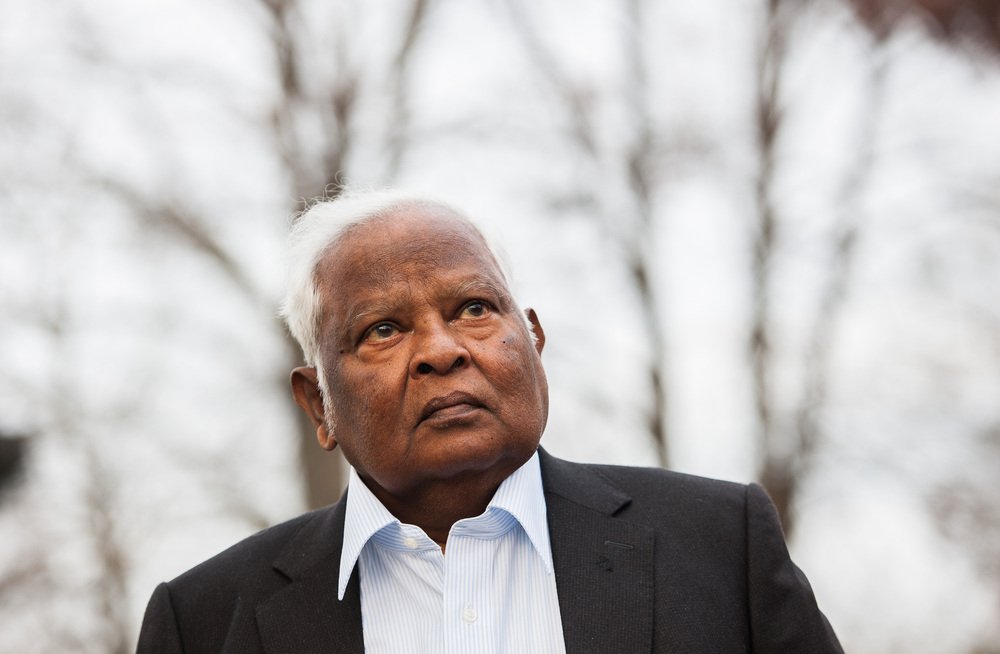
In a poem titled “The Faces” in a collection aptly called Pride and Pain in Difficult Times sent to me by his daughter soon after his passing, the late Basil Fernando had written a reflection which was more personal than his published poems that I was familiar with.
The words had moving force, a tinge of sadness perhaps even of regret. Its theme was of conversations with someone once close to him but with whom he had quarrelled.
Thus, the fragment of thought ran quietly; “In the sky, I sometimes see formations of Faces…now gone, once I saw the spectacle and cigarettes of the one I quarrelled with for years.” As the poem continued, “Eager to continue, I followed the cloud…but a harsh wind was pursuing him, shattering the image to pieces. Suspending the debate. Yet again.”
Reading this, I was reminded of Basil’s preoccupation—some would say obsession—with Sri Lanka, comprising in itself a series of uniquely ‘suspended debates’.
I say ‘suspended’ because at each time of radical change, perhaps through eagerly awaited changes at the ballot (2015), or at one time through a peoples’ revolution (2022), that promise of a better Sri Lanka always beckoned. Nevertheless, harsh realities embodying the pervasive power of Lord Acton’s grim reminder that, “absolute power corrupts absolutely” kept the realisation of that promise tantalisingly out of reach.
He and I differed in our many unfinished conversations on the country in which both of us were born. These dialogues between us were typically characterised by invigorating differences of opinion. That included a tendency on Basil’s part to hold the 1978 Constitution under the cynical imprimatur of JR Jayawardena, along with the birth of the Executive Presidency—which he referred to as the Gyges Ring, Plato’s magical ring of power—as the fount of all governance evils in Sri Lanka.
I was more inclined to go further back in time, marvelling at the grand irony of the autochthonous Constitution of 1972. Proudly taught to us in the classrooms of Colombo’s Faculty of Law as a homegrown constitutional product of Sri Lanka’s adorably feted leftist leaders, this document contained the seeds of democratic destruction and decay that would eventually cripple the nation and its people. The 1972 Constitution subordinated both the judiciary and the public service to political command. That too while demolishing Section 29(2) of the Independence Constitution which offered protection to the minorities and prohibited the privileging of one race or religious group over the other.
That said, as much as Basil had a sentimental touch—as I often joked with him—about Sri Lanka’s Left, he was a healthy realist, acknowledging not only the grievous sins of the country’s political leadership but also the politicisation of Colombo’s civil society itself, a taboo subject in most polite circles.
He had a profound distaste for, as he labelled it, “the elite gatekeepers of Sri Lanka’s professional human rights industry” and was never shy to voice this openly. More often than not, when collaborating on shared ventures, I developed splitting headaches when the conversations became too heated.
But the less than inspiring transformation of Sri Lankan activism from principled dissent to political fracture was too stark to ignore. This was particularly seen as the institution of the Supreme Court weakened to an unprecedented extent from 1999 onwards, with ugly controversies swirling around the Office of the Chief Justice. The response of public intellectuals in the legal field to these disturbing developments was nonchalant, divided more often than not by political considerations.
In fact, Basil first reached out to me during that time as I took on a case of a lay litigant and a teacher of English who had been sentenced to one year of rigorous imprisonment for “speaking loudly in court” and objecting to the Chief Justice hearing his case.
The patent injustice of this sentence aside, the victim had been tortured by prison guards after being thrown into jail in a manner reflective of Fyodor Dostoevsky’s chilling indictments of state totalitarianism. The only recourse—to even nominal justice in the sense of an acknowledgement of a perversion of justice by the apex court—was to petition the United Nations Human Rights Committee (UNHRC) under the Optional Protocol to the International Covenant on Civil and Political Rights.
Even so, discreet silence on this case was more the norm in the legal community as well as in wider civil society circles. This was not a grand constitutional question of law that would capture headlines. More to the point, the fear of being cited by a formidable Court for contempt was widespread. As one legal personality quipped at the time, “this is like hitting your head against a rock”.
Basil was one of the few who extended unwavering support to this case. Indeed, he and I both were never reluctant to hit our collective heads against rock—in which we took the greatest joy. That effort was successful in that the UNHRC opined that this sentencing of a litigant for contempt was manifestly unjust.
Perhaps it was this immediate identification with the helpless and the marginalised that was Basil’s most endearing trait. This was reflected in the poems that he penned that looked at the agony of human beings.
Many were the late-night conversations where he reflected on a subject that was wholly unfamiliar to me; caste injustices in a land where much of this lay subtly hidden under layers of prejudice rather than spoken of openly as elsewhere in the subcontinent.
Emotionally involved in all the cases that he took on, he saw the law as a creature intimately linked to human beings, not in the cold abstract. Many were the late-night calls that I got when he was especially disturbed by a violation of rights that was distinctly more horrendous than the routine or run-of-the-mill cases.
“How can human beings act in this cruel manner?”, was the question that he inevitably asked. To which question of course there was no valid answer. Inevitably there were instances when that empathy led him to be tricked by others, but I never saw any bitterness even though I often remonstrated with him to be more cautious.
In the international human rights arena, he was an important voice in telling the world that Sri Lanka’s impunity problem was not just limited to its treatment of minorities. Rather, this was a cancer deeply embedded in the entrails of the state itself, catching up both the majority and minorities to a greater or lesser measure as the case may be, despite an apparent privileging of the Sinhala Buddhist majority.
To dwell on the thousands of cases that he personally shepherded throughout the intricate maze of the country’s legal system and the many families of survivors that he looked after would be beyond my reach. He was generous with his time and personal resources to an extent that I seldom saw in another person. Suffice to say that those who looked to him as their only help in times of pain would surely remember how one man’s empathy made a singular difference to their lives.
It is difficult to come to terms with the death of men and women who are, in many respects, larger than life. The late Mr. Basil Fernando was one such man. He will be sorely missed.
Kishali Pinto-Jayawardena served on the board of directors of Hong Kong-based Asian Human Rights Commission (2010-2014), the Rule of Law Centre, Colombo, and sat on the editorial board of Article 2, a human rights journal published by the AHRC. Among several other publications, she co-authored The Other Lanka with Basil Fernando, a collection of legal and philosophical writings on what Sri Lanka might have been as an example of the observance of the rule of law in South Asia (2006).
Photo credit: Right Livelihood
You May Also Like…
A Funeral in Rathugala
Amalini De Sayrah
May 9th is an overcast day in Rathugala. Figures dressed in white zoom past on motorbikes or walk slowly through the...
Mining Heavy Mineral Sands: Deepening Dependency, Not Enhancing Leverage
Amali Wedagedara
The decision to mine mineral sands along two-thirds of Sri Lanka’s coastline is fuelling anxiety and tension among...
The Art of Witness: Memory and Resistance in Sri Lanka
Yolanda Foster
When I first arrived in Colombo in the 1990s, I was in my twenties and had just begun a volunteer role with Peace...