
Unfinished Business: The Rise of the Financial Bourgeoisie in Sri Lanka
Shiran Illanperuma
“While the economic changes from the time of Dutch rule began releasing the economy and society from the traditions of the past, there was an incompleteness about this process of change, making the development of capitalism, even to this day, very much of an ‘unfinished business’”
Kumari Jayawardena, Nobodies to Somebodies (2000: xxi)
Kumari Jayawardena’s Nobodies to Somebodies (2000) is a pioneering account of the rise of the colonial bourgeoisie in Sri Lanka, its sources of capital accumulation, its fields of investment, and its construction of social, cultural, and political power. Jayawardena’s study established the basic character of the Sri Lankan bourgeoisie that developed during the colonial period—merchant rather than industrial, comprador rather than independent, and oriented towards maximising social status and consumption patterns rather than improving the technical processes of production.
Jayawardena’s book, a fitting companion piece to her earlier Rise of the Labour Movement in Ceylon (1972), is an important resource for critical scholars because its rich archival research provides a kind of economic history of colonial Ceylon. More significantly, it links the economic with the political, demonstrating how patterns of investment and capital accumulation informed social and political processes, and vice versa. Through the analysis of the character of the Sri Lankan bourgeoisie, Jayawardena provides an outline of the contours and limitations of the Ceylonese independence movement itself—its relatively reformist and collaborationist approach towards imperialism, the tendency towards fractious and identity-based narratives to consolidate political legitimacy, and the inability to develop a coherent programme for economic sovereignty.
In the preface to Nobodies to Somebodies, Jayawardena pays special tribute to S.B.D. De Silva’s The Political Economy of Underdevelopment (1982) and Newton Gunasinghe’s Changing Socio-Economic Relations in the Kandyan Countryside (1990). Both works were applications of Marxism to the concrete conditions of Sri Lanka, tracing the development of relations of production during and after the colonial era. While De Silva’s was a globetrotting historical analysis centred on the colonial plantation economy, Gunasinghe’s was a grounded case study focusing on the Kandyan peasant economy. Taken together, the three books constitute a sequence of meditations on the mode of production in Sri Lanka, particularly how historically constituted relations of production in the country relate to questions of (under)development as well as politics and culture.
The timing of the publication of Nobodies to Somebodies is itself worthy of note, as it came out during a historic trough of the left movement in both political and intellectual terms. Globally, the collapse of the Soviet Union in 1991 and the heralding of the so-called ‘End of History’ by Francis Fukuyama seemed to have smashed any notion of an alternative to neoliberal capitalism in the political imagination. Domestically, the actions of the People’s Alliance government—which came to power in 1994 with broad support of the left—mirrored this unipolar moment by surrendering to a liberalisation programme that was in some ways more thorough than that conducted by its right-wing predecessors.
In the intellectual sphere, Jayawardena herself notes that since the shock of the anti-Tamil pogrom in 1983, “academic work was overdetermined by the ethnic issue”, while increasing feminist consciousness also spurred “a spate of writing on gender” (Jayawardena 2015: xiii). It should be added that the smashing of the trade union movement in the 1980 strike, three years before the 1983 pogrom, also played a role in the shift from class to identity-based scholarship—though the latter (identity) is fundamentally a manifestation of the former (class). Nobodies to Somebodies could therefore also be read as a return to certain upstream questions about class formation and capital accumulation in Sri Lanka at a time when such questions were considered passé.
To revisit Nobodies to Somebodies in 2026 is to revisit the text at a time when there has been a renewed academic interest in Marxist analysis since the 2008 financial crisis and the ensuing Long Depression. Corresponding with the relative decline of the unipolar power of the United States (US), which has led to more aggressive and militaristic outbursts as compensation, there has also been a renewed interest in imperialism. In the Global South, there is political polarisation leading to profound instability, manifesting in an ‘angry tide’ of far-right governments in Latin America, popular coups with an anti-imperialist orientation in West Africa, and a surge of youth-led protests in South Asia with varying political outcomes. In Sri Lanka, the 2022 Aragalaya (struggle) and the 2024 elections appeared to consolidate a general rejection of the two historic blocs of Sri Lankan parliamentary politics, the United National Party (UNP) and the Sri Lanka Freedom Party (SLFP)—this itself entails a popular perception that the distinctions between the two factions of the ruling class are no longer relevant. The present conjuncture therefore provides fertile ground to revisit the central theme and object of study of Jayawardena’s Nobodies to Somebodies.
The first part of this essay situates Nobodies to Somebodies within the lineages of Marxist class analysis in Sri Lanka, from the first generation of Marxist intellectuals, who were also political leaders and activists, to the second and third generations of intellectuals, who were more firmly incorporated into structures of academic knowledge production. The second part of this essay is an attempt to construct, in general terms, the evolution of the colonial bourgeoisie to the present day.
Tracing its evolution from the immediate post-independence era to the import-substitution era to liberalisation, financialisation, and the 2022 economic crisis, it is argued that the Sri Lankan bourgeoisie has transformed from ‘merchant rentier’ to ‘financial creditor’—thereby developing a stronger mutuality of interests with international finance capital. The third part then tests this account against the bourgeoisie’s own accounts—the fields of investment, shareholder registers, segment-level capital expenditure and bank balance sheets of the 50 largest companies listed on the Colombo Stock Exchange (CSE), drawn from their latest annual reports.
Lineages of class analysis
By making the bourgeoisie the object of study, Nobodies to Somebodies sits within a longer arc of Marxist analysis with high political stakes. Jayawardena notes that identifying the role of the bourgeoisie in Sri Lanka “influenced the programmes of the Left parties in the country and became the principal line of dissension among them” (Jayawardena 2015: xiii). The question of whether a peripheral country had already transitioned to capitalism, or whether that transition was “unfinished business”, had profound theoretical implications for whether the task of the Marxist left was to fight for bourgeois-democratic reforms or for socialism. By the 1950s, the Ceylon Communist Party had come to the following analysis of the Sri Lankan capitalist class:
The capitalists of this country are not the industrial capitalists of a modern society. Our capitalists are the side-growth of a colonial economy controlled by foreign imperialists. Till very recently their income came largely from the subsidiary services they rendered to the British owners of Ceylon’s wealth — in the plantations, in trade and commerce, transport and administration. Their loyalties were to the foreign masters from whom they earned their income, and their interests, also, lay in the continuation of foreign exploitation… They have engaged, not in production, but in the provision of services. Small men that they are, they lack skill, vision, experience, and prosper only so long as those on whom they depend also prosper. The soil in which they grow is the soil prepared by the alien exploiter for his own benefit. In any other soil they wither. Their interests lie in the continued prosperity of, that is, in the continued exploitation of our resources by, the foreign imperialists. (Wickramasinghe 1955: 5–6)
Already, important distinctions are being made. First is the difference between capital invested in industrial production and capital invested in circulation. Second is the difference between capital that arises endogenously out of competitive entrepreneurship and capital that arises out of demand generated by an external force. Third is the difference between capital that is nationalist—that seeks to develop and master the home market—and capital that is comprador—that serves as an intermediary or facilitator of the exploitation of the home market by foreign capital. Notably, the polemic is targeted specifically at “planters, bus owners, distillery owners and a few big traders” (Wickramasinghe 1955: 80). The text does not provide a scholarly historiography of the emergence of these segments of the bourgeoisie, nor does it set out to—serving instead as part analysis, part programme, and part polemic.
S.B. D. De Silva’s The Political Economy of Underdevelopment (1982) provided a more robust historical analysis of the plantation economy, with a focus on class formation in non-settler economies such as Sri Lanka. De Silva situated the problematique of underdevelopment in terms of the non-transition from merchant to industrial capital. He argued that the plantation economy lacked many of the features associated with industrial capital, including resident investors, free labour, and a tendency towards an increasing organic composition of capital through technical innovation and the mechanisation of the production process. De Silva concluded that the plantation system was in effect precapitalist, dominated by merchant capital that profited off circulation, and dependent on unfree labour (De Silva 1982: 448–449, 468–470). This outcome was by design, as the policies of the colonial state generally stifled the emergence of independent nodes of industrial accumulation that would compete with the imperial core. As such, “the colonial mode of production… was locked within the strait-jacket of merchant capital” and continued to depend on the aegis of metropolitan capitalism to survive (De Silva 1982: 480).
Jayawardena’s analysis focuses more on the arrack-renting bourgeoisie than on the plantation bourgeoisie. Properly speaking, Nobodies to Somebodies is not an account of the rise of the Ceylonese propertied classes in general. Although there are important accounts of various factions of traders and moneylenders, landowners, and small manufacturers, the bulk of Nobodies to Somebodies is chiefly concerned with the arrack-renting bourgeoisie that emerged as ancillary to the plantation economy.
In Jayawardena’s telling, the gradual dissolution of the mercantilist system through the Colebrooke-Cameron reforms and the rise of the colonial state opened avenues for accumulation among segments of the local population. First, the seizure of land and its conversion into plantations attracted a degree of foreign investment. Second, the abolition of rajakariya (compulsory labour service) and the import of bonded labour from South India created a market of wage workers—a kind of proto-proletariat. Third, the intervention of the state to invest in connective infrastructure supportive of the plantations created concentrated pockets of workers and boosted demand for ancillary services. Therefore, the growth of the plantations and the colonial state generated demand for additional goods and services, a portion of which local entrepreneurs were able to provide. While bigger plantation and trading capital stayed at arm’s length from direct political processes, Jayawardena shows that it was this middle layer of merchant capitalists, the arrack renters, who established themselves as the political elite within the system established by the Soulbury Commission. Yet the rentier origins of this class meant that they nonetheless identified with big plantation capital, attempted to ape its lifestyle and accoutrements, and, when the opportunity presented itself, invested in the same lines of economic activity.
From renter to creditor
From the traditional Communist movement to De Silva’s classical Marxism and Jayawardena’s account of the colonial bourgeoisie, the concepts of industrial and merchant capital (and the corresponding concepts of national and comprador bourgeoisie) were the main theoretical tools. However, Abhayavardhana (2008: 349) notes that “merchant capital and industrial capital are different aspects of capital in general”. Moreover, the tendency towards monopoly identified by Marx, and later elaborated by Hobson and Lenin, means that the current epoch is defined by the “domination of finance capital”. Therefore, in order to pick up from where Jayawardena left off, it is necessary to trace the evolution and financialisation of the colonial bourgeoisie.
In Jayawardena’s telling, the colonial bourgeoisie was a by-product of demand generated by foreign investment in the plantation economy and by state investment in supportive infrastructure for the former. Through an analysis of regional arrack rents, she demonstrates how the clustering of labour in plantations and mines, alongside the application of labour in the construction of roads and railways, and in the provision of goods (printing and carpentry) and services (ports and banking), generated the initial demand for arrack. The colonial bourgeoisie was therefore stimulated by colonial investment from both the demand and the supply side.
The post-independence economy did not attempt to stray from the path of the colonial plantation economy. Rather, the basic pillars of the plantation economy were to be kept untouched even in the face of the contradictions resulting from its existence. By the end of the US war on Korea, which had elevated demand for and prices of Sri Lankan rubber, the weakness of the plantation economy began to show. Diminishing returns in plantation agriculture intersected with deteriorating terms of trade, placing severe pressure on foreign currency reserves and exposing the dependency on food imports. In this context, the spatial fix offered by metropolitan capital, and accepted by domestic political elites, was the Gal Oya irrigation scheme. This project sought to deliver both food self-sufficiency and employment through state investment. Though self-financed by the state, the Gal Oya project did not entail a reconstitution of agrarian social relations. Rather, it avoided the question of land reform in the Wet Zone and the plantation sector by redirecting surplus labour to the Dry Zone.
This spatial fix was ultimately insufficient to deal with the contradictions of the plantation economy. From 1956 onwards, a form of import-substitution industrialisation (ISI) was grafted on to the existing social structure of the plantation economy. Gunasinghe (2004) notes that state-led ISI provided an expansion of state employment for young Sinhala graduates while providing quotas and protection that sustained a stratum of small and middle-level manufacturers. The ISI era facilitated a nominal growth of proto-industrial capital. However, since the commanding heights of the economy were led by the state—due to the scale of investment and the technical know-how required to operate heavy industry—most domestic capital remained at the level of circulation and low value-added manufacturing. As De Silva (1982: 506) notes, the import-substitution era failed to fully transform merchant capital into industrial capital. He attributes this to three factors: first, that manufacturing activities were mainly of non-essential goods; second, that domestic demand remained depressed due to the persistence of precapitalist agrarian relations; and third, that external pressures such as the debt crisis in the periphery and the intervention of institutions such as the International Monetary Fund (IMF) and the World Bank subverted the continuous implementation of ISI policies.
The shift towards open economic policies brought about a reversal in the character of the bourgeoisie. Foreign competition from import liberalisation destroyed many of the domestic manufactures that had developed due to ISI policies. Privatisation often led to asset stripping or the closure of industrial ventures that could not compete in the open economy. The availability of imports facilitated the rise of new lines of trading. Merchant capital which had begun to venture into manufactures in the ISI era switched back to the familiar pattern of import-export trade. Meanwhile, larger manufacturers that wished to compete in export markets had to depend on partnerships, financing, technology, and market access mediated by foreign multinationals. The Accelerated Mahaweli Project—like the Gal Oya project, and the road and rail construction under British rule before it—provided a boost of demand to various lines of domestic capital without fundamentally transforming the merchant character of capital.
These shifts were not experienced as abstractions; they were lived, and fought over, as identity. Gunasinghe, writing in the aftermath of the 1983 pogrom, showed that ISI had raised “a fair section of middle-level Sinhala entrepreneurs to the position of captains of industry”, and that liberalisation ruined many of them while enriching small and middle-level traders, among whom Tamil and Muslim businessmen were overrepresented (Gunasinghe 2004: 100, 102, 111). The grievance took ethnic rather than class form: Sinhala chauvinist ideology, he argued, “initially emerged from the ranks of the middle-level traders” (Gunasinghe 2004: 113). He had read 1956 in similar terms, as “the manipulation of the state apparatus by a commercial petty bourgeoisie to promote one of their factions to the rank of an industrial bourgeoisie” (Gunasinghe 1990: 65). New fractions of capital, in other words, have repeatedly sought political projects through identity.
The shift towards export-oriented industrialisation—especially in the apparel sector—was not due to innate comparative advantages or competitive domestic entrepreneurship. Sri Lanka was a beneficiary of the Multifibre Arrangement (1974 to 1994), which set out specific quotas for developing country textile exports. This ensured guaranteed demand and a stable source of income without having to compete on price. Therefore, the export-oriented firms that emerged during the open economy era were, at the root, fundamentally dependent on the trade policies of the metropolitan centres. The political ramifications of this have become especially clear in the aftermath of the Trump administration’s “Liberation Day” tariffs, to which the local apparel manufacturing lobby has responded by pressuring the government to agree to whatever terms were necessary to guarantee continued market access. This dependency on access to the Western market means that the export industrialists of the open economy are more than willing to push state policy into an accommodative arrangement with imperialism in order to safeguard their own position. As such, they exhibit comprador political orientations not so different from those of the plantation and arrack-renting bourgeoisie.
By the end of the civil war in 2009, record low interest rates in the aftermath of the global financial crisis spurred foreign borrowing. Debt-fuelled infrastructure investment provided a boon to domestic construction firms and services such as real estate, tourism and the IT sector. Again, the familiar pattern of foreign and state-led development generating demand for domestic merchant capital continued.
An often understudied aspect of the post-1978 liberalisation programme is financial liberalisation and the resulting financialisation of domestic merchant capital. First, interest rate liberalisation and the privatisation of development banks starved domestic manufacturers of affordable patient capital for production. Second, the privatisation programmes of the 1990s provided the initial listings for the Colombo Stock Exchange (CSE), and these deals were themselves advised and underwritten by commercial banks. Financials comprise close to 30% of the market capitalisation of the 50 largest listed companies (Table I).
Third, domestic banks and financial interests were emerging as major owners of the government’s foreign currency debt. Licensed commercial banks were buying International Sovereign Bonds (ISBs) in the secondary market well before the crisis. Regulations issued in July 2021 under the Foreign Exchange Act No. 12 of 2017 permitted local non-financial companies to invest in ISBs in the secondary market (as long as 50% of the foreign currency was borrowed from an entity or person not residing in Sri Lanka) (Central Bank of Sri Lanka 2021). By the time Sri Lanka had defaulted on its external debts, roughly 12% of outstanding ISBs were held by a ‘Local Consortium’ which included Commercial Bank of Ceylon, DFCC Bank, Hatton National Bank (HNB), National Development Bank (NDB), Nations Trust Bank (NTB), Pan Asia Banking Corporation, Seylan Bank, LOLC Finance and LOLC Financial Sector Holdings. These banks were represented by the foreign firms Newstate Partners and Baker McKenzie during the debt restructuring negotiations.
Fourth, the enactment of the Central Bank Act, a condition of the 17th IMF programme, means that the Central Bank can no longer finance the government deficit, and so the government must borrow from the private sector. The resulting elevation of interest rates means that lending to the government has become a more profitable line of business than long-term investment in fixed capital. This has become abundantly clear in the immediate aftermath of the IMF-led structural adjustment programme, which saw commercial bank profits soar even as real incomes declined and poverty multiplied.
The bourgeoisie in its own accounts
What does this bourgeoisie look like in its own accounts? The 50 largest companies listed on the CSE—together worth 5.8 trillion LKR, roughly a fifth of gross domestic product—offer a partial but revealing map (Table I). Only two are export manufacturers, and between them they account for 1.6% of market capitalisation and 0.2% of profit; the largest apparel exporters, the country’s principal industrial employers, remain unlisted family concerns. Six firms manufacture for the home market, most of them behind tariff walls or import bans—ceramic tiles, cables, glass—and collect 4% of profit. The rest is circulation, licence, and rent. Fourteen banks, finance companies, and insurers take 29% of market capitalisation and 46% of profit. Five excise-licensed alcohol and tobacco companies—the lineal descendants of the arrack renters, in the case of Distilleries and its parent Melstacorp quite literally—take 17% of market capitalisation and 14% of profit. Trade, retail and distribution, the diversified conglomerates in leisure, property and services, and the regulated or state-contracted sectors of telecoms, construction, power purchase and real estate account for a further 42% of market capitalisation.
The 50 tickers, moreover, reduce to far fewer owners: Melstacorp and Distilleries, Carson Cumberbatch and Bukit Darah, C T Holdings and Cargills, Vallibel One and Royal Ceramics and LB Finance, LOLC and LOLC Finance and Browns, and Hayleys and Haycarb are the same profits listed twice, and control rests with a handful of families. The pattern Jayawardena identified in the colonial period—capital following demand generated by the state and by foreign investment, invested in trade, services and licensed consumption rather than in the technical transformation of production—is intact. What has changed over the last decade is the weight of finance within it: between 2016 and 2025, the equity of the listed financial companies grew 3.3 times in dollar terms, and that of the non-financial companies 1.35 times.
These data have limits that should be stated plainly. Jayawardena worked from the records of the arrack rents in part because they were what the colonial archive kept. The annual reports of listed companies are today’s equivalent, and they are similarly partial. The apparel manufacturers, which directly sustain some 350,000 jobs (Singsit 2025), do not appear in them. Family control runs through private holding companies whose accounts are not published. The informal and small-firm economy leaves no annual report at all, and capital that leaves the country appears only when a listed group discloses it. The listed accounts therefore understate the export-manufacturing fraction of the bourgeoisie—Hayleys, the most industrial of the conglomerates, earns 53% of its revenue from exports (Hayleys PLC 2025)—and cannot speak for the class as a whole. What they reveal clearly is the mechanism: how the largest concentrations of domestic capital earn their surplus, and where they put it.
Table I: Fields of investment of the 50 largest companies listed on the Colombo Stock Exchange, by market capitalisation, 2026
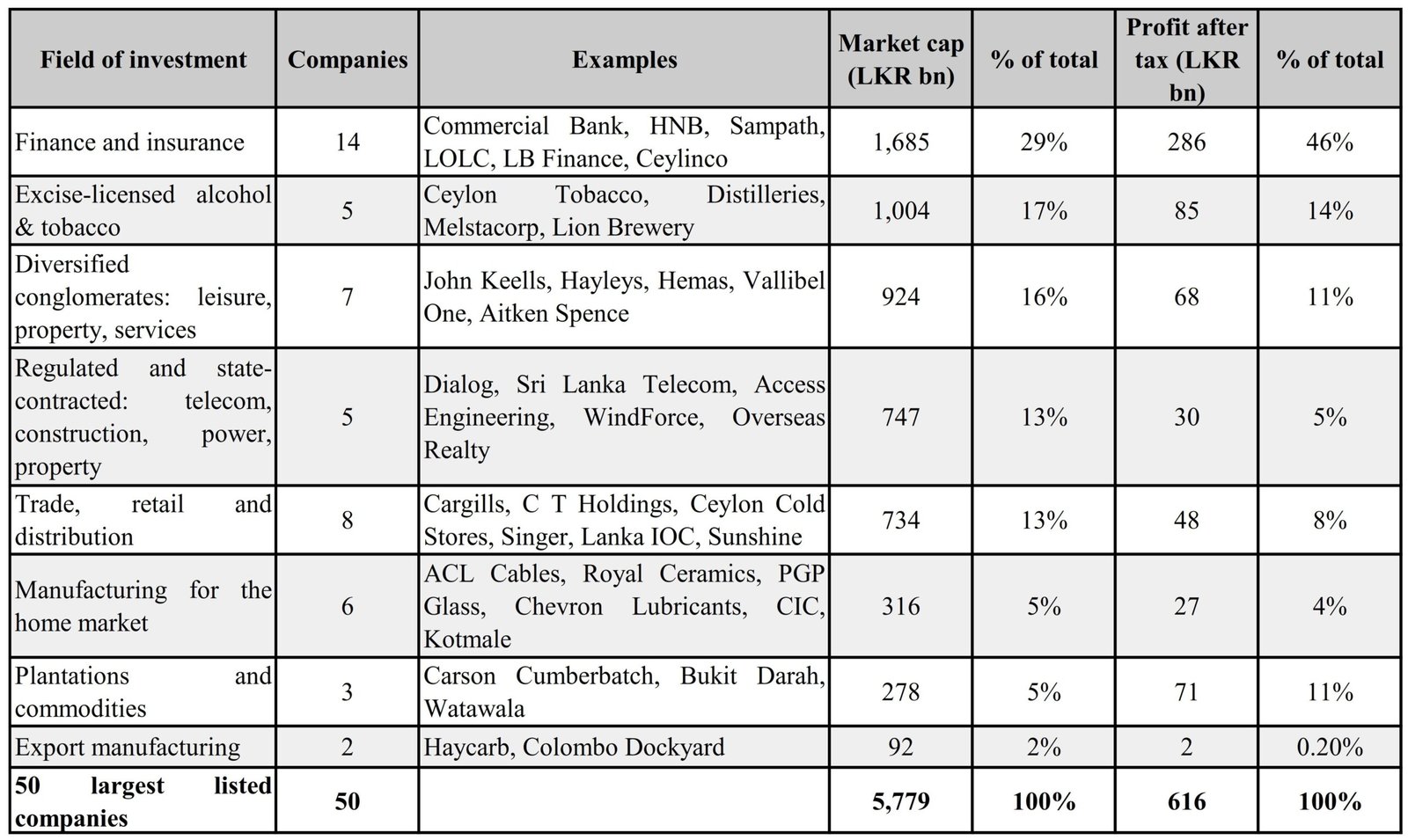
Notes: Companies ranked by market capitalisation in June 2026, voting and non-voting share classes collapsed. Classification by dominant activity is the author’s. Profit after tax is consolidated and includes non-controlling interests, for the latest published financial year (calendar 2024 or year to March 2025 in most cases); Browns Investments’ one-off gain of 53 billion LKR on group investment transactions is excluded. Stacked listings (parent and subsidiary both listed) mean the same profits appear more than once.
Source: Author’s compilation from the annual reports of the 50 companies and CSE market capitalisation data.
What the largest groups do with their surplus confirms the picture. Listed groups must disclose capital expenditure by business segment, and the segment notes of the eight largest diversified conglomerates—John Keells, Hayleys, Hemas, Melstacorp (which consolidates Aitken Spence), Carson Cumberbatch, Vallibel One, Sunshine and Richard Pieris—show where 106 billion LKR of new fixed investment went in the latest financial year (Table II).
Forty-two per cent went into hotels, a casino and property, almost entirely John Keells’ Cinnamon Life complex in Colombo, into which the group put 41 billion LKR in a single year while its leisure segment lost 7 billion LKR. The second largest destination, plantations and commodities, was mostly outside the country: 13 billion LKR of Carson Cumberbatch’s capital went into oil palm estates in Indonesia and Malaysia and edible-oil refining in Indonesia and India. Manufacturing for export received 7%, and almost all of that went to a single group, Hayleys, whose activated carbon, glove, and textile businesses make it the exception that proves the rule. Meanwhile, the segments that generate the surplus do not absorb it: finance and excise-licensed beverages earned 40% of the eight groups’ profit before tax and received under 7% of their capital expenditure. Distilleries earned 27.7 billion LKR before tax and spent 0.4 billion LKR on fixed assets; LB Finance earned two-thirds of Vallibel One’s profit. This is the mechanism by which the rent of the licence and the interest of the creditor are converted not into the technical transformation of production but into hotels, supermarkets, and offshore plantations—the same preference for status and consumption over production that Jayawardena found in the arrack renters, now at the scale of the conglomerate.
Table II: Capital expenditure and profit before tax by field of activity, eight diversified conglomerates, latest financial year
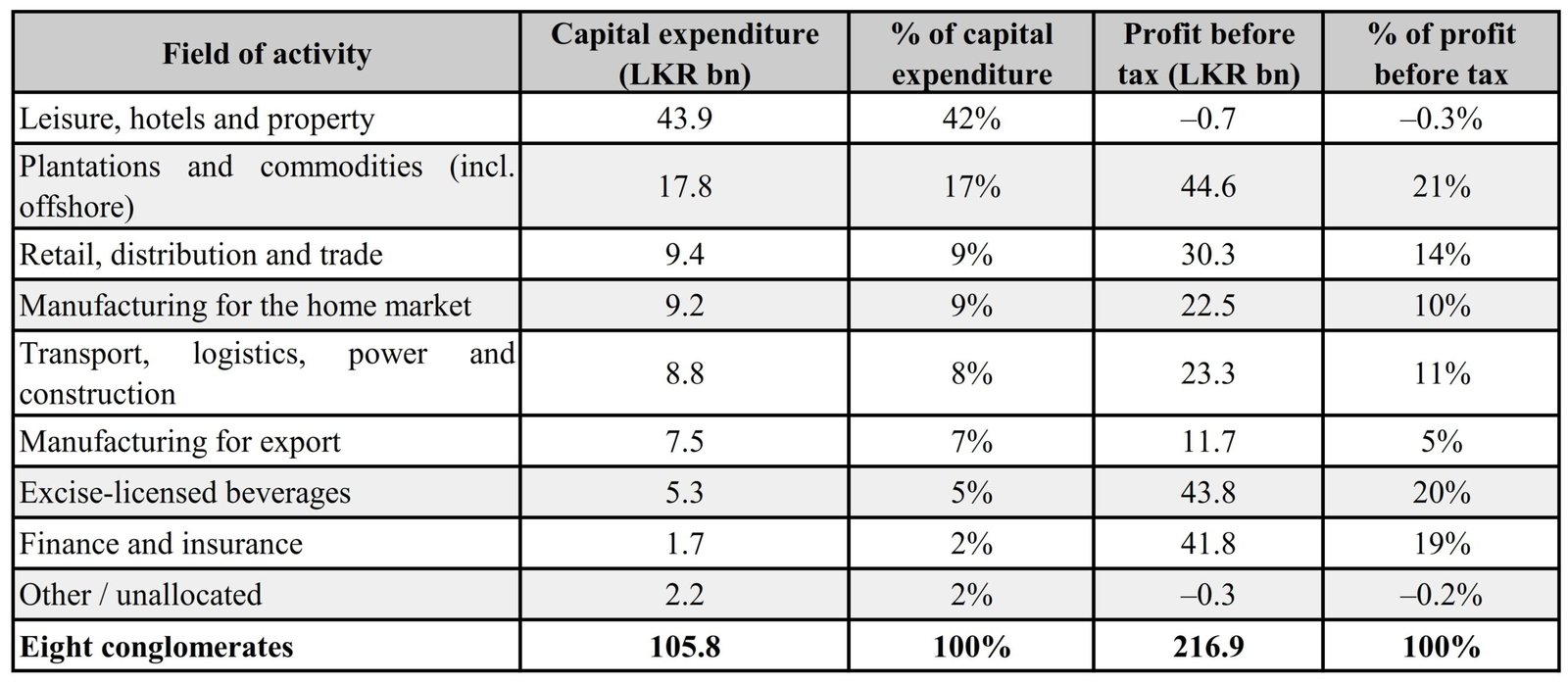
Notes: John Keells Holdings, Hayleys, Hemas Holdings, Melstacorp (consolidating Aitken Spence), Carson Cumberbatch, Vallibel One, Sunshine Holdings and Richard Pieris; financial years ending March 2025 (Vallibel One March 2026). Capital expenditure is the purchase of or additions to property, plant and equipment as disclosed in each group’s operating-segment note; assignment of segments to fields is the author’s. Profit before tax is by segment as reported. CIC Holdings, the remaining large conglomerate in the top 50, does not disclose segment capital expenditure. A single year of capital expenditure is lumpy: John Keells’ figure is the final stage of a multi-year construction of Cinnamon Life.
Source: Author’s compilation from the operating-segment notes in the annual reports of the eight groups.
The shareholder registers show who these groups are. Every listed company must publish its 20 largest shareholders, and those lists show that 16 family or founder blocs control 31 of the 50 largest companies and 53% of their market capitalisation (Table III). Five of them—Dhammika Perera’s Vallibel–Hayleys group, the Stassen group of the late Harry Jayawardena’s heirs and the Yaseen family, Ishara Nanayakkara’s LOLC, the Selvanathans’ Carson–Bukit Darah complex and the Pages’ C T Holdings–Cargills—control 19 companies and 40% of the market between them. Foreign capital holds a further 18%, almost all of it in licences rather than production: telecom (Axiata), tobacco (British American Tobacco), and fuel (Indian Oil). The state owns only Sri Lanka Telecom and People’s Leasing outright.
Two further features of the registers matter for the argument of this essay. First, no family controls a private bank, but every major family holds a strategic stake in one or more of them—the Harry Jayawardena family’s Stassen in HNB, DFCC and Commercial Bank; Dhammika Perera’s Vallibel in Sampath; Ishara Naanyakkara’s LOLC in HNB and Seylan; the Captain family’s John Keells in Nations Trust—and the banks hold each other: HNB owns 12.5% of DFCC, DFCC 9.7% of Commercial Bank, and NDB 8.7% of Seylan. The ‘widely held’ private banks that hold 3.4 trillion LKR of government paper are thus the joint property of the same families that dominate trade, licensed consumption and leisure—this is the institutional form in which the merchant rentier became the financial creditor.
Second, the largest passive shareholder in the class is the state’s own funds. The Employees’ Provident Fund (EPF), the compulsory savings of the country’s workers, appears among the 20 largest shareholders of 28 of the 50 companies and holds between 8 and 14% of Sampath, Seylan, NDB, Commercial Bank, Royal Ceramics, Central Finance and Vallibel One; with Sri Lanka Insurance the Bank of Ceylon and the National Savings Bank, it forms the largest bloc of shareholders in five of the seven private banks. The same fund is the largest domestic holder of Treasury bonds. The workers’ pension is at once the state’s principal creditor and used as a minority partner of the bourgeoisie.
Table III: Ownership blocs among the 50 largest listed companies, from the 20-largest-shareholder disclosures
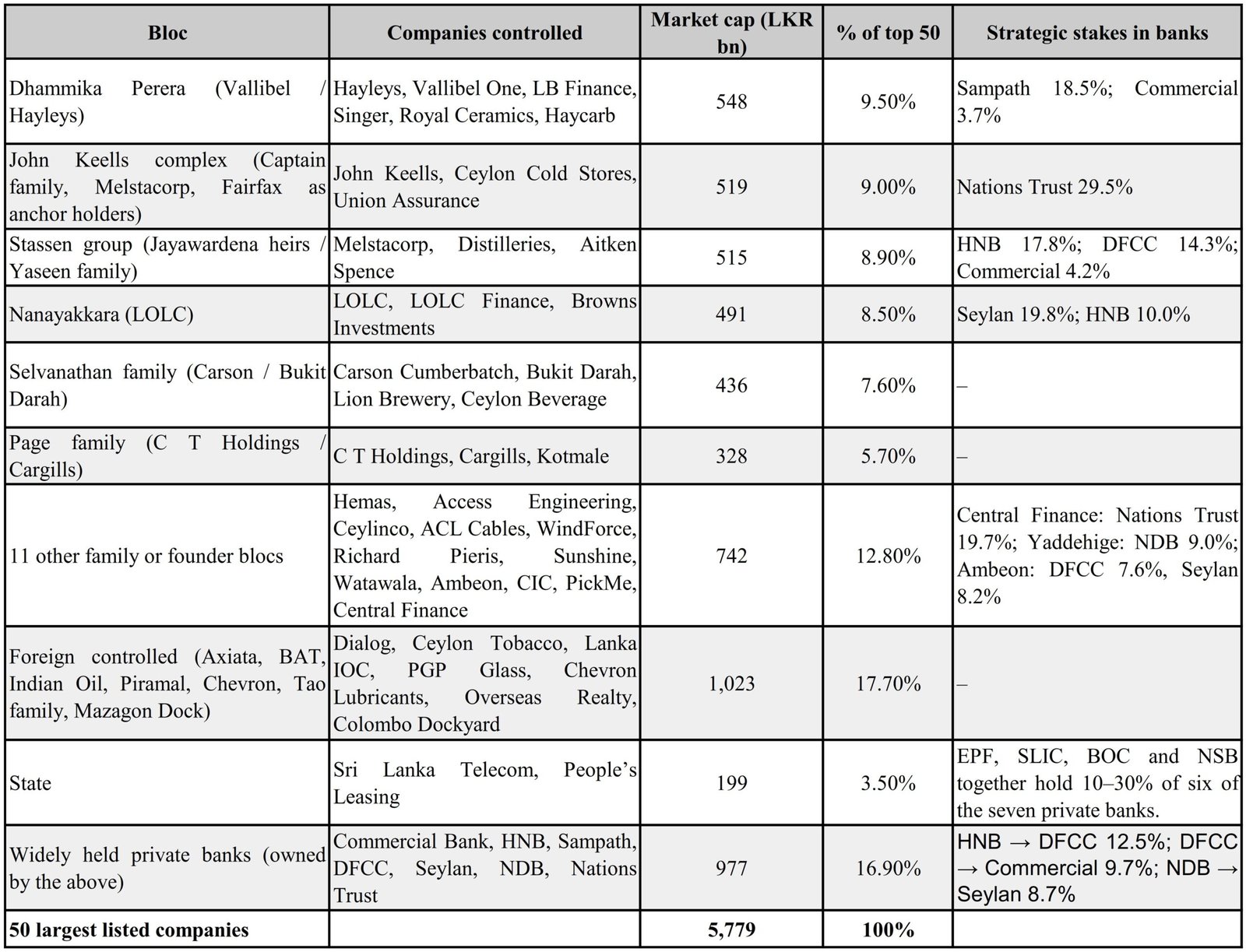
Notes: Voting shares, as disclosed under CSE Listing Rule 7.6 in each company’s latest annual report (December 2024 to March 2026). A bloc is assigned control where a family or founding group holds a majority or an unassailable plurality; the seven banks and the John Keells companies have no controlling holder. Holdings registered through bank nominee accounts are attributed to the beneficial holder named in the register. Attribution of private holding companies to families (for example, Milford Exports and Stassen Exports to the late Harry Jayawardena’s group; Skyworld, Camille and Sezeka to Sena Yaddehige) follows the directors’ interests disclosed in the same reports. Colombo Dockyard passed from Onomichi to Mazagon Dock, an Indian state enterprise, after its report date. BAT = British American Tobacco; SLIC = Sri Lanka Insurance Corporation; BOC = Bank of Ceylon; NSB = National Savings Bank.
Source: Author’s compilation from the shareholder information sections of the 50 annual reports.
The last step is what the banks themselves hold. By the end of 2024, the seven listed commercial banks—which include six of the nine members of the Local Consortium (see above)—held 3.4 trillion LKR of Government of Sri Lanka securities: a third of their total assets, and nearly two-thirds the size of their entire loan book (Table IV). Interest earned on government paper amounted to 411 billion LKR, 40% of their total interest income and more than twice their combined profit after tax. Every one of the seven earned a higher gross yield on lending to the state (12.4% on average) than on lending to customers (11.4%)—and government securities require no branches, no credit officers and no impairment provisions, and carry a zero risk weight against capital. The sovereign restructuring itself was booked as a gain: on exchanging their ISBs for new step-up and past-due-interest bonds, Hatton National Bank reversed 91.6 billion LKR of impairment provisions against a derecognition loss of 49.5 billion LKR, and Commercial Bank reversed 88.6 billion LKR against a loss of 45.1 billion LKR. The combined profits of the seven banks accordingly nearly doubled in 2024, from 89 billion LKR to 168 billion LKR, while the profits of the non-financial companies among the 50 largest listed firms grew by 4%.
Table IV: Government of Sri Lanka (GoSL) securities on the books of the seven listed commercial banks, consolidated, LKR billions
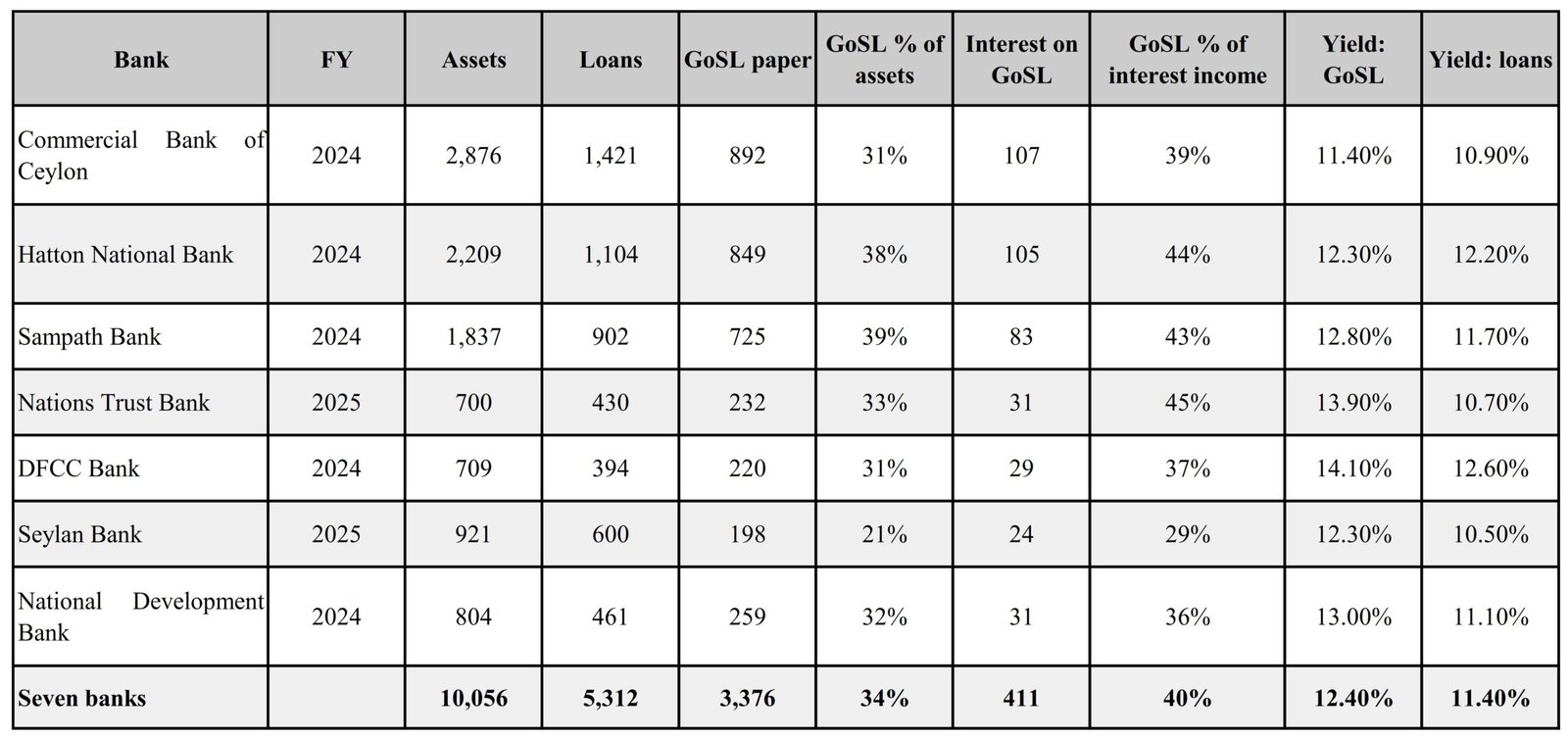
Notes: GoSL securities are Treasury bills, Treasury bonds and the restructured sovereign dollar bonds (step-up, past-due-interest and residual ISBs) across all accounting categories; foreign government paper and corporate debentures are excluded. Yields are gross interest income for the year divided by the average of opening and closing balances. FY = financial year; FY2024 is the calendar year; Nations Trust and Seylan are shown for FY2025, the latest published.
Source: Author’s compilation from the audited financial statements and notes in the annual reports of Commercial Bank of Ceylon PLC (2024), Hatton National Bank PLC (2024), Sampath Bank PLC (2024), Nations Trust Bank PLC (2025), DFCC Bank PLC (2024), Seylan Bank PLC (2025) and National Development Bank PLC (2024); interest on GoSL securities as disclosed in each bank’s Central Bank-mandated note “Net interest income from Sri Lanka Government Securities”.
The creditor’s gain has a material counterpart. Interest absorbed 50.4% of the government’s recurrent expenditure in 2024 (Central Bank of Sri Lanka 2025: 50). Much of the revenue to pay it was raised from consumption: after the 2024 revisions to value-added tax (VAT), the poorest 40% of households faced a rise of about 60% in their VAT payments (Jayawardena 2024). The domestic debt restructuring of 2023 “exclusively targeted the retirement provident funds of formal sector workers”, while the banking and financial sectors were excluded (Samarawickrama 2023); the listed banks then declared 46.21 billion LKR in dividends for 2024, their highest payout for any financial year (Daily Mirror 2025). The costs shed by the state and the banks did not disappear. Austerity shifts them from the paid economy onto unpaid care work, which falls disproportionately on women (Kadirgamar 2023). They also took spatial form: Colombo’s Urban Regeneration Programme evicted more than 50,000 working-class families to high-rise flats on the city’s periphery, while “[m]alls, five-star-hotels, and luxury apartments are being constructed over the demolished homes of the working-class poor” (Abeyasekera 2025). This is the landscape in which Cinnamon Life was built.
Conclusion
The bourgeoisie that emerged during the colonial and immediate post-colonial era was fundamentally merchant in character—living off demand generated by state and foreign investment that did not fundamentally change production relations. The import-substitution era failed to decisively transform this merchant capital into industrial capital. The open economy brought with it financial liberalisation. The result is that a section of the domestic bourgeoisie has graduated from merchant rentier to financial creditor. The accounts of the 50 largest listed companies show what this means in practice: a class whose fields of investment are trade, licensed consumption, leisure and finance rather than production; whose 16 families jointly own, through cross-holdings that no one of them controls, the banks that hold 3.4 trillion LKR of the public debt; and whose surplus, when it is reinvested at all, goes into casinos, supermarkets and offshore plantations. By controlling the levers of finance, this segment of the domestic bourgeoisie subordinates all smaller fractions of capital. Moreover, it has developed a mutuality of interests with international finance capital and the monetary order that is centred on the United States. Domestic and foreign finance capital now jointly dictate a policy of austerity that compresses wages and the space for state-led investment.
However, this combination creates its own contradictions, as without productive investment the asset base of the financial sector cannot grow without resorting to extreme speculation. While the colonial arrack-renting bourgeoisie accumulated “their original capital literally from the coppers of the poor” (Jayawardena 2015: 103), this new creditor bourgeoisie accumulates through the government’s interest payments—financed by indirect taxes on the poor and, through the Employees’ Provident Fund, by their compulsory savings.
Has history, then, ended with this transformation? The 2024 elections suggest an interregnum rather than an end. The vote removed the parties of the old bourgeoisie but not its creditor fraction, and the officials in charge of the Treasury and the Central Bank remained the same (Illanperuma 2024). Devaka Gunawardena, writing before the elections, described the moment in Gramsci’s terms as an organic crisis—the passing of masses from “a state of political passivity to a certain activity”—and warned of the enduring possibility of a “reactionary Caesarist” solution (Gunawardena 2023: 23). The political subject of 2024 was in large part a young petty bourgeoisie seeking to reproduce itself as a class outside the patronage networks of the old parties (Illanperuma 2024). No political project has yet been organised around the creditor relation itself—who holds the public debt, at what rate, and at whose expense. De Silva quoted David Rockefeller’s hope that multinational enterprise would “get on with the unfinished business of developing the world economy” (De Silva 1982: 488). The business of economic sovereignty remains, in the other sense, unfinished.
Shiran Illanperuma is a Sri Lankan journalist and political economist. He is a researcher at Tricontinental: Institute for Social Research and co-editor of Wenhua Zongheng: A Journal of Contemporary Chinese Thought. He is a visiting lecturer at the Bandaranaike Centre for International Studies. He has an MSc in Economic Policy from SOAS, University of London.
Photo credit: Nazly Ahmed (source: https://bit.ly/4zkLVB4)
References
Abeyasekera, Asha L. (2025). “Valuing People over Property: Social Housing for Colombo’s Working Classes”. Daily Mirror (5 May): https://www.dailymirror.lk/opinion/Valuing-People-over-Property-Social-Housing-for-Colombos-Working-Classes/172-308169
Abhayavardhana, Hector. (2008). “The Political Economy of Underdevelopment”. In Hector Abhayavardhana: Selected Writings. Colombo: Social Scientists’ Association.
Central Bank of Sri Lanka. (2021). “Local Companies Permitted to Invest in the International Sovereign Bonds in the Secondary Market”. Press release (8 July). Available at https://www.cbsl.gov.lk/sites/default/files/cbslweb_documents/press/pr/press_20210708_local_companies_permitted_to_invest_in_isb_secondary_market_e.pdf
Central Bank of Sri Lanka. (2025). Annual Economic Review 2024. Colombo: Central Bank of Sri Lanka.
Daily Mirror. (2025). “Banks Declare Highest Ever Dividend Haul for 2024”. (21 March): https://www.dailymirror.lk/print/business-news/Banks-declare-highest-ever-dividend-haul-for-2024/273-304846
De Silva, S.B.D. (1982). The Political Economy of Underdevelopment. London: Routledge & Kegan Paul.
Gunasinghe, Newton. (1990). Changing Socio-Economic Relations in the Kandyan Countryside. Colombo: Social Scientists’ Association.
Gunasinghe, Newton. (2004). “The Open Economy and Its Impact on Ethnic Relations in Sri Lanka”. In Deborah Winslow and Michael D. Woost (Eds.). Economy, Culture, and Civil War in Sri Lanka (99–114). Bloomington: Indiana University Press.
Gunawardena, Devaka. (2023). “2024 and Beyond: Electoral Politics and the Left”. Polity, 11 (2): 23-26. Available at https://polity.lk/wp-content/uploads/2024/06/2024-AND-BEYOND.pdf
Hayleys PLC. (2025). Annual Report 2024/25. Colombo: Hayleys PLC.
Illanperuma, Shiran. (2024). “Sri Lanka’s New Government, the Indo-Pacific Debt Trap, and the Struggle for the 21st Century”. Tricontinental Interventions: Conjunctural Analysis from Asia No. 4 (December). Tricontinental: Institute for Social Research. Available at https://thetricontinental.org/asia/ticaa4-sri-lanka-s-new-government-the-indo-pacific-debt-trap/
Jayawardena, Kumari. (2015). Nobodies to Somebodies. Colombo: Social Scientists’ Association and Sanjiva Books.
Jayawardena, Priyanka. (2024). “VAT Hike in Sri Lanka: Who Really Pays the Price?” Daily FT (15 October): https://www.ft.lk/Columnists/VAT-hike-in-Sri-Lanka-Who-really-pays-the-price/4-767971
Kadirgamar, Niyanthini. (2023). “How the Economic Crisis Hit ‘Home’ for Sri Lanka”. RESURJ (26 April). Available at https://resurj.org/reflection/how-the-economic-crisis-hit-home-for-sri-lanka/
Samarawickrama, Chaturanga Pradeep. (2023). “Reduce Returns on EPF: 77% Adults Say It Is Not Necessary”. Daily Mirror (5 December): https://www.dailymirror.lk/amp/breaking-news/Reduce-returns-on-EPF-77-adults-say-it-is-not-necessary/108-272622
Singsit, Jangoulun. (2025). “JAAF Backs Sri Lanka’s Push for Fairer Tariffs in US Trade Talks”. Just Style (30 April): https://www.just-style.com/news/jaaf-sri-lanka-fashion/
Wickramasinghe, S.A. (1955). The Way Ahead: An Economic Policy for Ceylon. Colombo: Lanka Press.
You May Also Like…

Unfinished Conversations: The Life and Works of Intrepid Human Rights Lawyer Basil Fernando
Kishali Pinto-Jayawardena
In a poem titled “The Faces” in a collection aptly called Pride and Pain in Difficult Times sent to me by his daughter...

A Funeral in Rathugala
Amalini De Sayrah
May 9th is an overcast day in Rathugala. Figures dressed in white zoom past on motorbikes or walk slowly through the...
Mining Heavy Mineral Sands: Deepening Dependency, Not Enhancing Leverage
Amali Wedagedara
The decision to mine mineral sands along two-thirds of Sri Lanka’s coastline is fuelling anxiety and tension among...