
The Art of Witness: Memory and Resistance in Sri Lanka
Yolanda Foster
When I first arrived in Colombo in the 1990s, I was in my twenties and had just begun a volunteer role with Peace Brigades International (PBI). Sri Lanka was still emerging from the repression of the Janatha Vimukthi Peramuna (JVP) insurrection and the government crackdowns that followed. Tens of thousands had disappeared. President Chandrika Bandaranaike Kumaratunga’s new government, elected in August 1994, promised to tackle the legacy of violence. She initially launched negotiations with the Liberation Tigers of Tamil Eelam (LTTE), proposing limited devolution and a ceasefire. But the peace process soon broke down. On 19 April 1995, the LTTE ended the truce with a major attack on Sri Lankan naval vessels in Trincomalee.
The return to war was not experienced, however, as a single, clearly demarcated moment. In Colombo, its presence accumulated. There were more soldiers on the roads, more checkpoints and identity checks. Some of my Tamil friends became reluctant to move around the city after dark. Their fear was not abstract. Under the Prevention of Terrorism Act (PTA), detention on suspicion could have frighteningly uncertain consequences, particularly in a country already marked by a history of enforced disappearance.
I encountered something of this arbitrariness when a Tamil friend, a student visiting from London, was arrested after smoking on the railway platform at Bentota. What began as an entirely ordinary moment ended with his detention “on suspicion” and remand in Kalutara prison. I made inquiries on his behalf with the British High Commission, without which I feared his detention might have continued much longer. The incident was shocking because of the speed with which everyday life could change. A railway platform could become a site of suspicion; an ordinary journey could end in detention. My friend did not want to talk publicly about the incident afterwards as he feared reprisals for relatives.
Yet everyday life continued around these experiences. People went to work, met friends and attended parties. Much remained unspoken. What strikes me now is this uneasy coexistence of normality and fear, and how differently it could be experienced depending on who you were.
The uneven field of visibility
Looking back from the present, it is important not to impose retrospective clarity on that period. Wars are not necessarily experienced with the coherence with which they are later written into history. In Sri Lanka, the war was also organised through limited visibility. What could be seen, reported, travelled to and publicly acknowledged was profoundly uneven. Censorship restricted reporting from the frontlines; checkpoints, military controls, road closures and restrictions on movement constrained access to and within the North and East; journalists and human rights defenders operated under threat. Organisations like the Committee to Protect Journalists documented both censorship and restrictions on independent access to conflict areas (Committee to Protect Journalists 1999). The security state therefore shaped not only territory, but perception: it helped determine what entered public view and what remained distant, fragmented or obscured.
For those of us living in Colombo, reliable information about conditions in conflict-affected areas could be remarkably tricky to obtain. Some of the accounts I came to trust most were not those available through mainstream news, but those carried back by UN and humanitarian workers returning from the field. Their descriptions of shortages, restrictions and the conditions under which civilians were living could be shocking precisely because they exposed the gulf between everyday life in Colombo and realities elsewhere in the country. My flatmate (who worked for UNDP) returned home once shaking with disbelief that children had to suffer in a hospital in Jaffna due to restrictions on the passage of oxygen tanks to the North. Jon Lee Anderson’s later reporting captures something of this fractured geography of perception, contrasting the apparent normality of Colombo and the South with radically different realities in conflict-affected areas, and later documenting the increasing exclusion of independent witnesses from the war zone (Anderson 2011). Looking back with the benefit of subsequent investigations, testimony, and archives, it is easy to forget how partial the field of knowledge was at the time.
But limited visibility was not only geographical. Different fields of visibility existed within Colombo itself. Living in Wellawatte, a predominantly Tamil neighbourhood, I witnessed night-time roundups of Tamils and security operations that seemed barely to register elsewhere in the city. People could be taken from their homes or stopped for questioning while, only a few neighbourhoods away, urban life continued with an appearance of normality. Contemporary human rights reporting confirms the scale of such operations: thousands of Tamils were arrested in Colombo during this period, including during cordon-and-search operations (Amnesty International 1998). The war did not have to be geographically distant to remain outside another person’s field of vision.
Limited visibility was therefore produced not only through concealment but through compartmentalisation and habituation. In Colombo, checkpoints, sandbags, armed soldiers and oil barrels gradually became part of the architecture of everyday life. The same checkpoint could mean inconvenience to one person and the possibility of detention to another. People travelled to work, met friends and attended parties while a devastating war unfolded elsewhere in the country—and sometimes, within other neighbourhoods of the same city. Some aspects of violence were kept beyond public view; others became so ordinary that they were no longer fully seen.
I use autoethnography in this essay partly to bring the reader inside this restricted field of vision. My own encounters were necessarily partial, conditioned by where I could travel, what could be reported, which spaces I could enter, and which artists and activists I was able to meet. Rather than attempting retrospectively to overcome those limitations, I want to make them visible. My emphasis on artists and cultural spaces in Colombo and the South reflects, in part, the political geography of the period and the limits of my own situated encounters.
This matters for understanding the artistic interventions that follow. Many of the artists I encountered worked precisely within this unstable terrain between visibility and invisibility. Their interventions did not simply represent violence. They disrupted familiar ways of looking, returned attention to what had become normalised, and brought experiences otherwise held at the margins of public consciousness into spaces where they demanded encounter.
One of my most visceral encounters with this climate of surveillance took place in 1998, late one night in my flat in Wellawatte. Close to midnight, there was a loud knock at the door. When I opened it, a Special Task Force (STF) officer entered uninvited, patrolling for “suspects”. His presence filled the room: eyes roaming over my desk, bookshelves, and finally my body. He demanded my passport, unimpressed by my residency visa, and began opening cupboards, lifting clothes, surveying the space with a swagger lent by the Kalashnikov slung across his chest.
In that moment I understood something of the absolute imbalance of power: his weapon against my silence. It was only when the mother of a Tamil family from downstairs came upstairs to stand beside me that I found my composure, insisting he had no right to trespass further. Finally, eyes glazed with boredom, he left. I could not leave so easily. For a brief moment, the security apparatus I had watched governing the movements of others had crossed the threshold into my own domestic space.
In my diary entry that night, I doodled a heavy boot. At the time it was simply a way of registering the unease of the encounter—an instinctive attempt to capture something that words alone struggled to hold. Only much later did I begin to understand such gestures as a form of witnessing: small acts of attention that resist the flattening of lived experience into official narratives. That night stayed with me as a touchstone. When I later encountered artists and activists, I recognised in their work a much more sustained struggle to make perceptible what censorship, distance, fear and habituation could render invisible.
The atmosphere of intrusion and surveillance was not confined to private homes. The same gaze of authority extended into the public sphere, shaping what could be spoken, written or shown. The security state did not only police bodies and territory; it also sought to regulate memory, imagination and the act of bearing witness.
Art as dissent: Cultural witnesses and thought leaders
In Sri Lanka, moments of national trauma have often called forth artists as witnesses when institutions failed. For some, art became a form of testimony—an insistence that memory would not be erased. One of the leading figures in this field is Jagath Weerasinghe. His personal experience of the 1983 pogrom shaped a vision of art as collective witness.
One evening at the Goethe-Institut in Colombo, Professor Weerasinghe spoke of how art can become a pilgrimage—how the viewer’s path through space becomes ritual; how installations can function as stations of witness. His installation Yantra Gala and the Round Pilgrimage, which I encountered at the Heritage Gallery in Colombo in 1997, invited visitors to walk across broken rice and soil toward canvases depicting grieving mothers and sites of atrocity. The viewer’s body became part of the pilgrimage, drawn into complicity and mourning. Weerasinghe described his practice as a visual interpretation of collective memory under siege (Weerasinghe 1997). In encountering these works, I began to understand more clearly what artists can do in moments of repression: they train us to see what power, distance and habituation allow us not to see.
As a lecturer at the Institute of Aesthetic Studies, later the University of the Visual and Performing Arts, Weerasinghe encouraged students to think critically about representation and ethics in art. His pedagogy emphasised questioning official narratives and using visual language to provoke reflection rather than as propaganda. This commitment to critical thinking helped seed a generation of artists who viewed art not as escape, but as civic engagement.
Alongside Weerasinghe, Chandragupta Thenuwara and his Barrelism series spoke directly to the normalisation of militarised space. Thenuwara returned from Moscow in 1992 to find Colombo dominated by checkpoints. His early inspiration had been the human figure, but confronted with checkpoint culture, he felt compelled to engage with it. His first conceptualisation of Barrelism began in 1997, when he transformed those ubiquitous instruments of militarisation into art. His exhibition at the Heritage Gallery included installations of painted oil barrels arranged in columns, juxtaposing devotion and militarisation.
Seen through the restricted field of vision I have described, Barrelism takes on a particular force. Thenuwara was not revealing something that had been hidden. He was making visible again something we had learned not to see. The barrel was already everywhere. But its meaning depended profoundly upon the body approaching it. For one Colombo resident it might signify inconvenience or another routine security check. For a Tamil travelling through the city, it could carry the possibility of questioning or detention.
By removing the barrel from the checkpoint and placing it inside the gallery, Thenuwara interrupted that habituation. Stripped of its apparently functional security context, the object became strange again. The viewer was asked to attend to the architecture through which everyday movement had been organised and to recognise the violence implicit in what had come to appear ordinary.
In this sense, Barrelism did more than represent militarisation. It intervened in the politics of perception itself. It asked the relatively protected art observer to look again at an object whose significance could be radically different for someone else moving through the same city. The invitation was deceptively simple. Thenuwara was inviting us to look again, to remember that what was now everyday was not normal (Foster 2002).
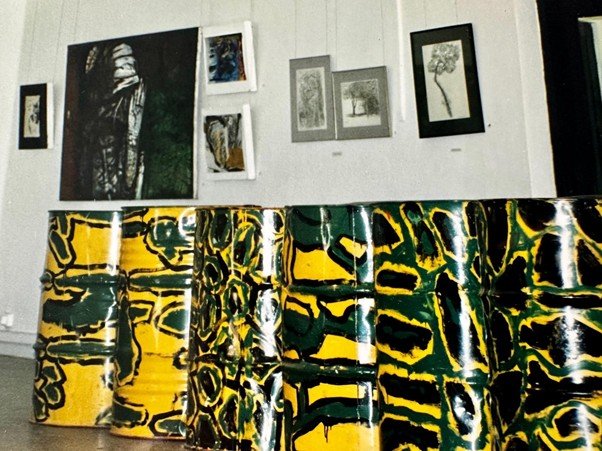
Barrelism, Heritage Gallery, Colombo, 1997
Photo credit: Yolanda Foster
In September 1998, Artists Against War took this disruption of habitual seeing out of the gallery and into the city. They held an informal exhibition outside Fort Railway Station, deliberately choosing a public space where those who did not visit galleries could encounter art face-to-face. I attended the Peace Flags exhibition. It was provocative to see banners with barrels unfurling against a Colombo sky that had started to darken with clouds of war. I was struck by one banner in which deep red seeping down the flag symbolised blood spilt. Underneath it was an abstract set of bones hinting at the death and destruction that mainstream media was reluctant to cover.
The quiet audacity of those flags claimed civic space back for citizens. But they did something else as well. They interrupted the distinction between the onlooker and the witness. Blood, bones and militarisation were inserted into an ordinary transit space, confronting commuters with experiences that could otherwise remain distant or abstract. The station itself became a site of witnessing.
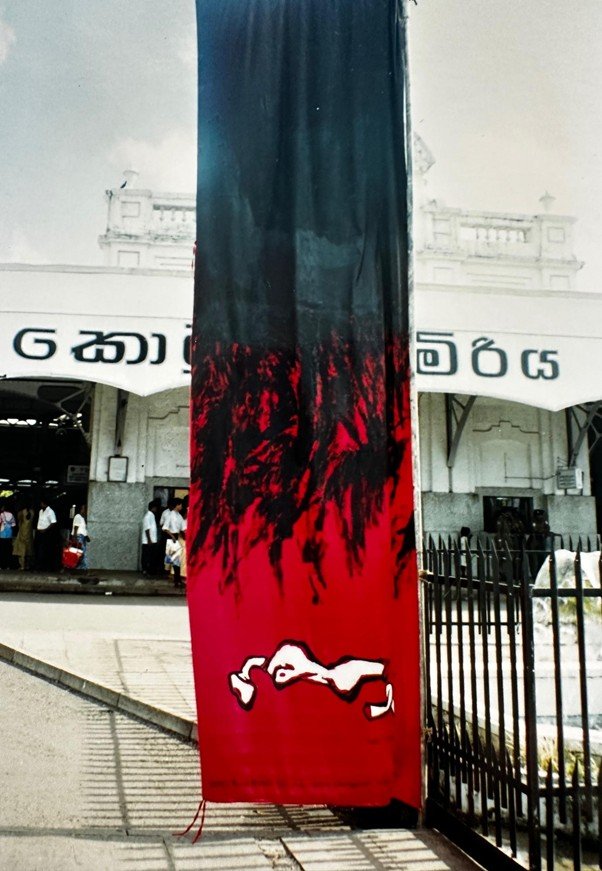
Peace Flags exhibition, Colombo Railway Station, 1998
Photo credit: Yolanda Foster
More than two decades later, the occupation of Galle Face during the Aragalaya would reclaim public space on a vastly larger scale. But already in the late 1990s, artists were experimenting with a proposition that runs through this essay: where power constrains visibility, the act of making people look again, can itself become a form of resistance.
Spaces of reflection and resistance
After my time with Peace Brigades International, I became a Visiting Fellow at the Social Scientists’ Association (SSA) in Colombo. Under the leadership of Kumari Jayawardena, SSA was a vibrant intellectual space where scholars, journalists and activists debated ethnicity, class, gender and human rights. Through conversations there, and through its journal Pravada, I began to think more critically about how nationalism narrows the field of what can be said and remembered, and how culture might create alternative spaces in which difficult truths could remain visible.
These questions became increasingly urgent as the war intensified. The LTTE’s bombing of the Temple of the Tooth in Kandy on 25 January 1998 provoked public outrage and contributed to a hardening security climate. On 5 June that year, the government imposed sweeping censorship on reporting relating to military and security operations. Access to conflict areas was also heavily constrained (Committee to Protect Journalists 1999). News of what was happening in the North therefore reached those of us in Colombo through a restricted informational landscape, while emergency regulations and intimidation encouraged journalists and others to censor themselves.
This produced a troubling double movement: violence elsewhere could be rendered distant or inaccessible, while the visible apparatus of the security state became increasingly normalised. The complex realities of the conflict could be compressed into nationalist narratives of “them” and “us”. It was within this narrowed field of public knowledge that art and culture acquired particular significance. They could operate as alternative archives of experience, making perceptible what official narratives obscured and preserving memories that might otherwise disappear from public view.
Art against nationalist narratives: The No Order Group
Emerging in the late 1990s, the No Order Group became an important experimental art network in Colombo, bringing together artists who rejected nationalist cultural narratives and explored hybrid identities shaped by war and globalisation. Artists associated with it included Jagath Weerasinghe, Kingsley Gunatilleke, Chandragupta Thenuwara, Anoli Perera, Muhammed Cader and G. R. Constantine. They sought to challenge claims around the purity of identity and create alternative histories through art. At a time of increasingly assertive nationalist narratives, these artists insisted on plural memory and hybridity (No Order Group Exhibition 1999).
Constantine’s work in the late 1990s reflected on the Temple of the Tooth bombing. His collages juxtaposed images of destroyed shrines, churches and skulls, insisting that the suffering of war could not be reduced to a single ethnic narrative. Using bricolage, he challenged the purity of majoritarian nationalism, presenting identity instead as dynamic and hybrid.
These artists transformed the gallery into a counter-archive, a space where memory resisted erasure. Kingsley Gunatilleke turned to official documents as raw material. By appropriating state publications—year planners, commemorative reports and pamphlets—he revealed how official forms of record-keeping could produce sanitised accounts of conflict. In his altered year planners, the neat calendars of officialdom are disrupted by images of war, displacement and loss. Here again, artistic practice interfered with the organisation of visibility, bringing what bureaucratic language could obscure back into view.
The No Order artists extended their work into collectives, teaching and alternative art spaces. Thenuwara played a leadership role at the Vibhavi Academy of Fine Arts (VAFA), an alternative arts centre outside state patronage, where younger artists were encouraged to think critically about society and representation. In 1999 he created Shrine of the Innocents, a funerary memorial of clay bricks inscribed with the names of disappeared children—an attempt to offer acknowledgement when families were still haunted by silence. Resistance here was not confined to an individual artwork. It also became pedagogical: a practice of creating spaces in which another generation could learn to question what it was being shown.
While the No Order Group forged a public critique in Colombo, the situation for artists in the North and East was profoundly different. Under heavy militarisation, surveillance and the constant threat of reprisal, open dissent could carry fatal consequences. The assassination of journalist Nimalarajan Mylvaganam in Jaffna in 2000 sent a chilling signal about the dangers facing those attempting to document events in the North (Committee to Protect Journalists 2001). Yet, even in this constrained environment, some artists refused silence. T. Shanaathanan, for example, chronicled the fragmented geographies of Jaffna through cartographic drawings and installations, mapping not only physical terrain but the psychic dislocations of displacement and war.
My reflective encounter with much of this work came later. That belatedness is itself relevant to the partial geography of this essay. The artistic history of the North and East was not absent; rather, it was produced and encountered within a profoundly different geography of access, militarisation and visibility from the Colombo art world in which many of my own encounters took place. I visited Batticaloa in 1998 and experienced the way fear can silence. Our NGO hosts warned me not to travel after dark, so we tried to return to our base at sunset. After cycling past the Lake Hotel, we experienced something terrifying. A man, who we think was a security official watching us earlier, tried to push my translator off her bike and sexually assault her. We managed to escape by using my umbrella in self-defence. It was a sobering and depressing experience of what could happen if you tried to investigate other landscapes. We wanted to report the incident to the police, but our NGO hosts said it would only cause more reprisals.
From surveillance to civic activism
The years after the 2002 ceasefire, and especially during the Rajapaksa era, were marked by renewed repression and censorship. Surveillance of journalists, artists and activists intensified; abductions and attacks contributed to a climate in which free expression carried serious risks (Amnesty International 2008).
Parallel to artistic interventions, civic movements mobilised around freedom of expression. The Free Media Movement, founded in 1991, gained renewed prominence as journalists faced attacks and censorship. Groups such as the Centre for Policy Alternatives and INFORM Human Rights Documentation Centre documented violations and defended democratic and civic space.
Creative resistance did not vanish under these conditions—it adapted. The Theertha Collective in Colombo sustained experimental workshops and exhibitions probing identity and memory. Other initiatives provided spaces in which experiences of displacement, loss and survival could be expressed without necessarily adopting the language of conventional political advocacy. Cultural infrastructure itself could become a means of preserving critical space.
From silence to defiance
Even as artists found ways to speak through installation, allegory and collective practice, the architecture of fear continued to shape everyday life. Checkpoints, surveillance and silences had become part of the country’s collective nervous system.
And yet, out of this climate of fear came extraordinary acts of defiance. Some were not framed as “art” at all but were, in essence, deeply aesthetic gestures—choreographies of endurance and ritual. Few embody this more powerfully than Sandya Ekneligoda, who transformed private grief into public acts of courage.
When I first saw Sandya Ekneligoda wrapped in white, carrying the portrait of her disappeared husband, I recognised something of the same quiet insistence I had witnessed years earlier in artists such as Weerasinghe and Thenuwara: a refusal to allow what had been pushed from public view simply to disappear.
Prageeth Ekneligoda was a political cartoonist and writer known for his satirical critiques of corruption and authoritarianism. On the evening of 24 January 2010, two days before the presidential election, he left his office in Homagama and never returned. His disappearance took place amid escalating threats to journalists and a climate of impunity for attacks on government critics (Amnesty International 2010).
At the time I was working with the South Asia team at Amnesty International in London, and I remember how his disappearance reverberated through the human rights community. As reports and appeals circulated, Sandya’s voice slowly began to emerge—not only as that of a victim, but as a determined public advocate for truth.
From 2010 onwards Sandya refused silence. She attended court hearings, spoke publicly and pursued legal cases despite years of intimidation and harassment. In 2014 she travelled with Amnesty International to Geneva, joining others in a campaign pledging that “we will speak without fear.” Seeing her there, calm and unwavering, I sensed how personal grief had been transformed into a form of civic courage. She has even turned ritual into dissent, publicly smashing coconuts against the Rajapaksa regime (Foster 2016).
Over the years Sandya became a familiar presence at the United Nations Human Rights Council in Geneva, quietly but persistently challenging the Sri Lankan government’s version of events. When I met her in March 2026, she reflected on how creativity had become one of the strengths of her campaign (Foster 2026a). Ritual, symbolism and persistence allowed her to communicate across political and cultural divides. Yet the courage this requires should not be romanticised. She told me about a menacing phone call she had received the previous year—a reminder that speaking out could still carry risks (Foster 2026b).
Sandya is not bulletproof. She is a woman who continues despite fear. And yet there are moments when her presence carries something almost mythic. Seeing her dressed in black and red, wearing the symbol of Kali’s trident, I feel a sense of hope. In that image she seems to draw on an older lineage—a tradition of women who refuse silence and demand truth in the face of power.
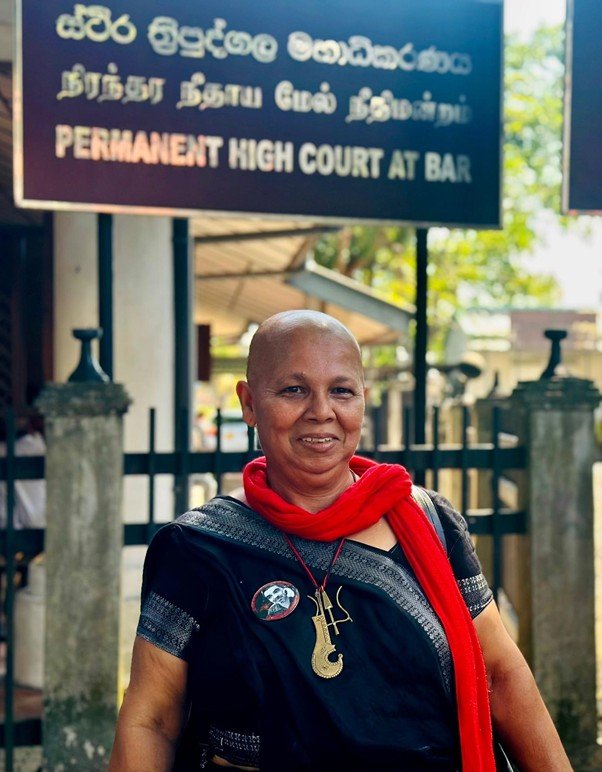
Sandya Ekneligoda invoking Kali outside the High Court, Colombo, November 2025
Photo credit: Yolanda Foster
If Barrelism made the apparatus of militarisation newly visible, Sandya’s repeated carrying of Prageeth’s portrait performs a related reversal. Disappearance removes a person from the field of the visible; Sandya repeatedly puts him back into it. Each journey to court, each vigil and each public appearance with his image insists that absence will not become erasure.
Her actions resonate with a wider global lineage of memory activism, recalling movements such as Argentina’s Mothers of the Plaza de Mayo. In Sri Lanka, the Women’s Action Network echoed this tradition when activists created saris inscribed with the names of the disappeared. Displayed in Geneva in 2015 outside the UN Human Rights Council, the garments unfurled like banners of grief and resilience across borders.
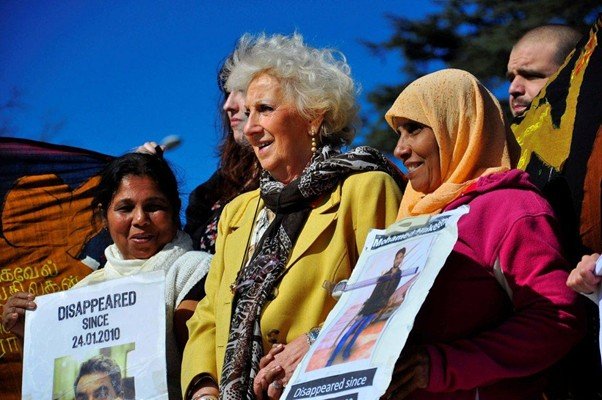
Sandya Ekneligoda alongside Estela de Carlotto at a protest in Geneva, 2015
Photo credit: Amnesty International Switzerland
Culture as infrastructure for dissent
Between the personal defiance of figures like Sandya Ekneligoda and the collective eruption of the Aragalaya lay years of quieter institution-building. Initiatives such as Theertha and VAFA created alternative pedagogies and exhibition venues, encouraging pluralism and experimentation. Artists associated with earlier movements mentored younger practitioners, embedding critical reflection into art education. Others joined civic coalitions such as Platform for Freedom, bringing artists, writers and activists together in defence of democratic space. In the war-affected North, T. Shanaathanan co-founded the Sri Lanka Archive of Contemporary Art, Architecture and Design in Jaffna in 2014, creating another form of counter-archive and sustaining a culture of record-keeping.
I had begun to encounter the usefulness of these creative spaces in my own human rights work. From 2008 to 2014 it was hard for Amnesty International (where I was working) to gain access to the country. We continued to report on human rights issues through testimonies collected remotely and by Sri Lankan colleagues. But we wanted to be able to connect with people in the country directly. So, in 2016–17, I was involved in Silenced Shadows, a publication that used poetry to explore experiences that could be difficult or dangerous to articulate through direct testimony. At a time when fear continued to shape what people felt able to say publicly, poetry offered another register of witness: indirect enough to create a measure of safety, yet capable of communicating the emotional and lived texture that formal human rights documentation could struggle to hold.
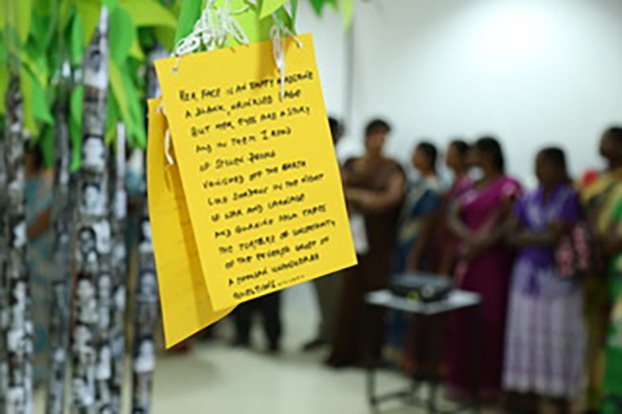
In January 2017, as Amnesty began to re-establish a larger public presence in Sri Lanka after years of difficult access, the global organisation worked with local artists and civil society colleagues to organise a day of Memory and Justice at the Sri Lanka Foundation Institute in Colombo. The premise was deliberately collective: enforced disappearance had touched communities across Sri Lanka, despite their very different histories and experiences of violence. Art offered a way of bringing some of those fragmented memories and communities of experience into the same public space. Poetry and visual installations sat alongside human rights discussion. At the launch families and citizens placed messages on a Memory Tree. The designer, Nalinda Seneviratne, incorporated photographs held in Amnesty International’s archives, originally sent to the organisation over the years by families of people who had disappeared.
At the time, I described the event as both an act of memory and a call for justice. Looking back, I understand more clearly why its aesthetic dimension mattered. The Memory Tree did not substitute for truth or accountability. But it transformed archival traces into a collective act of public remembrance: individual faces accumulated into the structure of a tree, making absence visible while its green leaves evoked persistence and renewal. This mattered because many citizens were still uneasy to discuss rights issues publicly. People missing from families and public life were returned, however briefly, to the field of the visible. When direct speech is constrained by fear, censorship or political risk, aesthetic forms can create another route through which experience enters public space.
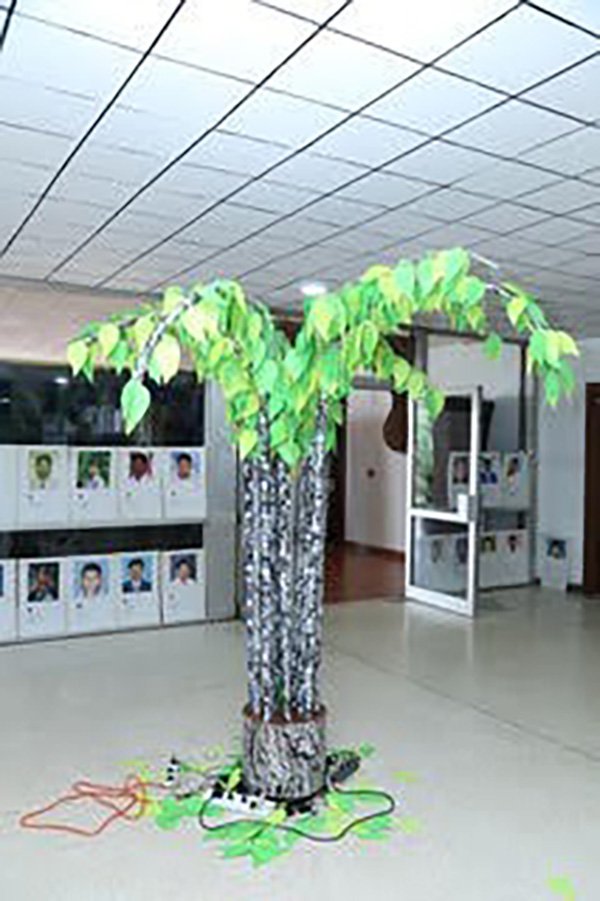
Memory Tree, Nalinda Seneviratne,
Memory and Justice, Sri Lanka Foundation Institute, Colombo, January 2017
Photo credit: Yolanda Foster
Alongside institutional work, public art continued to reshape civic space. During the constitutional crisis of 2018, after President Maithripala Sirisena attempted to dismiss Prime Minister Ranil Wickremesinghe and install Mahinda Rajapaksa in his place, artists responded to broader questions of democracy and accountability (International Crisis Group 2018).
In December 2018, Chandragupta Thenuwara helped curate an art exhibition on the theme of human rights in Colombo. A particularly striking intervention occurred when Ruwanthie de Chickera and David Cotterrell installed a six-foot ice sculpture of Sri Lanka’s Parliament at Independence Square. I stood among the small crowd watching as the tropical heat slowly dissolved its form. The edges blurred and water began to pool across the pavement. Passers-by stopped. Some lit candles; others took photographs.
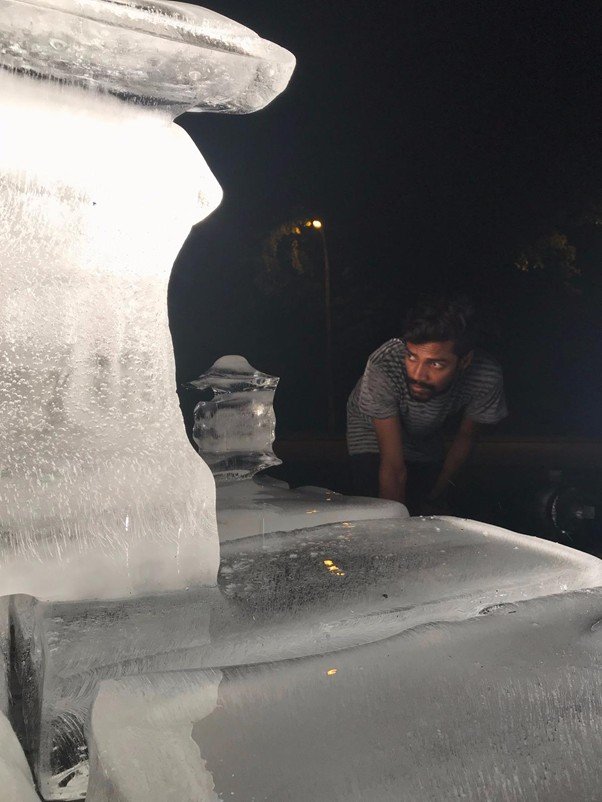
Just Ice: Sculpture of Parliament melting, 2018
Photo credit: David Cotterrell
What moved me was not only the symbolism of the melting Parliament but the quiet audacity of the gesture itself. After years in which dissent had often retreated into private spaces, it felt radical to see artists reclaiming the street—inviting passers-by to witness the fragility of democracy unfolding in real time. Here again art altered the conditions of looking. Parliament, normally imagined as an institution of solidity and authority, became fragile, temporary and literally dissolving before the citizen’s gaze.
From the violence of 1988–89 to the art of the Aragalaya
For artist Sujith Ratnayake, the origins of art as witness lie in the trauma of Sri Lanka’s second JVP insurrection of 1988–89. As he explained when I interviewed him in November 2025, the violence of that period—when thousands of young people, including university students, were killed or disappeared—profoundly shaped his understanding of what art could and should do in society. Art, for him, could not remain detached from public life; it had to respond to the wounds and contradictions of the society in which it emerged (Foster 2025).
One of his earliest acts of artistic intervention came in 1994, when he participated in an exhibition at the University of Ruhuna commemorating students who had been killed during the insurrection. Rather than a conventional gallery show, the artists created a memorial space on campus. Ratnayake later described this moment as politically and personally formative. Freed from commercial pressures, the exhibition revealed another possibility for artistic practice: art as remembrance and resistance rather than commodity (Foster 2025).
During this period he worked across multiple media—sculpture, painting and large-scale cut-out forms—exploring how visual art could function as a public language of dissent. Ratnayake recalled initiatives such as Wake Up My Motherland, which opened space for experimental and politically engaged work outside the conventional gallery system (Foster 2025).
Nearly three decades later, that same impulse resurfaced during Sri Lanka’s Aragalaya. When economic collapse and public anger brought thousands of people onto the streets in 2022, Ratnayake found himself drawn into the extraordinary atmosphere of solidarity at Galle Face Green. What struck him most was the diversity of those who arrived: people from different ethnic, social and generational backgrounds united by a shared sense that something fundamental in the country had to change. As he put it, “People were originally on the road for economic reasons, but they came to realise it was a political crisis” (Foster 2025).
Recognising that protesters were spending long hours at the site, Ratnayake began bringing canvases, easels and art materials to the encampment. Gradually he established a small open-air studio and gallery, inviting visitors—including children—to participate in drawing, painting and collaborative art-making. The protest site became not only a political forum but a creative commons where art functioned as civic participation.
When pro-government mobs later attacked the protest site, Ratnayake’s makeshift studio was set on fire. He recalled how he wept as the space and materials he had assembled were consumed by fire. Yet the attack also revealed the symbolic power art had acquired within the movement. The studio had become more than a place to paint; it was somewhere citizens could gather, imagine and express a shared vision of democratic change (Foster 2025).
GotaGoGama itself became an experimental civic space. Hand-painted placards and stencilled slogans filled the site. Sinhala, Tamil and English intertwined on walls and banners. Street theatre mocked political leaders; musicians and poets staged open-air performances; graphic artists circulated digital posters carrying the spirit of the protest beyond Colombo.
Art did not merely decorate the movement. It helped sustain it, providing shared symbols, humour and emotional resonance during long days and nights of occupation. Across decades, artistic resistance in Sri Lanka had moved between witnessing, interruption, pedagogy and civic participation.
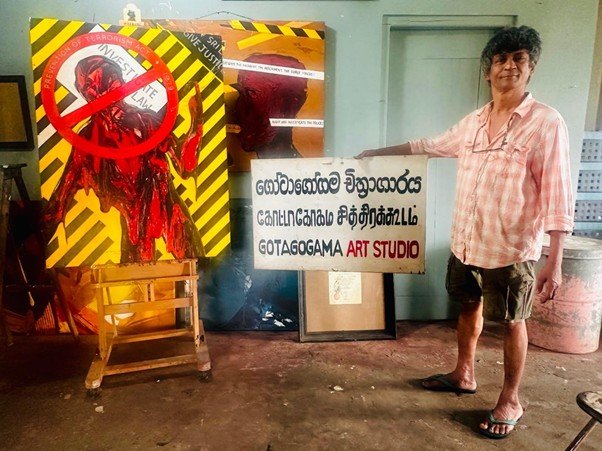
Sujith Ratnayake in his studio with art used in the Aragalaya Art Studio, 2025
Photo credit: Yolanda Foster
From witness to catalyst
In recent years, I have found myself drawn back into the question that first emerged for me in the 1990s: how can creativity sustain memory when formal mechanisms of justice fail?
In 2025, I travelled to Seeduwa on the outskirts of Colombo to attend the annual memorial organised by Families of the Disappeared. Mothers and sisters gathered holding photographs of loved ones still missing after decades. I recognised one mother, Sithy Ameena, whom I had first met years earlier. She embraced me and asked, “Why has my son still not been produced?” Her question lingered long after the speeches ended.
At the centre of the gathering stood the memorial designed by Chandragupta Thenuwara: a quiet grid of photographs. Families laid flowers beneath the images; one woman pressed her forehead against the tiles.
The memorial functioned as both an archive and an altar. The photographs performed another reversal of disappearance: those whom the state had failed to account for were returned, face by face, to public visibility. In a landscape of denial, the memorial insisted on memory. As the ceremony ended, families boarded buses to Colombo to protest. Remembrance flowed into activism.
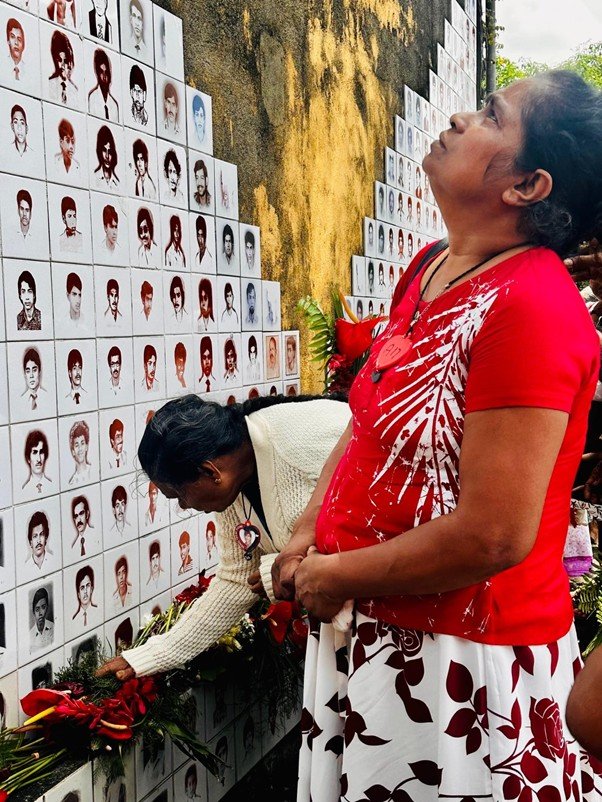
Monument for the Disappeared, Seeduwa, designed by Chandragupta Thenuwara, 2025
Photo credit: Yolanda Foster
The power of art as witness is that it allows us an encounter with lived experience. If we slow down to look at a painting or attend to what theatre, ritual or an image is showing us, we begin to encounter the world from the position of a witness rather than simply accepting official versions of truth.
In 2025, through a project called We Remember, I collaborated with activists working on truth for the disappeared to create visual works, including posters for the UN Human Rights Council. The project formed part of a wider Artivism initiative hosted by the Centre for Applied Human Rights at the University of York. What struck me in some of the images the activists made was how visceral their messages were. One drew a map of Sri Lanka noting: “it is a country of mass graves”. Participants could recite locations and names of families. This was experiential witnessing: knowledge carried through memory, image and lived experience rather than through the sanitising language of an official record.
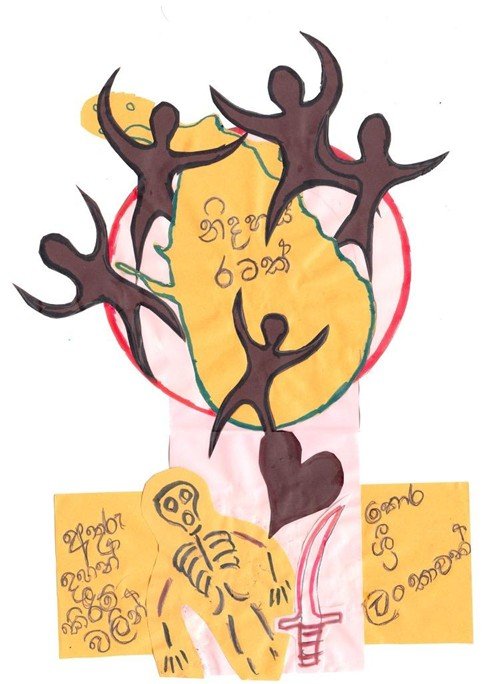
Print made by a member of Families of the Disappeared, Negombo 2025
“Sri Lanka is a country of mass graves”
Photo credit: Yolanda Foster
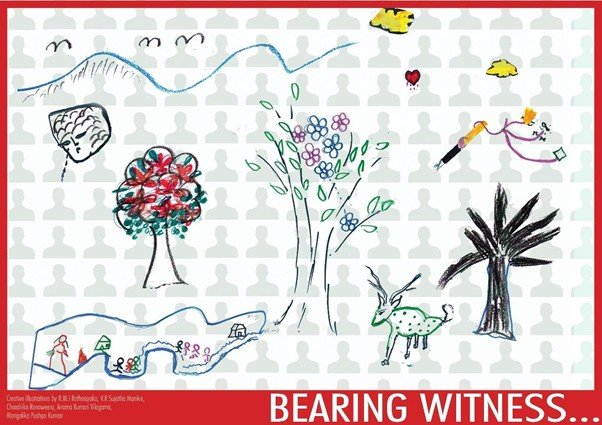
Images produced by families and activists for the disappeared for the UN Committee on Enforced Disappearances, 2025
Photo credit: Yolanda Foster
Art against erasure
Disappearances, silence and denial scar Sri Lanka’s history. Through art and activism, a counter-history endures—a history that insists on remembering, that refuses to let grief be buried in bureaucracy. From Weerasinghe’s pilgrimages to Thenuwara’s barrels, from Sandya Ekneligoda’s rituals to the collective creativity of Galle Face, art in Sri Lanka has provided ways of holding truth when institutions have failed.
This is the power of aesthetic witnessing. It asks us to remain attentive to the fragile signals of truth that persist even in difficult times. It reminds us that perception itself can be an ethical act—a refusal to accept the world only as it is presented to us.
Over the years, I have found language for this in the writings of Simone Weil, who described attention as the rarest and purest form of generosity (Weil 1952). What she called attention feels to me like a kind of attunement—a quiet discipline of perception in which one learns to listen more deeply to the world. In moments of such attention, something shifts: surface narratives fall away and the full texture of reality—grief, courage, contradictions—can be felt more clearly.
I have come to think of this practice as aesthetic witnessing: a way of attending to the world through image, gesture and presence, where perception itself becomes an ethical act. It is not only a method of interpretation but a discipline of attention—one that allows artists, activists and observers alike to recognise truths that might otherwise remain obscured.
Looking back, the connection between attention and resistance seems clearer to me. The war I encountered in the 1990s was not equally visible to everyone. Its realities were fragmented by censorship, geography, ethnicity, security controls and the ordinary human capacity to become accustomed to what surrounds us. The artists and activists in this essay repeatedly intervene in that field of perception. A barrel is made strange. A flag brings bones into a railway station. A disappeared man’s photograph is carried into court, making the invisible visible. Parliament melts before the public gaze. Each gesture asks, in a different way, that we look again.
How do we learn to see clearly in a world where so much is hidden, denied or distorted? The artists and activists whose work threads through this essay offer one answer. Through images, ritual and collective memory, they remind us that attention itself can become a form of resistance.
And in that act of attention, memory endures.
Yolanda Foster is an independent researcher and human rights advocate whose work explores art, resistance and justice. She is on the board of the London-based Sri Lanka Campaign for Peace and Justice.
Lead photo: Memory Tree, Nalinda Seneviratne, 2017 (Credit: Yolanda Foster)
References
Amnesty International. (1998). Amnesty International Report 1998: Sri Lanka. London: Amnesty International.
Amnesty International. (2008). Sri Lanka: Silencing Dissent. AI Index ASA 37/001/2008. London: Amnesty International.
Amnesty International. (2010). Sri Lanka: Demand Investigation into Missing Journalist Prageeth Eknaligoda. ASA 37/003/2010. London: Amnesty International.
Amnesty International. (2016). Silenced Shadows: Global Poetry Competition on Enforced Disappearances in Sri Lanka. Public Statement, ASA 37/4027/2016, 16 May.
Amnesty International (2017) ‘Sri Lanka: Amnesty International hosts “Memory and Justice” a day of activities and poetry book launch’, 21 January.
Amnesty International. (2022). Sri Lanka: End the Use of and Repeal the Draconian PTA. ASA 37/5241/2022. London: Amnesty International.
Anderson, Jon Lee. (2011). “Death of the Tiger”. The New Yorker (17 January): https://www.newyorker.com/magazine/2011/01/17/death-of-the-tiger
Committee to Protect Journalists. (1999). “Attacks on the Press in 1998: Sri Lanka”. New York: Committee to Protect Journalists.
Committee to Protect Journalists. (2001). “Journalists Killed in 2000: Nimalarajan Mylvaganam”. New York: Committee to Protect Journalists.
Cotterrell, David, and Chandraguptha Thenuwara (curators). (2018). Human Rights Arts 2018. Exhibition, J. D. A. Perera Gallery, Colombo, 10–15 December.
Foster, Yolanda. (2002). The Performance of Hybridity in the Visual Culture of the No Order Group of Sri Lanka. In Neluka Silva (ed.), The Hybrid Island: Culture Crossings and the Invention of Identity in Sri Lanka (93-103). Colombo: Social Scientists’ Association.
Foster, Yolanda. (2016). “Still Searching for the Truth: One Woman’s Relentless Quest for Justice”. Groundviews (14 November): https://groundviews.org/2016/11/14/still-searching-for-the-truth-one-womans-relentless-quest-for-justice/
Foster, Yolanda. (2025). Interview with Sujith Ratnayake, Sri Lanka, November 2025.
Foster, Yolanda. (2026a). Interview with Sandya Ekneligoda, Colombo, March 2026.
Foster, Yolanda. (2026b). “Remembering Prageeth: Justice Delayed, Justice Denied.” LinkedIn, February 2026.
International Crisis Group. (2018). Sri Lanka’s Constitutional Crisis. Asia Briefing No. 156. Brussels: International Crisis Group.
No Order Group Exhibition. (1999). Vibhavi Academy of Fine Arts (VAFA) Gallery, Ethul Kotte, Sri Lanka, 8 August.
Weerasinghe, Jagath. (1997). Yantra Gala and the Round Pilgrimage. Solo exhibition, Heritage Gallery, Colombo. Personal observation and discussion with the artist.
Weil, Simone. (1952). Gravity and Grace. Translated by E. Craufurd. London: Routledge & Kegan Paul.
You May Also Like…
‘Border villages’: Emergence, Salience, and implications for ‘Community’ in Sri Lanka
Viyanga Gunasekera
Despite Sri Lanka being an island and not sharing land borders with another country, the term ‘border villages’...
Image-Based Sexual Abuse, and Consent, in the Digital Age
Sely Liyanage
The rapid development of digital technologies has created new forms of content and new forms of harm. Some content is...
India’s Youth Protest and the Limits of Demand-Driven Mobilisation
Manoranjan Pegu
The recent protests ‘led’ by the Cockroach Janta Party (CJP) in India, have been seen as the latest addition to South...