
State Formation and Conflicts in Sri Lanka. Sunil Bastian. London: Bloomsbury Academic, 2025.
Bhadrajee Hewage
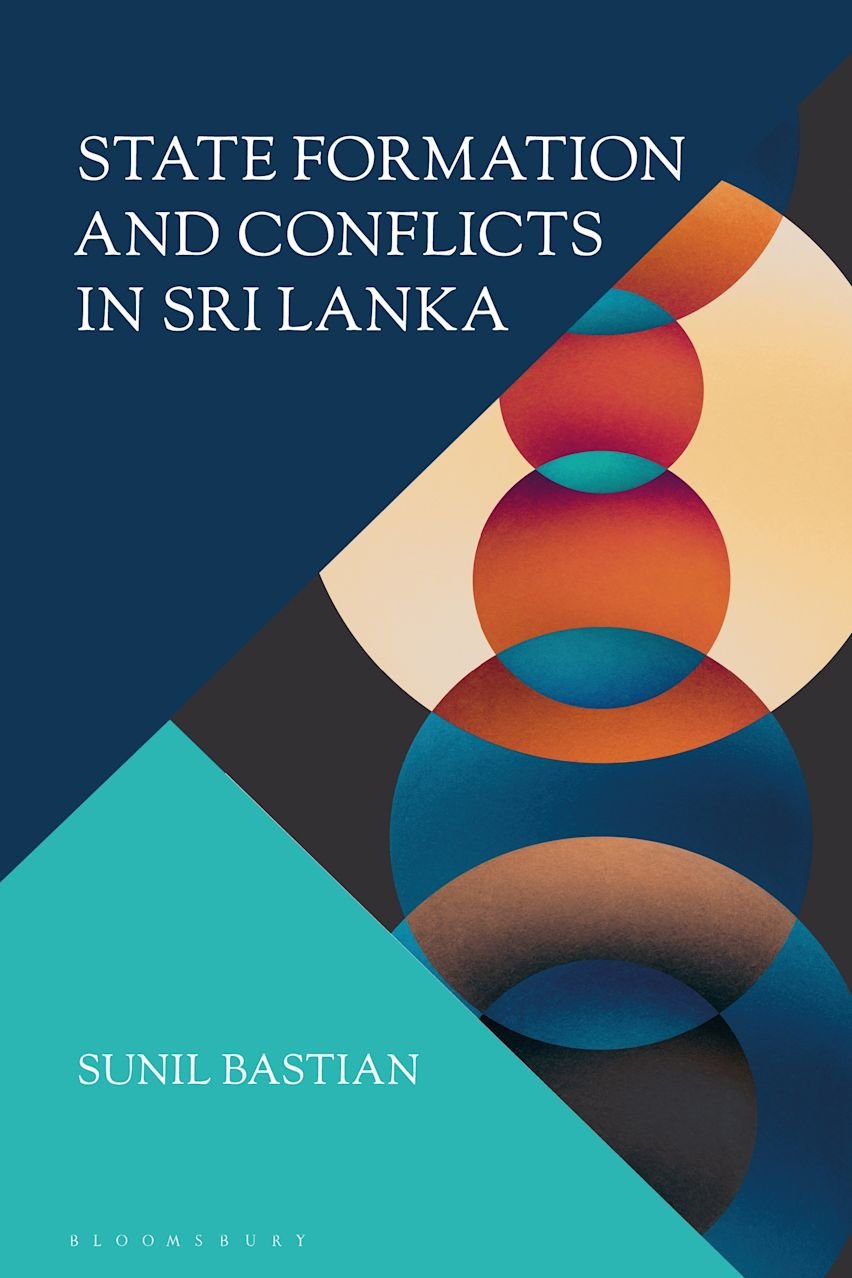
Sunil Bastian’s State Formation and Conflicts in Sri Lanka is an ambitious and intellectually sophisticated reinterpretation of postcolonial Sri Lankan history. Rather than treating the country’s political violence, ethnic conflict, constitutional crises and economic transformations as discrete episodes, Bastian situates them within a single analytical framework centred on the historical process of state formation. The result is a work that moves beyond conventional narratives of democratisation, ethnic conflict, development or civil war, offering instead an integrated explanation of how successive political struggles have shaped—and continue to shape—the Sri Lankan state.
From the outset, Bastian argues that the conventional understanding of the state as a fixed institutional entity obscures the dynamic historical processes through which states are continually constituted, contested and transformed. Instead, drawing upon historical sociology and state formation literature, he writes how states are “not natural or inevitable, but are the products of specific social processes and political struggles which generate a process of state formation” (2). This theoretical repositioning provides the monograph’s organising principle. Rather than asking why Sri Lanka experienced ethnic conflict, civil war, or economic crises, he asks how these phenomena emerged from the interaction between evolving state structures, capitalist transformation, electoral politics, and international political economy. It should thus be considered an attempt to explain how postcolonial state formation has generated recurring cycles of conflict.
Political violence as systemic not exceptional
Bastian explains in the introduction that his interest in this wider topic arose from assembling data on violence since 1977, only to discover that political violence was “not an aberration or exception, but a systemic characteristic of the Sri Lankan state and state–society relations” (1). This observation becomes the intellectual motivation for abandoning conventional approaches to studying the Sri Lankan state. Equally significant is his rejection of widely accepted descriptions of Sri Lanka as either a democracy or a welfare state. Such labels, he argues, sit uneasily beside the persistent record of state repression and political violence. The implication is not that democratic institutions or welfare policies were absent, but that institutional labels alone cannot explain the actual character of state-society relations. This distinction between formal institutions and political practice becomes one of the central themes that runs throughout the book.
Bastian’s theoretical framework is carefully developed. States are presented as historically contingent political formations rather than completed institutional structures. Their formation occurs simultaneously within domestic political struggles and global transformations. Bastian identifies three “strategic state–society relations” that organise the remainder of the book (5). These are relations between the centralised state and ethnic minorities; electoral politics and state formation; and relations between the state and the Sinhala majority within the politics of capitalist transition. He demonstrates how each became strategically important in constructing state power. This analytical architecture gives the book an impressive coherence. Events separated by decades—including citizenship legislation, the ‘Sinhala Only’ Act, welfare policies, constitutional reforms, neoliberal restructuring, the civil war and the post-war state—are interpreted as different moments within the same evolving process.
Chapter 1 demonstrates the historical depth of Bastian’s argument by locating the origins of the postcolonial Sri Lankan state in British colonial rule. He situates British rule within the wider expansion of European colonial capitalism and argues that it fundamentally reconfigured the institutional and spatial foundations upon which the postcolonial state would later be built. As Bastian argues, British colonialism “constructed the state that formed the foundation of the postcolonial state” (11), transforming earlier patterns of territorial authority into a centralised administrative apparatus capable of exercising political, judicial, and coercive control. He further demonstrates how the amalgamation of the Kandyan Kingdom with the maritime provinces and the territorial reorganisation introduced through the 1833 Colebrooke-Cameron reforms created a unified political space centred on Colombo.
Cartography as instrument of colonialism
These reforms, Bastian argues, not only consolidated colonial authority but also transferred “the idea of a state that prevailed within the colonial power” onto the geographical space of Sri Lanka, while modern cartography itself became “an instrument of colonialism” (12) that erased earlier spatial identities. In his interpretation, maps, provincial boundaries and administrative districts therefore emerge not as politically neutral bureaucratic devices but as constitutive technologies of colonial state formation. At the same time, he challenges liberal narratives of British rule by drawing on the earlier work of Kumari Jayawardena to argue that an exclusive focus on major rebellions obscures “numerous social struggles” that took place on a “local level” (14), thereby underestimating the coercive character of colonial rule and masking the role of politics, power struggles, and violence in the process of state formation.
The same historical sensitivity characterises his treatment of colonial census practices, which he presents as a central mechanism through which the colonial state transformed fluid social identities into fixed political categories. Referencing the prior work of Patrick Peebles and Nira Wickramasinghe, Bastian argues that the regular census did far more than record demographic information: it institutionalised racial categories that subsequently became embedded within representative politics through the Legislative Council. The continuation of these classifications after independence, he suggests, ensured that ethnic identities remained integral to the operation of the postcolonial state itself. By tracing how census classifications became institutionalised within colonial governance and subsequently reproduced by the postcolonial state, he convincingly demonstrates that ethnic identities were thus not simply reflections of social reality but products of state-making practices that acquired enduring political significance.
Chapter 2 shifts from the colonial foundations of state formation to the first three decades of independence, where Bastian’s analytical framework begins to demonstrate its explanatory power. Rather than offering a conventional chronological political history, he structures the chapter around the three strategic dimensions of state–society relations outlined earlier, and the relationship between the state and the Sinhala majority within capitalist transition. This thematic approach enables him to reinterpret familiar post-independence developments through the lens of state formation rather than ethnic conflict alone. Particularly persuasive is his argument that the construction of the centralised Sinhala Buddhist state did not begin with the watershed election of 1956, as is commonly assumed, but immediately after independence through the politics of citizenship.
Rejecting the conventional distinction between a supposedly moderate UNP and a nationalist SLFP, Bastian argues that the conventional analysis of worsening relations between the state and minority groups focuses largely on changes that came after the 1956 election, yet this “ignores the Sinhala Buddhist nationalist character” (28) of the first regime led by the UNP. The decisive moment, he contends, was the citizenship legislation introduced under D. S. Senanayake, which deprived of citizenship and political rights, the overwhelming majority of Tamils of recent Indian origin. He convincingly demonstrates that these measures simultaneously satisfied Sinhala nationalist aspirations, preserved the plantation economy by maintaining a politically disenfranchised labour force, and fundamentally reshaped Sri Lanka’s relationship with India. Equally significant is his observation, citing Luwie Ganeshathasan and Asanga Welikala, that many Indian Tamils “remained in limbo” (30), long after the Sirimavo-Gandhi Agreement in 1974, underscoring the long-term consequences of the postcolonial state’s citizenship regime.
Bastian extends this reinterpretation to subsequent constitutional and linguistic developments, treating the ‘Sinhala Only’ Act and the 1972 Constitution not simply as manifestations of ethnic nationalism but as successive stages in consolidating a centralised Sinhala Buddhist state. The Official Language Act, he writes, represented a rejection of the earlier principle of parity between Sinhala and Tamil and symbolically asserted the supremacy of the Sinhala language throughout the territory of the state. Likewise, the 1972 Constitution represented both a constitutional rupture and the institutional expression of a political balance overwhelmingly dominated by parties supported by the Sinhala majority. By removing the minority protections contained in Section 29 (2) (c) of the previous Constitution; reaffirming Sinhala as the sole official language; granting Buddhism a privileged constitutional status; and emphasising the unitary character of the state, the Constitution further undermined the prospects for successful state formation in a multi-ethnic society.
Bastian’s discussion of Tamil political responses is correspondingly nuanced. Rather than depicting separatism as inevitable, he reconstructs a gradual evolution from constitutional safeguards to federalism, regional autonomy, and ultimately the demand for an independent Tamil Eelam. His examination of the Bandaranaike-Chelvanayagam (1957) and Senanayake-Chelvanayagam (1965) Pacts demonstrates that meaningful constitutional alternatives repeatedly existed but were frustrated by Sinhala nationalist mobilisation. The culmination of this trajectory came with the Vaddukoddai Resolution (1976), which declared that the Tamils of Ceylon were “a nation distinct and apart from Sinhalese” (35), thereby transforming the question from one of minority rights into what Jayadeva Uyangoda later characterised as “the non-negotiable contestation for state power” (36).
New phase not rupture
Rather than treating the post-1977 era as a discrete historical rupture, Bastian presents it as the next phase in the continuing process of Sri Lankan state formation in Chapter 3. He argues that 1977 inaugurated a “qualitatively new period” (65) in the formation of the postcolonial Sri Lankan state, shaped by three interconnected developments: the inauguration of a new period of capitalist transition that prioritised the private sector, markets and global capitalism; the intensification of Tamil separatism; and the emergence of what he terms the “global neoliberal political project” (65). Rather than interpreting economic liberalisation simply as a programme of development, he convincingly embeds constitutional reform, economic restructuring, and coercive state power within a single political project aimed at stabilising the postcolonial state during capitalist transition. Situating these reforms within David Harvey’s characterisation of neoliberalism as a system based upon “private property rights, individual liberty, unencumbered markets, and free trade” (70), Bastian demonstrates that Sri Lanka’s post-1977 transformation formed part of a much wider ideological reconfiguration of global capitalism rather than an isolated domestic policy shift.
Chapter 4 turns to the Norwegian-facilitated negotiations between the Sri Lankan government and the Liberation Tigers of Tamil Eelam (LTTE). Bastian carefully reconstructs the divergent political objectives of the principal actors and situates the negotiations within the broader process of postcolonial state formation. He argues that the United National Front’s (UNF) electoral victory opened the way for the strategic stabilisation of the state through a ceasefire agreement with the LTTE, and to push capitalist transition to a new level, while also marking a unique phase in Sri Lankan state formation because of the unprecedented participation of international actors. At the heart of this process was the 2002 Ceasefire Agreement, whose underlying premise was the recognition of two competing centres of authority within a fractured state, framed in such a way that “the parity of status” (107) between the two parties was acknowledged. Bastian’s explanation for the subsequent collapse of negotiations is correspondingly nuanced. Rather than attributing failure to a single cause, he identifies three mutually reinforcing factors that ultimately rendered the peace process politically unsustainable.
First, Bastian demonstrates that the LTTE and the UNF government entered negotiations pursuing fundamentally different political projects. Whereas the UNF viewed negotiations primarily as a mechanism for reviving economic growth and advancing neoliberal restructuring, the LTTE approached them as an opportunity to consolidate its own state-building project. Second, he highlights contradictions among the international actors themselves. Although the United States actively supported negotiations, it continued to rigidly classify and consider the LTTE as a terrorist organisation. Third—and perhaps most persuasively—Bastian argues that the negotiations were fatally undermined by the exclusion of President Chandrika Kumaratunga from the process. Noting how Norway and the UNP government “isolated” (106) Kumaratunga and the Sri Lankan military, Bastian later concludes that this reflected Norway’s tendency to privilege its own peacebuilding agenda over the institutional realities of Sri Lankan politics. Given the deep rivalry between the two principal Sinhala political parties, he argues that meaningful negotiations were unlikely to survive once the constitutional head of state had been marginalised from the process.
Chapter 5 extends Bastian’s historical sociology of state formation into the post-war era by arguing that the military defeat of the LTTE in 2009 did not mark the completion of Sri Lankan state formation but rather inaugurated a new phase in its evolution. The defining characteristic of this period, he argues, is “the consolidation of the territory of the centralized Sinhala Buddhist state through military means” (121), a process that had begun with the enactment of the Prevention of Terrorism Act in 1979 and culminated three decades later with the destruction of the LTTE. He refuses to interpret military victory as the end of the conflict. Instead, he insists that territorial consolidation fundamentally altered—but did not resolve—the underlying contradictions of postcolonial state formation. The post-war state emerged stronger in territorial authority, yet still faced unresolved tensions surrounding minority rights, militarisation, legitimacy, capitalist transition, and international accountability.
International dimensions
Particularly illuminating is Bastian’s discussion of the international dimensions of the post-war state. Rather than portraying external actors as consistent defenders either of state sovereignty or universal human rights, he demonstrates that international responses were shaped primarily by shifting strategic interests. India’s acquiescence to the military campaign reflected changing regional calculations following the assassination of Rajiv Gandhi, while the United States simultaneously supported the Sri Lankan state’s campaign against the LTTE through military assistance yet continued to express concern over civilian casualties. Bastian extends this analysis to China’s expanding influence; India’s strategic engagement with Trincomalee; UN Human Rights Council resolutions; and the suspension and restoration of GSP+, demonstrating that the evolution of the post-war state cannot be understood independently of broader regional and global strategic competition.
The concluding sections of the chapter provide a particularly timely analysis by linking post-war political economy to the 2022 economic crisis. Bastian argues that the post-war state’s increasing dependence on global financial markets, rather than concessional bilateral or multilateral finance, fundamentally transformed the political economy of state formation. Structural transformations, combined with more than four decades of neoliberal restructuring and widening social inequality, rendered the post-war state acutely vulnerable to external shocks. Consequently, the 2022 economic collapse and the Aragalaya protest movement are interpreted not as exceptional events but as the latest manifestation of long-term contradictions embedded within Sri Lanka’s state formation process. He concludes by warning that policymakers who continue to rely upon “economic growth, trickle-down and safety nets” do not appear “to have learnt any lessons from this recent history”, arguing instead that Sri Lanka requires “a new discussion on social policy” (155) grounded in the historical experience of four decades of capitalist transition and repeated episodes of political violence. This powerful conclusion brings the monograph full circle, demonstrating that the unresolved tensions identified in the colonial and early postcolonial periods continue to shape the trajectory of the contemporary Sri Lankan state.
The book’s major contribution lies in this remarkable analytical consistency. Throughout nearly 80 years of postcolonial history, Bastian never abandons his central framework. Ethnic conflict, constitutional change, welfare policy, economic liberalisation, civil war, international intervention, and post-war reconstruction are repeatedly interpreted through the interconnected processes of state formation. The study also demonstrates impressive empirical breadth. Political institutions, census practices, land policy, elections, constitutional law, welfare programmes, foreign aid, military strategy, and international diplomacy are all woven together into a single explanatory narrative. Rather than portraying 1948, 1956, 1977 or 2009 as complete ruptures, he consistently identifies institutional continuities linking colonial and postcolonial state formation. This long historical perspective considerably strengthens the explanations provided.
Competing explanatory perspectives
At the same time, the monograph invites several constructive observations. Bastian’s state-formation framework is exceptionally powerful, yet its application occasionally leaves relatively little space for competing explanatory perspectives. Readers may wish for a more explicit engagement with alternative interpretations of ethnicity, nationalism, democratisation or political economy before these are ultimately subsumed within the state-formation paradigm. While the book is strongest when analysing political elites, institutions and strategic state-society relations; social movements, everyday political practices, and local experiences generally appear through their interaction with state strategies, rather than as autonomous historical actors. This naturally reflects the author’s analytical priorities but inevitably leaves certain dimensions of social history less developed. Finally, Bastian repeatedly acknowledges that many dimensions of Sri Lanka’s political violence require further research, particularly village-level studies capable of revealing the lived consequences of repression and conflict.
Overall, the monograph represents a major contribution to the study of modern Sri Lanka. It succeeds because it offers far more than a chronological account of political events. It provides a coherent historical sociology of the Sri Lankan state, demonstrating how ethnicity, capitalist transformation, electoral politics, international relations, and violence have interacted in shaping postcolonial state formation. Even where readers may disagree with aspects of Bastian’s interpretation, the analytical framework is sufficiently rigorous to compel serious engagement. For scholars of Sri Lanka, comparative state formation, nationalism, political violence, and South Asian politics, this book will become an indispensable reference. Its theoretical ambition, empirical richness and sustained analytical coherence ensure that it will remain an important contribution to debates on the nature of the Sri Lankan state and the historical origins of its persistent conflicts.
Bhadrajee Hewage (DPhil., Oxon) researches the intersection of religious, cultural, social and intellectual history in modern South Asia.
You May Also Like…
India’s Youth Protest and the Limits of Demand-Driven Mobilisation
Manoranjan Pegu
The recent protests ‘led’ by the Cockroach Janta Party (CJP) in India, have been seen as the latest addition to South...
This Government, That Opposition, and the Work Still Ours
Lionel Bopage
For sixty-six years, until his death in 2014, the legendary comrade Bala Tampoe led the Ceylon Mercantile Union...
Our support for the open letter: To Iran’s political prisoners, trapped ‘between two blades of a scissors’
Collective
As migrants and refugees in diaspora and in exile from Iran, who have our loved ones suffering in the Iranian state’s...