
Gananath Obeyesekere: Dazzling Scholar with Integrity
Dennis B. McGilvray
Adding to the Polity conversations about Gananath Obeyesekere, I wish to mention a further dimension of his remarkable career that deserves praise: the clarity of his exposition and his integrity as a scholar.
Just as Jock Stirrat was instructed by his Cambridge mentors, Edmund Leach and Stanley Tambiah, to meet Gananath immediately upon his arrival in Ceylon in July 1969, I, too, was told by my University of Chicago thesis advisor, Nur Yalman, to seek out Obeyesekere as soon as possible when I landed in Colombo the following month. Within weeks I took the train to Peradeniya and was greeted by Gananath and his cluster of students in the Ceylon Studies Seminar—among them Tissa Fernando, Kitsiri Malalgoda, and H. L. Seneviratne.
When I conveyed my hope of conducting fieldwork among matrilineal Tamils and Moors on the east coast—communities touched upon in Yalman’s newly released book, Under the Bo Tree (1967)—Gananath was quick to provide me with introductions to his contacts in the Batticaloa region, including K. N. Dharmalingam, Village Council chairman for Tirukkovil, who in turn introduced me to K. Shahul Hamead, the Muslim Qazi of Akkaraipattu, whose eldest son Nilam became a trusted partner in my dissertation project and in much of my fieldwork since then. This was also the start of my quest to learn Sri Lankan Tamil, the Batticaloa variety (McGilvray 2025).
At that point, Gananath himself had only published his University of Washington PhD thesis under the legal-sounding title Land Tenure in Village Ceylon (1967), and I had no inkling of the psychodynamic and mythopoetic directions his future writings would take. To be sure, over the subsequent decades, as my own research steadily deepened on Tamil and Moorish social structure and popular religion in the town of Akkaraipattu, I followed Gananath’s publications with amazement and fascination, but I saw few direct connections with the east coast of the island.
In my own university teaching, I regularly assigned Medusa’s Hair (1981)—a book particularly popular with my hormonally-charged undergraduate students—but in my own writing I clung steadily to caste and matrilineal kinship. That was until Gananath published his monumental work, The Cult of the Goddess Pattini (1984), when I suddenly had to face up to a Freudian theory in my own ethnographic backyard.
It wasn’t as if I lacked any acquaintance with psychological anthropology. In fact, I took graduate courses at Harvard with John Whiting, a guru in the field of childrearing and culture, and at the University of Chicago with Melford Spiro, the very same neo-Freudian who taught Gananath when he was a graduate student at the University of Washington. I’m sure this helped me to get hired at the University of Colorado under the fuzzy rubric of “psychological and symbolic anthropology”.
However, while I was always happy to teach my students about psychoanalytic theories, including some of Gananath’s dazzling work, I remained more of a Geertzian or neo-Weberian in my own research, always more comfortable with ethnographic comparisons and cultural influences. The works by Gananath that inspired me the most were his historical reinterpretations, and this is reflected in what I wrote about Mukkuvar caste origins and the evolution of matrilineal law in Batticaloa (McGilvray 2008: 55-96; McGilvray 2011: 137-159).
To follow all of the details, you would need to consult The Cult of the Goddess Pattini, especially Chapter 15, “The Hindu Goddess Pattini” (1984: 553-602). Here, at the conclusion of his truly amazing 629 page magnum opus, Gananath offered his theory to explain how the stoic, benign, and wifely Sinhalese Buddhist goddess Pattini had been transformed into the angry, temperamental, bipolar Hindu goddess Kannaki on Sri Lanka’s east coast.
As Gananath outlined his argument in lucid and concrete detail, the causal factor was said to be increasing “Sanskritization”, the imposition of rigid Brahmanical Hindu ideals of wifely obedience and severe sexual repression that caused mothers to behave harshly and unpredictably toward their children, ultimately producing a collective psychological projection of the Tamil “mother goddess” as vacillating, temperamental, and in need of propitiation. Gananath characterised the east coast Tamil goddess Kannaki as an intermediate divinity along the spectrum of Sanskritic transformation, while in Jaffna the process was complete: there he contended Kannaki had been assimilated to the unambiguously fierce Kali.
Although the theory included several psychoanalytic “black boxes” (my term), it was truly ingenious and daring. Fundamentally, however, it assumed the deep impact of male-centered Brahmanical priestly ideology on Hindu Tamil women in the Batticaloa region, an influence that was conspicuously absent in my ethnographic experience in the 1970s–1980s. Festivals to “cool” the angry heat of the goddess Kannaki were very popular in Akkaraipattu, but there was no local Brahman caste, only a matrilineal priesthood of explicitly non-Brahman Virasaiva (Lingāyat) Kurukkals.
In fact, most Hindus had no clear impression of what a Brahman was, nor had they ever met one. The Tamil family system on the east coast was matrilocal, and wives retained ownership of both houses and paddy lands. Married sisters lived side-by-side and could provide some protection against spousal violence. It was very hard to imagine how Brahmanical ideology could be totally repressing women’s autonomy and sexual desires under these circumstances.
Faced with Gananath’s daunting edifice of psychodynamic theory, I had no particular desire to tackle it epistemologically, but I realised that I could question it on purely ethnographic grounds alone. At that point, I was still scrambling for tenure at the University of Colorado, and under the circumstances I figured that any scholarly publicity could be good publicity. Normally, I would have given Gananath a chance to review and criticise my article in manuscript form, but there was no time for that. I was willing to risk a small kerfuffle with Gananath if it demonstrated to my department that I was part of a significant academic debate with such an eminent anthropologist, so I wrote up my critique of his Tamil Pattini/Kannaki chapter and submitted it for the Stirling Award in psychological anthropology, a competition sponsored by the American Anthropological Association.
Months later, I was informed that my essay had won the Stirling Award and that it would be published in Ethos, the journal of the Society for Psychological Anthropology. I also learned that my essay had also caused considerable consternation to Gananath; the editor told me he had received Gananath’s extensive rebuttal, but that it was far too lengthy and disjointed to publish. In any case, it was never shared with me, and I still have no idea what he said.
From that point onward, however, I feared my relationship with Gananath had been permanently jinxed. Only later, after my article finally appeared in print (McGilvray 1988), I learned that one of the three independent judges for the Stirling Award had been Gananath Obeyesekere himself! This totally confirmed my admiration for Gananath: not only was he an astonishingly prodigious and highly creative scholar, but he had also proven to be a true academic colleague. Gananath and I continued to enjoy a cordial relationship for the remainder of his days, and like Mark Whitaker, I also recall Gananath’s mango martinis.
Dennis B. McGilvray is Professor of Anthropology emeritus at the University of Colorado Boulder, and a past president of the American Institute of Sri Lankan Studies (AISLS). His new book, A House for Every Daughter: Matrilocal Marriage and Dowry in Sri Lanka and South India, is forthcoming from Rutgers University Press.
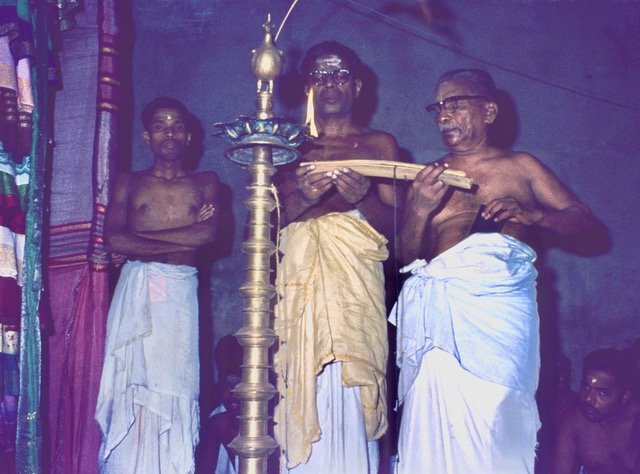
Image: Tamil Hindu men reciting the “cooling” (குளிர்த்தி) ritual at the Kannaki kovil in Karaitivu, south of Kalmunai (credit: Dennis B. McGilvray, 1975)
References
McGilvray, Dennis B. (1988). “The 1987 Stirling Award Essay: Sex, repression, and Sanskritization in Sri Lanka?” Ethos 16 (2): 99-127.
McGilvray, Dennis B. (2008). Crucible of Conflict: Tamil and Muslim Society on the East Coast of Sri Lanka. Durham and London: Duke University Press. Re-issued 2024 by Tambapanni Academic Publishers, Colombo.
McGilvray, Dennis B. (2011). “Dowry in Batticaloa: The Historical Transformation of a Matrilineal Property System.” In H. L. Seneviratne (Ed). The Anthropologist and the Native: Essays for Gananath Obeyesekere (137-159). London and New York: Anthem Press.
McGilvray, Dennis B. (2025). “From Chicago to Sri Lanka: How I Tackled Tamil in the Field.” In Margherita Trento, Constantine V. Nakassis, N. Govindarajan, and Sascha Ebeling (Eds.). For the Love of Tamil: Essays in Honor of E. Annamalai (507-515). Series Minor CVIII. Naples: Unior Press. Open Access http://www.fedoabooks.unina.it/index.php/fedoapress/catalog/view/691/777/3505
Obeyesekere, Gananath. (1967). Land Tenure in Village Ceylon. Cambridge: Cambridge University Press.
Obeyesekere, Gananath. (1981). Medusa’s Hair: An Essay on Personal Symbols and Religious Experience. Chicago and London: University of Chicago Press.
Obeyesekere, Gananath. (1984). The Cult of the Goddess Pattini. Chicago and London: University of Chicago Press.
Yalman, Nur. (1967). Under the Bo Tree: Studies in Caste, Kinship, and Marriage in the Interior of Ceylon. Berkeley and Los Angeles: University of California Press.
You May Also Like…
India’s Youth Protest and the Limits of Demand-Driven Mobilisation
Manoranjan Pegu
The recent protests ‘led’ by the Cockroach Janta Party (CJP) in India, have been seen as the latest addition to South...
This Government, That Opposition, and the Work Still Ours
Lionel Bopage
For sixty-six years, until his death in 2014, the legendary comrade Bala Tampoe led the Ceylon Mercantile Union...
Our support for the open letter: To Iran’s political prisoners, trapped ‘between two blades of a scissors’
Collective
As migrants and refugees in diaspora and in exile from Iran, who have our loved ones suffering in the Iranian state’s...