
An Accidental Education with Gananath Obeyesekere
Mark P. Whitaker
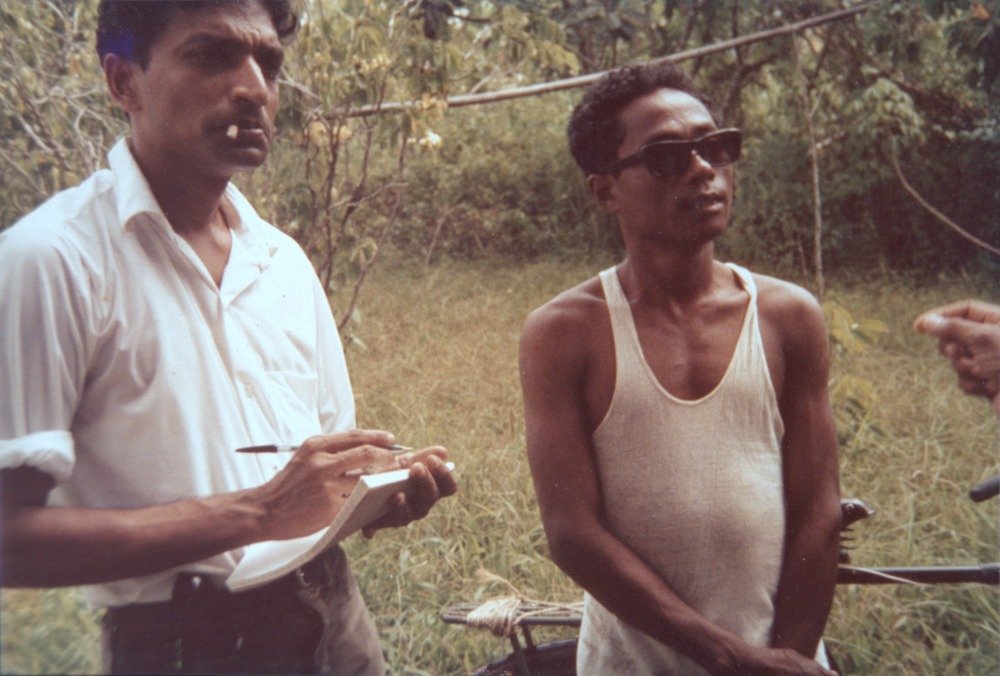
I must begin with an embarrassing admission. Although Gananath Obeyesekere became my PhD thesis supervisor in 1981, our association was accidental; or perhaps I should say fortuitously unlikely.[1] When Professor Obeyesekere came to Princeton University in fall 1980 I was a young second-year graduate student of James Fernandez.
Professor Fernandez is famous for his magisterial book Bwiti (1982), an ethnography of a Fang religious movement in Gabon based on fieldwork in the 1960s, but had turned his anthropological attention to Spain by the 1970s. I had been hoping to do fieldwork on large religious festivals in the Socialist Republic of Romania (attracted, partly, by the obvious ontological contradictions) and was attached to Fernandez’s European rather than West African interests. There was also an intellectual affinity. Fernandez was a symbolic anthropologist who was trying to move the field toward a more sophisticated analysis of the rhetoric of religious experience. I was impressed by this, especially by his notion that people used metaphorically structured ritual events to explain abstractly ineffable and far off subjects (God, European colonialism) by way of near and well-known local predicates (sheep, human illnesses).
But I was gradually growing skeptical of the metaphysical trappings of the larger symbolic movement, and its applicability to socialist Romania’s paradoxes, due to my own reading of the work of the philosopher Wittgenstein and, frankly, graduate student contrariness. A more important problem, though, was the recent election of Ronald Reagan to the US presidency. His intensification of the Cold War cut Romania off the map of accessible (and fundable) ethnographic destinations. Suddenly I was a pilgrim without a pilgrimage.
So, when Gananath Obeyesekere was hired by Princeton to chair the department of Anthropology, I knew very little about his work except that he focused on South Asia, was himself Sri Lankan, and cut an elegant, witty, and sophisticated figure in departmental get-togethers. I remember him effortlessly quoting the last stanza of Yeats’ “The Circus Animals’ Desertion” in an amused answer to one invited academic’s anemically mechanistic description of religious inspiration at a departmental seminar. He lingered especially over the last three lines:
… Now that my ladder’s gone,
I must lie down where all the ladders start,
In the foul rag-and-bone shop of the heart.
“After all, you see”, he added pleasantly, “people are not photocopy machines!”.
Out of curiosity, then, I picked up a copy of Medusa’s Hair: An Essay on Personal Symbols and Religious Experience (1981), published just that year, and, captivated by the prose as much as by the analysis, read it through in one sitting. I remember being struck on the one hand, by the depth of sympathy and intimacy with which he recounted the inner and outer lives of Kataragama’s religious devotees and, on the other, by the intellectual ambition of the book’s attempt to fuse neo-Freudian depth psychology with symbolic analysis and Weberian sociology.
Since ‘Gananath’, as he quickly insisted we graduate students call him, kept his office door open, and as I was professionally at sea, I began to stop by frequently to argue with him about his book and various other topics. He loved a good argument. Now, as an old academic myself, I know how rare it is for a department chair to allow random graduate students to wander in for a chat! I also realise I must often have been keeping him from more important matters. Yet I remember we talked about Wittgenstein’s later philosophy, particularly his Philosophical Investigations and On Certainty, which I deeply admired; bickered over Freud (whose psychology I viewed with conventional anthropological scepticism); and returned frequently enough to Weber’s sociology, that I became convinced of the need to read him more carefully. An accidental education—at least on my part.
Hindu temple festivals on Sri Lanka’s east coast
Eventually, in the spring, he asked me what I was going to do for my PhD research now that my Romanian project was no longer possible. When I said I had no real idea, he suggested I study Hindu temple festivals on Sri Lanka’s east coast. I was aghast at the suggestion. I protested that I knew nothing about South Asia, Sri Lanka, its eastern coast, or Hinduism, and had no appropriate language training—and no money. He told me I could borrow money, go to Sri Lanka, learn Tamil there (he gave me the name of Dr. E. Balasundaram, a folklorist at the University of Colombo, who, he said, would teach me; he did!), and that I should write a proposal from there to get support for the two years he reckoned my research should take me once I had found a field site. He also pulled from his desk drawer a very long list of books and articles about Sri Lanka that he said I should read—I do not remember the actual number but when I tell this story to my students, I always say 200—and wiggled it at me, his eyebrows levitating with amusement. Astounded, and unable to come up with a coherent counter, I simply took the list and went on from there to, basically, do everything he suggested. He saved my career and got me, finally, out of his office!
I spent the next two and a half years in Sri Lanka’s Batticaloa district, mostly in the Tamil Hindu temple town of Mandur, studying its regionally important Murukan temple. I was seeking to grasp how its religious, political (both local and national), sociological, economic, and narrative practices all co-existed, distinctly yet thickly mingled, in an artfully incoherent but functionally satisfactory annual temple festival. A form of cultural resistance, I eventually realised, familiarly related to other forms of cultural resistance practiced in South Asia more generally.
While there I was also moved by various Sri Lankan academics and intellectuals, especially by the Batticaloa journalist Sivaram Dharmaratnam, toward a more postcolonial and self-critical stance about my own work and position as a white, foreign, anthropologist (what, later, would be called “reflexivity”). I only gradually realised that this was also what Gananath Obeyesekere had been subtly prodding me towards in our various discussions.
As for Gananath himself, I only saw him once during this period. About a year in, while he was passing through Colombo, I found him staying in a friend’s apartment preparing for more fieldwork. Comfortably attired in a sarong, surrounded at a kitchen table by copious notes and papers, he got up to pull two, all but completely chopped, King coconuts from a fridge, popped in straws, and offered me one. He then grilled me, gently, about what I had found out so far. He acted interested but offered no criticisms or, for that matter, compliments; simply told me I had to keep on learning Tamil. Somehow, I left feeling like I was doing the right thing.
Shaken and disoriented
I returned to Aaron Burr Hall and the Princeton department of Anthropology in the fall of 1983 quite shaken by the July 1983 anti-Tamil riots, and the beginning of Sri Lanka’s 26-year long civil war between Sinhalese and Tamil nationalists. While I was gone the department, and American anthropology in general, had started undergoing an intellectual shift away from symbolic and Levi-Straussian structural analyses toward postcolonial theories of epistemic violation and Foucauldian power analysis. It was important but also disorienting. New jargon abounded, and new intellectual pieties.
I found some comfort, however, in Gananath’s intellectual persistence. Soon after I returned, he published his definitive study of the Pattini/Kannaki complex in Sri Lanka, The Cult of the Goddess Pattini (1984). I remember being impressed by the way his analysis upended the conventional Orientalist wisdom that this ritual complex (or set of complexes) was derived from a supposedly historical classical text, the Cilappatikāram (“The Story of the Anklet”) by showing (over the course of 629 pages of ethnographic and textual detail) that it was more likely the other way around. “A more imaginative interpretation using a broad variety of sources” he argued, “from myth, ritual, and popular literature—would correct this narrow perspective” (1984: 605), I found his unabashed mingling of approaches congenial to solving my own problems working out the place in history of the Hindu temples I was trying to write about.
Gananath would also often show up in the department with Richard Gombrich, then the Boden Professor of Sanskrit at the University of Oxford, and previously the author of Precept and Practice: Traditional Buddhism in the Rural Highlands of Ceylon (1971). They were working together as co-authors on Buddhism Transformed: Religious Change in Sri Lanka (1988) and, as I recall, would occasionally discuss parts of this in the department. I remember being impressed by the ease of intellectual interchange between the two of them and the way they carried their learning so lightly, but firmly.
I also remember at this time seeing many yellow legal pads full of Gananath’s handwritten pages being typed up in the Anthropology office—for all of his work at that time was written out long hand. These were the pages of his Lewis Henry Morgan lectures. Later published as The Work of Culture: Symbolic Transformations in Psychoanalysis and Anthropology (1990), he was working out his de-essentialist theory of Freudian depth psychology and hermeneutic anthropological analysis. Skimming one page in passing, I marveled at how easily prose seemed to pour out onto his pages—sans typewriter, sans word processor (only then arriving) and, of course, anachronistically speaking, sans chatbot. Gananath wrote and spoke with ease in elegant complete sentences, paragraphs, and arguments.
In 1986 I completed my PhD but, given the recession, I continued hanging around the department for the next three years while seeking academic employment. Gananath and Ranjini Obeyesekere would occasionally have the department and hangers-on like myself over for dinner at their house in Princeton. I still remember their graciousness to everyone and Gananath’s famous, and calorically exuberant, cashew nut curry.
It was also at this time that Gananath began writing an answer to Marshal Sahlins’ study of Hawaiian Kingship and its unfortunate meeting with the British explorer, Captain Cook. I remember one occasion when Gananath read out a draft paper to graduate students of what eventually became the article “British Cannibals: Contemplation of an Event in the Death and Resurrection of James Cook, Explorer” (1992a), and also his award-winning book The Apotheosis of Captain Cook: European Mythmaking in the Pacific (1992b). These publications set off, of course, Gananath’s famous scholarly debate with University of Chicago Professor Marshall Sahlins whose vituperative rejoinder came three years later in How “Natives” Think About Captain Cook, For Example (1995).
I have written elsewhere about this controversy at some length, and my own belief that academic commentators, some falling all over themselves to speak up for “their” team, were too taken up with academic politics and personal loyalties to grasp the controversy’s real importance as an exploration of the extent to which people are always, or perhaps sometimes not, prisoners of their own local understandings (Whitaker 2011). I will not rehash my views here.
One cloudy afternoon
Yet I remember being struck by three things that cloudy afternoon, as Gananath read his draft to us from a chair by the table where we kept the instant—and very bad—coffee. First, I was amazed that he was reading to us, the graduate students, in our lounge (that is, the busy hall that functioned as our lounge) rather than to his fellow faculty members in the more impressive formal seminar room next door. Of course, he eventually did that too. Still, I recall feeling this reading as a quiet sign of his respect for us.
Second, I remember being excited by the logical neatness of his argument that the “fact” of Captain Cook’s fatal deification by a Hawaiian epistēmē may have been, rather, a Western act of mythmaking. We were all, I remember, convinced of the importance of Gananath’s argument and loud in our praise. But he was cautious. He said he did not feel he had enough ethnographic and historical background yet to prove the validity of his claim. He needed to do more research. And of course he did. That attention to intellectual rigour stuck with me, a further example of his subtle mentorship.
Finally, third, I remember a point he made after he read the paper about how some insights into Hawaiian history, as in ethnography more generally, must be provoked by personal experience—in his case, by his experiences of colonialism but, most particularly, by his personal exposure to terror. After all, it was likely terror (among other things) that Hawaiians felt at Captain Cook’s terrible behaviour. Gananath’s own terror was inspired by events all over the late 20th century world but also, more existentially, by his own encounters with terror in Sri Lanka.
In the preface to his book Gananath explained this further. Surveying the carnage being carried out by all sides in Sri Lanka—“the twenty-four thousand square miles of spectacularly beautiful country, rich in traditions of radical non-violence”—Gananath asserted: “There are no good or bad guys in the deadly game of contemporary political violence…” (1992b: xvi) For that reason, he felt compelled (as should we all) to remember the fates of “ordinary people […] all over the world” killed by such violence (xvii). For me, still inwardly shaken by what I had seen in July 1983, this defense of scholarly witnessing provided a welcome ethical purchase for grasping some of the horrors I had witnessed.
In the years following my departure from Princeton I saw Gananath much less—often only momentarily at conferences in the United States or at lectures he gave in Sri Lanka while I was there doing research. He retired from Princeton in 2000 but, of course, continued to produce remarkable scholarship prodigiously for the rest of his life: of his fifteen books, nine were completed after his “retirement”. Indeed, I think an argument could be made that some of Gananath’s most significant scholarship occurred in this vigorous twilight of his professional life.
In 2004, however, while in Sri Lanka for research with my wife, Professor Ann Kingsolver, and my son, David, then six years old, we made our way to Gananath and Ranjini’s lovely house perched high on a ridge overlooking Kandy with the Hanthana mountains looming beyond. Gananath and Ranjini showed the patience of experienced grandparents with my ever-curious son as he wandered around their house and played with the plants that lined their balcony. They chatted amicably with Ann and me over drinks. That is, Gananath mixed delicious but completely devastating mango martinis for Ann and me; and as we moved on to talk about my work and his own continuing research in Sri Lanka’s southeast, I cannot imagine what I said to him with that martini numbing my brain. But I remember feeling warmly received.
Sliver of the whole
As a scholar and a teacher Gananath Obeyesekere’s concerns, and influence, were so wide that my own personal recollections of him can only provide a sliver of the whole. As a teacher of graduate students, for example, Gananath dedicated himself to encouraging the contributions of Sri Lankans and other South Asians to world anthropological scholarship. At Princeton he mentored many students from Sri Lanka. Indeed, coming into the department in Princeton as I was going out was Dr. Darini Rajasingham-Senanayake, formerly attached to the International Centre for Ethnic Studies in Colombo. And as I began my own much more limited career in graduate education, one of my first students, Dr. Pathmanesan Sanmugeswaran, now of the Open University of Sri Lanka, was directly recommended to me by Gananath. Both have become colleagues as well as friends.
Beyond Princeton, wherever I go in Sri Lanka or among scholars studying Buddhism or Sri Lanka in the United States and Britain I run into scholars whose careers were touched, incited, or artfully redirected by encounters with Gananath. What I admire about this is the way it shows that Gananath always encouraged young scholars (as he did me), by never treating them with disdain or, worse, holding them back out of generational jealousy (as some less generous senior scholars do). In my teaching, therefore, I have tried to emulate both his emphasis on bringing students from Sri Lanka and South Asia to the US for graduate school, and the subtle forms of generous mentorship he employed to teach without indoctrination. That is, to give young scholars the tools they need to find their own special paths to knowledge.
As a scholar, Gananath’s seminal work in Buddhist studies, his revolutionary interventions in medical and psychological anthropology, his inventive new way of doing comparative anthropology—of karma and rebirth, for example (2002)—and, most impressive to me, his 2012 investigation of the “passive cerebration” (7) of mystical inspiration in The Awakened Ones: Phenomenology of Visionary Experience, all lay outside my personal memory of our interactions.
But his writings and general approach continue to have a profound effect on my own intellectual journey even so. I think, for example, I have grown into an appreciation of his efforts to bring the insights of Buddhism (for he famously described himself as a Buddhist “of sorts”) into direct interaction with scholarly debates too long enisled in European problematics. I am fascinated, therefore, by the lucidity of the way his oeuvre lets me see certain kinds of experiences, such as the raw terror of civil war victims or the mystically generated “aphoristic” thinking of “awakened” visionaries as different as Buddha, Blake and Wittgenstein, and thus follow the resulting intellectual currents as they meander across sociocultural borders. For in this way their various but mingled phenomenological practices, familiarly if not essentially related, can be seen clearly enough to reveal how variously situated humans draw from them, according to the localised preoccupations of their proximate language games.
Joyful smell of flowers
In 2017, for example, I had a conversation with Mrs. G, a middle-class Hindu woman in Batticaloa. She was a devotee of the late Nuwara Eliya guru, Swami Raman Kalimuthu Murugesu, founder of the Sri Lankatheeswara temple dedicated to the Goddess Gayatri. She told me that one day, in the 1990s, she was meditating by looking into the eyes of her guru when she spotted a gleam. “And then I smelled flowers. A wonderful heat shot out all over my body and filled me with joy (cantōṣam).” She remained in this state, motionless, for hours. Years later, in 2007, upon hearing of Swami Murugesu’s death in Chennai—or, as she understood it, his attainment of permanent meditation (camāti)—she experienced the exact same delight.
Anthropologists, psychologists, and religious studies scholars have long wondered how best to understand such mystical experiences. Reduce them to symptoms of, or expressive reactions to, surrounding exterior or interior forces (to mirrors, that is, of nature and culture)? Treat them as forms of sui generis irrational subjectivity existing beyond scientific explanation? Or, alternatively, understand them as subjectivities culturally constructed by selves, likewise culturally crafted?
Gananath Obeyesekere, I think, forged a “phenomenological” path through these apparently oppositional “Cartesian” alternatives by freely using a mix of philosophical (Buddhist), sociocultural (Weberian), common language (Wittgensteinian), and psychoanalytic (Neo-Freudian) tools, among others, to chart his own course to his, and our, scholarly enlightenment.
Perhaps, who knows, by following his lead I too may one day understand the joyful smell of Mrs. G’s flowers? And in doing so, keep remembering Gananath.
Mark P. Whitaker is Professor of Anthropology at the University of Kentucky; and co-editor (with Darini Rajasingham-Senanayake and Pathmanesan Sanmugeswaran) of Multi-Religiosity in Contemporary Sri Lanka: Innovation, Shared Spaces, Contestation (2022, Routledge: London and New York).
Photo credit: Ranjini Obeyesekere
References
Fernandez, J. W. (1982). Bwiti: An Ethnography of the Religious Imagination in Africa. Princeton: Princeton University Press.
Gombrich, Richard F. (1971). Precept and Practice: Traditional Buddhism in the Rural Highlands of Ceylon. Oxford: Clarendon Press.
Gombrich, Richard, and Gananath Obeyesekere. (1988). Buddhism Transformed: Religious Change in Sri Lanka. Princeton: Princeton University Press.
Obeyesekere, Gananath. (2012). The Awakened Ones: Phenomenology of Visionary Experience. New York: Columbia University Press.
Obeyesekere, Gananath. (2002). Imagining Karma: Ethical Transformation in Amerindian, Buddhist, and Greek Rebirth. Berkley: University of California Press.
Obeyesekere, Gananath. (1992a). “‘British Cannibals’: Contemplation of an Event in the Death and Resurrection of James Cook, Explorer”. Critical Inquiry, (Summer 1992) 18 (4): 630-654.
Obeyesekere, Gananath. (1992b). The Apotheosis of Captain Cook: European Mythmaking in the Pacific. Princeton: Princeton University Press.
Obeyesekere, Gananath. (1990). The Work of Culture: Symbolic Transformations in Psychoanalysis and Anthropology. Chicago: University of Chicago Press.
Obeyesekere, Gananath. (1984). The Cult of the Goddess Pattini. Chicago: University of Chicago Press.
Obeyesekere, Gananath. (1981). Medusa’s Hair: An Essay on Personal Symbols and Religious Experience. Chicago: University of Chicago Press.
Sahlins, Marshall. (1995). How “Natives” Think: About Captain Cook, For Example. Chicago: University of Chicago Press.
Whitaker, Mark. (2011) “Human Rights and ‘Practical Rationality’ among Sri Lankan Tamils and Americans”. In H. L. Seneviratne (Ed.), The Anthropologist and the Native: Essays for Gananath Obeyesekere (471-486). London & New York: Anthem Press.
Notes
[1] Editors’ Note: An earlier version of this essay has been translated into and published in Sinhala: විටකර්, මාර්ක් පී. (2026). “ගණනාත් ඔබේසේකර මතකයට නඟාගනීම”. රංජිත් පෙරේරා සහ ක්රිශාන්ත ෆෙඩ්රික්ස් (සංස්.), විදර්ශන: ගණනාත් ඔබේසේරක උපහාර කලාපය. කළුබෝවිල: විදර්ශන ප්රකාශකයෝ [Whitaker, Mark P. (2026). “Remembering Gananath Obeyesekere”. In Ranjith Perera and Krishantha Fedricks (Eds.), Vision: A Volume in Tribute to Gananath Obeyesekere. Kalubowila: Vidarshana Publishers].
You May Also Like…

Mining Heavy Mineral Sands: Deepening Dependency, Not Enhancing Leverage
Amali Wedagedara
The decision to mine mineral sands along two-thirds of Sri Lanka’s coastline is fuelling anxiety and tension among...
The Art of Witness: Memory and Resistance in Sri Lanka
Yolanda Foster
When I first arrived in Colombo in the 1990s, I was in my twenties and had just begun a volunteer role with Peace...

‘Border villages’: Emergence, Salience, and implications for ‘Community’ in Sri Lanka
Viyanga Gunasekera
Despite Sri Lanka being an island and not sharing land borders with another country, the term ‘border villages’...