
From Living With, to Drowning Under, Floods: A Village Transformed
Shashik Silva
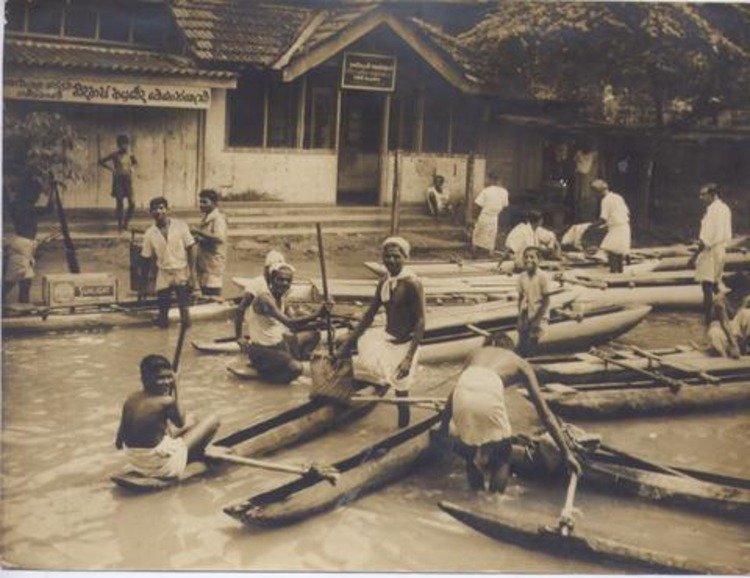
Welewatta has always flooded. This village in the Kolonnawa Divisional Secretariat (DS), home to 1424 families, floods when the Kelani River swells during the rainy season. Water overflows into this community on Colombo’s suburban edge; and for generations, residents simply adapted.
Sumanadasa, now 70 years old, grew up in a raised house built by his parents in 1960, complete with a traditional canoe (oruwa) placed by the side of his home. He carries decades of memories of sharing his life with the yearly floods. Neighbours helped each other when the waters came, and flooding was not seen as a disaster but as part of life; something they had to learn to live with.
But something has shifted. This account, based on an oral interview with Sumanadasa, a lifelong resident of Welewatta, traces how the experience of flooding has transformed over his lifetime from a manageable seasonal phenomenon to an increasingly destructive crisis. His testimony reveals how unplanned development and consumerist lifestyles dismantle the organic relationships between people and the environment.
Living with floods
“Floods have always been here”, Sumanadasa begins, when I ask about his first memory of flooding. “From the time I can remember, there was flooding almost every Vesak [in the month of May], and then in December which we used to call Naththal Pitāraya (the ‘Christmas Overflow’).”
His recollections are undramatic and said casually. The only flood that was different was the 1989 event, which he calls Maha Gan Wathura (‘the Great Flood’). “That was exceptionally high water. I was in my early thirties then.”
If floods came almost every year, what preparations did families make back in the day?
There was no special preparedness, according to him. The routine was simple and familiar. Every elevated house in the village had a soldaraya, an overhead storage platform built into the structure, specifically for flood times. “When the flood came, men were worried about their buffaloes and made sure to untie them so they could swim away to higher ground. Women made sure all the clothes were tied in a sari and put them in the soldaraya.”
In most years, the floods didn’t reach the houses. Apart from 1989, and then much later in 2016, and of course 2025, the water stayed below floor level. “So we remained in our home”, he explains. Families from lower-lying homes would temporarily move into houses like his on higher ground in the early days. “There were a few houses in those days into which the rest of the village moved when there was a flood. My house was one of those.”
And when even the elevated houses flooded? “Most of those houses had an oruwa. People got into it and paddled to safety, mostly staying in places like temples.”
When asked about the impact of floods in those days, Sumanadasa’s assessment reflects how normalised the experience had become. “The damage was most of the time a loss of the elawalu koratuwa (vegetable garden). The buffaloes saved their lives by swimming to higher ground.” The losses were predictable, manageable, and part of the seasonal cycle.
This is not to say flooding was without danger in those days. Sumanadasa recalls one or two accidents over the years when an oruwa flipped while people were paddling them, and lives were lost. Yet even these tragedies were understood as inherent risks of a known system. The community had knowledge, tools, and practices, to manage flooding, even if that management was never perfect or entirely safe.
Flooding in those days was understood, not as an environmental or climate disaster, but as part of the fabric of daily life. It came as expected, sometimes at lower levels, sometimes higher, but always anticipated.
Sumanadasa even speaks of Yālu Wathura, which translates directly as ‘friendly flood’. According to him, a Yālu Wathura would often follow a severe one. This was largely made up of clean rainwater, and its ‘duty’ was to wash away whatever mud had been left behind by the heavier river overflow. His memory of Yālu Wathura explains how generations engaged with flooding as a natural cycle where nature itself provided the answers for recovery.
Sumanadasa’s memories include swimming competitions among young people and fish from the river finding their way into gardens where they could be easily caught and made into fresh curry. The water was clean then, he recalls. “We used the water that came through the flood for our day-to-day work, washing clothes and such.”
The simplicity of life then made coexistence with flooding possible in ways it no longer is. The most valuable possessions to protect, Sumanadasa explains, were clothes and perhaps a battery-operated radio. Furniture meant mainly a cupboard. When the floods came, loss was measured in vegetable gardens. Recovery required no external aid. Families simply returned when the waters receded, cleaned up, and resumed their lives.
The government occasionally provided cooked meals during floods and dry rations through cooperatives afterward, but this was the extent of assistance. Back then, people did not expect compensation from the government for flood impacts as they do today. Flooding was not recognised as a disaster requiring relief, as at present. It was simply part of life in Welewatta.
The wela or marsh played a crucial role in making human-flood coexistence possible. The village name ‘Welewatta’ itself is derived from wela and watta, meaning “land in a marsh”.
Sumanadasa describes several ways people engaged with the wela throughout the year. “The wela stores water during the rainy seasons. During the dry season, it is still wet, so some people find better places to grow vegetables in the wela during the dry season.” The marshland also supported livestock. “The wela also provided grass for the buffaloes to feed on”, he explains.
These marshlands served as vital natural infrastructure, holding and slowing floodwater. “Earlier, water first filled into the wela, and then came to the gardens, and then, if it was more severe, into the houses.” This natural progression gave people time and warning to prepare themselves.
The transformation
So has flooding changed since those early days?, I asked.
“Yes, very much”, Sumanadasa responds. “The water is no good now. It smells bad. The mud that comes with the water is dark.” He continues: “We experienced massive floods in 2016 and again in 2025 [during and after Cyclone Ditwah]. Both of these entered into my raised house, which had only been affected once before in a similar way, back in 1989.”
The impact, he explains, extends far beyond his own household. “There are a lot of people in this village now. Earlier there were just a few families, but the number of houses that get flooded is huge now.” But it’s not just the number of houses, it’s what people lose. “There is a lot of electronic equipment, furniture, vehicles. The damage to those things means a lot of losses. There are people who are self-employed and run small businesses. Their livelihoods also get impacted.”
The traditional adaptations that served for generations have now become inadequate. The oruwa, once the lifeline during severe floods, is now nearly useless. “It’s difficult to take it through the narrow roads”, Sumanadasa explains. “Earlier we only had to save our lives with the oruwa. Now we have plenty of things that we have to save.” His elevated house, built in 1960 specifically to remain above floodwaters, has been inundated in the two major floods affecting the Colombo District in the 21st century.
Why the marshlands disappeared
The transformation Sumanadasa describes is not merely about more frequent or higher floods. It’s about a fundamental change in how water moves through the landscape in towns and cities.
“Now there is no wela. All the welas have been filled and used for various construction projects. There are plenty of container yards, warehouses, as well as housing settlements that started with the involvement of the politicians.”
According to Sumanadasa, politicians in the area have given the marshlands to their political supporters who help them during elections. The people who received this land have either built houses, or the land has been purchased by companies to build warehouses.
This process has been clearly visible since the early 1990s, he says, and now there is almost no marshland left. Without the marshlands to absorb and slow the water, floods now arrive with devastating speed and volume. “Flood water comes directly into houses.”
The disappearance of the wela happened gradually over decades but accelerated dramatically in recent years. What were once open wetlands that could hold floodwater have been systematically filled in and built over. The water that once spread across these natural buffers is now funneled through narrow roads, carrying pollution and garbage directly into homes. The natural warning system, where water would first fill the wela before reaching gardens and then houses, has been eliminated entirely.
However, the community is not fully innocent in this transformation. When asked who received plots of land from the wela, Sumanadasa mentioned that people from both inside and outside the village benefited from these political perks. This means that both the politicians who distributed the land, and the people who received or took possession of them, are culpable in the disappearance of the wela.
It is deeply ironic that a place named for its relationship with wetlands has systematically destroyed those very wetlands. What had served as the community’s natural flood protection has been destroyed by the development that took place in the area over the past few decades. These transformations served political and commercial interests while destroying the natural systems that protected the community for generations.
From coexistence to fear
The severity and nature of the floods, along with the increasing complexity of life, have changed the way people perceive flooding; shifting from a matter of coexistence to a phenomenon to be feared. “Our lives are not as simple as they used to be”, Sumanadasa reflects. “We’re happy now if the flood does not come. Instead of untying the cattle, now we have to drive our vehicles out of the village. Things are very different now.”
This simple statement captures a fundamental transformation. In the past, flooding meant following familiar routines such as untying cattle, storing clothes in the soldaraya, and moving between houses. People knew what to do, and the community helped each other through it. Now flooding brings fear and anxiety. People worry not just about the water but also about losing their many possessions.
The regular Vesak floods and Nathal Pitāraya are now unpredictable and cause much more damage. The water that was once clean now smells bad and leaves garbage everywhere. People used to know what to expect and how to handle floods. Now they feel helpless.
Flooding once brought people together. Now it causes losses and makes everyone vulnerable. The government used to provide meals occasionally. Now people expect the government to compensate for damages and rescue them. Communities can no longer manage floods on their own.
The knowledge, tools, and marshlands that once helped them live with floods are all gone. The disappearance of the wela was not just an environmental loss, but the end of a long history of living in balance with the Kelani River.
Warning
Welewatta’s story is a warning about what happens when development destroys the natural systems that keep a community safe. The village was named for its marshlands, yet it has filled those very lands in, destroying its own capacity to live with flood water. As the wela disappeared, so did the clean seasonal floods and the community’s traditional ways of adapting.
However, the crisis is not just about the loss of land. As life has become more complex, the organic relationship between people and their environment has been challenged. Today’s residents carry the burden of protecting expensive electronics, vehicles, and businesses, which are possessions that cannot simply be moved to a soldaraya or carried in an oruwa. In the nearby Megoda-Kolonnawa area, a boutique (petti kade) owner reported incredible losses of around 150 lakh rupees from the 2025 floods (Wickramasinghe 2025).
The situation is worsening. The 2025 flood was the most severe in recent times, reaching approximately 500mm higher than the 2016 event (Yehiya 2026). Climate change projections suggest the crisis will only deepen. Nearly 70% of the Kolonnawa DS area lies below sea level, and with sea levels expected to rise by 210mm by 2050 (Yehiya 2026), flooding will become even more frequent and devastating.
Welewatta’s story is not unique. Data from the Urban Development Authority shows that across Kolonnawa, land used for warehouses and storage more than tripled between 2008 and 2022, growing from 32.25 hectares to 108.3 hectares. During the same period, water bodies were cut in half, dropping from 56.76 hectares to 28.5 hectares. Marshlands and wetlands also shrank by half, from 44.23 hectares to 22.5 hectares (Sunday Times 2024).
These numbers confirm Sumanadasa’s experience that natural flood protection was sacrificed for the sake of commercial buildings and political interests. The wela once protected the people of the adjacent watta. The loss of the wela was everyone’s loss in Welewatta.
Shashik Silva is Chief Operating Officer at the Social Scientists’ Association and a resident of Kolonnawa.
Image source: 1966 flood © The Times of Ceylon (Department of National Archives, http://124.43.74.75:8080/atom_times/index.php/326-IM-581-0335-1720222)
References
Sunday Times. (2024). “After the floods, Kolonnawa and other Colombo suburbs come under the microscope”. (16 June): https://www.sundaytimes.lk/240616/news/after-the-floods-kolonnawa-and-other-colombo-suburbs-come-under-the-microscope-560395.html
Wickramasinghe, Kamanthi. (2025). “Megoda-Kolonnawa residents struggle to revive lives after devastating floods”. Daily Mirror (10 December): https://www.dailymirror.lk/news-features/Megoda-Kolonnawa-residents-struggle-to-revive-lives-after-devastating-floods/131-327407
Yehiya, Riza. (2026). “Kelani River: Colombo’s lifeline at risk”. The Morning (7 January): https://www.themorning.lk/articles/vON8LlQXGEdbKK5g4792
You May Also Like…
Mining Heavy Mineral Sands: Deepening Dependency, Not Enhancing Leverage
Amali Wedagedara
The decision to mine mineral sands along two-thirds of Sri Lanka’s coastline is fuelling anxiety and tension among...
The Art of Witness: Memory and Resistance in Sri Lanka
Yolanda Foster
When I first arrived in Colombo in the 1990s, I was in my twenties and had just begun a volunteer role with Peace...
‘Border villages’: Emergence, Salience, and implications for ‘Community’ in Sri Lanka
Viyanga Gunasekera
Despite Sri Lanka being an island and not sharing land borders with another country, the term ‘border villages’...