
Mistaking Continuity for Change and Renewal for Rupture: Two Years of NPP Rule
Pradeep Peiris
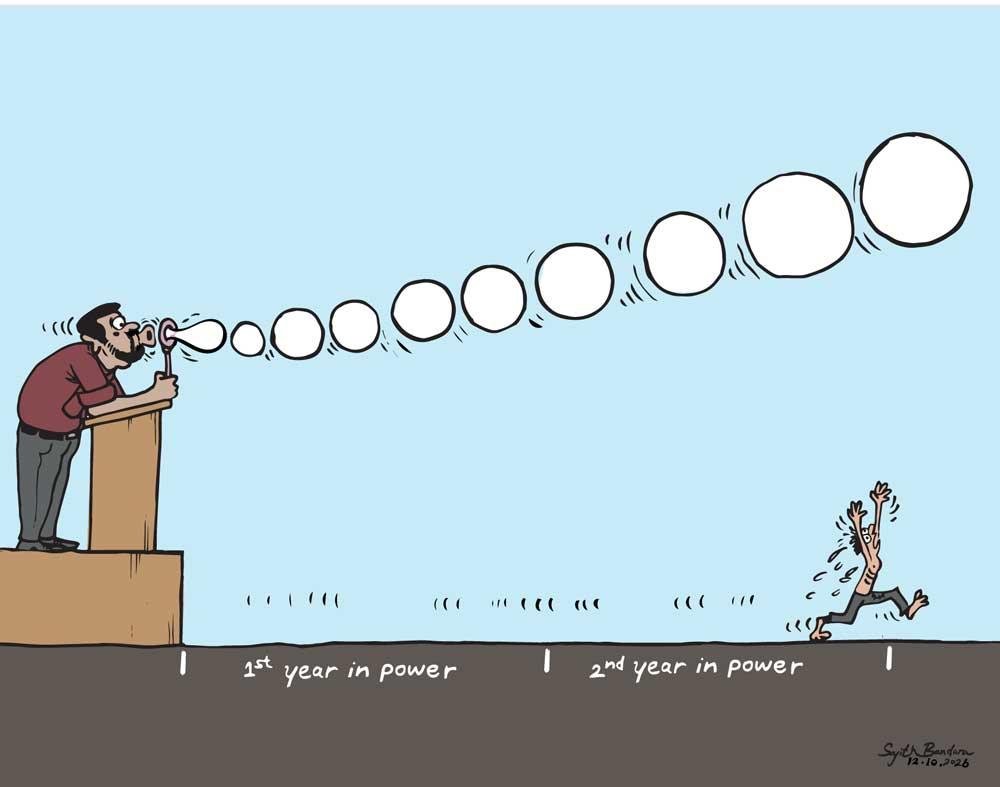
“Sahodarayas (comrades) / Sahodarayange Aanduwa (the government of comrades) have ruled the country for two years – and it is still in one piece!” This is how the old ruling elite speak of the National People’s Power (NPP) in the wake of its 2024 election victory. This sneering use of ‘comrade’ is intended to remind people of the true character of the NPP: a) a political group that has a violent past; and b) a group from outside of the traditional ruling classes.
Before the election, this liberal-conservative elite class predicted post-election violence if the NPP won, and that the new government was doomed to fail as it was an inexperienced lot. Therefore, in counterpoint, the NPP’s two years in power itself is a victory to be celebrated. It is a verdict on the resilience of Sri Lankan democracy—democratic institutions are seen as legitimate not only by elites, but also by subalterns.
In recent weeks, many columns have examined the NPP’s two years in power. However, those Manichean analyses—good vs bad—serve neither the NPP nor Sri Lankan society. Denying the NPP’s appreciable record over the past two years, is as dishonest as refusing to be critical of it when deserved. This essay, while acknowledging the commendable democratic governance exhibited by the NPP, argues that the NPP is unwilling to be the agent of change the country expected when electing it to office. It is important to remember that the NPP was given an unprecedented electoral mandate not to be an agent of continuity but of change; and not an agent of renewal but of rupture.
A government of ‘good governance’
Judging by its credentials over the past two years, the NPP is perhaps the best government of ‘good governance’ Sri Lanka has had since independence. While not denying exceptions to this verdict, the NPP’s delivery of governance is, in general, objective, decent and committed. It is only confused about its political role, which this paper discusses later.
The NPP had to face tremendous challenges in its first two years. It took office in an extremely challenging economic environment following the unprecedented 2022 economic crisis. The situation, already bad, worsened with Cyclone Ditwah’s landfall. This disaster was far more severe than the 2004 Indian Ocean Tsunami in terms of the damage it caused to the country’s infrastructure, as it affected almost all districts. In addition, the US-Israel war on Iran in the Persian Gulf further tightened the screws on the economy. The new government also had to deal with unexpected diplomatic challenges following the US Navy sinking two Iranian ships in the sea close to Sri Lanka. In contrast to its political rivals, the NPP, with its fairly educated yet novice members in professional politics, showed considerable professionalism and political maturity in handling these challenges.
Compared with previous regimes, state institutions function independent of political influence. In addition, the NPP government invested more resources to improve the capacities of those institutions further. The institutions responsible for upholding law and order—police, courts and the Bribery Commission—have been given special attention. Moreover, it provided political leadership for those institutions to execute their duties autonomously. In the past, criminal politicians and their cronies, irrespective of whether they were partners of the regime or not, were protected from the law by the cartelised political party system. But under NPP rule, the law is being applied to politicians and their cronies responsible for crimes, no matter how powerful they are. If it were not for NPP rule, investigations and legal action in cases such as the Easter Sunday attacks and the massive corruption cases involving the Rajapaksa family and their cronies would not have progressed.
Over the past two years, the NPP demonstrated unequivocal commitment to a procedural form of democracy—one that focuses on institutions rather than outcomes. Interestingly, it is this procedural form of democracy that the country adopted since independence that has produced an ‘elite democracy’ in which citizens are not the rulers but the ones who suffer the brunt of elite competition. Over the past two years, NPP has demonstrated that reforming the political system to improve democratic participation is not its priority. The NPP seems to believe that efficient, committed, and uncorrupt leaders could make the old system work for the betterment of citizens and make the people, not the elites, sovereign. Therefore, the underlying assumption is that it was the corrupt politicians who made the democratic model faulty, and the system needs no reforms.
Market economy with a human face?
Since 1977, Left parties have been vocal as critics of the neoliberal economy while in the opposition, only to capitulate to it once in power. We witnessed this in 1994. The People’s Alliance and its Left coalition coined the term “market economy with a human face” when it succumbed to the neoliberal economic policies J. R. Jayewardene introduced in 1977. Since then, traditional Left parties have had no qualms about supporting successive governments which continued with the neoliberal economic policy. While in opposition, JVP leaders ruthlessly exposed the hypocrisy of traditional Left parties. However, in the run-up to the 2024 election, when they began to see power within reach, the NPP announced that it did not intend to shift from its predecessor’s economic policies, although the JVP is a party historically opposed to capitalist economic policy.
It is true that the NPP’s hands were tied and it had only limited options in the International Monetary Fund (IMF) loan negotiations that the previous Ranil Wickremesinghe government initiated following the announcement of bankruptcy in 2022. Since assuming power, the NPP has maintained the core framework of the IMF and World Bank economic reform programme despite its pre-election promise to renegotiate the terms of the agreement. The government has been accused of slashing welfare and imposing high indirect and direct tax rates, hurting the household economy of poor and lower middle-income classes.
According to a recent opinion poll, 51% of Sri Lankans claim that their household economy has worsened compared to a year ago, while 30% said it remained the same—meaning it is difficult (CPA-SI 2026). However, only 20.7% said they are dissatisfied with how the government and the IMF are working together to address the economic crisis. Unlike previous regimes, this government has shown it can implement IMF reforms efficiently and faithfully. In appreciation of this, the IMF staff team that visited the country in September expressed satisfaction with how the government handled the economy and said, “Sri Lanka’s economy has proved remarkably resilient to successive shocks” (IMF 2026).
Whether the NPP’s adoption of neoliberal economic policies was a choice or lack of choice is debatable, but the attitude of the government over the past two years suggests that the majority of the members in parliament have signed up for such an economic philosophy. It is not difficult to find NPP MPs, including senior JVPers, speaking about the economy the same way proponents of neoliberal policies do. For example, senior JVP leader and minister, Sunil Handunnetti, months after assuming power, stated that the government does not intend to continue Aswesuma, declaring that Sri Lanka must “move away from this dependency mentality” (Gunadasa 2025). The NPP leadership’s insensitivity towards the grievances of the people of Mannar island—who face an existential crisis due to the installation of wind power turbines and due to the proposed ilmenite mining project—is also testimony to the fact that, like previous regimes, this government prioritises state income and the interests of the capitalist classes over the concerns of its citizens (Korf and Peiris 2026).
It must be acknowledged that the NPP intervened to protect citizens from market deviations from orthodox market economic principles. For example, it reactivated the Paddy Marketing Board to purchase paddy directly from farmers and tried to undermine the rice mill cartel (although it admittedly did not go far). It also made a massive investment in upgrading the state-owned transport sector—renovating bus terminals and train stations, introducing a fleet of Metro buses, in addition to allocating 80 billion LKR to introduce electric trains next year. The modification of the previous regime’s restructuring of the Ceylon Electricity Board is another good example of NPP government intervention in the market to safeguard the citizens and the interests of the state. While implementing a stringent tax policy to increase government income, the NPP invested that income in large-scale infrastructure projects (Dissanayake 2026), whereas previous governments relied entirely on foreign loans. Remarkably, no serious accusations have been made against the NPP or its senior leadership of redirecting state wealth to cronies under the guise of development infrastructure projects or using it to hold extravagant events to boost the party’s or its leadership’s image. Aside from these variations and deviations, there is so far no serious indication that the NPP plans to break with the neoliberal economic policy the country has embarked upon since 1977.
NPP’s soft majoritarianism
Since independence, Sri Lanka has been a majoritarian democracy in which laws and state policies are determined by the preferences of the majority community. Drawing on Yiftachel’s (2000) concept of ‘ethnocracy’, Uyangoda (2011) characterises Sri Lanka as an ‘ethnocratic state’. A basic feature of the ethnocratic state, he states, is:
[t]he setting up of a hierarchical ethnic order, or an ‘ethnocratic social structure,’ which define(s) and affirm(s) the ways in which political structures, institutions, and legislative processes emerge and function in an ethnically differentiated manner. (55)
Against this backdrop, over seven decades, the main political parties, to survive and thrive, played majoritarian politics at election time and in between.
The NPP broke away from the decades-old identity-based electoral engineering tradition of the main political parties at the 2024 election. They attempted to please neither the Sinhala majority nor minority communities in their election campaign. Minority communities across the country voted for the NPP against the wishes of minority parties. Despite the absence of nationalist rhetoric in its campaign, the NPP also won in Sinhala-majority districts. In fact, on the one hand, the NPP leadership came under the wrath of the extremist Buddhist monks and extremist lay elements for not supporting their effort in stirring ethnic tensions on which their political future depended. On the other hand, expediting the legal proceedings of the Easter Sunday attacks, launching a special project to complete investigations into complaints on missing persons by 2027, and releasing over 700 acres of land in the North and East to the public convinced minority communities that the government is interested in seeking justice even if they may not be received well by the majority Sinhala community.
The NPP’s position on ethnicity and democracy can be best characterised as soft-majoritarianism. In the sense that, although it does not actively promote or appear to represent Sinhala nationalist politics, works with all the communities without discrimination, and carefully employs secular and non-racist language, the NPP is yet to take concrete steps to transform the majoritarian politics of the country. The recent saga of Ven. Gnanasara exposed the NPP leadership’s position on Sinhala Buddhist nationalism. The president rushed to appoint a committee to indulge the demands of the Sinhala Buddhist nationalists—allowing Ven. Gnanasara to wear his religious robe in public. After meeting with the chief prelates in Kandy, the prime minister assured the press that her administration remains committed to protecting Buddhism’s foremost place as enshrined in the Constitution. Reacting to the Buddhist monks’ demand for a presidential pardon for Ven. Gnanasara, Minister Lalkantha, a senior JVP figure, vowed that the NPP would not allow racism to raise its head again in Sri Lanka. Therefore, it is clear that the NPP government is against racism but ambivalent about the Sinhala Buddhist majoritarianism that successive governments have nurtured since independence.
The NPP also remains tight-lipped about devolving power, fully implementing the 13th Amendment introduced to address the grievances of minority communities, and addressing demands for truth and justice for war-related atrocities. Despite having pledged to repeal it, the NPP government still continues with the draconian Prevention of Terrorism Act (PTA)[1] that brought immense suffering especially to the minorities. As one commentator stated:
Economically, the North-East remains militarised. Land that Tamil families farmed and lived on for generations is still held by the armed forces, including the cemeteries where fighters were buried. Livelihoods are constrained by occupation, surveillance and the steady expansion of military enterprises into civilian economic life. (Shanmugathas 2026)
Similarly, despite being critical of it while in the opposition and promising to abolish it, the NPP now maintains a disturbing silence about the executive presidency. Though J. R. Jayewardene justified it as necessary to safeguard the interests of minority communities, the practice over the past four decades says otherwise. Successive regimes have used it as an instrument of state oppression with political minorities bearing the brunt of it.
It is understandable that a new government faces difficulties in initiating radical transformations, especially those challenging Sinhala nationalism. However, what is sad is that the government shows no clear inclination to take steps to clear the way for politics that transcend the decades-old majoritarianism.The Chandrika Bandaranaike Kumaratunga government in the 1990s, even without a massive electoral mandate like the NPP has, not only showed it was ready to push forward challenging policy reforms but also took initiatives such as Sudu Nelum and Thavalama to build a public support base for the necessary political transformation. In contrast, the past two years show that the NPP government is either not ready to take the political risk of initiating pluralist reforms or does not believe it needs to change the majoritarian nature of the country’s politics.
The political zeitgeist of the Aragalaya and the NPP’s electoral mandate
There are two general approaches to assessing the performance of a new regime: a) assess the performance against what it promised in the election manifesto; or b) compare the performance with that of its predecessors. However, I argue that both methods are inadequate to assess the NPP government’s performance.
The 2022 Aragalaya (popular uprising against the Rajapaksa regime) produced an unimaginable tectonic shift in Sri Lanka’s politics and catapulted the NPP to power. The NPP’s 2024 victory is not only historic, but also an outcome of a historic moment. Unfortunately, many, including NPP members, seem to have forgotten about that historic moment that dawned on Sri Lankans for the first time since independence. Therefore, the political trajectory and outcome of two years of the NPP’s governance cannot be assessed in isolation from the dynamics that brought it to power—the zeitgeist of the Aragalaya.
In German, ‘zeitgeist’ means ‘the spirit of the age’ or ‘the spirit of the time’. The political zeitgeist of Aragalaya characterises a wide range of radical democratic imaginations: ‘anti-establishment sentiments’, ‘demand for accountability’, ‘crisis of legitimacy of old political classes’, ‘system change’, ‘rejection of old political cleavages such as ethnicity, religion and partisan boundaries’, and ‘ultimate political authority belongs to citizens’. Although anti-Rajapaksa sentiments sparked the initial protests, months of protest produced a civic spirit that demanded a radical transformation of politics. In the backdrop of this political mood, a rare convergence—not an overlap—of political interests of ethnic and religious communities was witnessed. Communities clearly indicated their desire for a new political future and an end to the old system, to forge a new social contract instead of one based on ethnic and patronage politics, and to replace the old corrupt, lumpen political class with young, educated representatives who are emblematic of political integrity.
The NPP was seen as the party that resonated with this ethos the most; it appeared to represent a rupture from the old political class, did not rely on ethnic and patronage politics; the candidates it put forward were educated and not known for corruption scandals or other criminal activities; it advocated against elitist politics and stressed the importance of strengthening popular sovereignty. By contesting the 2019 presidential and 2020 parliamentary elections apart from other parties, the NPP preserved its identity as an independent political entity. Therefore, especially after the 2022 uprising, it was seen as different from other political parties.
On the other hand, progressive protest leaders were attracted to the NPP’s political programme as it was seen as the best political vehicle to sustain their struggle after Ranil Wickremesinghe unleashed a brutal assault on Galle Face protestors in July 2022. Although the Rajapaksas stepped down under mounting pressure from protesters, they avoided becoming politically redundant by electing their archrival, UNP leader Ranil Wickremesinghe, as president. The liberal urban youth who played a critical role during the Aragalaya promptly left the protest site thinking the mission was accomplished or joined the Wickremesinghe government. However, the progressive youth believed the Aragalaya should continue until it produced radical system change in the country’s politics. Hence many of them formed an alliance with the NPP and worked towards its 2024 victory.
Therefore, the NPP’s 2024 electoral victory is not only historic, but it also carries a historic responsibility. It has a mandate that no previous government has been given since independence. The NPP’s impressive liberal democratic report card over the past two years is certainly welcome. However, as a student of politics, I am increasingly unconvinced that their leadership has understood and embraced the historic role entrusted to them.
Pradeep Peiris (PhD., Colombo) is senior lecturer in the Department of Political Science and Public Policy at the University of Colombo. He is the author of Catch-All Parties and Party-Voter Nexus in Sri Lanka (Springer Nature, Singapore, 2022).
Image credit: Sajith Bandara (source: https://bit.ly/4t1T1ZH)
References
Centre for Policy Alternatives – Social Indicator. (2026). Confidence in Democratic Governance Index (Wave 7): Topline Report. Available at https://www.cpalanka.org/topline-report-confidence-in-democratic-governance-index-wave-7/
Dissanayake, Anura Kumara. (2026). “Full Speech of President AKD at NPP Public Meeting”. Newswire (6 September): https://www.newswire.lk/2026/09/06/full-speech-of-president-akd-at-npp-public-meeting/
Gunadasa, Saman. (2025). “Sri Lanka: The JVP/NPP government moves to cut social welfare”. World Socialist Web Site (4 December): https://www.wsws.org/en/articles/2025/12/05/dxny-d05.html
International Monetary Fund (IMF). (2026). “IMF Staff Team Concludes Visit to Sri Lanka” (Press Release No. 26/301). IMF (23 September). Available at https://www.imf.org/en/news/articles/2026/09/23/pr26301-sri-lanka-imf-staff-team-concludes-visit
Korf, Benedikt, and Pradeep Peiris. (2026). “The Tale of Two Betrayals: The Struggle of the People of Mannar”. Groundviews (29 September): https://groundviews.org/2026/09/29/the-tale-of-two-betrayals-the-struggle-of-the-people-of-mannar/
Pinto-Jayawardene, Kishali. (2026). “Is the NPP’s anti-terrorism law meant to protect the ‘people’ or the ‘state’?”. The Sunday Times (23 August): https://www.sundaytimes.lk/260823/columns/is-the-npps-anti-terrorism-law-meant-to-protect-the-people-or-the-state-653165.html
Shanmugathas, Pitasanna. (2026). “Tamils’ Right to Mourn Must Not Be Infringed”. Groundviews (28 September): https://groundviews.org/2026/09/28/tamils-right-to-mourn-must-not-be-infringed/
Uyangoda, Jayadeva. (2011). “Travails of State Reform in the Context of Protracted Civil War in Sri Lanka”. In Kristian Stokke and Jayadeva Uyangoda (eds.), Liberal Peace in Question: Politics of State and Market Reform in Sri Lanka (35-62). New York and London: Anthem Press.
Yiftachel, Oren. (2000). “Ethnocracy” and its Discontents: Minorities, Protests and Israeli Polity. Critical Inquiry, 26 (4): 725-756.
Note
[1] Soon to be replaced with the Protection of the State from Terrorism Act (PSTA), still granting broad executive and police powers to the authorities (Pinto-Jayawardene 2026).
You May Also Like…
Unfinished Business: The Rise of the Financial Bourgeoisie in Sri Lanka
Shiran Illanperuma
“While the economic changes from the time of Dutch rule began releasing the economy and society from the traditions of...
Unfinished Conversations: The Life and Works of Intrepid Human Rights Lawyer Basil Fernando
Kishali Pinto-Jayawardena
In a poem titled “The Faces” in a collection aptly called Pride and Pain in Difficult Times sent to me by his daughter...
A Funeral in Rathugala
Amalini De Sayrah
May 9th is an overcast day in Rathugala. Figures dressed in white zoom past on motorbikes or walk slowly through the...