
Mining Heavy Mineral Sands: Deepening Dependency, Not Enhancing Leverage
Amali Wedagedara
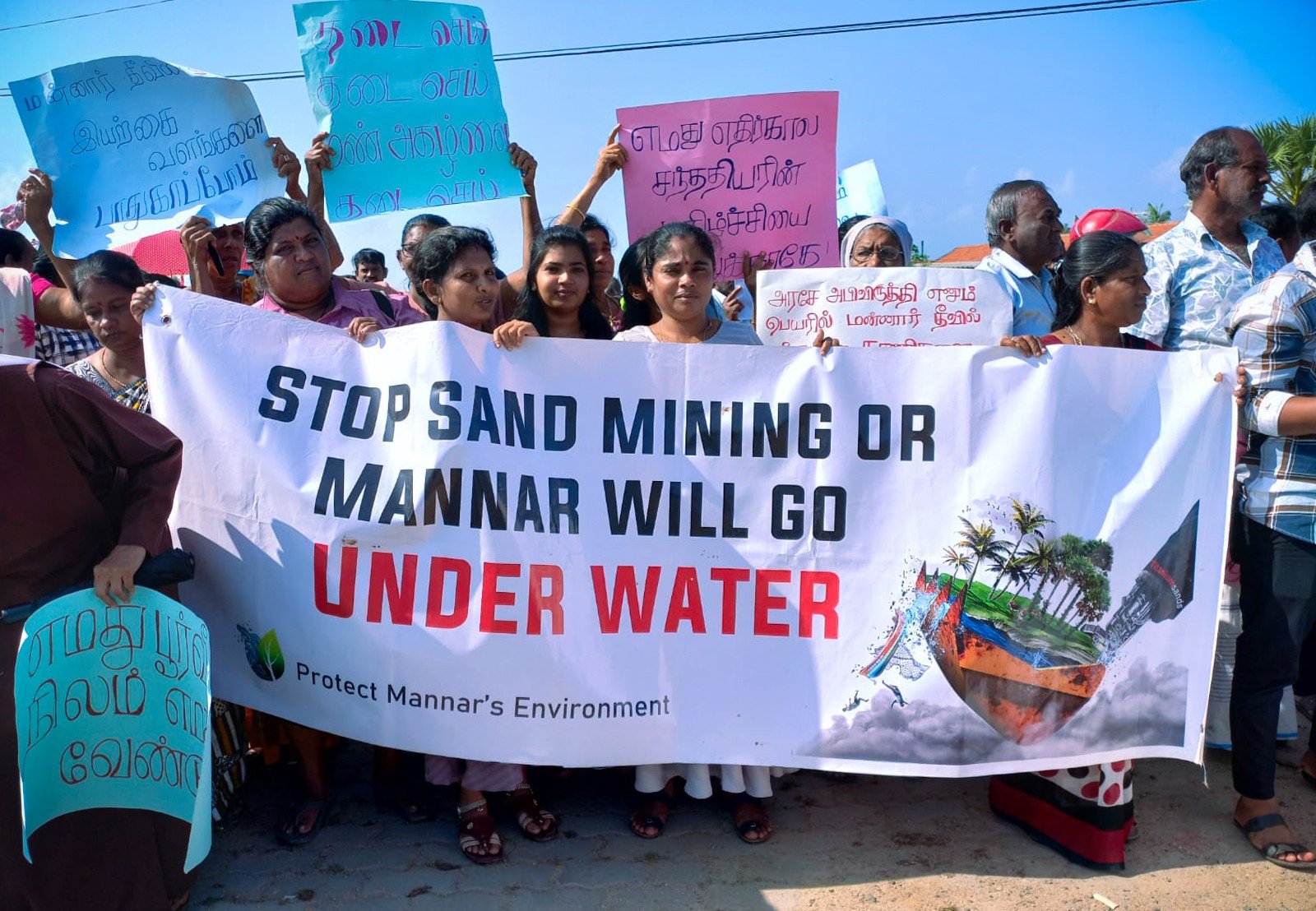
The decision to mine mineral sands along two-thirds of Sri Lanka’s coastline is fuelling anxiety and tension among communities living near proposed mining sites. The Government of Sri Lanka (GoSL) and pro-mining lobbies disregard these concerns and highlight opportunities of ‘value addition’, generating foreign exchange, and industrialisation of the Sri Lankan economy. They also ride on global narratives set by the World Bank and other financial, political and environmental institutions that rare earth elements (REE) are critical to the “green transition”.
This article argues that Sri Lanka’s National Mineral Policy 2026, framed as “value addition”, is structurally incapable of delivering industrialisation or leverage. The state’s new framework for management of Sri Lanka’s national mineral wealth is designed to extract raw materials for global supply chains while externalising social, environmental and economic costs onto local communities. As a small island nation which relies on a stable coastline for its survival, coastal mining is not a sustainable economic strategy for Sri Lanka.
The article illustrates that mere possession of valuable minerals is not a sufficient condition to exercise leverage in the global mineral supply chain dominated by large foreign firms, financial capital, extension services and industrial and manufacturing capabilities. The mineral rush, a new form of commodity frontier driven by big finance, high-tech, aerospace and defence industry, that Sri Lanka hopes to benefit from, will reproduce dependencies and entrench Sri Lanka as a low-value mineral producer while degrading the environment, damaging local economies, displacing people, and undermining sovereignty.
Global critical mineral production deep-rooted in dependency
Resource-rich countries in Africa, Latin America and Asia are envisioned as the bedrock of the future green global economy. After being caricatured as examples of ‘the resource curse’ for decades, mineral-rich countries such as Kenya, Senegal, Mozambique and South Africa have attempted to break free through ‘value addition’. However, many of them are stuck in the concentrate stage where mineral separation plants (MSPs) transform raw sands into individual mineral concentrates such as ilmenite, rutile, zircon and monazite. Even in cases where foreign companies from Australia, France and Ireland are involved, instances of graduating to downstream processing (mineral upgrading into synthetic rutile or titanium slag for pigment manufacturing, titanium metal production, ceramics, refractories using heat and hydrochloric acid) have been limited and proven unsuccessful.
Industrial mining and separations have not generated significant foreign exchange either. Base Titanium, an Australian company operating the Kwale mineral sands in Kenya, declares that in 2023 the company paid only USD 53.4 million in tax, royalties, VAT and other statutory payments to the Kenyan government. Foreign companies are simply interested in controlling the value chain by getting hold of net mineral stock, exporting them to their offtake partners (trading house, smelter, refiner or industrial end-user) and accruing profit.
Popular narratives attribute poverty in these countries to a ‘resource curse’—that poverty is caused by corruption and conflict—obscuring how the global value chain on minerals is organised asymmetrically to keep resource-rich countries at the bottom rung.
Global value and supply chains have a pecking order. Raw material or commodity producing countries are located at the bottom, while countries engaged in processing, manufacturing, design and branding capture the value. Contrary to traditional value chains, mineral sands value and supply chains are controlled by China. China dominates in downstream processing and added value vis-à-vis all critical minerals (copper, lithium, cobalt, graphite and rare earths). According to the International Energy Agency (IEA), the value chain is unlikely to change in the near future.
For many minerals, refining capacity remains closely linked to established chemical processing infrastructure, accumulated technical expertise and proximity to downstream manufacturing. As a result, even as mining becomes more geographically diversified, midstream bottlenecks persist, reinforcing supply chain vulnerabilities and strategic dependencies. (IEA 2026)
Within this value chain, mineral-supplying countries only earn rents from extraction.
Mineral-rich countries in Africa, Asia and Latin America have attempted to exercise leverage by cementing their position and breaking free from the extractive growth model they have been trapped in historically. Zambia, Zimbabwe, Ghana, Liberia, Mozambique, Botswana, the Democratic Republic of Congo (DRC), Argentine, Brazil, Indonesia, Malaysia, India and South Africa have emphasised value addition in mining, promoted FDIs, and tried to develop linkages between the mining and manufacturing sectors.
Despite these efforts, structural reforms and FDIs, mining in Africa remains “an enclave economy”, isolated from other industrial sectors (Ackah-Baidoo 2020). Internationalised extension services, such as mine equipment supply and construction services, are examples. African countries, except South Africa, remain net importers of heavy machinery needed for mining from the United States, China, France and the United Kingdom. Automation of mining has, on the one hand, reduced employment opportunities for local people and, on the other hand, blocked local people from accessing well-paid jobs in the mining sector due to skill gaps (Deberdt and Le Billon 2024; Wegenast et al. 2019).
The experience in Zambia illustrates the particular challenges faced by mineral-rich countries. Despite being a major mining country, particularly for copper, and the existence of bilateral arrangements such as the Zambia-DRC battery manufacturing plant, value addition initiatives have stalled. Not only are the dominant foreign mining companies reluctant to move beyond extraction, the off-take agreements Zambia forms with foreign buyers before mining even begins make it difficult for local companies to access mineral inputs needed for value addition (Cervantes Barron et al. 2024). Local companies are forced to import copper produced in Zambia at a higher price and are at risk of being “priced out of participating in value addition business models”. Furthermore, macroeconomic vulnerability in Zambia, such as a weaker currency and high interest rates, coupled with energy costs, has meant that “start up costs […] are prohibitively expensive”. Meanwhile, debt crises and subsequent structural reforms in the mining sector leading to privatisation and financialisation led by the International Monetary Fund (IMF) have radically eroded industrial bases in Zambia, and in South Africa as well.
Abusive transfer-pricing and under-pricing of ores and concentrates by foreign companies have long been a source of illicit financial flows. In Zambia itself, trade misinvoicing through shell companies, offshore accounts, exploitative contracts, volume misreporting and illicit trade practices between 2012 and 2020 had generated a USD 44.9 billion loss (Banda and Hinfelaar 2025). In Burkina Faso, USD 4.93 billion was lost in illicit flows between 2012 and 2021 in five key mineral trades (ITIE-BF 2024). Empirical evidence confirms that illicit financial flows are endemic in extractive economies, be it South Africa, DRC, Nigeria or Angola (Nkemgha 2026). Apart from weak governance mechanisms and corruption, structural weaknesses arising from liberalising capital accounts and information asymmetries between foreign mining companies and local governments have aided capital outflows.
Geopolitical competition aligned with green industrialisation to capture the value chains can also produce new forms of green colonialism and imperialism as the dominant states assert control over natural resources. South Africa, for example, is accused of being sub-imperialist by maintaining “extractive relations [with its neighbours similar to those] between core and periphery in the world capitalist system” (Bond 2024). Contrary to expectations of regional collaboration and leverage, South Africa, as a semi-peripheral state, uses its comparative dominance over neighbouring African countries to carry out “super-exploitation, resource extraction and unequal ecological exchange” (Bond 2023).
The African experiences are instructive of the challenges faced in value addition and developing downstream activities. The leverage African countries exercise is linked to their capacity to produce high volumes of minerals. These experiences indicate that Sri Lanka would have to intensify mining at industrial scale by opening more land for mining along the coastal areas from Puttalam, Mannar, Trincomalee, Pulmoddai, Thirukkovil, Kirinda to Beruwala and multiplying extraction volumes.
Image 1, created by the Movement for Climate and Economic Justice (MCEJ) based on exploration licences issued by the Geological Survey and Mines Bureau (GSMB), illustrates areas earmarked for heavy mineral sands mining in Sri Lanka.
Image 1: Areas earmarked for mineral sands mining in Sri Lanka
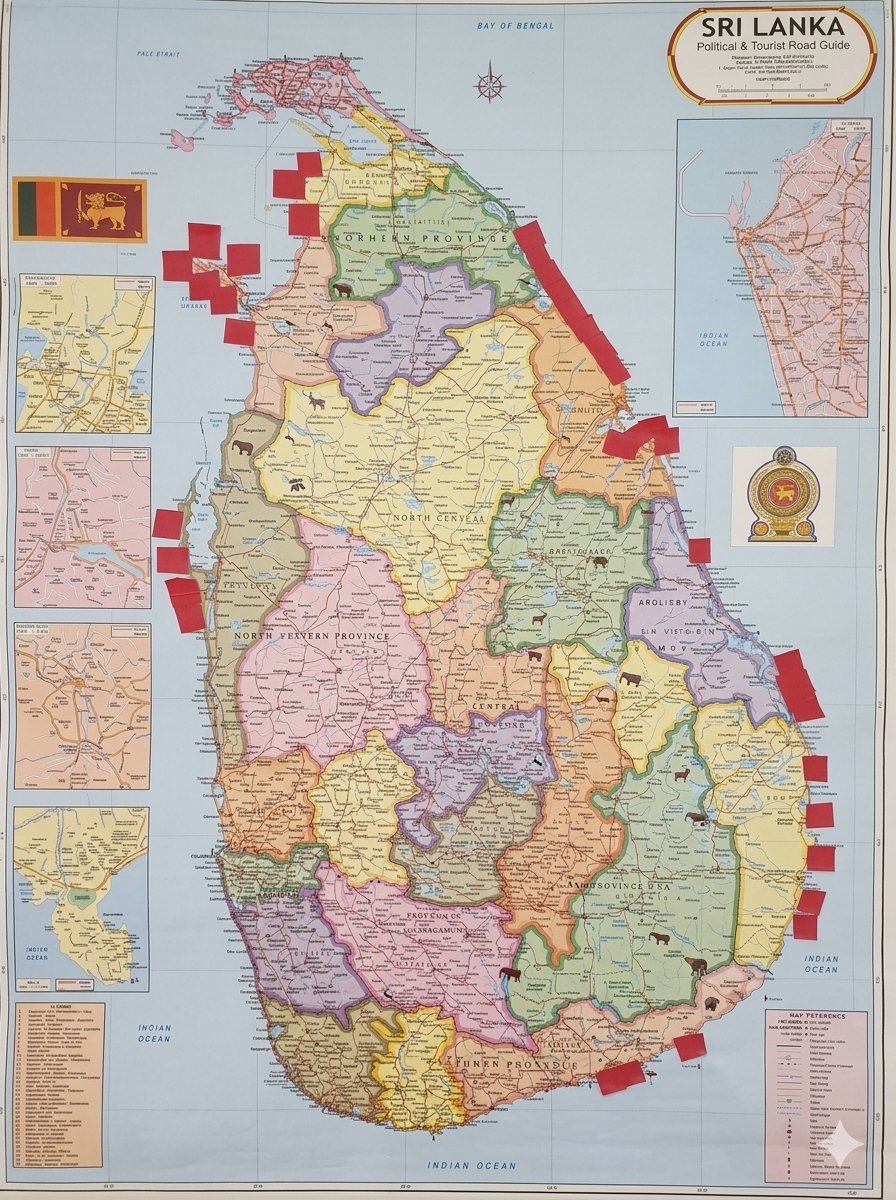
Source: Movement for Climate and Economic Justice (MCEJ)
They also indicate that foreign firms will dominate the industry, as Sri Lanka lacks technology, capital and infrastructure (energy and chemical industry). Sri Lanka will have to accept social, economic and environmental degradation as a necessary cost. Since the government would be unable to compensate for the costs in real market value, the greatest burden, or the ‘sacrifice’ for making Sri Lanka a mining hub, would have to be borne by the people living near mining sites.
Mineral sands mining in Sri Lanka should neither be a lobbying contest, nor a narrow investment decision. The question is not whether Sri Lanka can attract foreign investors to mine our beaches, but on what terms, for whose benefit, at whose cost, and with what value and for whom. Therefore, any assessment on whether mineral sands mining is a viable industry for Sri Lanka to pursue, or not, should factor full life cycle costs (initial and operating costs, rehabilitation and decommissioning costs, post-closure care, cost overrun risks, water pollution and scarcity, displacement and resettlement, health and livelihoods, opportunity costs over land and water, unequal distribution of costs and benefits, and such) and entrenched dependencies in the supply chain of heavy mineral sands (foreign finance, technology, off-take agreements, extension services, processing and manufacturing).
At present, the viability of mineral sands mining is assessed solely by the number of investor proposals, even though these proposals do not promise substantial investment or foreign-exchange revenue. As the next section discusses, the entire value-addition proposal also rests on weak foundations: it degrades the environment, damages local economies, displaces people, and undermines sovereignty.
Value addition through devaluation and dispossession
The National Mineral Policy 2026, a forward-looking document on paper, is defective in its design. The value addition on minerals that the policy advocates is predicated upon the devaluation of, for example, the environment, people, and their livelihoods, as well as governance frameworks. Dispossession is also built into the model.
Sites earmarked for mining are neither empty nor uninhabited. Mannar Island, for example, has around 75,000 people, among whom 22,345 are fishers. The island has paddy fields, coconut lands, home gardens and other farmlands. In Oluvil in the Eastern Province, there are competing claims over land allocated for the Taprobane Minerals project by coconut and peanut farmers. Industrial mining in these areas will dispossess local inhabitants of their farms and communal lands, fishing grounds, livelihoods and homes.
How does the government determine that mining projects bringing a few million dollars of investment are worth dispossessing and displacing thousands of people while destroying their livelihoods and dignity? The formulas of development have placed a higher value on a few million dollars in the name of FDI while degrading and undermining the local communities, their aspirations for development, their livelihoods, the wildlife and the environment.
In the recent past, be it Rathupaswala or Mannar, successive governments have demonstrated that not only are they willing to sacrifice people for ‘development’ but also resort to deploying the military to quell people’s resistance. The idea that FDIs, foreign exchange and capital-centric development are of greater consequence than food production—enabling at the very least a subsistence living—and assuring ecological wellbeing, normalises accumulation by dispossession and devaluation of livelihoods, environment and labour (particularly of women) built into the neoliberal development model. Not only are the local people and their economies undervalued, but it’s also expected that the dispossessed will eventually do the hazardous work in the mines.
EIAs reduced to tokenism
The pattern of trivialising the social and economic impact of mining on local people is visible when it comes to the environment as well. Many proposed mining sites overlap with protected environments. It is also a fact that Sri Lanka’s coastline is already fragile and subjected to erosion. However, environmental impact assessments (EIAs), the principal framework to reveal the magnitude of environmental impact, have proven to have failed. EIAs have fallen prey to the evils of commercialisation, as conducting EIAs has become the responsibility of the companies implementing development projects. Across numerous mega developmental projects, from the expressways, Mattala Airport and Magampura Port, the Port City project and Mannar wind farms, EIAs failed in their function of enacting regulatory safeguards and resulted in understating the environmental costs and deceiving the public. In addition, EIAs are structured around the idea that environmental costs are inevitable in cases of development and neglect to account for environmental externalities in the cost-benefit analysis, which is highly problematic in times of the climate crisis and ecological breakdown that people in Sri Lanka are going through.
According to a comprehensive database on heavy mineral sands mining compiled by Bisht and Martinez-Alier (2023), Sri Lanka is the only island state opting for coastal mineral mining, except for Madagascar, which is about nine times larger than Sri Lanka. Thirukkovil, Ampara, Puttalam and Mannar are identified as coastal regions facing severe erosion. Nevertheless, these areas are earmarked for mineral mining. In Mannar, Puttalam and Thirukkovil, for example, foreign companies are given industrial mining licenses without conducting a strategic environmental assessment (SEA). Having no sense of how mega developmental projects like the Port City could have shaken the foundation of the central hills due to quarrying, the government is going to open the vulnerable coast for mineral mining.
GSMB as an enclave of miners
Devaluation is also extended to the governance frameworks. The Geological Survey and Mines Bureau (GSMB), tasked with identifying mineral deposits, licensing mineral exploration and industrial mining, is the regulator of mining in Sri Lanka. However, the GSMB has a notorious track record for not only being corrupt, but also for being technocratic, undemocratic and opaque when it comes to decision-making. Decades of malpractices—former officials holding licences and functioning as advisors to mining companies—qualify GSMB rather as an ‘enclave of miners’, not as the impartial regulator. Unfortunately, the swiftness to transfer GSMB from the Ministry of Environment to the Ministry of Trade, issue policies, amend the Mining Act, or issue new licenses is not reflected when it comes to structurally transforming the GSMB to rid corruption, enhancing transparency and accountability and empowering it as the regulator.
Presently, the GSMB merely functions as a front office to service mining companies. However, the fact that minerals are held in public trust, that these resources belong to the Sri Lankan people, compels (or should compel) the GSMB to play a more people-centred role—to consult communities living close to mining sites, ensure exploration and mining licenses are only issued if communities consent, and maintain steady communication lines with the people. Conversely, this responsibility is outsourced to the mining companies.
Mining companies, in the name of community consultation and acquiring “social licenses”, bribe local politicians and government officials. The corporate social responsibility (CSR) marketing they do—distributing smart boards to local schools, participating in dengue control campaigns, organising cricket matches and marathons—also amounts to unethical inducements, as these community engagements do not accompany informed dialogues on mining. Social media campaigns that mining companies in Sri Lanka conduct are centred around misinforming and hiding social and environmental consequences of mining. Therefore, requirements for free, prior and informed consent (FPIC) that the national policy mandates would not go far to benefit communities.
As the global examples illustrate, devaluation and dispossession of the people, environment and the frameworks of governance are not the exception but systemic and ingrained in the model of profit making in mining. Any development activity founded on devaluing people and the environment will end up transferring wealth from local communities to local and foreign investors, operating as shareholders of mining.
Legal and financial dependency forecloses resource sovereignty
The new mineral policy could be read in parallel to assertions of resource sovereignty and resource nationalism prevalent in the DRC, Indonesia or the Sahel countries, building on permanent sovereignty over natural resources enshrined in international law. However, institutionalised dependencies resulting from financial subordination, weak capital controls, weak regulatory frameworks, significant infrastructure deficit and risky legal frameworks such as bilateral investment treaties and pro-investor clauses make mining an unreliable business.
Over 30 bilateral treaties that Sri Lanka has signed since 1977 with the expectation of attracting investment have become tools to undermine its economic sovereignty. Under the Mines and Minerals Act 1999, foreign companies are barred from owning mining licenses. Nevertheless, several Australia- and UK-based mining companies such as Titanium Sands, Capital Metals, and Iluka operate in Sri Lanka on mining licenses acquired through shell companies, circumventing local ownership rules. In 2021, News1st reported that Titanium Sands acquired licenses through two shell companies in Mauritius—Bright Angel Ltd. and Srinel Holdings (Shazuli 2021). In addition to violating domestic law, Titanium Sands is set to benefit from a tax treaty the GoSL has with Mauritius, resulting in a loss of revenue for Sri Lanka.
How these companies undermine Sri Lanka’s economic sovereignty became apparent recently when the GSMB annulled two industrial mining licenses of Capital Metals citing failure to commence mining (Wijedasa 2023). Capital Metals acquired two mining licenses through a series of nested holding companies, like Matryoshka dolls, each owning the one below it. Capital Metals PLC owns Capital Metals Ltd incorporated in British Virgin Islands (BVI), which owns Brighton Metals Ltd (BVI), which owns Redgate Lanka (Pvt) Ltd. Redgate Lanka holds 39.99% of Damsila Exports (Pvt) Ltd in possession of two industrial mining licenses. Although the GSMB cancelled these licenses in May 2023, it had to reinstate them in December 2023 following threats of litigation against Sri Lanka for violating its Bilateral Investment Treaty agreement with the Government of the United Kingdom and Northern Ireland (Capital Metals 2024). Corruption and governance failure of the regulatory framework on mining in Sri Lanka dominates the discourse on mining, but the Capital Metals example illustrates that Sri Lanka cannot regulate even when it tries. The neocolonial legal architecture does not merely impede resource or economic sovereignty; it legally forecloses it.
Even though Sri Lanka emphasises value addition, foreign firms involved in mining do not agree. The CEO of Capital Metals has openly teased the Government for its claims over value addition by suggesting that the government should learn to walk before it runs. Their business model relies on exporting heavy minerals mined from Sri Lanka to China through offtake partners like the LB Group. Offtake agreements of this nature recall the experience in Zambia discussed earlier where dominant foreign companies enclose mineral trading even before mining begins. The GoSL will receive barely USD 200 million over 10 years as tax and royalties.
The involvement of foreign companies, bringing technology and capital, will no doubt multiply the volume of mineral extraction and exports, but it is less likely to result in value addition and transfer of technology and skills, which would result in local industrialisation capable of loosening the financial stronghold of international financial institutions (IFIs), the technology and skills gap, and the infrastructure deficit, from which Sri Lanka is suffering. Initiatives to build alternative supply chains by the US, EU, Australia and India to reduce their dependency on China treat Sri Lanka not as a partner in industrialisation, but as an emerging frontier for resource colonisation and extraction.
Furthermore, the price that countries in the upper stratum of the supply chain paid is not an option open for Sri Lanka by the simple fact of being a densely populated small island state of 65,610 km2. The Chinese monopoly in supply and value chains comes through the willingness to absorb the environmental and social costs of mining and processing as a necessary and unavoidable trade-off. In conventional dependencies created between the core and periphery, the core countries externalised the environmental and social costs to the peripheral countries. For China, being a developing country in the semi-periphery, acquiring the leverage came at a price. The ‘Rare Earth Kingdom’ in Inner Mongolia, where the Bayan Obo mine is located, and other areas in Jiangxi are highly polluted, with groundwater and farmland contaminated.
The new global rush, reflected in geopolitical alliances and partnerships led by the US, Canada, EU, Australia and India, seeking to create alternative supply chains, risks not only reproducing older forms of dependencies, but also dumping negative externalities on peripheral countries like Sri Lanka.
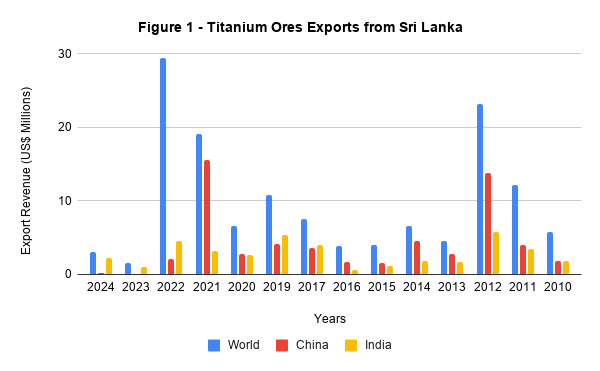
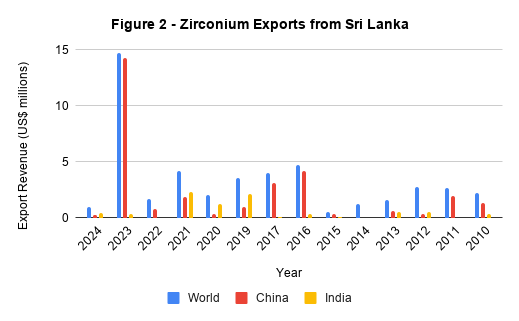
Source: WITS data, World Bank
Figures 1 and 2 illustrate patterns of foreign exchange generated from Sri Lanka’s titanium and zirconium ore exports over more than a decade to all trading countries (world), between 2010 and 2024. China and India are the most significant export destinations. Unlike other commodities exported from Sri Lanka, such as tea, rubber and garments, zircon- and titanium-related exports appear to be highly fluctuating. For example, export of titanium ores which generated USD 29.4 million in 2022 dropped to USD 1.5 million in 2023. While titanium related exports have generated more foreign revenue, albeit less than USD 30 million per year, average income from zircon related exports have been relatively low, below USD 5 million per year with the exception in 2023. The highest value in terms of foreign exchange revenue from titanium related exports was in 2022, 2012 and 2021, respectively.
The extreme oscillation demonstrated in terms of foreign exchange revenue can also explain how competitive minerals from Sri Lanka are vis-à-vis minerals provided by other dominant market players from Africa, and Australia. While Sri Lanka exports zirconium ores and concentrates and several titanium-related products, led by titanium ores and concentrates, titanium oxides, colouring matter, pigments and preparations based on titanium, quantities exported are dwarfed by those of the major exporters such as Australia, South Africa and Mozambique.
The massive mineral production in these countries as well as the ability to guarantee quality makes it not only harder for Sri Lanka to gain market access, but also to get a steady price. In addition to supply, fluctuating demand from producers such as China would affect smaller suppliers. Confirming these observations, a 2025 study on industrial mineral exports states that “mineral sands lack the structural competitiveness observed in graphite and quartz” and recommends focusing on the latter sectors for value addition “recognizing mica and mineral sands as structurally weaker sectors” (Sehan et al. 2025).
Out of the modernisation box
There is no doubt that Sri Lanka must break free from the structural dependency it has been stuck with since independence. However, the new pathways that governments have been presenting, such as mineral based industrialisation and global market integration, will only deepen structures of underdevelopment that Sri Lanka has suffered from since independence.
The National Export Development Plan 2026–2030 envisions “Mineral-Based Industries as one of its eight priority vertical sectors targeted for rapid diversification and global market integration, with a target of over USD 1 billion per annum in export earnings”.
But the government acknowledged that it has not done an impact study to decide “whether the economic benefits that Sri Lanka receives from mineral extraction and imports outweigh the related environmental, social, and economic impact and resource depletion costs before drafting this year’s National Mineral Policy” (Samaraweera 2026).
Those costs will exceed the anticipated foreign exchange revenue. Protected by bilateral treaties and other investment clauses, mining licences will consolidate the grip of global capital and corporate power over Sri Lanka’s economy and permit predators to exploit our natural resources and people for short-term gains.
To find solutions, policymakers must think out of the box of modernisation, which gives primacy to big capital and scale. How do we reimagine development as a debt-burdened island nation at the heart of a climate crisis? Sustainable development planning from which Sri Lankans can benefit should rely on building state capacity, long term ecological sustainability and the wellbeing of the people. Economic activities founded on devaluing local people and the environment, dispossessing them of their livelihoods and wealth, and eroding economic sovereignty cannot be a source of economic development or stability.
Amali Wedagedara (PhD, Hawai‘i) is a feminist political economist, a senior researcher at the Bandaranaike Centre for International Studies, and a member of the Movement for Climate and Economic Justice.
Image source: https://bit.ly/4dKHlEb
References
Ackah-Baidoo, Patricia. (2020). “Implementing local content under the Africa Mining Vision” an achievable outcome?” Canadian Journal of Development Studies, 41 (3): 486-503. doi.org/10.1080/02255189.2020.1809360
Banda, Tinenenji and Marja Hinfelaar. (2025). Corruption and critical mining sector in Zambia. (15 September). Bergen: U4 Anti-Corruption Resource Centre, Chr. Michelsen Institute. Available at https://www.u4.no/publications/corruption-and-the-critical-mining-sector-in-zambia/fullversion
Bisht, Arpita, and Joan Martinez-Alier. (2023). “Coastal sand mining of heavy mineral sands: Contestations, resistance and ecological distribution conflicts at HMS extraction frontiers across the world”. Journal of Industrial Ecology, 27: 238-253.
Bond, Patrick. (2023). “‘Nothing has changed, South Africa’s sub-imperialist role has been reinforced’: Samir Amin’s durable critique of apartheid/post-apartheid political economy”. Politikon, 50 (4): 1-20. doi.org/10.1080/02589346.2023.2280800
Bond, Patrick. (2024). “The US imperial dominance, BRICS sub-imperialism and unequal ecological exchange”. CADTM (10 January). Available at https://www.cadtm.org/US-imperial-dominance-BRICS-sub-imperialism-and-unequal-ecological-exchange
Capital Metals PLC. (2024). Annual Report and Financial Statements for the Year Ended 31 March 2024. Available at https://capitalmetals.com/wp-content/uploads/2026/04/Annual-Report-2024.pdf
Cervantes Barron, Karla; Rebecca K.M. Clube; Roseta Chabala; Mwansa Matokwani; and Mulenga Joseph Chikwamo. (2024). “Value addition for who? Challenges to local participation in downstream critical mineral ventures in Zambia”. The Extractive Industries and Society, 20, 101554. doi.org/10.1016/j.exis.2024.101554
Deberdt, Raphael and Philippe Le Billon. (2021). “Conflict minerals and battery materials supply chains: a mapping review of responsible sourcing initiatives”. The Extractive Industries and Society. 8 (4), 100935. doi.org/10.1016/j.exis.2021.100935
Government of Sri Lanka. (2026). National Export Development Plan (NEDP) 2026 – 2030. Available at https://www.srilankabusiness.com/national-export-development-plan/
International Energy Agency. (2026). Global Critical Minerals Outlook 2026. (16 July). Paris: IEA. Available at https://www.iea.org/reports/global-critical-minerals-outlook-2026
ITIE-BF. (2024). Study on illicit financial flows in Burkina Faso’s extractive sector. (August 2024). Available at https://eiti.org/documents/study-illicit-financial-flows-burkina-fasos-extractive-sector
Nkemgha, Guivis. (2026). “The extractive sector and illicit financial flows in Africa: mechanisms and policy implications for transparency and governance”. Economics of Governance, 27, 28. doi.org/10.1007/s10101-026-00367-1
Samaraweera, Buddhika. (2026). “Govt admits: Mineral Policy drafted without impact study”. The Morning (8 July): https://www.themorning.lk/articles/LnNRTiqDng9wiw0SpLva
Sehan, A.A.M.; R. Dilojan; A.M.D.H. Adhikari.; I.M.T.N. Ilankoon; and P.A.S. Mushmika. (2025). “Appraisal of Sri Lanka’s Exporting Industrial Minerals Using Publicly Available Mineral Data Bases”. Proceedings of ISERME 2025 (19-20 September). doi.org/10.31705/ISERME.2025.5
Shazuli, Hassaan. (2021). “Sri Lanka’s minerals under threat from Australian firm”. News1st (28 January): https://www.newsfirst.lk/2021/01/28/sri-lankas-minerals-under-threat-from-australian-firm
Wijedasa, Namini. (2023). “Sri Lanka’s mining industry buried in corruption while unexploited resources just sit in the ground”. The Sunday Times (22 October): https://www.sundaytimes.lk/231022/news/sri-lankas-mining-industry-buried-in-corruption-while-unexploited-resources-just-sit-in-the-ground-536492.html
Wegenast, Tim, Mario Krauser, George Struver, and Julian Giesen. (2019). “At Africa’s expense? Disaggregating the employment effects of Chinese mining operations in sub-Saharan Africa”, World Development, 118, June 2019: 39-51. 10.1016/j.worlddev.2019.02.007
World Integrated Trade Solutions (WITS) Data, 2026. World Bank. Available at https://wits.worldbank.org/
You May Also Like…
The Art of Witness: Memory and Resistance in Sri Lanka
Yolanda Foster
When I first arrived in Colombo in the 1990s, I was in my twenties and had just begun a volunteer role with Peace...

‘Border villages’: Emergence, Salience, and implications for ‘Community’ in Sri Lanka
Viyanga Gunasekera
Despite Sri Lanka being an island and not sharing land borders with another country, the term ‘border villages’...

Image-Based Sexual Abuse, and Consent, in the Digital Age
Sely Liyanage
The rapid development of digital technologies has created new forms of content and new forms of harm. Some content is...