
‘Border villages’: Emergence, Salience, and implications for ‘Community’ in Sri Lanka
Viyanga Gunasekera
Despite Sri Lanka being an island and not sharing land borders with another country, the term ‘border villages’ (මායිම් ගම්මාන/ எல்லையோர கிராமங்கள்) is still used in socio-political rhetoric. It is a rather vague term used in everyday conversations, where people simultaneously know, and do not know, what it means. It typically refers to Sinhala-populated areas in or adjacent to the north and east, transected by the war between the Liberation Tigers of Tamil Eelam (LTTE) and the Sri Lanka armed forces. This term was particularly prevalent in politics and mainstream media, gaining prominence during the war (1983-2009) as a way to demarcate the geographical and ideological separation of ethnic communities and their perceived homelands in the war zone.
Drawing on an analysis of newspaper articles, Hansards, media reports, secondary literature, and conversations with people living in ‘border villages’[1], I unpack the history of the ‘border’ and examine its continuing salience, exploring the implications for community relations in those regions over time. In this article, I specifically examine Sinhala nationalist discourses surrounding the border phenomenon.
The term ‘border villages’ is highly contentious and stigmatised. When I began this research in 2023-2024, I believed it to be no longer relevant, given that the war had ended roughly 15 years before and there are currently no claims for secession within Sri Lanka. However, since then, I have come across numerous references to the idea of two states and the ‘border’ within Sri Lanka. As I discuss later in the article, some of these references are direct, while others imply a geographical and ideological fault line. Nevertheless, they show that the idea of a border is sustained by various actors and impacts how we understand inter-ethnic relations in Sri Lanka. Therefore, I use the term ‘border villages’ with caution, acknowledging its limitations and the ethno-nationalist politics at play.
Border studies
Border studies scholarship shows that borders are complex socio-political phenomena. On the one hand, there is a state-centric understanding of ‘borders’ as lines drawn at the edges of state territories that are fixed, static and homogenous (Donnan and Wilson 1999; Rumford 2006). On the other hand, this idea is contested, and borders are increasingly viewed as unique, shifting spaces with processes involving heterogeneous practices, actors (state and non-state), inclusion and exclusion, hierarchies and controls, and political and structural dynamics (Togral Koca 2019; Johnson et al. 2011; Laine 2016).
As such, studying the ‘border’ phenomenon can shed light on nationalistic imagining of community, its role in nation-building, as well as consequences for the lived experience of community. Particularly in Sri Lanka, the dominant Sinhala nation is imagined as a collection of Sinhala-Buddhist, self-sufficient, rural village communities (Brow 1999: 68; Woost 1994: 81). The ‘border’ has been a critical space in this physical and ideological state construction of the Sinhala nation, as I discuss in the next section.
The ‘border’ is also a space where multiple ethnic communities, who are also war-affected, live in close proximity, potentially challenging or reifying hegemonic ideas of ethnic community. Studying borders “sheds light on how temporality is actively and selectively used in the making of borders, by remembering particular pasts and the forgetting or deemphasising of others” (Pfoser 2022: 580). In the case of border villages, therefore, turning to the past is important—to explore how the border phenomenon evolved; who or what was involved in making the border; and who or what was excluded or silenced—in examining implications for today.
‘Border’ in the colonial and post-independence eras
While the term ‘border villages’ was used more frequently during the war, the terminology and the idea of a ‘border’ within the island date back to the colonial era. British colonisation, and its divide and rule policy (de Mel 2022) in particular, affected many aspects of Ceylon, including administration, culture, identity, politics, and so on (Wickramasinghe 2006). References to a ‘border’ can be seen in the writings of 20th century colonial writers. John Still, a British administrator, used the term “border land”, which is also a chapter heading in his book The Jungle Tide (1930: 123), to refer to a division between the northern and southern regions of the island. It is one of the first mentions of the term ‘border’ that explicitly refers to geographical and racial differences: “In the north of Ceylon, as of England, there is a border land where two races meet… The northern frontier, where the Tamils and Sinhalese joined hands, ran through a region known as the Wanni” (Still 1930: 123–25). Such dualistic understandings of people and spaces also point to the British census process, the classification of peoples, colonial cartography, and executive and legislative governance (i.e., the 1833 Colebrooke-Cameron reforms), all based on European understandings of the island (Wickramasinghe 2006; Thiranagama 2011). Colonial approaches had effectively imposed and solidified ‘ethnic’ identities, communities, borders and conflicts as normative and political frameworks of Sri Lankan society.
Discourse in the post-independence era shows that colonial-era categories were also useful to the new post-independence political elites (Stokke 1998). An island-based mentality and a linear narration of history followed, in which Sinhala and Tamil nationalisms gained traction (Rajasingham-Senanayake 1999; Sivasundaram 2013). Sri Lankan political parties are constituted mainly along ethnic lines, and the major parties such as the Sri Lanka Freedom Party (SLFP), the United National Party (UNP), and more recently the Sri Lanka Podujana Peramuna (SLPP) have been instrumental in reinforcing Sinhala hegemony (see de Mel 2022: 92). In constructing the Sinhala-Buddhist nation, Still’s so-called “border space” has been key, as it is here in the country’s rural dry zone that the state sought national development through the controversial Gal Oya and Mahaweli multi-purpose projects (see Haniffa 2006; Spencer 2011; Kelegama and Korf 2023).
Gunaratna (1988) writes of how the Mahaweli Ministry made plans to introduce three Sinhala settlements—Yan Oya and Maduru Oya in the east and Malwathu Oya in the northwest (see map below). He explains that this was proposed so that the “separatist Tamils” will not be able to “ask for a separate state if the land they are asking for is already occupied [by Sinhala people]” (Gunaratna 1988: 28; discussed in Witharana 2022: 107-111).
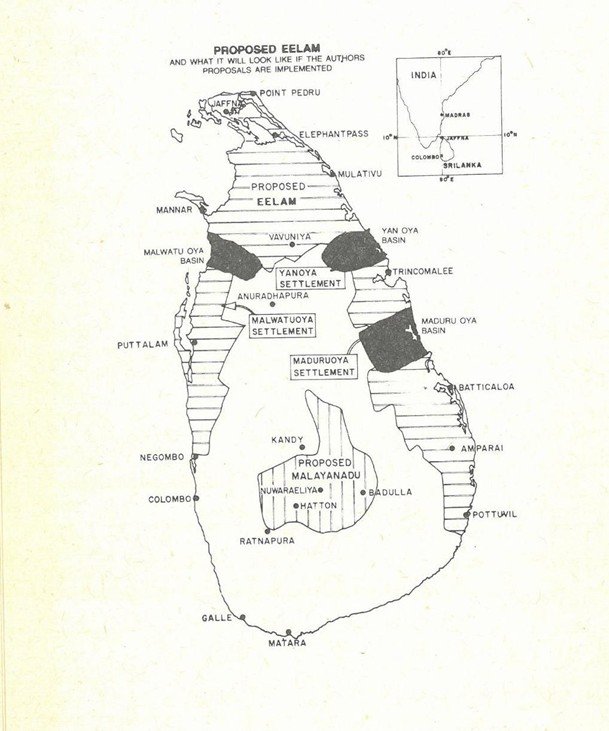
Map 1: Proposed Tamil Eelam and state interventions as recounted by Gunaratna (1988: 26)
Wartime ‘borders’
Even though successive wartime governments did not recognise a formal border, this has not stopped state and non-state actors from using the term and utilising people in the borderlands for diverse purposes. As Brow (1990:15) argues, the border has been an “ideological and military battleground”. The ‘ethnic war’ helped solidify the perceived differences and divisions between ethnicised communities, and the idea of the border between people and territories gained further traction and political leverage. The home guards force, and the ‘frontiersmen’ ideology described by Kelegama and Korf (2023) as the state using locals to secure the Sinhala villages at the ‘borders,’ are ways in which the state invoked the idea of the border during the war. Home guards (also referred to as the civil defence force and the civil security department) were deployed in border villages where the state military lacked capacity or was supplemented for armed protection of villagers from attacks by the LTTE. Local villagers—mainly Sinhala men but later on women and Muslim men—were given weapons, uniforms and rapid training (Silva 2010: 33). These villagers alternated between agricultural work and defence (de Mel and Medawatte 2021: 134). It also served as a calling to ‘patriotic’ Sinhalas to actively defend their ‘motherland’ at the ‘borders’ (Silva 2010; Kelegama and Korf 2023).
My analysis of Sinhala and Tamil newspapers shows that the term border villages is indeed used in media reporting and refers to the areas previously caught between the LTTE and the state military. In addition to the term border village, alternative terms such as “not rescued areas”; “areas belonging to no one”; “unprotected villages”; “threatened villages”; “terrorist threatened villages”; “villages at the mouth of the Tigers”; and “Tiger threatened villages[2]” were also used. In Sinhala newspapers, the term ‘border villages’ mainly refers to Sinhala villages and sometimes Muslim villages, but rarely to mixed ethnicity or Tamil villages. In Tamil newspapers, border villages indicate Tamil villages when discussing certain issues (such as military attacks or raising awareness on human rights); but refer to Sinhala villages when covering news such as the provision of firearms to villagers i.e., home guards (Virakesari 1999).
One of the most interesting phrases indicating ‘border villages’ that I came across in the Sinhala newspapers is “villages at the mouth of the Tigers” or “කොටි කටේ ගම්මාන” (Weerasinghe 1998; Jayatunga 1999; Lankadeepa 1999a; 1999b; 2006; Priyankara 1999). It shows how the media was engaged in sensationalising the violence and ethnic divide of the war. Interestingly, the phrase almost always refers to the Sinhala villages and sometimes Muslims villages, but not to Tamil villages.
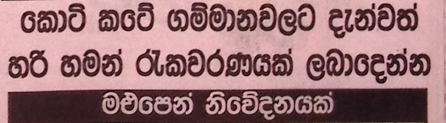
For example, an article titled “Provide the villages at the mouth of the Tigers with adequate security at least now! An announcement from Mahajana Eksath Peramuna [People’s United Front]” (Lankadeepa 1999b), urges immediate systematic protection for “Sinhala villages”. The case is the same in an article titled “Let’s distribute siren pipes for the people at the mouth of the Tigers—Dr Jayalath implores philanthropists” (Lankadeepa 1999a), where the body of the article specifies the affected groups as “Sinhala villages bordering the North Eastern provinces”.
My analysis shows that newspapers and Hansards report a range of issues related to border villages, such as the need for more security, providing firearms to people in border villages, giving aid, violent attacks, disappearances and displacements. Urging greater security and the provision of firearms, particularly to Sinhalese villagers, were the most prominent themes in both Sinhala and Tamil newspapers as well as in Hansard records. The provision of firearms particularly indicates the expansion of the home guards force in the border villages during the war, which was a strategy used by the government to maintain the borders (Silva 2010).
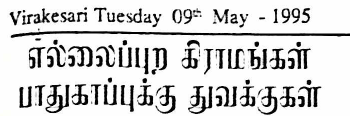
Numerous Virakesari articles simply report that guns have been provided to Sinhala people in border villages in order to increase protection in those areas (1995; 1999). Lankadeepa, in contrast, is emotionally evocative in its reporting. An article titled “Leaving villages due to fear of Tigers is like handing over the homeland to them” (Bandurathna 2006) reports a speech made by a politician who emotionally manipulates the people not to leave the border villages as they have a responsibility to protect their ‘motherland’:
Mr Weerawansa said as follows. If you leave, abandoning the villages and lands due to fear of Tiger militants, it is like giving them their homeland by giving the country’s land. We all protect you all living in border villages. The security of the villages is enhanced by improving the home-guard service. Our organisation is strong enough to provide you with all the support… Don’t leave the villages and lands. Let’s protect our motherland as one [the political organisation and villagers].
Similarly, during a parliament debate on the massacre of Sinhala villagers by the LTTE in Kebithigollewa , Duminda Dissanayake, then deputy minister of ports and aviation, praised the bravery of the people who live in border villages as those who “remain in those places, despite many more deaths, to ensure that this country is not broken into pieces, and to protect this country for the future generations”, again highlighting the need to retain people in villages to protect the border (Parliament 2006, 21 June: 1620).
While many politicians debated the political implications of the term ‘border villages’ and its strategic use during the war, there was very little consideration or care for the actual locations and their peoples. A huge responsibility of protecting the ‘motherland’ from the LTTE was imposed on civilians in border villages by both politicians and the media. This shows how the ‘frontiersmen’ concept was popularised among common people, eventually hardening the ideological border between the Sinhalese and the Tamils in Sri Lanka.
The strategic use of border villages and their people is reiterated in political debates during the war. Members of Parliament are not explicit in their suggestions of using villagers as human shields or untrained civilians for military work, but it is implied in their suggestions for retention of villagers in these ‘threatened villages’. For example, then opposition parliamentarian P. Harrison repeatedly says that security in the border villages needs to be strengthened and infrastructure developed so that villagers do not need to leave these areas:
Ensure the safety of these people. Not only that, increase the security in the border villages. There are several villages like that [with less security]. If the Minister for Electricity and Energy is here, I ask him to provide electricity to those border villages. Because, if they get electricity, those people will continue to live there. If the roads are cleared, byroads are developed, and electricity is also provided, these people will continue to remain at least at night. Otherwise, if these people leave their villages and come, there won’t be an end to that. (Parliament 2006, 21 June: 1562-1563).
The provision of firearms, an increase in security in border areas, and strengthening of the home guards program are mostly discussed as strategies to retain the Sinhala people in the villages to sustain the border rather than as measures to ensure the wellbeing of the people. Other sources and conversations during my fieldwork confirm that firearms and home guard duties were given to the Sinhalese people, and sometimes to Muslims, but never to Tamil people (Silva 2010).
The Hansards also highlight the motives of different resettlement programmes, such as in Weli Oya, where people, especially the Sinhalese, from the south were given land and livelihood opportunities, and resettled in the ‘border’ areas. This is because the control of Weli Oya/Manal Aru territory has been critical for the legitimacy of both Sinhala and Tamil nationalisms (Geiser and Korf 2026). For the state during the war, it was important to ensure that people remained in these areas to sustain the border.
Jagath Balasuriya, then Minister of National Heritage, praised the deceased Berty Premalal MP for visiting the border villages and ensuring that villagers remained there without returning to their original villages, which is of “national importance”. The border villages, although denied as political and administrative entities, were often used as tactics in warfare to protect the borders.
There was a 30-year war in this country. When Mr Berty Premalal Dissanayake acted as the minister and when the people in the border villages were preparing to leave and return to their original villages, he spent his own money – sometimes even gave people money – and took continuous action to ensure that these people were settled in those [border] areas. On a national level, the action taken was of great significance. Because, had such a course of action not been taken, the results could have been very different. (Parliament 2014, 23 May: 1084)
Postwar ‘borders’
In the aftermath of the war, narratives of heroism and the rightful place of the Sinhalese in the country saw a sharp rise (Dewasiri 2013; McCargo and Senaratne 2020). Its full force can be seen in the resurgence of the Mahaweli project in former LTTE-controlled areas (Kelegama 2024; Kelegama and Moore 2026); continued military presence in the north and east (ACPR & PEARL 2017); memorialisation of the war victory and silencing of pluralistic memories (de Mel 2007; Hettiarachchi 2022); and ‘Sinhalisation’ projects by the state, the military, and Buddhist monks (ICG 2012; Kithsiri 2021; People’s Alliance for Right to Land 2023; Kumanan [@kumanan93] 2023; Senaratne 2023).
With the war ending in 2009, the idea of a geographical border may seem no longer relevant, and the term ‘border villages’ is hardly used at present. However, it is not completely forgotten or given up, especially by influential actors who continue to dramatically evoke the idea of a border between the Sinhala and Tamil people and territories as part of popular political rhetoric (Rambukwella 2024); if only to say that border villages no longer exist. During the 2024 election campaign, Namal Rajapaksa said,
President Mahinda Rajapaksa removed the word border villages from the vocabulary of this motherland. Anuradhapura was a border village then. As long as we are in politics, I would like to remind you all that we will not let border villages be formed in this country. We are ready to respect all religions in this Buddhist country. We do it. We should also remind you that we are not giving land and police powers to the provincial councils… We will protect the Tamil culture, we will protect the language, but we remind you that we will not give constitutional police and land powers or integrate North and East. (@Dailymirror_SL 2024)
This shows that, as during the war, in the postwar period too, the political narrative points to the strategic acknowledgment and use of border villages. Namal Rajapaksa is reminding people that the Sinhalese are the defenders of ‘Sinhala culture’ and of the integrity of the island as undivided and indivisible. In this discourse, there are no more border villages.
I also noted the term ‘border village’ in a recent news story that gained considerable traction about a graduate student from the University of Peradeniya pursuing a PhD in the USA. The news report is titled “Kumudumali who came from a border village and went to America” (Newsfirst Sri Lanka 2024). While the news content primarily highlights the graduate’s courage and perseverance, and very little about her social background—she does mention she is from a border village and that she had to live in displacement camps during the war—the news title is able to strategically grab the attention of the readers by using the term ‘border village’. A podcast inspired by the same news story uses a similar title (Business Advisor 2024). Similarly, the Australian Broadcasting Corporation featured a news story titled “Border Girls”, which highlights women from the so-called border villages who are rebuilding their lives after decades of war by stepping into leadership roles and pursuing education (see Dias 2017). These references suggest that the media too might still use the term ‘border village’ to capture public attention despite its diminished relevance today. The above examples show how the ‘border’ remains salient, even in the absence of war, as the state continues protecting the frontier through ‘development’ and political rhetoric, and as the term ‘border village’ continues to evoke emotional significance.
‘Border’ villagers respond to ‘border villages’
Given the prevalence of the Sinhala and Tamil terms for border villages in the mainstream media and political rhetoric, I initially assumed that my interlocutors[3] would also know the term. Interestingly, almost all of the Tamil interlocutors had not heard this term. Two interlocutors, who are Tamil, knew the Sinhala term: a village leader from Trincomalee knew about it because he had many village friends in the military, and they used to sing Sinhala songs that included the term ‘border villages’, and another village leader from Vavuniya mentioned that it is used in government offices, especially to determine qualification for aid or funding for development and livelihood projects.
In contrast to the experience of the Tamil-speaking interlocutors, most of the Sinhala-speaking interlocutors had heard the term but held different ideas about it. Some had only heard the term but could not explain what it meant.
Some women understood ‘border villages’ as underdeveloped villages. Understanding border villages as underdeveloped is common, because most of these villages are situated in the dry zone and are rural poor areas with a lack of resources and state support for infrastructure development (see also Korf and Silva 2003; Korf 2004). According to two Sinhala women,
Border villages are rural villages. There are border villages in Vavuniya like Bogaswewa. They do not have water. [They are] very underdeveloped. (Middle-aged Sinhala woman, Vavuniya)
It is [border villages] where there are fewer people and not much populated. But [our village] is a village in the urban area… It is an area with a lot of jungle that is called the border villages. (Middle-aged Sinhala woman, Vavuniya).
Those who had this understanding also told me that their village is not a ‘border village’, meaning a poor village.
Women from a state settlement explained that ‘border villages’ refers to boundaries between ethnically separated villages or units in their peasant colonisation scheme. This indicates how state-imposed communal borders are imagined on the ground. Some other women, who are not from the colonisation scheme, referred to the war and ethnic relations as they explained to me what they knew about border villages. For example, they mentioned that people tend to live in ethnically separate villages or that the border refers to the Sinhala villages located near to Tamil villages. This again shows how the border phenomenon influences people’s understanding of community as being based on ethnicity.
A village leader from Trincomalee shared an insight based on his experience as a home guard during the war, which explains why locals might know or not know what ‘border villages’ are:
Yes, these are also border villages. Beyond the border villages used to be the LTTE. It was around the border villages that there were barbed wires and military bunkers… only a few people in the village know this term. Because it is not relevant to the others noh… We know it because we were home guards and it was our responsibility to protect the village. (Male village leader, Trincomalee)
With the prevalence of the local term ‘border villages’ in mainstream media, I was surprised to learn that people who live in these spaces had little to no idea about what it means or that it is a term that might be used to refer to their villages. The village leader’s explanation above clearly shows to whom the border is important and who is/was sustaining it.
As I argue in this paper, the border materialises through British colonialism’s divide-and-rule policy; it becomes a contested site between the state and the LTTE, and the state’s efforts to protect the frontiers and push it forward; it is a tool for the media and political elites, who use it to stir Sinhala patriotism; and a symbol to Tamil nationalists for separatism and memorialisation (see Weingarten 2025).
None of these reasons or aspects of the ‘border’ seem to be relevant to the people living in these areas. The village leader above knew the term because he was a ‘frontiersman’, directly involved in protecting the geographical and ideological borders during the war. However, it was not relevant to others who did not have to think or act in line with the frontiersmen’s ideology or memorialising ethnonationalist borders. However, it is not often that we hear these stories from the peripheries of the state.
The Citizen Commission on Border Villages, established in the early 1990s through the collaboration of human rights organisations (with a history of working in ‘border villages’), was a short-lived exception to the popular mainstream narrative, in which local people’s realities and stories were included. The Commission was established to record the experience of people particularly in the so-called border villages during the war, regardless of their ethnicity. It consisted of three commissioners and a secretary who conducted hearings and recorded people’s issues and testimonies. Despite the wealth of testimonies recorded, a final report was never produced (Haniffa 2006). However, because of its work, everyday issues and voices of the people in border areas were reported in both Lankadeepa and Virakesari newspapers. An article titled “People in border villages are oppressed from both sides – The citizen commission says that they need facilities” (Gamage 1998) mentions how the people in border villages are neglected, lacking drinking water due to being in the dry zone, as well as other facilities like health, food and education.
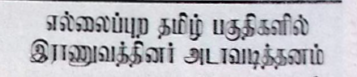
An article titled “People in border villages don’t like the war: The government needs to initiate a peace process – Problems due to military presence, an investigation report finds” (Virakesari 1998) notes how the people in the north and east ‘border villages’ irrespective of ethnicity, believe that the government is deceiving them by continuing to engage in war and not opting for a peace process; how the people do not even understand why there is a war in the first place; and how they believe it is completely unnecessary to them personally. Quoting Prof. Arjuna Parakrama, a member of the Commission, the article reports that people in ‘border villages’ are not “ethnic extremists that engage in conflicts [among themselves]”. It also reported that the people in the border areas blamed the military for increased LTTE attacks in their villages, because,
there are many military camps in the border villages, and people say that it was after these military camps were established that many attacks and violent incidents started to happen. There are military camps inside and right in the middle of villages.
Similarly, a book titled තැලෙන ගම්මාන: යුද්ධයෙන් පීඩිත ගම්මානවල තොරතුරු ස්වල්පයකි [Oppressed villages: some information on war-affected villages] by S. G. Punchihewa (1998), one of the two chairpersons appointed to the Commission, records some stories collected from the people in ‘border villages’ during the Commission’s work. This collection of stories comprises lived experiences of Tamils, Muslims, and Sinhalese during the war. For example, people in a Muslim village near Valaichchenai recount how they were made helpless by both the army and the LTTE, who demanded they pay “army tax” as well as “tiger tax” in the form of fish, firewood, and milk (Punchihewa 1998: 26-27). Sinhalese villagers from Halmillawetiya complain about initial LTTE attacks in the village and then worsened conditions with the arrival of armed forces and the entry of drugs, alcohol, deforestation, and so on, into their communities (32-33). Another story is about a Tamil man called Selvendran, whose leg had to be amputated after he was shot in the leg when caught in the crossfire between the army and the LTTE. His father had also been disabled after being beaten by the army. Selvendran asked the Commission, “What should I do [to take care of my family]? Stop this war” (30-31). This book recounts numerous such stories of people in ‘border villages’ during the war, illustrating how they were affected by various parties and issues, regardless of ethnicity.
These accounts and other conversations with my interlocutors show the lived experiences and immediate concerns of people in border villages. While the mainstream narrative frequently portrayed their lives as being rural, underdeveloped, and ‘at the mouth of the Tigers’, emphasised the need for bravery even to visit these places, called for more military and guns, and insisted on protecting the frontiers/borders; the people were struggling to fulfil their basic needs and had a broader understanding of the war than as an ethnic conflict. In the postwar period, we hardly know anything about how their lives and communal relations have changed or not. However, in general, it is possible to infer how dominant narratives or understandings and lived experiences may have implications for understanding community/social relations in Sri Lanka.
Seeing community and social relations through ‘border villages’
My engagement with the so-called ‘border villages’ during this research through different sources has highlighted significant implications for how these war-affected areas and community relations are understood in Sri Lanka. Firstly, there seems to be a stigma attached to border villages as poor, underdeveloped, and dire, areas. Research also shows that the war and dry climate made it difficult for these people to engage in cultivation, and they had no choice but to join the military (for young men); and garment factories and sometimes sex work (for women), for economic survival (Korf and Silva 2003; de Mel 2007). These realities and shifting positionalities have resulted in a stigmatised understanding of border villages, as expressed by interlocutors.
A structural stigma is implied by political elites, who tend to view these communities as easily influenced and exploitable for political advantage, even in the postwar period. These places remain underdeveloped and poor because politicians and representatives of the state have no real interest in them beyond political gain. Writing on this issue recently, Mohamed (2025; 2026) shows that, even though better-known ‘border villages’ such as Aranthalawa and Kebithigollewa are still evoked in public speeches and annual commemorations, there is no real concern for their socio-economic development after the war. Despite prolonged exposure to war, ‘border villages’ are areas where state involvement in postwar rebuilding is either minimal or heavily militarised (Kelegama 2024). People in the ‘border villages’ continue to lack support for livelihoods, infrastructure development, securing land rights, and psychosocial wellbeing (Korf and Silva 2003; de Mel 2007; de Silva et al. 2019; Gunasekera 2025).
Secondly, the Sinhala narrative of border villages largely includes only the Sinhalese, distorting the nature of community and communal relations in the border areas. There is very little reference in this narrative to the other communities that lived, experienced the war, and continue to live in these spaces, as I observed through my research. Sometimes academic scholarship and NGO peacebuilding projects that utilise border villages as case studies also refer only to the Sinhala communities (Selvadurai 2017; ICES 2020; Mihlar 2024). As a result, border villages tend to be remembered as places where only Sinhala people lived and experienced the tragic consequences of the war. The Muslim and Tamil people who historically occupied these spaces and were exposed to similar experiences of the war are erased. This also reifies the idea of ethnic borders between people and geographies, and obscures alternative realities.
Thirdly, when political ideologies like that of ‘frontiersmen’ reach the grassroots, they tend to be adopted as local and personal realities that distort community relations. Kelegama and Korf (2023: 14) describe instances where Sinhalese villagers remark how areas in the North claimed as the Tamil homeland were defended against capture by the LTTE because they remained in the villages. My discussions with a group of Sinhalese women from ‘border villages’ in the Anuradhapura district in 2019 show that they believe it was their nationalistic duty and pride to remain in war-affected lands amidst violence and precarity, in order to protect the border from extending beyond their village. A woman recalled, “If we had left the villages and lands that day [of violent attacks], the border would be in Colombo today” (ICES 2020: 20). While this shows the resilience of communities, it also points to how state and non-state sanctioned borders become solidified when nationalist ideologies reach the grassroots.
Finally, the colonial underpinnings, political rhetoric, media reporting, and popular manifestations of the border that I discussed highlight the ethnic narrative of the ‘border villages’. Border villages are largely read through an ethnic lens, even when communities other than the Sinhalese are included. This also implies that ordinary people in the border villages were in conflict with the ethnic other, whereas all the interlocutors in my study were in fact displaced to different areas for prolonged periods of time during the war. While conflicts with the ethnic other may be true in certain cases, it also obscures alternative lived experiences and stories of these spaces beyond ethnic borders and war. Because of the predominantly ethnic outlook, academically, too, they are regarded as useful areas to focus on ‘interethnic coexistence’ and peace, both in the past and present (de Silva et al. 2019; Rajasingham-Senanayake 1995, 2002). However, such approaches prioritise ethnicity over alternative forms of community based on aspects such as livelihoods, care practices, language, intergenerational connections, lived spaces, and memories that grassroots people might experience and practice.[4]
My interlocutors’ responses to the idea of and term ‘border villages’ and Citizen Commission accounts clearly show that there is more to the story of ‘border villages’ than what popular discourse might suggest. Over time, the border has indicated ethnonationalist and geographical differences and divisions, and seems to remain salient to different state and non-state actors for various purposes. At the same time, this border does not seem to resonate much in the everyday life of the people who occupy this space. An ethnic lens or an uncritical approach to these spaces highlights certain divisive characteristics that usually define ‘border villages’, such as ethnic community, war, inter-ethnic coexistence, frontier zones, home guards, and impoverishment. But these may not reflect the lived experiences of people in these spaces, especially many years after the war. This brief analysis of ‘border villages’ shows that borders are not natural, but they are created, practised, and sustained by various actors for different purposes, and that hegemonic ideologies often do not resonate with lived experience.
Viyanga Gunasekera is a PhD candidate at the Australian National University, with research interests in border studies, conflict and peacebuilding, and women’s empowerment.
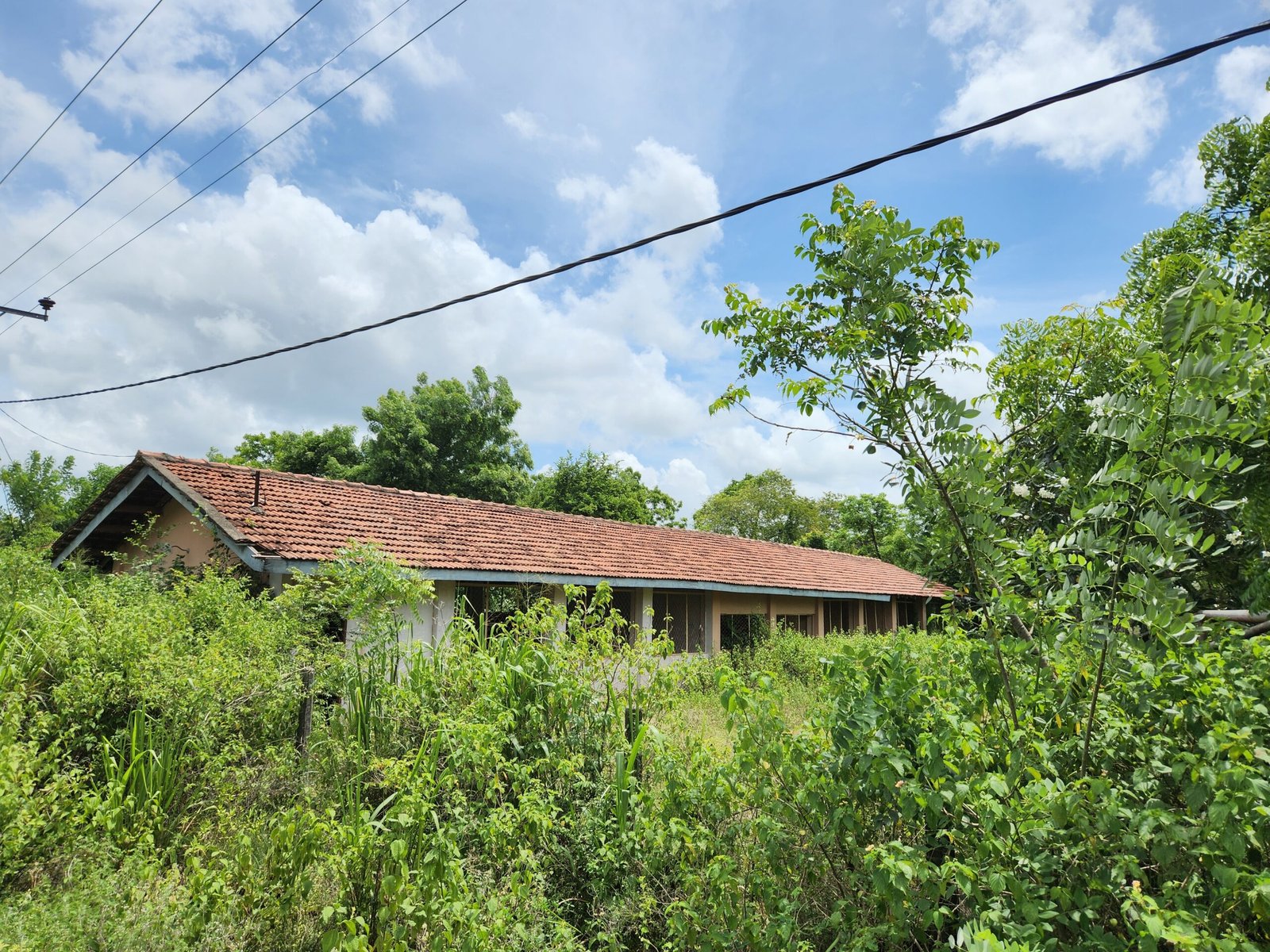
Image Caption and Photo Credit: Abandoned school building. Viyanga Gunasekera.
References
Adayaalam Centre for Policy Research (ACPR) and People for Equality and Relief in Lanka (PEARL). (2017). Normalising the Abnormal: The Militarisation of Mullaitivu. Jaffna, SL & Washington, USA: ACPR & PEARL.
Bandurathna. (2006). “Leaving villages due to fear of Tigers is like handing over the homeland to them”. Lankadeepa (30 June).
Brow, James. (1990). “The Incorporation of a Marginal Community within the Sinhalese Nation”. Anthropological Quarterly, 63 (1): 7–17. https://doi.org/10.2307/3317956.
Brow, James. (1999). “Utopia’s New-Found Space: Images of the Village Community in the Early Writings of Ananda Coomaraswamy”. Modern Asian Studies, 33 (1): 67–86. https://doi.org/10.1017/S0026749X9900308X.
Business Advisor. (2024). “මායිම් ගමෙන් තටු අරන් ඇමරිකාවට ගිය කුමුදුමාලි W U මෙතෙක් කල් කාටවත් නොකියපු කතාව [The Untold Story of Kumudumali W U, Who Took Wings from the Border Village and Went to America]”. YouTube (12 October). Available at https://www.youtube.com/watch?v=Zg0LdGaa_o4.
@Dailymirror_SL. (2024). “We will protect Tamils and their language, but we will not devolve powers to the North and East” [tweet]. X (21 August).
de Mel, Neloufer. (2007). Militarizing Sri Lanka: Popular Culture, Memory and Narrative in the Armed Conflict. New Delhi: Sage Publications India.
de Mel, Neloufer. (2022). “Sri Lanka’s Deep Wounds”. History Today, 72 (9): 90-93.
de Mel, Neloufer, and Danushka Medawatte. (2021). “Rural Women and Their Access to the Law: Gendering the Promise of Post-War Justice”. In Guy Elcheroth and Neloufer de Mel (eds.), In the Shadow of Transitional Justice: Cross-National Perspectives on the Transformative Potential of Remembrance. Europa Perspectives in Transitional Justice. London and New York: Routledge.
de Silva, Marisa, Nilshan Fonseka, and Farah Mihlar. (2019). The Forgotten Victims of War: A Border Village Study. Neelan Tiruchelvam Trust. Available at https://srilankabrief.org/wp-content/uploads/2019/10/The-Forgotten-Victims-of-War-A-Border-Village-Study-FINAL.pdf
Dewasiri, Nirmal Ranjith. (2013). ‘History’ after the War: Historical Consciousness in the Collective Sinhala-Buddhist Psyche in Postwar Sri Lanka. Research Paper No. 9. ICES Research Papers. Colombo: International Centre for Ethnic Studies.
Dias, Avani. (2017). “‘Border Girls’ Take on Male Roles to Help Sri Lanka Recover from Civil War”. ABC News (6 May): https://www.abc.net.au/news/2017-05-07/border-girls-help-sri-lanka-recover-from-civil-war/8499728.
Donnan, Hastings, and Thomas M. Wilson. (1999). Borders: Frontiers of Identity, Nation and State. Oxford: Routledge.
Gamage, Vinitha. (1998). “People in border villages are oppressed from both sides – The citizen commission says that they need facilities”. Lankadeepa (10 December).
Geiser, Urs, and Benedikt Korf. (2026). Manal Aru / Weli Oya: The Violent History of River Valley Development, Frontier Colonisation and Ethnic Territorialisation. Colombo: Social Scientists’ Association.
Gunaratna, Malinga H. (1988). For a Sovereign State. Ratmalana: Sarvodaya Book Publishing Services.
Gunasekera, Viyanga. (2025). “The Fight for Land Rights”. Groundviews (18 February). Available at https://groundviews.org/2025/02/18/the-fight-for-land-rights/
Haniffa, Farzana. (2006). In the Pursuit of Democracy in Post-Colonial Sri Lanka: Local Human Rights Approaches to Transitional Justice. New York: International Center for Transitional Justice.
Hettiarachchi, Radhika (ed.). (2022). We Are Present: Women’s Histories of Conflict, Courage, and Survival. New York: International Coalition of Sites of Conscience.
International Centre for Ethnic Studies (ICES). (2020). මායිම් වලින් එහා: නොනිමි බහුත්ව මතකයන් [Beyond Boundaries: Lived Pluralistic Memories]. Colombo: ICES. Available at https://www.ices.lk/publications-1/beyond-boundaries%3A-lived-pluralistic-memories
International Crisis Group (ICG). (2012). Sri Lanka’s North II: Rebuilding under the Military. No. 220. Asia Report. Colombo & Brussels: ICG. Available at https://www.crisisgroup.org/rpt/asia-pacific/sri-lanka/220-sri-lankas-north-ii-rebuilding-under-military
Jayatunga, Ashoka. (1999). “Monday Meeting”. Lankadeepa (27 September).
Johnson, Corey, Reece Jones, Anssi Paasi, Louise Amoore, Alison Mountz, Mark Salter, Chris Rumford. (2011). “Interventions on Rethinking ‘the Border’ in Border Studies”. Political Geography, 30 (2): 61–69. https://doi.org/10.1016/j.polgeo.2011.01.002
Kelegama, Thiruni. (2024). “Militarized Development in Post-War Sri Lanka: Consolidating Control”. Development and Change, 55 (5): 965–92. https://doi.org/10.1111/dech.12847
Kelegama, Thiruni, and Benedikt Korf. (2023). “The Lure of Land: Peasant Politics, Frontier Colonization and the Cunning State in Sri Lanka”. Modern Asian Studies, 57 (6): 2002–2021. https://doi.org/10.1017/S0026749X22000506
Kelegama, Thiruni, and Mick Moore. (2026). “Kivul Oya: A Political Trap for the NPP?” Groundviews (11 February). Available at https://groundviews.org/2026/02/11/kivul-oya-a-political-trap-for-the-npp/
Kithsiri, Thamali. (2021). “Constructing ‘Sinhala-Ness’ through Name Changes in Paanama”. Journal of Humanities and Social Sciences, 4 (2): 53–84.
Korf, Benedikt. (2004). “War, Livelihoods and Vulnerability in Sri Lanka”. Development and Change 35 (2): 275–95. https://doi.org/10.1111/j.1467-7660.2004.00352.x
Korf, Benedikt, and Tudor Silva. (2003). “Poverty, Ethnicity and Conflict in Sri Lanka”. Paper presented at Staying Poor: Chronic Poverty and Development Policy. University of Manchester. 7-9 April 2023. https://assets.publishing.service.gov.uk/media/57a08cdf40f0b649740014e8/KorfSilva.pdf
Kumanan [@kumanan93]. (2023). “A new Buddhist temple is going to be built by occupying pastures traditionally used by Tamil farmers in the border village” [Tweet]. X (2 August). https://x.com/kumanan93/status/1686678391242506240
Laine, Jussi P. (2016). “The Multiscalar Production of Borders”. Geopolitics, 21 (3): 465–82. https://doi.org/10.1080/14650045.2016.1195132
Lankadeepa. (1999a). “Let’s distribute siren pipes for the people in the mouth of the Tigers – Dr Jayalath implores philanthropists”. (22 September).
Lankadeepa. (1999b). “Provide the villages at the mouth of the Tigers with adequate security at least now! An announcement from Mahajana Eksath Peramuna [People’s United Front]”. (22 September).
Lankadeepa. (2006). “The villages at the mouth of the Tigers need top security”. (1 June).
McCargo, Duncan, and Dishani Senaratne. (2020). “Victor’s Memory: Sri Lanka’s Post-War Memoryscape in Comparative Perspective”. Conflict, Security & Development 20 (1): 97–113. https://doi.org/10.1080/14678802.2019.1705070
Mihlar, Farah. (2024). “Contending with Identity and Minority Rights in Transitional Justice: The Case Study of Sri Lanka”. The International Journal of Human Rights, 28 (10): 1592–614. https://doi.org/10.1080/13642987.2024.2355269
Mohamed, Shabeer. 2025. “Justice beyond Monuments: The Forgotten Struggles of Aranthalawa”. Sunday Observer, August 17. https://www.sundayobserver.lk/2025/08/17/impact/59637/the-forgotten-struggles-of-aranthalawa/
Mohamed, Shabeer. 2026. “From Terror Attack to the Present Day: The Unchanged Journey along the Kebithigollewa Road”. Sunday Observer, June 7. https://www.sundayobserver.lk/2026/06/07/news-features/78755/the-unchanged-journey-along-the-kebithigollewa-road/
Newsfirst Sri Lanka. (2024). “මායිම් ගමෙන් ඇවිත් අමෙරිකාවට ගිය කුමුදුමාලි W.U [Kumudumali Who Came from the Border Village and Went to America]”. YouTube (30 August). Available at https://www.youtube.com/watch?v=C4oMDn5yxfw
Parliament of Sri Lanka. (2006, June 21). “Adjournment Motion: Massacre at Kebithigollewa”. Hansard, 164 (13): 1557-1658.
Parliament of Sri Lanka. (2014, May 23). “Vote of Condolence: Hon. Berty Premalal Dissanayake”. Hansard, 225 (8): 1051-1115.
People’s Alliance for Right to Land (PARL). (2023). “Kurundi Viharaya and Thannimurippuwa Land Issue”. (12 July). Available at https://www.parlsl.com/publications/kurundi-viharaya-and-thannimurippuwa-land-issue
Pfoser, Alena. (2022). “Memory and Everyday Borderwork: Understanding Border Temporalities”. Geopolitics, 27 (2): 566–83.
Priyankara, Pubudu. (1999). “The day that a road opened to leave the mouth of the Tiger”. Lankadeepa (1 September).
Punchihewa, S. G. (1998). තැලෙන ගම්මාන: යුද්ධයෙන් පීඩිත ගම්මානවල තොරතුරු ස්වල්පයකි [Oppressed Villages: Some Information on War-Affected Villages]. Dehiwala: Movement for the Defense of Democratic Rights (MDDR).
Rajasingham, Darini. (1995). “Home-Lands, Border Zones and Refugees: Facts, Fictions, Displacements”. Pravada, 4 (2): 10–13.
Rajasingham-Senanayake, Darini. (1999). “Democracy and the Problem of Representation: The Making of Bi-Polar Ethnic Identity in Post/Colonial Sri Lanka”. In Joanna Pfaff-Czarnecka, Darini Rajasingham-Senanayake, Ashis Nandy, and Edmund Terence Gomez (eds.), Ethnic Futures: The State and Identity Politics in Asia. New Delhi, Thousand Oaks, London: SAGE Publications.
Rajasingham-Senanayake, Darini. (2002). “Identity on the Borderline: Modernity, New Ethnicities, and the Unmaking of Multiculturalism in Sri Lanka”. In Neluka Silva (ed.), The Hybrid Island: Culture Crossings and the Invention of Identity in Sri Lanka. London and New York: Zed Books.
Rambukwella, Harshana. (2024). “Imagining the Nation: A Critical Overview of Sinhala Nationalism and Its Cultural Coordinates”. In Kanchana N. Ruwanpura and Amjad Mohamed Saleem (eds.), Routledge Handbook of Contemporary Sri Lanka. London: Routledge.
Rumford, Chris. (2006). “Theorizing Borders”. European Journal of Social Theory, 9 (2): 155–69. https://doi.org/10.1177/1368431006063330
Selvadurai, Shyam (ed.). (2017). Write to Reconcile III: An Anthology. Colombo: National Peace Council.
Senaratne, Dishani. (2023). “Buddhist Constructions as a Tool of Non-Violent Extremism in Post-Conflict Sri Lanka”. In Elisa Orofino and William Allchorn (eds.), Routledge Handbook of Non-Violent Extremism: Groups, Perspectives and New Debates. London and New York: Routledge. Available at http://ebookcentral.proquest.com/lib/anu/detail.action?docID=7176663
Silva, Kalinga Tudor. (2010). “Home Guards in Sri Lanka: Guardians of Peace or Threat to Human Security?”. Economic and Political Weekly, 45 (36): 31–33.
Sivasundaram, Sujit. (2013). Islanded: Britain, Sri Lanka, and the Bounds of an Indian Ocean Colony. Chicago and London: University of Chicago Press.
Spencer, Jonathan. (2011). “Reflections on an Illiberal Peace: Stories from the East”. In Jonathan Goodhand, Jonathan Spencer, and Benedikt Korf (eds.), Conflict and Peacebuilding in Sri Lanka: Caught in the Peace Trap? London: Routledge.
Still, John. (1930). The Jungle Tide. Edinburgh: W. Blackwood & Sons.
Stokke, Kristian. (1998). “Sinhalese and Tamil Nationalism as Post-Colonial Political Projects from ‘above’, 1948–1983”. Political Geography, 17 (1): 83–113. https://doi.org/10.1016/S0962-6298(96)00070-4
Thiranagama, Sharika. (2011). In My Mother’s House: Civil War in Sri Lanka. Philadelphia: University of Pennsylvania Press.
Togral Koca, Burcu. (2019). “Local Bordering Practices, Refugees, and Civil Society: The Case of Berlin”. Geographical Review, 109 (4): 544–61. https://doi.org/10.1111/gere.12351.
Virakesari. (1995). “Guns to increase protection in border villages”. (9 May).
Virakesari. (1998). “People in border villages don’t like the war – The government needs to initiate a peace process”. (9 December).
Virakesari. (1999). “Increase protection in Sinhala border villages – Need to give machine guns”. (23 September).
Weerasinghe, Raja. (1998). “Presents and gifts for poor students in a village at the mouth of Tigers from Colombo university students”. Lankadeepa (16 December).
Weingarten, Naama. (2025). “Tamil Genocide Memorial Unveiled in Brampton after Years-Long Wait”. CBC News: Toronto (11 May): https://www.cbc.ca/news/canada/toronto/tamil-memorial-unveiled-brampton-1.7532342
Wickramasinghe, Nira. (2006). Sri Lanka in the Modern Age: A History of Contested Identities. Honolulu: University of Hawai’i Press.
Witharana, Bandura Dileepa. (2022). Negotiating Power and Constructing the Nation: Engineering in Sri Lanka. Colombo: Tambapanni Academic Press.
Woost, Michael D. (1994). “Developing a Nation of Villages: Rural Community as State Formation in Sri Lanka”. Critique of Anthropology, 14 (1): 77–95. https://doi.org/10.1177/0308275X9401400105
Notes
[1] What follows draws from my PhD fieldwork carried out in 2023 and 2024.
[2] Translations from Sinhala to English are mine, Tamil to English translations were by a professional translator.
[3] People in five ‘border villages’ in Vavuniya and Trincomalee.
[4] I describe these lived experiences in detail in my PhD thesis.
You May Also Like…

Image-Based Sexual Abuse, and Consent, in the Digital Age
Sely Liyanage
The rapid development of digital technologies has created new forms of content and new forms of harm. Some content is...
India’s Youth Protest and the Limits of Demand-Driven Mobilisation
Manoranjan Pegu
The recent protests ‘led’ by the Cockroach Janta Party (CJP) in India, have been seen as the latest addition to South...
This Government, That Opposition, and the Work Still Ours
Lionel Bopage
For sixty-six years, until his death in 2014, the legendary comrade Bala Tampoe led the Ceylon Mercantile Union...