
Literature and the Politics of Plural Identity, in and beyond Sri Lanka
Nadeera Rajapakse
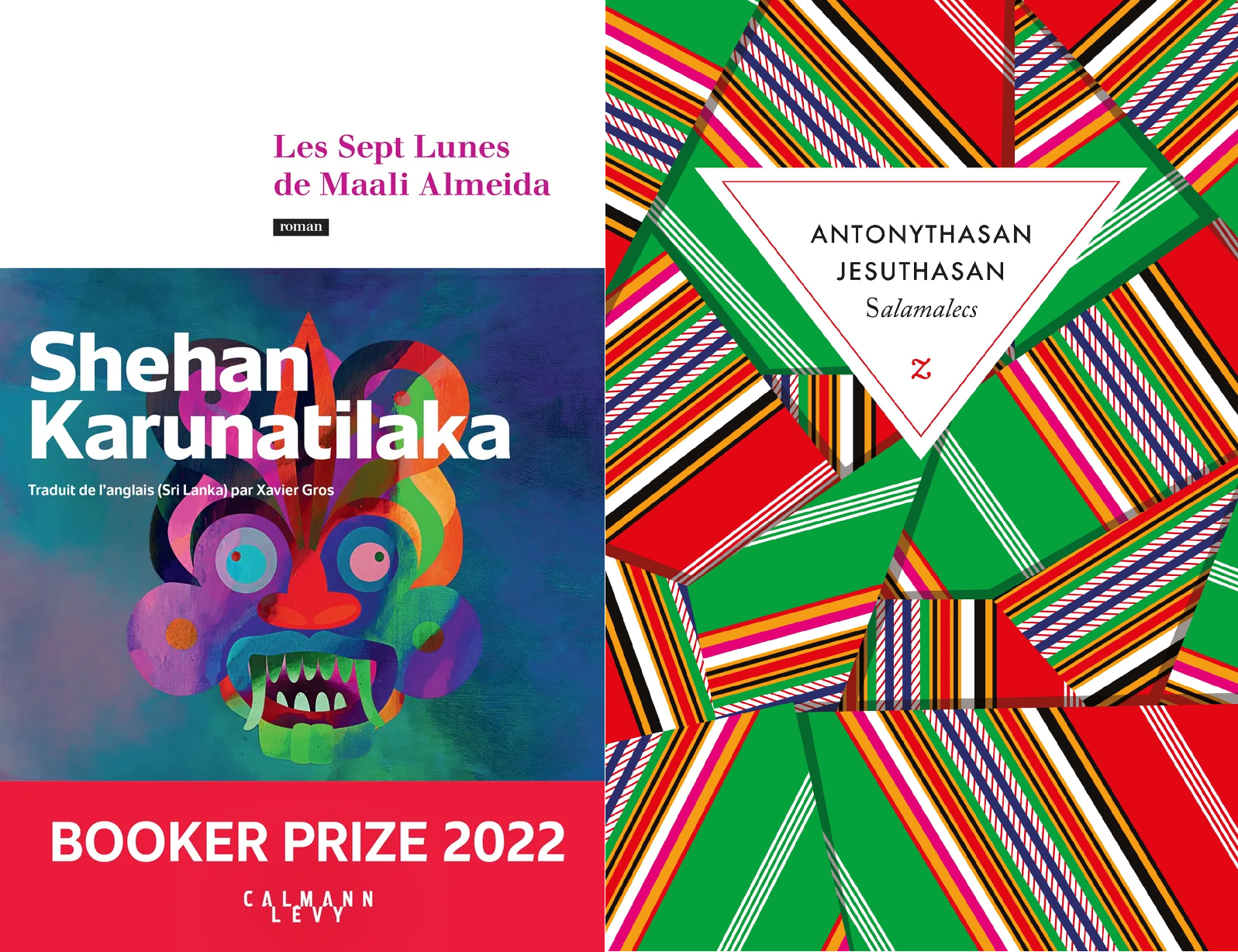
Two Sri Lankan writers: Antonythasan Jesuthasan in 2026 and Shehan Karunatilaka in 2025, have been awarded in consecutive years the Prix Émile Guimet, the French prize for Asian literature in translation. About the same time in 2025 during a visit to Sciences Po in Paris, Sri Lanka’s Prime Minister Harini Amarasuriya said that “the members of the diaspora are good ambassadors of our country” (Rajapakse 2025). If her remark imagines the diaspora as legible representatives of a nation; these writers render that vision more complex. Their work reveals identities that are neither singular nor coherent, but layered and contradictory.
Before the prize was announced this year, Jesuthasan, along with two other authors in exile, were interviewed at the Festival du Livre in Paris in May. One of the other writers, Pedro Kadivar, observed that in the eyes of the authorities who grant citizenship, one must be either French or a foreigner. This binary requirement stems from an ideological stance which is institutionally implemented. The French asylum process requires applicants to narrate persecution in individualised terms, transforming complex histories into personal stories of victimhood (Mantovan 2018). In doing so, identity becomes fixed in the moment of displacement, privileging what one is over who one might become. In both cases, the self is required to stabilise into a form that institutions can recognise. Sri Lanka, too, in many instances of its history, has expected and constrained its citizens to conform to a national identity, to respect a national culture, with similar narrowing impulses (DeVotta 2017). At their core, whether in Sri Lanka, or in France, lies the demand that a person be nationally and institutionally recognisable.
In reality, as Kadivar—who is of Iranian origin—suggests, a person may carry many overlapping identities simultaneously. Literature, fortunately, opens a different space, one that is wide and plural enough to hold what the narrow official narrative rejects: the lived, contradictory, plural experiences that do not fit nationalist categories. It allows identities to take forms that refuse to settle.
It is within this tension between institutional fixing and lived plurality that I discuss the recognition given to the two writers of Sri Lankan origin. In 2025, Shehan Karunatilaka was awarded the fiction prize for Les Sept Lunes de Maali Almeida, translated from English (The Seven Moons of Maali Almeida) by Xavier Gros and published by Calmann-Lévy. This year, the jury selected Salamalecs,[1] written in Tamil (ஸலாம் அலைக்) by Antonythasan Jesuthasan (under the nom de guerre Shobasakthi) and translated into French by Leticia Ibanez, published by Zulma. The two writers occupy different loci in relation to Sri Lanka: one is an exile in France, the other holds dual citizenship with New Zealand, and has lived in many countries.
I frame my literary analysis along three axes: plural identity; the critique of violence; and the experience of migration and exile. While the first two axes stay within the two novels, the third follows a path suggested by them: if Maali in Seven Moons cannot be narrowly claimed by any side and Nandan in Salamalecs holds two countries but one history, then the plurality each text bestows to its protagonist can also be studied from its source, the authors. The third axis thus, changes both method and scale, from the plural character to the plural author. The terrain of discussion becomes more uneven, since Karunatilaka and Jesuthasan occupy that plurality differently.
Plural identity
Starting with symmetry, both The Seven Moons of Maali Almeida and Salamalecs place the question of plural, unfixed identity at their centre, though each approaches it through a different formal and political logic. In Karunatilaka’s novel, Maali is a protagonist who transcends partisan boundaries. Morally compromised, entangled in secret alliances, moving between factions, he embodies the impossibility of a stable position in wartime. His politically dangerous photographs make him simultaneously heroic and treacherous, a truth-teller to some, a traitor to others. The novel suggests that in a civil-war context, where loyalties are unstable and the stakes of naming are lethal, the same person can occupy entirely different moral registers depending on who is looking. This is what Thiranagama captures in her book In My Mother’s House, when she writes of the ambivalence marking the lives of ex-militants: “The contingency of ex-militants’ lives now as they look back on their past, one that has been removed from the history of freedom fighting and placed in a history of treachery instead” (2011: 184).
Jesuthasan’s novel works the same questions of identity through form as much as content. Salamalecs is structured as a roman recto-verso, a narrative literally readable from two directions, with no fixed point of entry or conclusion. Such a choice of structure is stylistic while also functional. It mirrors a protagonist who is simultaneously in exile and a returnee, present father and absent one, political subject and administrative outsider. By way of this double entrée the novel insists that Nandan has two countries, France and Sri Lanka, but one history, a phrasing that refuses to treat plural identity as a simple accumulation of affiliations. The same life is read differently depending on where Nandan stands, who is speaking about him, and which institutional power is in the act of naming him. In the novel, identity is like refracted light: the same material reflects differently depending on the angle of reception.
Critiques of violence
To uphold plural, unfixed identities is also to refuse the ease of taking sides and instead, to insist on criticising violence regardless of who perpetrates it: the state, separatists, insurrectionists, or corrupt leaders. Both novels bring out this refusal. In Salamalecs, the chapter Corps Mystique (Mystical Body) presents a devastating passage: the LTTE’s violence rendered not through statistics or ideology but through the intimacy of a family unable to identify which of their twin sons was killed, forced to conduct funeral rites in ignorance, while the other twin was disappeared. This particular cruelty, the denial of even the rituals of grief, is one that other actors in Sri Lanka’s conflict have also perpetrated, and Jesuthasan does not exempt them. Elsewhere in the novel, the confusion of victim and perpetrator, mourner and celebrant, is made evident: militants in Paris celebrating a suicide bombing are confronted with the words, “21 de nos jeunes finissent carbonisés et pour vous, ça se fête?” (21 of our young people end up burnt to death and for you, that’s something to celebrate?) (2025: 31), a question that indicts the political culture that could transform mass death into an occasion for festivity.
In Jesuthasan’s story, violence does not stay in the past:
Savitri ne savait rien sur ma femme et mon fils. Les ténèbres étaient descendues sur moi ou, pour mieux le dire, mon esprit n’était plus qu’un désert où mon fils, ma femme et mon ancien hôte évoluaient à l’état d’ombres spectrales
(Savitri knew nothing about my wife and son. Darkness had descended upon me, or, to put it more accurately, my mind had become nothing more than a desert where my son, my wife, and my former host moved about as ghostly shadows). (2025: 112)
Darkness, desert, spectral shadows, belong to the language of trauma that refuses to heal.
It is also the language of The Seven Moons of Maali Almeida. Spectres and shadows dance around Karunatilaka’s novel. The entire narrative is structured around the ghostly and the unquiet dead, figures who cannot rest because the violence that produced them has never been fully reckoned with. The two novels, written in different languages and from different positions of belonging, share this haunted register, as though the experience of Sri Lanka’s war generates, across its survivors and witnesses, the same vocabulary of darkness and spectrality.
Karunatilaka’s critique of nationalist violence appears evocatively in a passage on the two flags: both bear a beast (a tiger and a lion), both are the colour of blood, one the tomato red of a fresh wound, the other the plum maroon of a scar unhealed. Neither beast, he notes, ever actually roamed these lands, yet there they sit, waving weapons, swimming in blood, “as if to acknowledge that Lanka was founded on bestiality and bloodshed” (2020: 138). The symmetry makes its point obvious: neither flag is innocent, neither founding myth untainted.
Both novels point towards an ethical position that separates grief from political allegiance. In a recent article, Maharoof (2026) advocates for the “recognition that multiple communities can carry legitimate histories of pain without those histories negating one another”. Such an insight is particularly important in Sri Lanka, where mourning itself often becomes politically contested. Rather than asking readers to choose between competing memories, the novels create space for several histories to coexist without collapsing them into a single narrative.
Migration and inherited histories
Turning now to the more uneven terrain of analysis, from fiction to the figure of the author, the experience of migration is far from incidental to Sri Lanka’s history, but it is not evenly distributed between the two authors. As a dual citizen, Karunatilaka probably occupies a form of belonging that meets institutional criteria; one that can be processed legibly and documented. Jesuthasan’s exile is less linear (Jesuthasan and Baron 2017). If the prime minister’s image of the diaspora as “ambassadors” presumes a singular, transferable connection to the nation, these two writers already demonstrate that such a relationship is elusive, even between two Sri Lankan-born novelists sharing the same prize in consecutive years.
Migration is not a departure from the question of plural identity. It is one of the historical processes through which such identities are produced. While institutions may seek stable categories of belonging, migration reveals belonging to be unstable, contradictory even. Thiranagama (2011) reminds us that movement was the most common experience of war reported by Tamils: from labour migration in the 19th century to internal displacement and then external refugee flight, it also became a way of understanding one’s relationship to history as inherited rather than chosen.
Jesuthasan’s story brings this out. In the chapter La Fosse (The Pit), he writes that every family watched a son leave: “chaque famille voyait partir un garçon parce qu’il rejoignait une organisation indépendantiste ou parce qu’il émigrait” (Every family saw one of their sons leave, either because he was joining a separatist organisation or because he was emigrating) (2025: 62). The two departures, into militancy or into exile, are placed side by side as if they were the only the two available futures, which was often the case.
What makes exile so difficult to convey to those who have not lived it is that leaving is not only a physical act. Thiranagama’s concept of ur (home, village, place of birth…) helps explain this condition. More than a place of origin, ur denotes the locality through which personhood is formed. Exile disrupts this reciprocal relationship between place and self, creating a persistent uncertainty about belonging. The challenge could be more pronounced for subsequent generations, who may inherit memories of a homeland without having themselves been constituted by it. Thus, across generations, the emotional labour needed to maintain a former home (somewhere in Sri Lanka as ur, for example), against the practical and present claims of Puttalam, Paris, or wherever one has actually settled, is considerable and unending.
This is what host countries and receiving institutions struggle to understand when they demand that identity be fixed, named, assigned to a category. The question is not simply “Where are you from?”, but what it means to be from somewhere when that somewhere has been violently taken from you, and when your children may have no somewhere to be from at all. If members of the diaspora are imagined as “ambassadors”, the question arises: which ur do they represent? The village left behind, the camp named on a birth document, or the fragmented, evolving landscapes of exile?
Naming home
This, in turn, shifts the question: not only what exile does to identity, but what forms of identity exile makes possible. Cheran Rudhramoorthy’s (2001) concept of the sixth thinai offers a useful lens here. Building on the classical Tamil literary tradition of landscape-based emotional worlds, he identifies a sixth landscape: the snowy terrain of the diaspora, a space marked by exile, estrangement, and longing. Jesuthasan could be writing from within this sixth thinai. His work insists on what we might call the condition of precarious refuge, the recognition that crossing a border does not put an end to vulnerability but prolongs and transforms it. The dangers of the country of origin give way to the surveillance and marginalisation of the country of arrival.
And haunting all of this is the difficulty of naming home at all. For many in the Tamil diaspora,[2] even the word is contested: Sri Lanka, Ilangai, Eelam, three names for a place that is, for each speaker, a different political and emotional reality. Exile, as opposed to migration, does not simply mean leaving a place; it means leaving a name they can no longer pronounce—and arriving somewhere that has no name for them yet.
Once again, the metaphor of the diaspora as ambassador, which implies a stable relationship between a representative and the nation represented, becomes shaky because the notion of ur complicates this assumption. If belonging is constituted through multiple and shifting locations, then diaspora subjects who inhabit several places simultaneously could hardly represent a singular homeland.
Although Karunatilaka’s experience as a voluntary migrant belongs to a different register compared to Jesuthasan’s experience of exile, both writers depict identities formed within, without and across borders. The difference lies not in the existence of multiplicity but in the conditions through which it emerges. Karunatilaka’s dual citizenship grants him institutional acceptance: two passports, two legal homes, neither contested by the state that issues it. But The Seven Moons of Maali Almeida is haunted by the instability of belonging: Maali’s ghost wanders a Colombo he can act upon but no longer inhabit, suspended between the recognised and the unrecognisable.
This brings the analysis back into the pages, where the two novels meet, not at a shared condition, but at the suggestion that institutional legibility, whether granted or withheld, does not suffice to resolve the deeper unsettlement that exile and war produce. Their point of convergence is not a shared migration experience, but a shared insight demonstrating that bureaucratic arrangements (exile, citizenship) cannot fully settle what displacement has unmoored. The question, then, is not only how identities are named, recognised, or misrecognised within the novels, but also how the novels themselves are recognised within literary culture.
The value of literature
There is sometimes a tendency to read literature from the Global South not as art but as testimony; to approach it as sociological data, as evidence of conditions rather than as inherent experimentation with form, voice, and meaning. The Prix Émile Guimet, in recognising both Karunatilaka and Jesuthasan, validates these novels as literary achievements, each in their own right. It represents a form of plural recognition: endorsing distinct linguistic, political, and experiential positions within a shared historical field. While I have used the focus of exile to discuss its impact on transforming and rendering identities even more complex, the prize overlooks this difference to reward the books of both authors for their own worth.
These writers, and others, are telling stories, while also acting as archivists, preserving experiences, voices, and forms of knowing that would otherwise remain outside the dominant literary stream. Fortunately, that archive has always existed, and is growing. Anthologies and collections such as Many Roads through Paradise (2014), Time Will Write a Song for You (2014), and Out of Sri Lanka (2023) are expanding the body of work available to readers who wish to move beyond the familiar names. Further, works like Voices of Peace (2018) and Herstories (2013) must also be brought to the fore, as texts that insist on the multiplicity of experience even within a single conflict, a single island, a single generation.[3] Because the underlying argument of this body of literature is one of plural identities, plural histories, and the refusal of national frameworks; of endorsing translingual, intercultural, and transnational ways of being.
Why does this matter beyond the literary? Because the stakes of remembering are also about the future. In Thiranagama’s study, the people she spoke with, displaced, bereaved, carrying the weight of the previous two decades, were not asking to dwell in the past. They were asking for a guarantee that it would not happen again. To imagine a future in which they would not have to flee once more. To say “move on” to those who have survived such violence is only meaningful if it is accompanied by a commitment to the future, not a dismissal of the past.
Literature is one of the spaces in which that reckoning becomes possible, where fractured, fracturing identities can be held without being resolved, where the complexity of what happened can be approached without being reduced. These are writers who refuse to cave to the politics of nationalism, who write instead from subject-positions of displacement and plurality. Jesuthasan writing from his position as an exile, Karunatilake writing as a migrant/expatriate; both criticise violence by its various perpetrators, implicitly and explicitly endorsing plural identities. They converge by allowing disparate histories to coexist on the page, not collapsed into a single narrative but held in necessary tension.
Emerging from this juxtaposition is a contrast between two modes of recognition. On the one hand, the state gestures toward inclusion through the language of representation, “good ambassadors”. On the other, literature insists on irreducible plurality, sometimes allowing different histories to jostle against one another, at other times allowing the same history to be lit up in different hues.
Maharoof (2026) raises these questions: “[…] how does a post-conflict society remember its past without perpetuating its divisions? And more importantly, is it possible to construct an inclusive national identity when the very act of remembering remains politically polarised?”.
The answer may lie in ceasing to look for a singular identity. If meaningful reconciliation is to take place, what is required is not representation in singular terms, but recognition through what might be called multiple acts of identification: an acknowledgement that identities are not fixed, but negotiated across time, space, and experience. And taking a cue from literature, one might begin to imagine a future for Sri Lanka as a nation that has never been one, to ask what it might become if allowed to be many.
Nadeera Rajapakse is an Assistant Professor in the History of Economic Thought at the University of Paris 1, Pantheon-Sorbonne, with research interests in identities, migrants, and global mobilities.
Image Credit: Calmann-Lévy Littérature (2024); Éditions Zulma (2025)
References
Cheran, Rudhramoorthy. (2001). The Sixth Genre: Memory, History and the Tamil Diaspora Imagination. Colombo: Marga Institute. Monograph Series on Ethnic Reconciliation, VII.
DeVotta, Neil. (2017). Majoritarian Politics in Sri Lanka: The Roots of Pluralism Breakdown. Ottawa: Global Centre for Pluralism.
Herstories.org. (2013). Available at: https://theherstoryarchive.org/
Hettiarachchi, Radhika (Ed.). (2022). We are Present: Women’s Histories of Conflict, Courage and Survival. New York: International Coalition of Sites of Conscience
Jesuthasan, Antonythasan, and Celementine V. Baron. (2017). Shoba, itinéraire d’un réfugié [Itinerary of a refugee]. LGF. Livre de poche.
Jesuthasan, Antonythasan, and Leticia Ibanez (Trans.). (2025). Salamalecs. Paris: Zulma.
Kabir, Sarah. (2018). Voices of peace: ‘they were just like us’ (First edition). Colombo: author publication.
Kannan, M, Rebecca Whittington, D Senthil Babu, David Buck, and Institut Français de Pondichéry (Eds). (2014). Time will write a song for you: Contemporary Tamil writing from Sri Lanka. Institut Français de Pondichéry Penguin Books.
Karunatilaka, Shehan. (2020). The Seven Moons of Maali Almeida. Penguin Random House India.
Karunatilaka, Shehan, and Xavier Gros (2024). Les sept lunes de Maali Almeida. Paris: Calmann-Levy.
Madavan, Delon. (2014): “Populations d’origine sud-asiatique à Paris et en Ile-de-France”, Hommes & migrations, 1308 (October): 33-43. https://doi.org/10.
Maharoof, Shihan. (2026). “Commemoration, Victimhood and the Search for an Inclusive Sri Lankan Identity”. Groundviews (28 June): https://groundviews.org/2026/06/28/commemoration-victimhood-and-the-search-for-an-inclusive-sri-lankan-identity/
Mantovan, Giacomo. (2018): “A ‘tactical’ use of collective history: the construction and certification of truth in life accounts for Sri Lankan Tamil asylum application in France”, Contemporary South Asia, 26 (2): 221-237. https://doi.org/10.1080/09584935.2017.1346585
Rajapakse, Nadeera. (2025). “The Good Ambassadors of the Diaspora. Sri Lankan Tamil Diaspora and the State”. Economic and Political Weekly, 60 (28). https://doi.
Ravinthiran, Vidyan, Seni Seneviratne, and Shash Trevett (Eds.). (2023). Out of Sri Lanka: Tamil, Sinhala, and English Poetry from Sri Lanka and its Diasporas. Northumberland: Bloodaxe Books Ltd.
Shyam, Selvadurai. (Ed.). (2014). Many roads through paradise, an anthology of Sri Lankan literature. New Delhi: Penguin Books India.
Thiranagama, Sharika. (2011). In my mother’s house: Civil war in Sri Lanka (1st ed). University of Pennsylvania Press.
Notes
[1] The French title Salamalecs carries its own story. Jesuthasan says that when he was learning French, his teacher, exasperated by his ineptitude, used this term to refer to his faltering attempts. The term Salamalecs draws on the French word for exaggerated or affected politeness, while also echoing the Arabic greeting salam alaykum.
[2] The Sri Lankan Tamil diaspora in France is itself far from homogeneous. It encompasses multiple political orientations, pro-LTTE, pro-Eelam, pro-Sri Lankan, pro-Ilangai, as well as divisions of class, caste, generation, and migration trajectory (Madavan 2014).
[3] I saw the play “Dear Children, Sincerely” directed by Ruwanthie de Chickera and performed by Stages Theatre Group, in Germany in June 2026, which further confirmed my belief that the arts are essential for giving voice to what history often leaves unsaid.
You May Also Like…
India’s Youth Protest and the Limits of Demand-Driven Mobilisation
Manoranjan Pegu
The recent protests ‘led’ by the Cockroach Janta Party (CJP) in India, have been seen as the latest addition to South...
This Government, That Opposition, and the Work Still Ours
Lionel Bopage
For sixty-six years, until his death in 2014, the legendary comrade Bala Tampoe led the Ceylon Mercantile Union...
Our support for the open letter: To Iran’s political prisoners, trapped ‘between two blades of a scissors’
Collective
As migrants and refugees in diaspora and in exile from Iran, who have our loved ones suffering in the Iranian state’s...