
Review and Repair Microfinance Authority Bill! Safeguard Women’s Dignity, Livelihoods, and Long-Term Security!
Suriya Women’s Development Centre
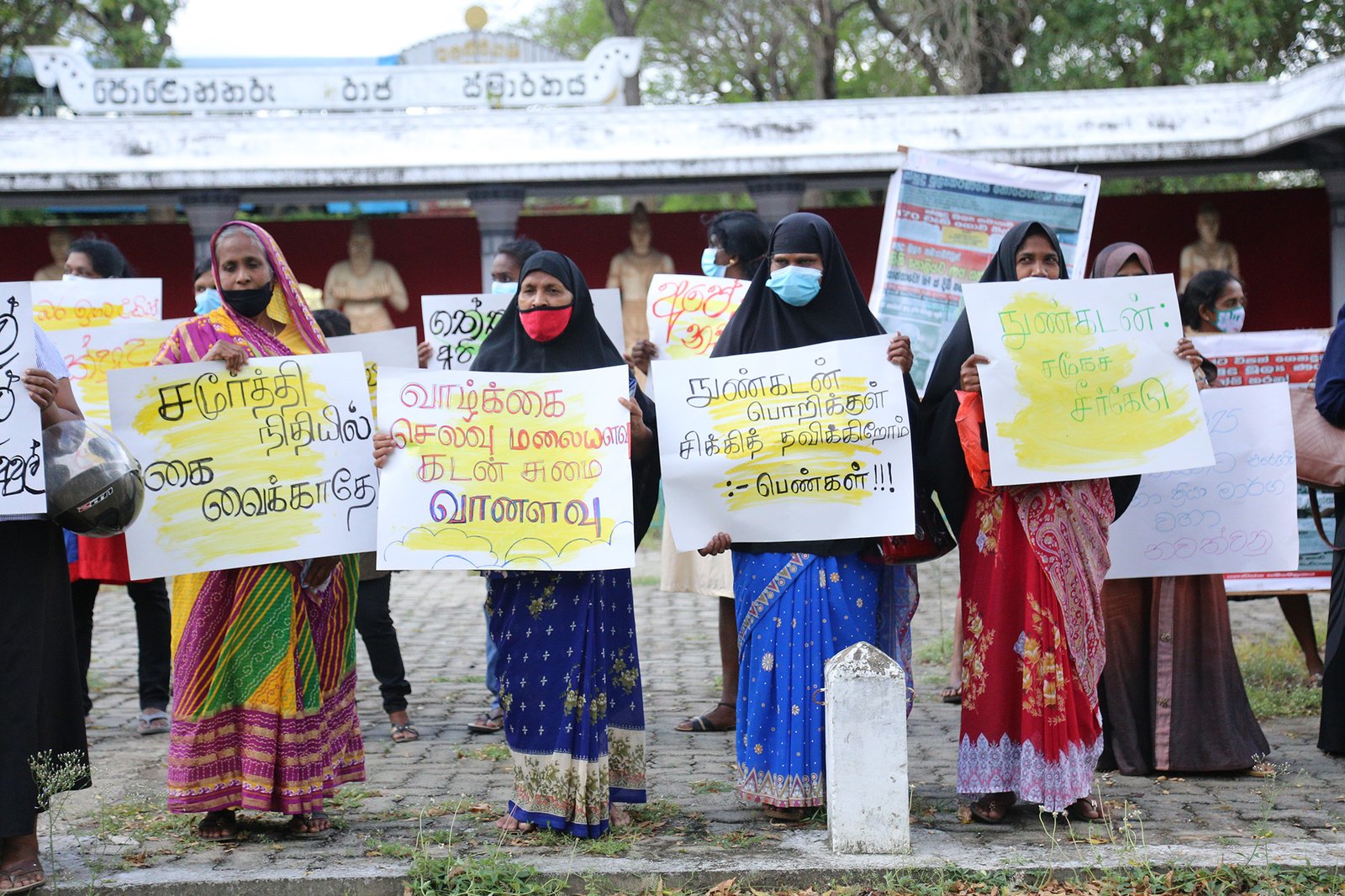
Editors’ Note: On 17 November 2025, the NPP government gazetted a bill to establish a statutory agency styled the Microfinance and Credit Regulatory Authority; to regulate the business of moneylending and microfinance in Sri Lanka; to “provide protection for the customers of the moneylending business and microfinance business”; and to repeal the 2016 Microfinance Act – that has signally failed in eliminating predatory microfinance and in protecting the rights of borrowers, the vast majority of whom are women in poverty.
The current bill replaced an earlier one gazetted by the previous government in October 2023 which has been strongly opposed by affected communities and civil society organisations. However, the November 2025 bill has fallen short in addressing the gaps and limitations of its predecessor, prompting calls on the government for fresh consultation towards its review and repair, including through the recognition and safeguarding of community–based and managed savings and credit schemes.
On 7 January 2026, the Parliamentary Sectoral Oversight Committee on Economic Development and International Relations met with a number of groups from across Sri Lanka as part of an ongoing discussion on proposed amendments to the Act. The following press release, lightly edited by us, highlights submissions made before the Committee as proposed by the Suriya Women’s Development Centre, Batticaloa.
Suriya Women’s Development Centre Presents Recommendations on the Microfinance and Credit Regulatory Authority Bill
A meeting of the Parliamentary Sectoral Oversight Committee on Economic Development and International Relations took place yesterday, 7 January 2026, at the Parliament premises, chaired by Hon. Lakmali Hemachandra, with participation from Committee Members, the Central Bank of Sri Lanka, and the Ministry of Finance.
The session brought together voices from the ground, including representatives of farmers’ collectives and women’s groups from several districts, particularly Anuradhapura, Polonnaruwa, Monaragala, Mullaitivu, and Batticaloa. These grassroots representatives shared firsthand accounts of the heavy toll microfinance debt has taken on rural and low-income communities, highlighting struggles such as coercive debt recovery, loss of assets, and long-term economic instability.
Suriya Women’s Development Centre contributed to the discussion, presenting recommendations grounded in decades of work with women facing microfinance-related debt and economic insecurity. Drawing on women’s lived experiences in rural, post-conflict, and crisis-affected areas, Suriya urged the Committee to ensure real protections for women borrowers, stricter oversight of unfair lending and abusive recovery practices, and enforceable safeguards during disasters and emergencies to prevent further harm to households already facing vulnerability.
Suriya emphasised that the Bill must recognise and protect borrowers, guarantee fairness and transparency in lending, and prevent punitive recovery measures that erode women’s dignity and livelihoods. Highlighting the reality on the ground, Suriya noted that women who are the majority of microfinance borrowers continue to bear a disproportionate burden of debt, facing harassment, asset loss, and enduring economic insecurity that affects entire families.
The key recommendations presented by Suriya include:
Section 3 – Objects of the Authority
Recommendations:
The Bill must recognise that women are the main target group of microfinance companies and must acknowledge the gendered and disproportionate harm women experience through microfinance.
-
-
- A mandatory requirement of gender impact assessment of all policies, directives, and decisions of the Authority prior to implementation
- Mandatory collection of sex-disaggregated data
- Explicitly identify actions to address social harms experienced by women borrowers
-
Section 5 – Board Composition
Recommendation:
At least 50% women’s representation on the Board with the inclusion of women’s rights organisations, representation of borrower or community groups
Sections 22 & 32 – Licensing of Microfinance Institutions and NGOs
At the village and community level, women’s groups manage small revolving funds to meet urgent household needs, medical expenses, and emergency situations. These systems operate on trust, solidarity, and collective responsibility, and are often the only accessible form of financial support for women in remote and crisis-affected areas.
While the Bill requires all microfinance institutions, including NGOs, to be licensed, Section 20(3) provides exemptions for banks, finance companies, cooperatives, Samurdhi banks, and government institutions. However, women’s group-led village-level revolving funds and similar community-based systems are not clearly included within these exemptions. Over-regulating such community systems risks undermining grassroots financial practices that directly support women’s survival and resilience, is part of community social safety nets, resilience and promotes domestic economies.
Recommendation:
-
-
- Explicit inclusion of women’s village-level revolving funds and similar community-based systems under Section 20(3) exemptions
-
Section 33 – Directives on Interest Rates and Lending Practices
The Bill allows the Authority to issue directives on lending practices but does not set statutory interest rate limits, rules governing interest calculation, or a prohibition on interest compounding. It also does not require disclosure of the Effective Interest Rate. The absence of statutory safeguards allows excessive and exploitative interest charges and debt cycles that trap women in continuous repayment stress.
Recommendations:
-
-
- Statutory limits on interest rates, with ceilings reviewed annually by the Authority
- Mandatory disclosure of the Effective Interest Rate
- Clear rules on interest calculation and loan charges, including for multiple loans
-
Debt Recovery Practices, Asset Protection, and Remedies
The Bill does not clearly prohibit harassment, intimidation, or public shaming during debt collection. Women borrowers report collectors coming to their homes, humiliating them in public spaces, and exerting pressure through family members. Women also risk losing jewellery, household items, or land documents, often under pressure or without full understanding. These practices create fear, stigma, and social harm, and prevent women from seeking help or redress.
Recommendations:
Develop gender-sensitive standards for debt recovery such as –
-
-
- Clear legal bans on harassment, intimidation, and public shaming
- Prohibit microfinance lenders from using women’s homes, public buildings or community spaces to run their businesses or debt management or recovery activities.
- Prohibit anyone who are not employees from engaging in debt recovery.
- Prohibit entry into borrowers’ homes or workplaces for debt recovery.
- Protection for women’s personal jewellery and essential household assets
- Prohibit lenders from forming groups of borrowers and holding them accountable for the repayment of loans of other members in the group.
- Authority to have clear process to cancel or write off unfair, abusive, or impossible-to-repay loans
- Authority to order refunds or compensation for financial, social, or emotional harm including loss of assets and property due to exploitative and unfair lending
-
Section 4(g) – Complaint Mechanism
Although the Bill allows for a complaint mechanism, it does not guarantee local accessibility, Tamil/local language support, confidentiality, or protection from retaliation. Many women cannot safely complain due to fear, stigma, and lack of access.
Recommendations:
-
-
- Locally accessible complaint mechanisms with local (Tamil and Sinhala) language services, with offline access
- Protection for women who submit complaints
-
Disaster and Emergency Context
Women in the Eastern Province regularly face floods, cyclones, and conflict-related emergencies. After such crises, livelihoods collapse and women often borrow to meet daily needs, healthcare costs, and recovery. The current Bill does not recognise climate induced disasters, emergency situations, leaving women exposed to continued interest, repayment pressure, abusive debt collection, and risk to assets during crises.
Recommendations:
-
-
- During declared disasters or emergencies including natural disasters or other sudden crises the Authority should ensure immediate suspension of loan repayments, interest, and penalties for affected borrowers.
- Borrowers should be also included in a universal social security programme to ensure mechanisms are already in place to face any unforeseen and unplanned incidents.
- The Authority should have the power to write off loans or provide refunds/compensation for borrowers unable to repay due to emergencies.
- Borrowers affected by emergencies must be protected from harassment, intimidation, and asset losses during and immediately after the crisis.
-
We urge the Parliamentary Oversight Committee to strengthen this Bill so that it safeguards women’s dignity, livelihoods, and long-term security.
Suriya Women’s Development Centre is a Batticaloa-based gender justice organisation founded in 1990.
Photo credit: Amila Udagedara (source: https://bit.ly/456DMUy)
You May Also Like…
The Art of Witness: Memory and Resistance in Sri Lanka
Yolanda Foster
When I first arrived in Colombo in the 1990s, I was in my twenties and had just begun a volunteer role with Peace...

‘Border villages’: Emergence, Salience, and implications for ‘Community’ in Sri Lanka
Viyanga Gunasekera
Despite Sri Lanka being an island and not sharing land borders with another country, the term ‘border villages’...

Image-Based Sexual Abuse, and Consent, in the Digital Age
Sely Liyanage
The rapid development of digital technologies has created new forms of content and new forms of harm. Some content is...