
Obeyesekere the Dreamer: Visionary Journeys in Anthropology
Anushka Kahandagamage
I remember vividly one pattern in my youthful dreams repeated time and again, without too much variation, that of roads amidst green hills and open spaces and people in little Sri Lankan houses helping me to reach the right forested paths, through which I have dream-hiked so many times, that seemed so real I sometimes think I have actually been on those journeys in my ordinary unlucid existence.
(Obeyesekere 2012: 475)
Gananath Obeyesekere was, above all, a collector of dreams and visions. To understand the ‘reality’ we inhabit, he chose different methods in the ethnographic mix: conversations, participation, and more excitingly, dreams. For Obeyesekere, dreams were a gateway to understand both the individual and society. He unearthed the meanings of behaviours by exploring dreams including trance, hypomantic [sic] states and visions.[1] In his work, dreams are vivid and have a broader meaning. In this essay, I trace his visionary journey through three books: Medusa’s Hair (1981), Buddhism Transformed (1988), and in particular the magisterial The Awakened Ones (2012); where he engages with philosophies, religious traditions and figures, both eastern as well as western.
Obeyesekere’s engagement with dreams involved inner psychology, religion and religious symbolism, human behaviour, and the ways these networks of phenomena manifest in society. Similar to the way he analyses nibbāna in The Awakened Ones, for him, dreams or visions came first, and rational explanations only thereafter. He used Western psychoanalysis as a tool to present the chaotic social realities of the East. While some Buddhist scholars claim that he is a scholar of Buddhism, and although he did engage deeply with Buddhist practices and ideas, I would argue that what ultimately became Buddhist was his method, which treated visionary experience as primary and rational explanation as secondary, using this approach as the guiding framework for his research.
In this piece, I engage with his interpretive world of dreams, where he navigates reality through intangible realms. Reading his work became an encounter between two analytical horizons: my own ethnographic understanding of trances, visions, and dreams intertwined with his analytical imaginations. I therefore understand him not through some distant detached evaluation, but through my own understanding of visions, dreams and trance—a process that echoes Hans-Georg Gadamer’s concept of the fusion of horizons (Gadamer 2004).
As a methodological point of departure, I share here a dream I experienced while writing a chapter of my PhD thesis that focused on Ven. Abhayaratanālaṁkāra, the originator of a post-war Sri Lankan Buddhist movement that deviated from conventional teachings and a central subject of my research over the past few years. He will recur throughout this piece.
I was immersed in listening to the sermons of Abhayaratanālaṁkāra while drafting the chapter, and I experienced a striking nocturnal episode. I was half-asleep, and the light from a streetlamp was permeating my room via the window. I sensed a presence in the room and perceived a large, shadowed figure standing by the bedside. I immediately turned to the side and looked at the figure; it had long ears and a wide mouth with long white teeth, a greenish complexion, and a hunched back. I tried to open my eyes and look more carefully and clearly, and suddenly the creature disappeared. Rather than interpreting this as an objective event, I read it reflexively, as an instance in which my dreams and ethnographic material briefly converged. In that moment, I felt myself momentarily entering the cosmos of Abēratna, replete with unknown realms and beings, one that you, too, will get to know in this essay.
Medusa’s Hair and Abēratna’s Maha Sohon
In the tangled threads of Medusa’s Hair, Obeyesekere enters the vivid world of the ascetic–ecstatic. He dives into the vortex of priests’ trances, visions, and dreams, where communion with the divine took shape and is materialised as iconography for followers, and which later solidified as deity statues in the shrines. In these altered states, the priests elaborated the attributes of Hūniyam, transforming him from a demon into a deity. This symbolic transformation unfolded alongside the turbulence of the new open economic policies, revealing how shifting socio-economic conditions reshaped the demands placed on religious spaces. These demands entered the dreams of priests and manifested in the form of iconography, forming divine presences compatible with the demands of the people.
According to Obeyesekere, Hūniyam, who was virtually unknown in Sri Lanka was becoming the guardian and the protector of the ascetic-ecstatic and was gaining traction among the urban proletariat. Instead of analysing the iconography of otherworldly beings which was already emerging, Obeyesekere makes the connection between the iconography and society through the world of dreams, which is a subtle and innovative methodological approach.
In my research on new Buddhist groups in Sri Lanka, I came across similar stories, where trance visions transformed into visual manifestations from a group called Waharaka, founded by Ven. Abhayaratanālaṁkāra. Reflecting on his lay life, Ven. Abhayaratanālaṁkāra recounted a story about one of his uncles, a gravedigger in his mid-sixties, who had received a charm meant to help him locate easy places to dig graves (Siriwardana 2012a). The charm required silence while in use, but the uncle accidentally spoke and soon began screaming that he had only two days left to live. Alarmed, his family brought him to Abēratna.
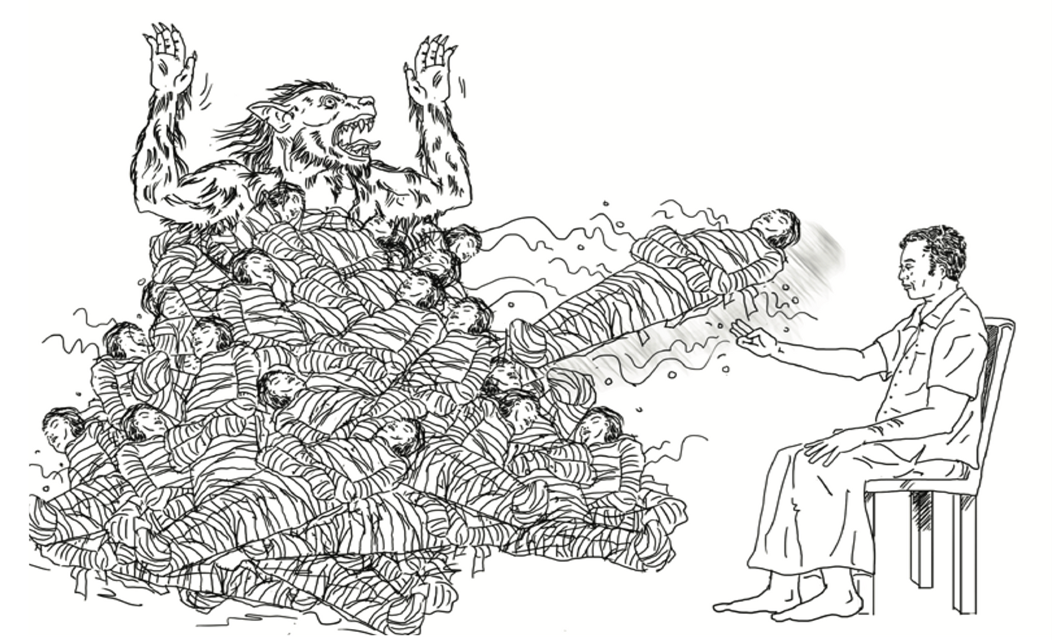
Entering a visionary state, Abēratna encountered a powerful figure who identified himself as the Great Graveyard Devil (Maha Sohon). The figure explained that the uncle had unknowingly summoned him and promised a dead body in return, a promise that had not been fulfilled. As a result, the spirit intended to claim multiple lives. Abēratna negotiated with the devil and began manifesting a pile of dead bodies. The devil was ultimately overwhelmed by the pile, buried within it, and forced to withdraw and apologise. When the vision ended, the uncle fully recovered.
Interestingly enough, while an image relating to this incident was created and published in the Waharaka periodical in 2012 (i.e., after the end of the war), the actual incident had taken place during the war. The iconography of a pile of dead bodies and a demon in the centre reflects the violence and instability, resonating with both the youth insurrections and the broader war environment. Abēratna intervenes by manifesting dead bodies and offering them to the demon, which can be read as a symbolic act of societal healing.
Obeyesekere transforms individual visions, dreams, and trance states into usable ethnographic material that generates communal meaning. The iconography we encounter in religious spaces is shaped and transformed through the socio-economic and political changes of society. This continuity between Obeyesekere’s interpretive framework of visions and contemporary post-war Buddhist experience prepares the ground for examining the more elaborate arguments in Buddhism Transformed.
From Buddhism Transformed to post-war Buddhism: Erotic-trance and encounters with Hūniyam
Obeyesekere’s engagement with the dream world appears throughout his writings and culminates in Buddhism Transformed, which, among other themes, explores the firewalkers of Kataragama. According to him, the rise of bhakti religiosity among Kataragama firewalkers reflects social transformation in Sri Lanka, which led to the breakdown of traditional village and kingship ties and the rise of urban individuality.
In some sections, he explores the stories of devotees who personally encountered the divine. While these divine encounters are not limited to Kataragama/Skandha, all gifts of possession (ārūḍa) must be sanctioned by Skandha. Devotion is demonstrated through many acts, including firewalking and Kāvadi dance. According to Obeyesekere, the body becomes a medium for divine presence and the dance resembles acts of eroticism. He connects this erotic trance to representations of sexual frustration prevalent in society, where premarital sexual relations are restricted and marital hardship is shaped by economic conditions in the country.
Firewalkers first appear in Obeyesekere’s work in 1978. However, in that paper, his narrative and analysis appear scattered and somewhat unclear, whereas in Buddhism Transformed the ideas are more finely developed and coherent.
There are different threads, characters and concepts running across his work. One of the protagonists is Hūniyam, who, after Medusa’s Hair, reappears in Buddhism Transformed, in more detail and as a part of a larger, transforming pantheon. This time the deity appears to Visuddhānanda, a chief monk of a small temple in Lunawa. Visuddhānanda declares that he has captured Hūniyam, with his uncle’s help, with the intention of doing good deeds. In a dream, Hūniyam directed him to a location where he found an image of Hūniyam (as predicted) and built a shrine there. He kept seeing Hūniyam in his dreams, and Hūniyam addressed him as “son.” In spite of this, Visuddhānanda claimed to have a particular power over Hūniyam (rather than the other way around), behaving rudely to him at seances, interrupting him, urging him to repeat, and so on.
In general, monks are looked down upon when they associate themselves with black magic. However in this case, the monk’s association with Hūniyam preserved and even elevated his status among the devotees. This is one of many stories in the book, and Obeyesekere uses it to illustrate how Hūniyam is rising in the religious pantheon.
Interestingly enough, I also encountered Hūniyam in Ven. Abhayaratanālaṁkāra’s hagiography. Wickrama, a resident of Abēratna’s neighbouring hamlet Induruwa, extended an invitation for Abēratna to visit his home. At Wickrama’s dwelling, Abēratna witnessed an abandoned shrine (dēvāla) engulfed in dark rays known as black rays (kaḷu kiraṇa). Together, Wickrama and Abēratna revived the shrine by performing a ritual (śāntikarma).[2] During one of the rituals, Abēratna had a profound encounter with Sūniyam, whom he calls deviyō (deity), who offered guidance on appropriate deity offerings.
According to Abhayaratanālaṁkāra, Sūniyam Deviyō revealed that the previous offerings made to the god were insufficient and displeased him, leading to divine discontent (Siriwardana 2012b). Following the god’s wrath, thousands of otherworldly beings appeared from the nearby rubber estate. Wearing sarongs, cowls, with their loincloths slung over their shoulders and wielding sickles and hoes, they resembled petty village thugs. After rectifying the deity offerings, all the otherworldly beings were pleased, and their sickles and hoes transformed into white flags.
Like the story of Visuddhānanda, Abēratna draws upon Hūniyam’s power through a personal connection, during a period that aligns with the historical context Obeyesekere describes, but appearing in the post-war Buddhist context in Sri Lanka.
Obeyesekere, alongside the rise of Protestant Buddhism in Sri Lanka, explores a category of religion which was appealing to the urban proletariat: spirit religion. This form of devotion is often flexible and liberating, and has proved to be particularly useful in navigating the uncertainties of economic pressures and breakdown of traditional village hierarchies which leads to social transformation.
The episode of Abēratna recounted above can be understood as a contemporary extension of this spirit religion: through his visionary encounter with the Maha Sohon and the revival of neglected shrines, Abēratna enacts the symbolic and practical dimensions of spirit religion, mediating fears and restoring order within a post-war social landscape.
The Awakened Ones: Challenging the Enlightenment through dream epistemology
In his book, The Awakened Ones, Obeyesekere journeys through dreams, visions, and trance, dances with philosophies, both Eastern and Western, and establishes Eastern visions as a method of understanding in contrast to Western Enlightenment. Throughout his work, he draws on these intangible realms to interpret social realities, but in this culminating text he most explicitly articulates his methodological philosophy, foregrounding visions, dreams, and trance as legitimate ways of understanding the world we inhabit. He draws on examples of visionary knowledge from both Eastern and Western religious traditions. But he begins his expedition with the awakening of the Buddha, which the West has misinterpreted as Enlightenment, beautifully elaborating the visions experienced by the Buddha during the different watches of the night.
Ven. Abhayaratanālaṁkāra, who we have already met through post-war Buddhist movements in Sri Lanka, recounts a story of awakening. According to his hagiography, which is scattered across many sources, in 2013, Waharaka Abhayaratanālaṁkāra, while meditating, gained a clearer perception of the world (Siriwardana 2014). Through the practice of meditation, he developed the ability to perceive hidden dimensions. With the newfound insight into the unseen realm, he was able to behold the three daughters of Māra[3], each appearing to be approximately eleven, fourteen, and seventeen years of age. These three girls attempted to seduce the monk using multiple tactics. According to Abhayaratanālaṁkāra, their seductive demeanours were incredibly explicit and beyond one’s imagination. Māra’s daughters were completely nude and engaged in sexually provocative dancing. In his encounters with otherworldly and mythical beings, including the daughters of Māra, the monk witnessed distressing scenes where men and children were engaged in sexual acts. Nevertheless, in the end, the monk ultimately defeated the daughters of Māra.
In Buddhist literature, the dramatic portrayal of the Buddha defeating Māra symbolises the struggle between good and evil, highlighting the ultimate victory of good. The person who defeats Māra encounters the cosmic world while remaining physically in the terrestrial realm. In this context, I argue that Abhayaratanālaṁkāra was depicted as the figure capable of vanquishing the ultimate evil of the universe, thus able to emerge victorious, a quality that Sinhala society, gripped by the fears of civil war, desperately needed.
In The Awakened Ones, Obeyesekere moves beyond relying solely on interviews and participant observation, the more direct and tangible methods of ethnography, to document dreams, visions, and trance as one of the primary sources of anthropological insight. This realm of visions occupies a space between the conscious and unconscious mind, and between the tangible and unseen worlds, a space that cannot be fully captured by Enlightenment rationality. The complete oeuvre of Obeyesekere up to The Awakened Ones, used dreams and visions as a tool of analysis. In this final masterpiece, he transforms visions and dreams into an epistemological framework derived from religious traditions across the world, particularly Buddhism, thereby challenging Enlightenment rationality, which continues to haunt the social sciences.
Anushka Kahandagamage (PhD, University of Otago) is a post-doctoral fellow in the Harvard Divinity School, Harvard University.
Photo credit: Anushka Kahandagamage
References
Gadamer, Hans-Georg. (2004). Truth and Method (J. Weinsheimer and D. G. Marshall, Trans.; 2nd rev. ed.). New York: Continuum.
Obeyesekere, Gananath. (1978). “The Fire-Walkers of Kataragama: The Rise of Bhakti Religiosity in Buddhist Sri Lanka”. The Journal of Asian Studies, 37 (3): 457–476. https://doi.org/10.2307/2053572
Obeyesekere, Gananath. (1981). Medusa’s Hair: An Essay on Personal Symbols and Religious Experience. Chicago: University of Chicago Press.
Obeyesekere, Gananath. (1988). Buddhism Transformed: Religious Change in Sri Lanka. Princeton, NJ: Princeton University Press.
Obeyesekere, Gananath. (2012). The Awakened Ones: Phenomenology of Visionary Experience. New York: Columbia University Press.
Siriwardana, Chandana. (2014). “Abhayaratanālaṁkāraya 33: Māra dūvaru piḷiban̆da vartamāna satya atdækīmak. (A present real experience regarding the daughters of Māra)”. Heḷa Bodu Piyuma (July 2014): 14-18. Available at https://storage.googleapis.com/www.waharaka.com/HelaBoduPiyuma/33.pdf#page=16
Siriwardana, Chandana. (2012a). “Abhayaratanālaṁkāraya 10: Paṭibhāna kavītvayen nægī ā suviśēṣīya pratikarma magin leda rōga suvapat kala hæti (How illnesses were cured through the special treatments that emerged from the poetics of the analytical knowledge of elucidation)”. Hela Bodu Piyuma, (August 2012): 23-27. Available at https://storage.googleapis.com/www.waharaka.com/HelaBoduPiyuma/10.pdf#page=25
Siriwardana, Chandana. (2012b). “Abhayaratanālaṁkāraya 06: Dēva pūjāvaka sæn̆gavuṇu hāskam æs dekinma balāgat hæṭi (How [I] witnessed the hidden secrets of an offering [to a] deity)”. Heḷa Bodu Piyuma (May 2012): 6-8. Available at https://storage.googleapis.com/www.waharaka.com/HelaBoduPiyuma/06.pdf#page=8
Notes
[1] In Medusa’s Hair, Obeyesekere uses the word hypomantic, instead of hypomanic.
[2] White magic (magic used for good purposes).
[3] Māra, whose name literally means ‘death’ or ‘maker of death’, is the embodiment of lust, greed, false views, delusion and illusion.
You May Also Like…

A ‘Duty of Care’ to Animals: Two Decades of Struggle for Law Reform in Sri Lanka
Kasun Kavishka
In late April 2026, Sri Lanka welcomed Aloka, an Indian stray dog who walked along with US-based Buddhists monks in...

Polity Vol 13 No. 2 (December 2025)
ContentsGoverning in Anticipation of Backlash by EditorsThe Great Flood by B. SkanthakumarFCEJ Stands in Support of...

A Heart That Never Forgets
Binu Peiris
Over the high walls of the white mansions where our money lay, Our youth sped their way holding the tears of our...