
Samanmali: A Life on the Frontlines of Women’s Struggles and Working-Class Resistance
Kumudini Samuel
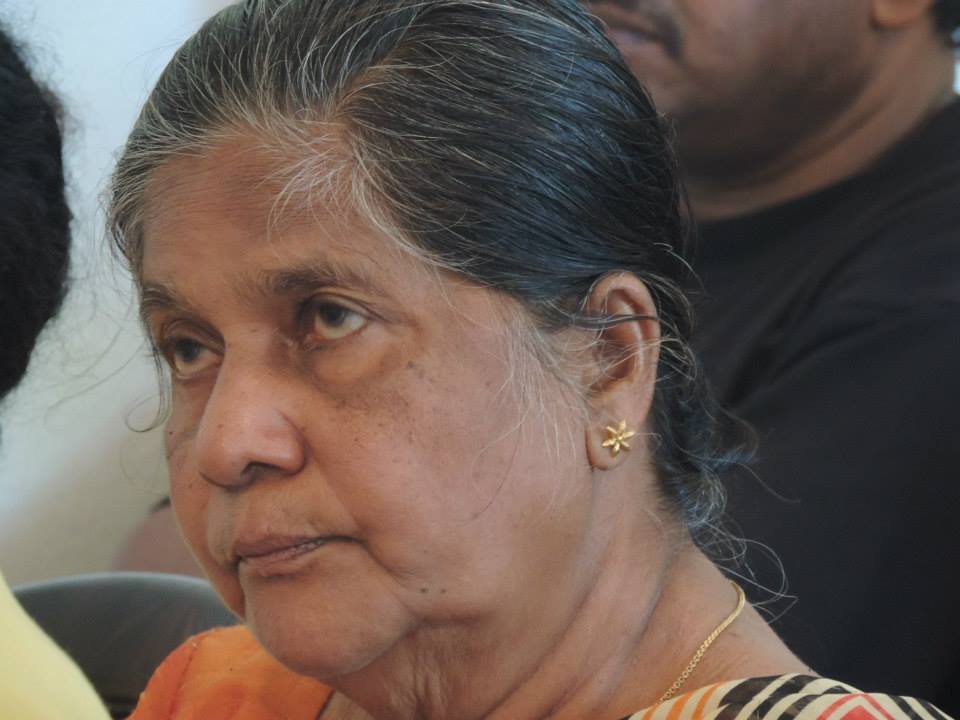
H. I. Samanmali (‘Saman’) passed away on 11 November, after withstanding years of illness with quiet strength. For those who worked alongside her, her loss is both professional and deeply personal.
As a director of the Da Bindu Collective and long-time executive editor of Da Bindu (‘Drops of Sweat’), she helped carve out a space where women workers could speak in their own voices, unfiltered and unafraid. Since its birth in 1984, the magazine/newspaper, the first of its kind, has carried the stories, struggles, and triumphs of women in the Free Trade Zones (FTZ). These were stories Samanmali recounted with a fierce commitment to justice. It is through this witness of over forty years that her own legacy will continue.
I first met Saman at her home in Gallawatte—at that time a quiet, semi-rural stretch of land within the Ekala Industrial Estate (Ekala Karmika Janapadaya), surrounded by bare land and a pol watte. The area was very different from what it is today. This land had originally been allocated by Prime Minister Sirimavo Bandaranaike for agricultural cultivation but was later converted into an industrial estate that housed factories employing thousands of workers.
Her husband Somapala, known among comrades as Somé, was active in the Ceylon Mercantile Union (CMU). The CMU had by then established strong trade union bases in several factories—Star Garments, Union Carbide, Monta Garments, and others. Both Somé and I were members of the Revolutionary Marxist Party (RMP), and it was through this political work that I came to know Saman.
A home that became a political nerve centre
To step into Samanmali’s home in the late 1970s and early 1980s was to step into a world of political energy. Only Somapala and Saman had a home directly adjacent to the factories, and as a result it became a constant hive of activity. It was a space where organising strategies were debated, workers’ grievances analysed, solidarity networks forged, and countless discussions and meetings held. Posters and placards were drawn there, leaflets and newspapers bundled, and activists, comrades, workers, women moved in and out as though the house were an open crossroads of political life. Discussions lasted late into the night.
As trade union and party activists moved constantly through their doors, Samanmali never stopped making tea, cooking meals, hosting discussions, and holding the space together. It was the quintessential domestic-political nexus where the labour of political struggle was supported and buttressed by invisible, indispensable domestic labour. Although Somapala helped occasionally, much of this care work done by Saman went unacknowledged by male comrades.
Her labour was often taken for granted by male comrades, yet it was precisely here—in this bustling, makeshift organising centre—that Saman absorbed every detail; from planning strikes and protests to producing leaflets and newspapers; and where she cultivated her political knowledge and her extraordinary clarity about working-class women’s lives that shaped her continued activism.
Feminist activism
In the early 1980s, the leadership of the RMP shifted from Bala Tampoe to Upali Cooray. The Ja-Ela cell of the party included Somapala, Wilfred, K.R. Fernando, Arthur, Gomes, Basil, and Anton Marcus—many of whom had roots in the CMU and would later form the breakaway Industrial Transport and General Workers Union (ITGWU), the trade union of the RMP.
Under Upali Cooray’s leadership, the RMP began to build a small loosely structured entity of women-helmed socialist feminist activists within the party which was somewhat grandly termed the ‘Women’s Liberation Movement’ (WLM). Its first members included Samanmali, Kumudini Rosa, Philomina, Mala Ratnaseeli, Mallika Pararajasingham, and myself.
This collective initiated women’s study circles and began building links with women working in the Ekala factories, seeking to deepen the workers’ understanding of exploitative labour practices, workers’ rights, and the broader currents of socialist feminist struggles for women’s emancipation and labour justice.
The WLM initiated study circles with women workers in the Ekala area, using materials from Kantha Handa and related publications, many from the Fourth International with which the RMP was affiliated. Samanmali played a crucial role in organising these study circles, where we discussed everything from the exploitative nature of the garment industry and export processing zones to broader debates on women’s oppression and their relentless double burden of paid and unpaid labour and the triple burden suffered by Tamil women oppressed by identity politics.
Kantha Handa (published by Voice of Women—the first feminist organisation in Sri Lanka) provided us with a steady stream of reading material; from critiques of media portrayals of women, to documentation of the exploitation in the plantation sector, details of struggles of nurses, debates on night work, discussion of women’s rights within the family, and much more.
The study circles eventually expanded from Ekala to Nawalapitiya (with women plantation workers), Jaffna (with women students), and Ratmalana (with women industrial workers). These early discussions would later shape Samanmali’s lifelong work with Da Bindu—both the newspaper, and the rich educational pamphlets produced by the Women’s Education and Training Centre (WETC), an initiative supported by the feminists in the RMP, which preceded the founding of the Women’s Centre.
Building a union among women workers
During this period, Samanmali, Philomena, and I walked the length and breadth of the Ekala Industrial Zone, visiting boarding houses, distributing leaflets, and persuading women to join our study circles, and encouraging them to become members of the ITGWU, the RMP-affiliated union.
This was an extremely difficult time for unionising. The July 1980 general strike had ended in defeat, unleashing state repression across the workers’ movement. Mobilising women under such conditions required courage, patience, and constant support. I remember meeting Bandu Shanthi, Leela Fernandez, and Hema Matarage at Polytex Garments with Saman and talking to them about the possibility of forming a union. They eventually did—and this led to the iconic Polytex strikes of the 1980s. Saman was central to this process; she was the only one with direct, daily access to women workers.
The Women’s Centre in Tudella
In 1981, this organising work resulted in the establishment of the Women’s Centre in Tudella, located on the main Negombo Road. It offered a safe and accessible space for women workers where we held discussions on workers’ rights, socialist feminism, the need for an autonomous women’s movement, and the conditions of Tamil plantation workers.
By the early 1980s we were also members of the Movement for Inter-Racial Justice and Equality (MIRJE). Saman, Somapala, and Wilfred served as MIRJE organisers in the Ja-Ela/Ekala area and played a vital role in protecting Tamil residents during the 1983 pogrom and later in rebuilding homes.
The choice to visit and make contacts with Tamil workers in the plantations and Jaffna in the midst of accelerating ethnic conflict and war; demanding the repeal of the Prevention of Terrorism Act (which MIRJE opposed right from 1979); calling for a negotiated political solution to the ethnic conflict, and to free political prisoners and release Nirmala Nithyanathan, places Samanmali within a broader tradition of left, feminist, and anti-racist organising, highlighting the intersectional dimensions of her activism.
Polytex and the emergence of women worker militancy
Working conditions at Polytex Garments were notoriously harsh. In the 1980s, with a workforce of 95% women, daily wages for skilled machine operators were a mere Rs 11.74; apprentices earned only Rs 8.60. Leave was restricted, lunch breaks were limited to half an hour, and overtime was compulsory when orders surged. The factory provided only four toilets for 800 workers, and paydays were irregular—often below Wages Board guidelines.
From their first strike action in 1980, to mitigate and win better conditions, Polytex women workers grew in strength and confidence. When their union leaders Bandu Shanthi and Leela Fernandez were arrested under Emergency Regulations and detained at Mahara Prison, the women regrouped at the Women’s Centre.
A second line of leadership emerged—Padmini Liyanage, Hema Matharage, “Yak” Mala (famous for her powerful voice), and “Pocket” Mala from the pocket-sewing section. Samanmali played a critical role in helping rally the near 750 workers, keeping the strike action intact, and strong.
We drew support from local residents, who often contributed kos, del, and coconuts gathered from their gardens. We also sought the support of surrounding factory workers, women’s groups, and powerful unions such as the port workers, the Government Clerical Service Union (GCSU) and the Ceylon Teachers Union (CTU). This underscores the gendered labour of social reproduction that makes political action possible but is often absent from historical accounts.
The victorious Polytex strike of December 1982 became the first successful strike led by women workers after the devastating crushing of the labour movement in July 1980. Ironically the success of the Polytex struggle led to patriarchal machinations that forced Saman to leave the Women’s Centre in 1983. Yet she never withdrew from the struggle. She established Da Bindu.
Da Bindu and continuing the struggle for autonomous organising
Saman founded Da Bindu with Cucu Rosa and Sr. Vivienne in Katunayake in 1984, strengthening the work in the FTZ, and continuing her deepest passion—writing and producing the Da Bindu newspaper and later magazine, which eventually earned her international recognition and awards.
Da Bindu is also a testament to her fierce belief and continued struggle to work autonomously as a feminist and to protect women’s autonomous organising. This she continued to do with her work with feminist formations such as the Women’s Action Committee (WAC), set up to support the Polytex struggle, which became a pioneering network of feminist movement building and later the coalition called Mothers and Daughters of Lanka (MDL).
The Da Bindu Collective began with the production of the Da Bindu newsletter, initially in cyclostyle form and moving on to a newspaper/magazine, its stories of struggle and its hard -won battles now amplified through the Da Bindu blog and website.
Starting as a drop-in centre in Katunayake, Da Bindu expanded its work to Biyagama in the 1990s. Post-war, it made connections with apparel workers in Jaffna, Kilinochchi and Vavuniya where it established centres, and moved on to form the Da Bindu Collective Union in 2021 at the request of these workers from the north. It has also engaged in critical research on manpower services and the apparel industry and is a longstanding member of the global Clean Clothes Campaign, with Samanmali serving on the steering committee of its South Asia Coalition as early as 1992. Da Bindu is also actively engaged in the Asia Floor Wage Alliance initiative for a living wage for Asian apparel workers and is represented on the socio-economic rights sub-committee of the Human Rights Commission of Sri Lanka (HRCSL).
A life of courage amidst adversity
Life was far from easy for Saman. Both she and Somé were under-resourced political activists. They had four small children who were dependent on them. Somé was self-employed, trying to live off an income derived from sourcing and marketing tea leaf on an extremely small scale and in a very competitive market. The loss of their eldest son aged 18 was a devastating blow and a source of lifelong grief.
The years of political repression under J. R. Jayewardene and Ranasinghe Premadasa, and the disappearances of comrades Ranjith and Lionel, forced the family to constantly seek safe shelter. Later in life, Saman was diagnosed with cancer and that was another battle she fought with strength and perseverance.
A quiet legacy that speaks loudly and lives on
Samanmali’s life was not lived on grand stages or in the spotlight. She built her legacy in boarding rooms, at factory gates, cramped homes, kitchen tables, and late-night discussions; in leaflets, posters, study circles, strike committees, and the pages of Da Bindu.
She stood at the intersection of political organising, feminist consciousness-building, and working-class struggle. Her life was a testament to what happens when women decide that their voices—and the voices of others like them—must be heard.
Just as my early experiences mobilising women workers in Ekala and supporting their strike actions shaped the beginnings of my own political activism, Saman was a beloved friend and comrade who inspired me with her courage and determination. She was akin to a mentor to me in those formative years. I hold deep and enduring respect for her unwavering commitment to Da Bindu, and to the struggles of women workers.
Later, we continued to work together—often and in solidarity—through the Women’s Action Committee and Mothers and Daughters of Lanka. Over the years, she made invaluable contributions to the Women and Media Collective (WMC) where I work. She visited us often, and her warm humour and lively stories added spirit and spark to many a paduru party!
The profound strength and pride embodied in Samanmali’s life lives on through her surviving children—Chamari, Indika, and especially Chamila. She leaves behind not only memories but a legacy of courage, commitment, and love that she gifted to all of us and to future generations; that shapes the struggles of today and will shape the struggles of the future.
Kumudini Samuel is Director (Programs and Research) at the Women and Media Collective and the author of A Hidden History: Women’s Activism for Peace in Sri Lanka 1982-2002 (Colombo: Social Scientists’ Association 2006).
Photo credit: B. Skanthakumar (January 2014)
You May Also Like…
Laughter, Debate, and Dissent: Personal Glimpses of Gananath Obeyesekere
Selvy Thiruchandran
I first met Gananath at the International Centre for Ethnic Studies (ICES) in Colombo, when its Director, Radhika...
A Bridge Between East and West
Richard F. Gombrich
My love and admiration of Gananath are so rooted in my view of my own life that if I failed to respond to this...
‘A literary man interested in anthropology’
Ranjini Obeyesekere interviewed by Crystal Baines
Dr. Ranjini (Ellepola) Obeyesekere is one of Sri Lanka’s leading translators, and among its first female theatre...