
Governing in Anticipation of Backlash
Editors
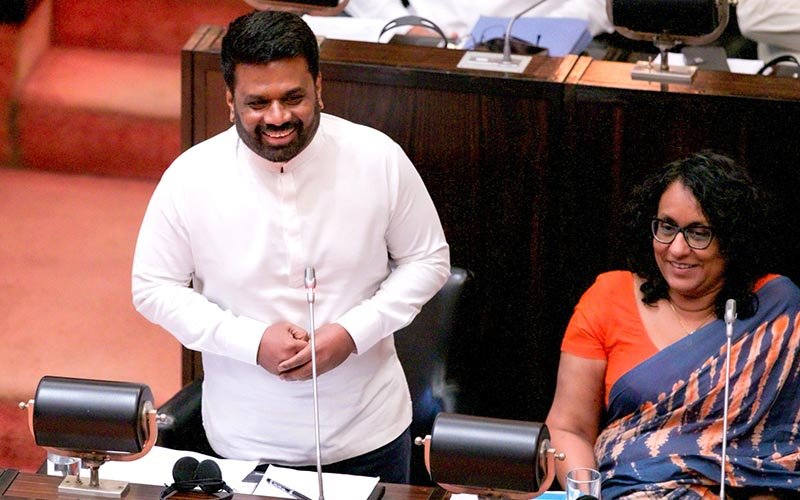
As Sri Lanka reels from the devastation caused by Cyclone Ditwah, President Anura Kumara Dissanayake in his address to the people on 30 November 2025, called for unity among all, above and beyond, what divides us.
At this decisive and calamitous moment, let us set aside all political differences for the sake of the country. Let us unite, free from distinctions of ethnicity, religion, party, or colour. There is ample time for politics, but there is little time to face this disaster. Let us come together to rebuild the nation. (Dissanayake 2025)
His vision of governance is one unencumbered by apparently tiresome identities of ethnicity, religion, class, and ideology. Indeed, such formulations of an inclusive democracy, neutral to social identity and political power, seem to be the rallying cry of the National People’s Power (NPP) government, beginning with its election manifesto (Uyangoda 2025).
But can a system of rule built on a history of socio-economic and political difference—truthfully, exclusion—transcend actually existing inequalities; even in the face of a catastrophe that apparently affects all, such as this?
1961 Satyagraha movement
The recent release[1] of Satyagraha: The Freedom Movement of the Tamils in Ceylon by Sinnathamby Ponniah, first published in 1963, is an uncannily well-timed reminder of how spectacularly the post-colonial state and successive governments have failed numerical ethno-linguistic minorities in the past.
The pamphlet-sized original publication reports on the Satyagraha of 1961, initiated by the Federal Party in response to the ‘Sinhala Only’ law that denied parity of status as an official language to Tamil.
The protests, based on the strategy of Gandhian civil disobedience, began on 20 February and ended 56 days later on 18 April 1961, when the government declared a state of emergency and unleashed the military on the protesters. The fateful decision of the Sirimavo Bandaranaike-led government to violently crack down on a group of peaceful protesters put Ceylon, as it then was, on a path leading to the militarisation of the ethnic conflict, and nearly three decades of horrific war.
As the invited speakers at the book launch recounted, the language policy and later “standardisation” of university entrance, drove many young Tamils to abandon constitutional modes of struggle for equality within an undivided state; embracing armed struggle for separatism and independence instead.
The Tamil-speaking people of Sri Lanka would have to wait another 26 years after the Satyagraha movement of 1961 before ‘Sinhala Only’ was repealed in the 13th Amendment to the 1978 Constitution. The 1987 revision made Sinhala and “Tamil also” the official languages of Sri Lanka, with English as a link language. The 16th Amendment further recognised the right of every citizen to use either state language when communicating with government offices and to receive communications in the language of their choice.
‘Tamil also’ observed in the breach
These guarantees, constitutional milestones notwithstanding, continue to be observed in the breach. Government communiques have described Cyclone Ditwah as one of the most devastating and deadliest weather disasters in recent years. Tamil-speaking communities in the central hills, east, north, northwest, southwest and western regions have been among those affected. Yet, advisories and alerts were not made in Tamil consistently, nor at times at all, in what is simply the latest episode in an ongoing saga of wilful indifference to constitutional and statutory rights for over four decades now.
It seems almost all the critical information on the cyclone issued by the state including from the Disaster Management Centre, the Meteorological Department, and Irrigation Department, was in Sinhala only. According to one researcher, “there was a significant disparity in both the frequency, and the granularity of life-saving, critical information provided in Sinhala vs. Tamil” such as landslide warnings, infrastructure and road closure updates, and river basin warnings. Even the update on the postponement of A/L examinations and logistical support provided by the Air Force for transporting exam papers to Jaffna was exclusively in Sinhala (Hattotuwa 2025).
These omissions were recognised by Deputy Minister of Mass Media Kaushalya Ariyarathne who requested public assistance from those who read and speak Tamil to help bridge this gap in a post on her public facebook page on 28 November.
To be fair, the NPP government inherited a state structure and bureaucracy which has scant regard for the language rights of Tamil-speaking people, leave alone their right to land. But the question that remains is: how is the NPP now going to address this appalling situation that has been so clearly brought to the fore in the wake of a catastrophe?
Constitutional reform no panacea
Given that the NPP has a two-thirds majority in parliament with broad support in all regions cutting across ethnicity, language, religion and class, some civil and political society actors believe that this government is squandering an opportune moment to reform the constitution of the state in Sri Lanka.
Yet, we remain sceptical that constitutional reform is the panacea to cure us of the ethnonationalism at the root of discrimination against Tamil-speakers. The Sri Lankan state has had almost 40 years to give meaning to the 13th and 16th Amendments and convince us otherwise, which it has abjectly failed to do.
If there is one lesson from Sri Lanka for would-be constitutional architects and engineers in civil society spaces, it is that constitutional reform in and of itself, is an insufficient condition to guarantee constitutional rights. This thread can be traced all the way back to the 1947 Soulbury Constitution.
As Professor Deepika Udagama pointed out at the book release event, Article 29(2) of the Soulbury Constitution prohibited discrimination based on religion, ethnicity, and caste. Yet the judiciary at the time failed to strike down either the Citizenship Acts, which disenfranchised communities of recent Indian origin particularly Tamil plantation workers; or the Official Language Act, on the grounds of discrimination against Tamil-speakers.
Office on Missing Persons
There are many more recent examples of how legal and institutional reform have failed those seeking justice even for egregious crimes against humanity, such as enforced disappearances. Take the Office on Missing Persons (OMP). When it was enacted, Mangala Samaraweera in his parliamentary address stated:
Today, however, seven years after the end of the brutal war and the defeat and the demise of LTTE terror, Sri Lanka is now ready to win the peace and heal the scars of conflict, sorrow and pain: this Bill is the first step in healing our own nation and its people so that we could face the challenges of the future as a united nation; unity in diversity! (Samaraweera 2016: 1320)
Yet, in the eight years since it was established, the OMP has only been able to trace 20 people, of the tens upon tens of thousands of the disappeared, revealing the deep institutional resistance to accountability in postwar Sri Lanka.
The modality of peaceful dissent embodied in the Satyagraha of 1961 is today echoed in the protests of the family members, overwhelmingly of Tamil ethnicity, though there are Muslims and Sinhalese among them, who were abducted or detained during the civil war. Some family members count more than 3000 days of protest in their struggle for truth and justice. Contrary to Minister Samaraweera’s promise, their pain and sorrow have been compounded over the years, by the refusal of consecutive postwar governments to answer their call.
Prime Minister (PM) Harini Amarasuriya when interviewed in November 2025, and asked about the NPPs pledge to establish a “home-grown process” to deal with allegations of past human rights violations, acknowledged the challenge of building trust among Tamil survivors who have been repeatedly let down by one government after another. The PM further responded as follows:
We need help, ideas, and open discussions that do not hold us accountable for past baggage, or measure us by old standards. What we really need now is to generate new thinking, a fresh approach to these difficult questions, that is less antagonistic, less polarised – and to build a more constructive way of engaging. There’s a lot of work ahead for all of us. (Srinivasan 2025)
Meanwhile President Dissanayake, at a meeting with the Ilankai Arasu Tamil Kachchi (Federal Party) in that same month, indicated that
the Government believes longstanding issues faced by the people of the Northern and Eastern Provinces can no longer be addressed through outdated political solutions. Therefore, it is necessary to move towards a new political framework and the support of everyone is essential in that process (President’s Media Division 2025)
Words short of meaning
These are words that fall short of conveying meaning. What is this “new political framework” that will replace outdated ones? What is the “fresh approach” to a home-grown process that will address demands for truth and justice for war related atrocities? In relation to forced disappearances, there is in fact already a home-grown process—the OMP. If the NPP is committed to building trust amongst victim survivors, it can resource and extend its political commitment to the OMP to fulfil its mandate as a matter of urgency.
Public statements and inaction by the NPP leadership since coming to power do not inspire confidence that it is willing to go the distance to address the long-standing demands of the Tamil people in relation to power-sharing, truth and justice, demilitarisation, return of land, etc.
Despite their two-thirds majority in parliament, the NPP’s political style is to govern in anticipation of Sinhala Buddhist nationalist backlash. The NPP believes that in doing so, it safeguards a second term and beyond in government. But for what, and whose, purpose—if its rule is only to maintain the status quo ante?
For now, the NPP believes that ethno-religious-linguistic minorities are thankful that this government is not “overtly racist” (Srinivasan 2025). For anything more, numerical minorities should bide their time for the promise of a “new political framework”—and in the interim civil society actors should be “less polarising, less antagonistic and more constructive” (Srinivasan 2025). At the same time, Tamil political leaders, rather than chasing the chimera of constitutional reform; should re-calibrate to focus on institutional reform, it is hinted.
The President’s response to rebuilding Sri Lanka after destruction by Ditwah brim with hope: “History has overlooked chances that have compelled us to pursue long-term objectives and coexist as a nation, and we are resolute in making this a point of no return this time” (Dissanayake 2025). Whether that “point of no return” applies also to the festering wounds inflicted by an ethnocratic state remains to be seen.
31 December 2025.
Image source: https://bit.ly/4qRqWSy
References
Dissanayake, Anura Kumara. (2025). “FULL SPEECH: President’s Address To The Nation”. Ministry of Mass Media (1 December). Available at https://media.gov.lk/media-gallery/latest-news/3507-full-speech-president-s-address-to-the-nation#
Hattotuwa, Sanjana. (2025). “Who gets warned? Language, discrimination, and disaster communication in Sri Lanka”. WordPress (29 November). Available at https://sanjanah.wordpress.com/2025/11/29/who-gets-warned-language-discrimination-and-disaster-communication-in-sri-lanka/
Dr. Kaushalya Ariyarathne. (2025). “In this critical time, we’re working to translate vital information into Tamil…” [post]. Facebook (28 November). Available at https://web.facebook.com/share/p/1EuhvFdeTm/
News.lk. (2025). “President Calls for New Political Solution to Address Issues in the North and East”. (19 November). Available at https://www.news.lk/current-affairs/president-calls-for-new-political-solution-to-address-issues-in-the-north-and-east
President’s Media Division. (2025). “President Calls for New Political Solution to Address Issues in the North and East”. (19 November). Available at https://pmd.gov.lk/news/president-calls-for-new-political-solution-to-address-issues-in-the-north-and-east/
Samaraweera, Mangala. (2016). “Office on Missing Persons (Establishment, Administration and Discharge of Functions) Bill”. Hansard, 245 (9) (11 August):1317-1327.
Srinivasan, Meera. (2025). “We need to create conditions for real, sustainable change: Sri Lankan PM”. The Hindu (11 November): https://www.thehindu.com/news/international/sri-lankan-prime-minister-harini-amarasuriya-interview/article70263009.ece
Uyangoda, Jayadeva. (2025). “The NPP Government and Its Democratic Promise: A Review”. Polity 13 (1): 6-13.
Notes
[1] The second enlarged 2024 edition, co-edited by Suppiah Ratneswaren and Malavarayan Vijayapalan and published by Agaram Publishers in England, was launched at the International Centre for Ethnic Studies (ICES) in Colombo on 28 November 2025.
You May Also Like…

Laughter, Debate, and Dissent: Personal Glimpses of Gananath Obeyesekere
Selvy Thiruchandran
I first met Gananath at the International Centre for Ethnic Studies (ICES) in Colombo, when its Director, Radhika...
A Bridge Between East and West
Richard F. Gombrich
My love and admiration of Gananath are so rooted in my view of my own life that if I failed to respond to this...
‘A literary man interested in anthropology’
Ranjini Obeyesekere interviewed by Crystal Baines
Dr. Ranjini (Ellepola) Obeyesekere is one of Sri Lanka’s leading translators, and among its first female theatre...