
Gananath: Two Stories and A Review
Victor C. de Munck
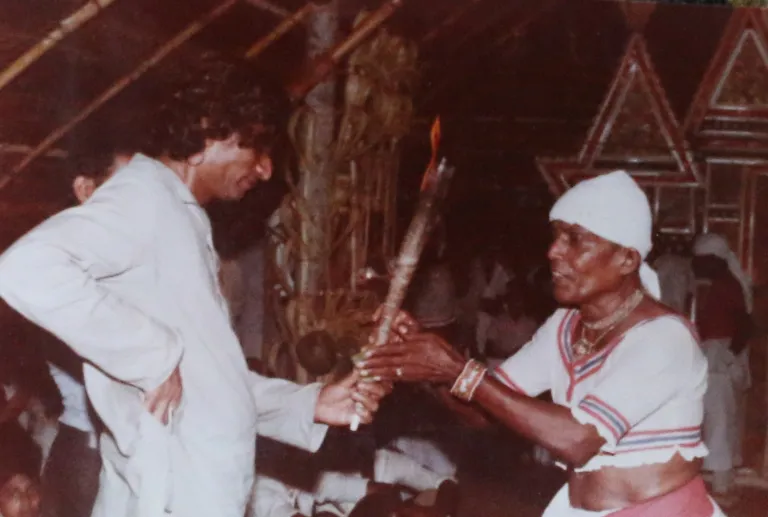
I was an undergraduate, and later a graduate, student of Gananath.[1] I have two stories I would like to recount. The first was as an undergraduate, when I got to know how he taught in class; the second was in Sri Lanka as a graduate student, when we met at a hotel near Kataragama and I was fortunate enough to go with him to the annual Kataragama festival.
Story 1: Gananath the Teacher
I was in my senior year at the University of California San Diego (UCSD), where he taught, in the early 1970s. At that time, classes were relaxed. People could smoke, go barefoot, and bring their dog to class so long as they were not disruptive.
If I remember, no one smoked in the class, or if they did, it was a rarity. But Gananath often smoked two cigarettes per lecture. How he smoked was entrancing, not just to me but to the class. He would hold the cigarette between his third and fourth fingers. When he wanted to inhale, he would cup his hand over his mouth, and inhale without the cigarette ever touching his lips.
He was an imposing man, and eyes turned toward him; his face was unique, as if painted by a Fauvist artist. His nose was sharp, long, and expressive, as were his eyes, which always appeared to be bright enough to see around the world. His voice, similarly, commanded the room with a natural, powerful ease that was at the same time sparkling. In short, he was an imposing, active figure that seemed forged by Dadimunda Deviyo (the god who protects both Buddhism and firewalkers).
When he taught, he was seldom like other professors, who were usually rather clear-spoken, modulating their speed so that we could hear every word clearly. Gananath spoke with electricity, often, and I (as well as others) were partly entranced and motivated to not just listen and digest but to question and dig deeper.
That is what the rarest of professors do, lighting the fire of wanting to learn what is in the unlit parts of life, that moves people to think outside the parameters of the mundane.
Story 2: Gananath at Kataragama
He had invited a few other anthropologists (among them James Brow, Deborah Winslow, Mike Woost) to come to Kataragama in 1979, where he held court just off the central area, in a place where he could look over people’s heads, see what was going on, and find people to interview and have energised conversations with.
He was very much at home there. Sometimes I would walk with him and his interlocutors, who were mostly firewalkers and people who put hooks into their bodies and seemed a bit like Buddhist and Hindu alternatives to Christ on the cross; though the analogy does not quite hold up to scrutiny. For one was not volitional and the other was.
Gananath was there, seeking to understand the mental/spiritual stratigraphy of humanity. His goal, it seemed to me, was to excavate and explain the complex conscious and unconscious layers of the mind.
A brief review of Gananath Obeyesekere’s method
Gananath’s relationship with interviewees was uniquely intimate. Even though his informants recognised his high status as a professor, the status barriers broke down quickly, not because he was talking down, but because of his delightful, welcoming personality. Although you might think this difference in status would lessen the honesty and depth of the interviews, surprisingly, it did not. His interviews were a mix of conversations and interview questions. These conversations went smoothly because they took place in environments where the interviewees felt safe and at ease. Plus, Professor Obeyesekere had spoken with many of them multiple times.
In my methods book (de Munck 2009), I note that one interview can be helpful, but I recommend at least three to gather reliable information. The first interview is usually a new experience for the interviewee and can be challenging for both parties. It is typically a “feeling out” interview, where the rules for how to proceed are made visible and agreed upon. In the second interview, the interviewee knows what to expect and is likely to feel more comfortable and willing to share the information the anthropologist seeks. In the third interview, we usually work together to construct and explain theories about why people act the way they do. Gananath had discussed his longitudinal interview methods with me a couple of times. I was happy to hear that my research methods strategy was akin to his.
From this perspective, Professor Obeyesekere’s interviews felt like friendly conversations in which everyone felt comfortable, creating a space for honest sharing. Normally, such a clear status difference might hinder the success of interviews, but not with Gananath. There were many shared moments of laughter during his interviews at Kataragama. He genuinely erased status differences as obstacles to his interactions with his interlocutors. Gananath built trust and made the social gaps between himself and his interviewees feel less noticeable. He would not only interview them but also invite them to his home for discussion and feasting; likewise, he was frequently invited to their homes. The warmth and closeness he shared with his main contacts were both impressive and insightful to me.
Further, he would say to me, “Throw away your notebooks and recorders. You can’t go around asking questions all the time”. He advised me not to stick to a strict list of questions. Instead, he encouraged me to focus on the person as a person and to build enduring, real (not fake) relationships with interlocutors. I followed his advice, and it was the best thing I may ever have done. I now have probably deeper friendships in the village where I lived for three straight years and now visit sporadically than anywhere else. After I followed his advice, the villagers relaxed around me, and later even gave me my notebooks when they thought I should be writing down what was being said or done in the village (Kutali, a pseudonym).
Professor Obeyesekere was a pioneer in ethnographic psychoanalysis. His research and theory are similar to Clifford Geertz’s; both are grounded in “thick description” and the interpretation of “symbols” as “vehicles” of meaning. However, whereas Geertz’s “thick description” focuses on social symbols related to kinship and social actions, Professor Obeyesekere’s work centres on symbols that emanate from the individual psyche. Geertz’s symbols are attached to visible objects and actions; Obeyesekere’s symbols emerge from deep within the human psyche. This leads to an analysis of the psychoanalytic actions and expressions of individuals, a subjective assessment that relies on Freudian theory and the researcher’s talents (in this case, Professor Obeyesekere).
Gananath was aware of these criticisms. Perhaps his best book, in my opinion, is The Work of Culture (1990). In this book he tackles the “Theoretical Divide” in psychological anthropology between researchers who developed the ethos theory of the relationship between culture and psychology and the Interpretivist position discussed above. There is a dialectical distinction between these two psychological theories of culture. It is dialectical because the core founders of the ethos school of anthropology (i.e., Benedict, Mead, Sapir, Whorf, and Bateson) viewed culture as an end product of subterranean processes (Kluckhohn, Erikson, and others), especially by exploring how unconscious psychological processes shape cultural practices. Freudian theory was anathema for the ethos theorists; partially because it was a western explanatory system, but also because they were interested in the expression of national characteristics. In short, the ethos theorists vouched for cultures as superorganic without realising it.
Gananath did not fall into the problem of reification. His theoretical position was a combination of Geertz and Freudian theory that he blended to analyse the unique ethnographic features of Sri Lankan culture. For Gananath, the people he interviewed expressed the most powerful features of the Sri Lankan cultural psyche. His engagement with psychoanalytic theory enabled him to offer insights into the internal dynamics of culture, moving beyond surface-level descriptions to uncover deeper meanings and motivations behind actions and rituals. For Gananath, psychoanalysis revealed internal collective beliefs that become particularly visible in ritual performances such as firewalking. While Geertz focused on the symbolic dimensions of culture, Obeyesekere emphasised the psychological underpinnings of such symbols as expressed in individuals, particularly through rituals of firewalking and trance possession, psychoanalysis, and the interpretive turn, as configured by him.
A problem with Gananath’s approach is that it relies on the brilliance of one person to connect individual psychoanalysis to cultural beliefs. Gananath was, in this way, unique, as he drew on his own contextualised understanding of his interlocutors, whom he had not only interviewed but also invited to his house and visited in their homes over many years. Through the strength and trust of these relationships, he was able to uncover the psychological underpinnings of cultural practices in a way that very few other anthropologists could or would.
Obeyesekere’s work is immensely important because he was a pioneer who used an innovative combination of psychoanalytic, traditional Manchester-type case studies, and Modernist agentive theories like those of Archer, and by recognising the distinction between culturally established norms and new, more individualised norms as presented by Giddens, Archer, and Habermas. His theory, methods, and analyses are an innovative combination of psychoanalysis, ethnography, and cultural norms that vary depending on context. His depiction and analysis, particularly on trance possession, firewalkers, and symbolism, remain singularly crucial for demonstrating how psychological processes influence cultural practices.
Further work should combine Obeyesekere’s model of theory, methods, and analysis with the structural and material conditions that shape human societies.
Victor C. de Munck is Professor of Anthropology at Vilnius University, Lithuania, and the author of several works on Sri Lanka including Seasonal Cycles: A Study of Social Change and Continuity in Sri Lanka, (2nd edition, 2020, New Delhi: Gyan Publishing House); his current research is on love, courtship, the cybernetic age, and population collapse in Lithuania, Georgia, Turkey, the US, and South Korea, as well as cross-culturally.
Image source: https://bit.ly/4aJA8mD
References
de Munck, Victor C. (2009). Research Design and Methods for Studying Cultures. New York: AltaMira Press.
Obeyesekere, Gananath. (1990). The Work of Culture: Symbolic Transformation in Psychoanalysis and Anthropology. Chicago: University of Chicago Press.
Notes
[1] I vacillate between Gananath and Professor Obeyesekere. Most, if not all his students refer to him as Gananath, calling him Professor feels like a formal distance that Gananath seemed to have a blind eye towards. The Professor label typically is used when I am discussing formal features of his writings in my appraisal below.
You May Also Like…
A ‘Duty of Care’ to Animals: Two Decades of Struggle for Law Reform in Sri Lanka
Kasun Kavishka
In late April 2026, Sri Lanka welcomed Aloka, an Indian stray dog who walked along with US-based Buddhists monks in...
Polity Vol 13 No. 2 (December 2025)
ContentsGoverning in Anticipation of Backlash by EditorsThe Great Flood by B. SkanthakumarFCEJ Stands in Support of...
A Heart That Never Forgets
Binu Peiris
Over the high walls of the white mansions where our money lay, Our youth sped their way holding the tears of our...