
‘A literary man interested in anthropology’
Ranjini Obeyesekere interviewed by Crystal Baines
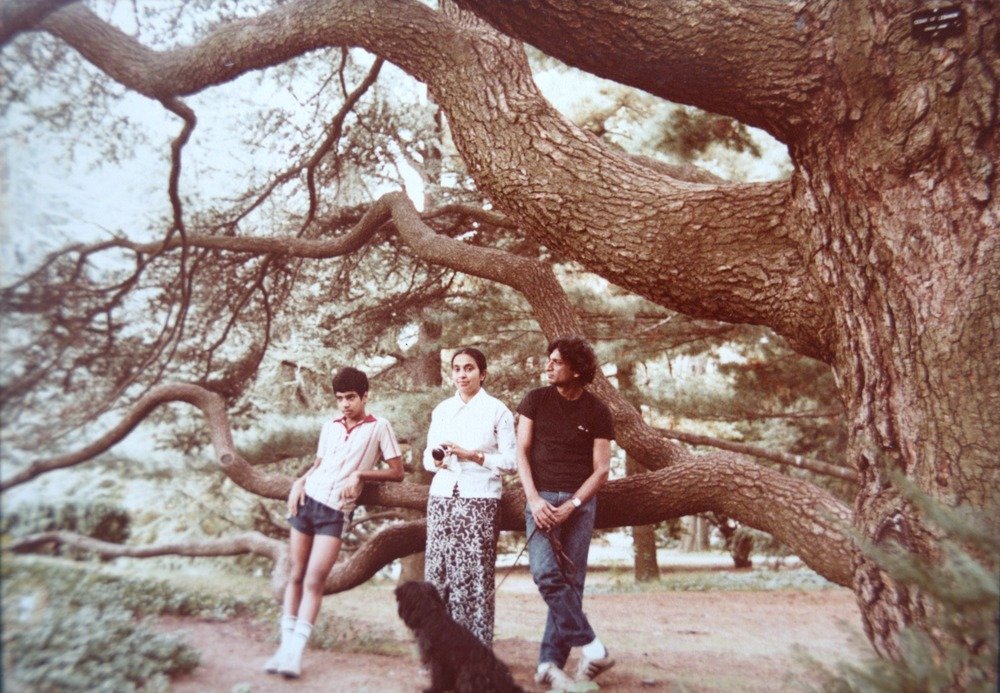
Dr. Ranjini (Ellepola) Obeyesekere is one of Sri Lanka’s leading translators, and among its first female theatre directors. She is the author, among other works, of Sinhala Writing and the New Critics (1974) and Sri Lankan Theatre in a Time of Terror: Political Satire in a Permitted Space (1999). Her translations range from modern Sinhala poetry and fiction to classical Buddhist literature. These include Portraits of Buddhist Women from the Saddharmaratnāvaliya (2001), Yasodhara: the Wife of the Bodhisattva (2009), and Performance in a Time of Terror: Five Sinhala Plays from Sri Lanka (2021). She was married to Gananath Obeyesekere from 1958 until his death on 25 March 2025. Crystal Baines of the Social Scientists’ Association interviewed her for Polity in Kandy in January 2026, editing and annotating the transcript after review and further comments by Ranjini Obeyesekere. What is yielded is a fascinating narrative of the intellectual environment that fostered the Obeyesekeres’ careers, revealing how literature, their shared interest, influenced Gananath Obeyesekere’s turn to anthropology.
Crystal Baines (CB): Can you recall your earliest memories of Gananath Obeyesekere?
Ranjini Obeyesekere (RO): We were undergraduates for four years at the University of Ceylon from 1951 to ‘55. In the first year the university was on Thurstan Road in Colombo and the lectures were held in small rooms around King George’s Hall. The remaining three years we were in Peradeniya.
In our first year he was nothing more than this tall lanky man who used to sit at the back of our English literature classes. I was an eager beaver who used to sit right in front. One day Prof. Ludowyk [Ludo] raised a student paper in class and asked, “Who wrote this?” Then Gananath stood up and said it was his. Ludo had this practice of awarding a book for the best student paper in the first year. So he gave Gananath a translation of the French novel Thérèse Desqueyroux by François Mauriac as a reward for writing the best paper in our year.
But beyond that one occasion I barely noticed him because he was a recluse; a loner who probably had only three or four friends. In the first two or three years at Peradeniya he would come for lectures and disappear. Our friends like Earnest Corea, Victor Walatara, ‘Bouncer’ Wickremasinghe used to hang around and talk outside in the corridors about whatever that interested us.
But what Gananath did or where he went, I never knew. I learned later that he waited for Friday to get on a train and go to the villages where he met the head monk or school master. He would also hang around the kadés and talk to the people. At first he travelled in the Central and North Central Provinces. That was his primary interest beyond the lectures. He was not really interested in anything or anyone else on campus.
CB: Except you?
RO: I think from a distance [laughs]. He said much later, “I always knew whom I was going to marry. I had made up my mind before you ever knew me.” I laughed and said “chutzpah!” But in those early years he never made any attempt to get to know any of us. I was not interested in him either because I had my own friends. And I had my own world in theatre. So he didn’t feature in any way in my world until much later.
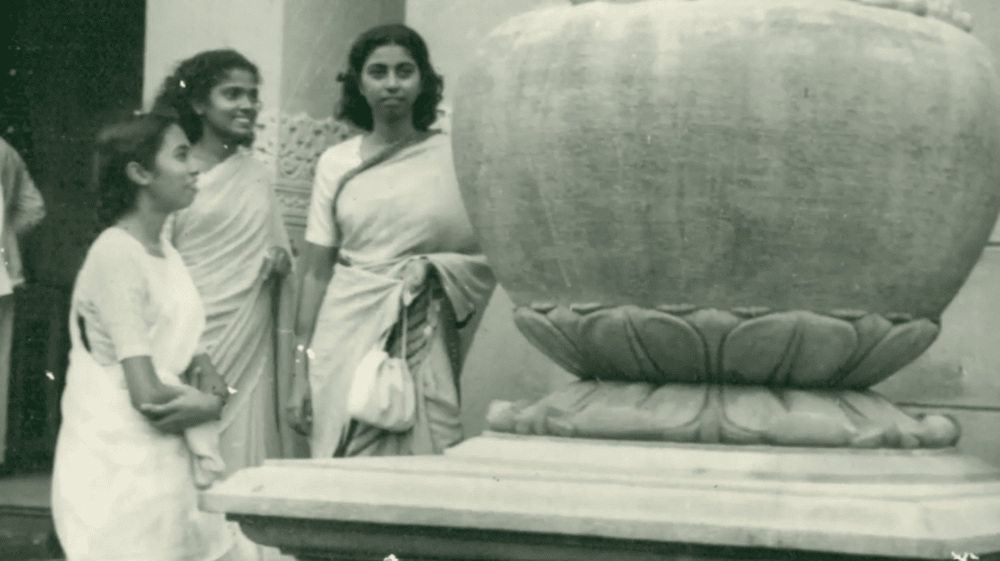
Undergraduate Ranjini (left)
But in our final year, he started sending me little snippets of Sinhala poems – pæl kavi[1] and love poems. Now I come from a home where Sinhala poems were often sung in the evenings. Every night my grandfather would sing from his bed to the little grandchildren. My father used to always sing poems in the shower or in his home office. So the poems I received intrigued me, but these letters were anonymous.
Then one day, Gananath had written an article to the university magazine on folk poetry, and it featured one of the poems he had sent me. That’s how I found out the anonymous sender of the Sinhala poems; and I became interested in getting to know what kind of a man he was.
CB: Although Prof. Obeyesekere is known as an internationally renowned anthropologist, both of you started your formal academic career in an English Department. How did this department and discipline shape and influence your later careers?
RO: It had a very strong influence. Over the years I realised how much he loved literature. He loved the poets, Shakespeare, Yeats, Hardy, Auden, Spender, Eliot, Blake, Byron, etc. And Alexander Pope! He identified with Pope. But he was also searching for the largely overlooked literature of this country. He wanted to go beyond classical English and Buddhist literature which was considered canon and study the people’s literature. This is where his training in the English Department came in. Because we learnt how to close-read and appreciate texts, he could see how sophisticated and insightful “folk” literature is. But he didn’t like to refer to them as “folk”, he thought it was patronising.
Gananath had a very good memory. Whether he was seated at home with family or doing research out in the field, something or someone would trigger the memory of a verse, a poem in Sinhala or English. Our background in literature, whether Sinhala or English, was a constant mental frame against which a lot of his work took place. A literary work would sometimes inspire the nuanced and critical approaches he took in his analysis.
He didn’t just accept the data he gathered. He would sometimes apply literature as a form of critical lens or framework to analyse what he observed, it allowed him to read in between the lines of what someone said. To him, literature revealed the deeper and complex histories or the psychological workings of a community. You see that in his Pattini research. Gananath was not an anthropologist in the beginning. He was a literary man interested in Anthropology, who then went on to be known as an anthropologist. He broke the boundaries between Anthropology and Literature. Both disciplines informed his worldview.
And it wasn’t just Gananath. Even though people labelled the English Department as snooty, elite and so on, it produced the best civil servants in the ‘50s and ‘60s and some of the best anthropologists like Stanley Tambiah, Laksiri Jayasuriya, Chandra Jayawardena, Kitsiri Malalgoda, Gehan Wijewardene, etc. I don’t think they were snooty elitists. All those students from that time were the bilingual postcolonial generation[2] influenced by the Indian independence movement, and most of them went on to serve the new state as administrators, teachers, and scholars in many disciplines.
Also, perhaps it was Prof. Ludowyk and his years at the English Department that widened Gananath’s interests to become an anthropologist. Gananath always said that Ludowyk was the greatest teacher he ever had. He always aspired to be like Ludowyk with his own students later. Most lecturers want their best students to join the department. But Ludo never pushed him to do that. When Gananath said his interests had gone beyond literature, Ludo had merely inquired how he was going to fund his fieldwork. You know Gananath, he just shrugged his shoulders [laughs].
So Ludo arranged a sub-warden position for Gananath in the Arunachalam residential hall (Peradeniya) and then wrote letters personally to his friends in Colombo requesting funding for this good student. He collected Rs 10,000, which was a big amount back then, and gave it to him with the only proviso that he write to these friends and thank them. The first thing Gananath bought with that money was a huge tape recorder. He said it was so heavy he had to carry it on his head [laughs]. Ludo also encouraged him to explore the gammaḍuva[3] ceremonies.
That’s how he first started his research on the Pattini rituals and later land tenure in Hinidumpattu and Madagama. When he started his research, (Ediriweera) Sarachchandra used to come with us as well to watch and study the dance and music in rituals. He was working on Manamé and Sinhabahu during this time. Martin Wickremesinghe was a senior friend of ours too; Gananath and Amaradasa Veerasinghe would visit him when he lived in Bindunuwewa. I think it’s around this time that Wickremesinghe was working on Viragaya. Later, when we were teaching in Peradeniya, Martin Wickremesinghe and Mrs. Prema Wickremesinghe would come stay with us in Kandy whenever he came for some event. Then he and Gananath would sit at the dinner table and talk for hours.
CB: Both of you were among the first group of students at the University of Ceylon when it shifted from its first home in College House down Thurstan Road Colombo, to Peradeniya. You have said that your generation of students studied in a ‘very fortunate era of Sri Lankan education’. What do you mean by this?
RO: I suppose it was the timing. Most of us had gone through school during the Second World War and independence. And in that period all sorts of nationalist sentiments were emerging in literature, culture, and drama. Most of us came from the small world of the school which was fashioned after this rigid western colonial college system; and there was this feeling that the world was opening out to a bilingual space that one was interested in.
In other words, there was a search for a new Sri Lankan literature and culture in the humanities. I don’t know whether it existed in the sciences. Perhaps in a different way. And all this was exacerbated by the fact that these thoughts of freedom and cultural resurgence came into the residential universities. So the ‘50s and ‘60s were very creative and active in that sense. It was free and open, and we took it for granted. For instance, no one told us women not to act in plays or anything. Now when I look back, I realise what an attractive campus Peradeniya was. It was brand new and full of interesting students with a wide range of interests.
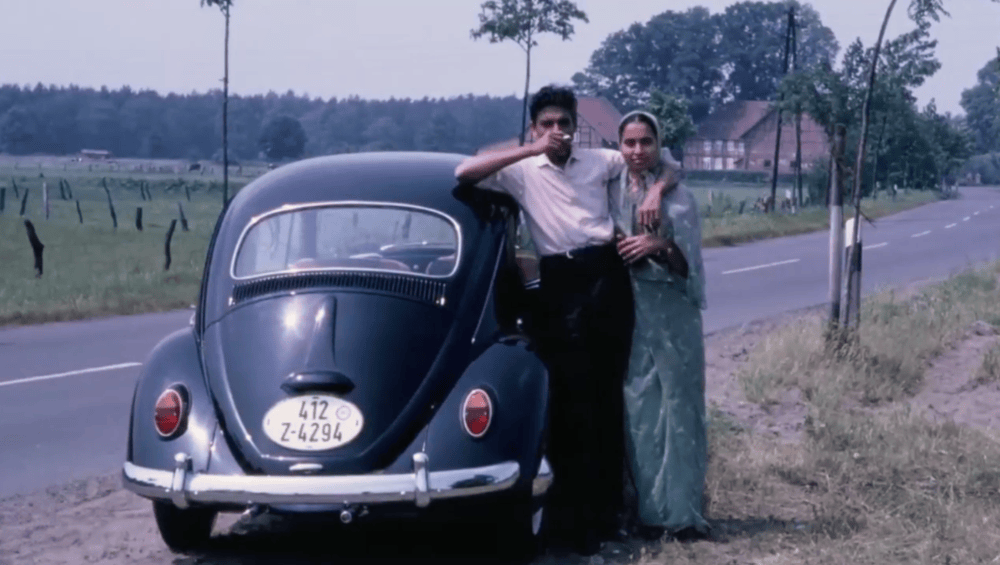
Gananath and Ranjini in the 1960s
CB: In Ivor Jennings’ The Road to Peradeniya he notes that the newly built halls at Peradeniya will house 1000 students, of whom 350 will be women. What was it like to be among that minority of women in Sri Lanka’s first secular university? Did you face any challenges as female students at the time?
RO: That’s interesting. I never knew those numbers, nor did I feel that I was a minority because we weren’t treated any differently by our peers and lecturers. Of course we must have stood out because female students wore saris everyday; multicoloured saris from Madras was the fashion back then. But we were just students like everybody else. And as I told you, I really thrived in my world of theatre; and we also did sports. But I never felt that we as women had to assert our position on campus. However, I was among the few women in my cohort who went on to do graduate studies and get a PhD. And when I went to America for my graduate studies in 1959-60, I did feel that men and women were treated differently in those classrooms. This was the time when the women’s movement and ‘flower power’ were taking off in America. The women I met there were surprised to hear that we had female academics, heads of departments, and state leaders. I think the tension between men and women in our universities in Sri Lanka occurred much later.
CB: You often speak about how ‘open’ the university was when you were a student. But over the last few decades there have been constraints on academic freedom in Sri Lanka and South Asia. What was it like back then?
RO: We had total freedom. We had lots of student-centred, student-oriented magazines in all three languages back then, and we could publish anything in them, even controversial topics. We started them on our own and the faculty never interfered. I remember I was part of a women’s group that started a literary magazine called Thunapaha. We published it from the Sangamitta Hall. Then Gananath co-founded with his friends Amaradasa Virasinghe, Sam Samarasinghe and a few others the Samskriti magazine which published on a range of topics on literature, film, theatre, culture, etc. They were inspired by F. R. Leavis’ Scrutiny.[4] Then we had the Inter-Hall debating and drama (DRAMSOC) competitions where students of all faculties participated.
The residential facilities also created a space for open discussion, and it allowed students to attend any lecture they wanted. For instance, students from the Medical and Engineering Faculties used to hear about the stunning lectures in History or Archeology from their roommates and then they would come and sit in on our lectures. When we retired and returned to Sri Lanka, we were looking for a doctor. We happened to consult Prof. Channa Ratnatunga, a top surgeon who immediately recognised Gananath from back when we were young lecturers at Peradeniya. Channa was a student in the Medical Faculty and his roommate was Danesh Casie-Chetty who was in Sociology. Channa told us that he had heard about Gananath’s lectures from Danesh and started attending them. Gananath didn’t even know this.
CB: Do you mean STEM students used to attend lectures in the Arts Faculty? That’s almost unheard of today.
RO: Really? Students from other faculties don’t come to Arts anymore? Then where do they meet for discussions? That’s what I mean. The space was more free back then and the residential halls were very interdisciplinary. Students from Medicine, History, English, Physics would have discussions and walk into classes together. Nobody questioned you or took attendance.
CB: Your personal and intellectual partnership spans over 60 years. In what ways did you influence each other’s work? Are there any memories of your academic connections that still stay with you?
RO: It’s hard to say. We got married in 1958. When you’re with someone for so long, you influence each other every day.
When I first started translating, I was interested only in modern Sinhala poetry, and the occasional classical poem like Guttila Kāvya. Meanwhile Gananath used to do his own translations of the ritual poetry. I wasn’t knowledgeable enough on the subject to help him. But when he had to translate excerpts from classical Sinhala texts into English, he used to ask me to read them, and I used to translate a few paragraphs or verses he happened to need. Until then I was never really interested in the classical Sinhala prose texts. But I wasn’t experienced enough at the time.
So when Gananath got his first Fulbright to go to the United States in the ‘50s, I stayed here and taught for a while at Buddhist Ladies College in Colombo. But I got bored with that and decided to go live in my grandfather’s house in Palapathwela, Matale and there I learnt Pali from an old teacher who was a former monk. That was how I developed as a translator. Perhaps it was Gananath’s influence that prompted me to return to my grandfather’s house. Then when we went to Princeton, I got my first grant to translate the Saddharmaratnāvaliya. This was through the Princeton Research Forum which was a women’s initiative.
As for memories, there are many. But here’s one. Sometimes I used to go with him on field visits. Once, when he was doing research on The Cult of the Goddess Pattini (1984), he decided to walk from Hiniduma to Veddagala, a village in the Sinharaja. He wanted to study rituals in the villages on the other side of the mountain [laughs]. We were accompanied by the Arachchi Mahattaya[5] and we had to walk miles and miles through leech infested jungles. Then we arrived at this beautiful stream at about 1 o’ clock in the afternoon. We had our bath mul[6] and swam in the water. Suddenly this Arachchi Mahattaya shouted “Ah æthi æthi egoda wenna egoda wenna.”[7] The students said, “Aney æyi mahattayā mēy anga sisil wenna nānḍa balanakota oyā apita yanna kiyanne.”[8] But he was insistent that we get out of the water and proceed. So Gananath agreed. This man had heard the waters rushing down from way upstream, and he knew that if we were delayed by half an hour, we would not be able to cross over. He knew that there was hard rainwater upstream and that there would soon be a flash flood. We saw the way the stream swelled into a torrential river. If we were on this side of the banks, we wouldn’t have been able to cross for days, if we were in the water we would have been carried away by it.
Then there was that time when he lost all the notes he gathered for his Pattini book. He did most of his field work and gathered material on the Pattini cult from our Peradeniya days and also while doing his research for Land Tenure in Village Ceylon (1967) in Madagama. He packed all these precious notes in two or three cardboard boxes which we took in our hand luggage to San Diego. He became busy with the semester as he had a series of new courses to teach. He kept his precious notes in a corner of his office and so for some time Pattini went to sleep in her boxes. Then one day, when he had time, he wanted to return to the notes, but not a single box was in sight! Obviously, he was upset and he started looking and inquiring everywhere. Then his secretary said that when people want to get rid of wastepaper, they put it in cardboard boxes for the janitor to clear up. So that’s what had happened. The janitor mistook the boxes for garbage and Gananath had no idea when the boxes were removed from his office.
So he kept thinking, what am I to do? What am I to do? These were years of research material. But then he decided to go back and retrieve what he could. So he returned over several summers to all the familiar places. But Yahonis Kapu Mahattaya[9] who sang the Marā Ipadīma[10] and all the other important songs had died. This means Gananath had lost the tapes of Yahonis Kapu Mahattaya’s fantastic voice! But he recorded another Marā Ipadīma with a younger Kapu Mahattaya of the same Rabaliya tradition and retraced the other texts and data. I helped him with the final editing and footnotes to help him recover what he had lost. But usually, he did his own editing. This was before computers, so he used to call his editing process “scissors and cello tape”. He resisted the computer for so long because he had a secretary in San Diego who could read his handwriting and she used to type things out for him. I didn’t have that privilege, so I was the first among us to learn how to use the personal computer!
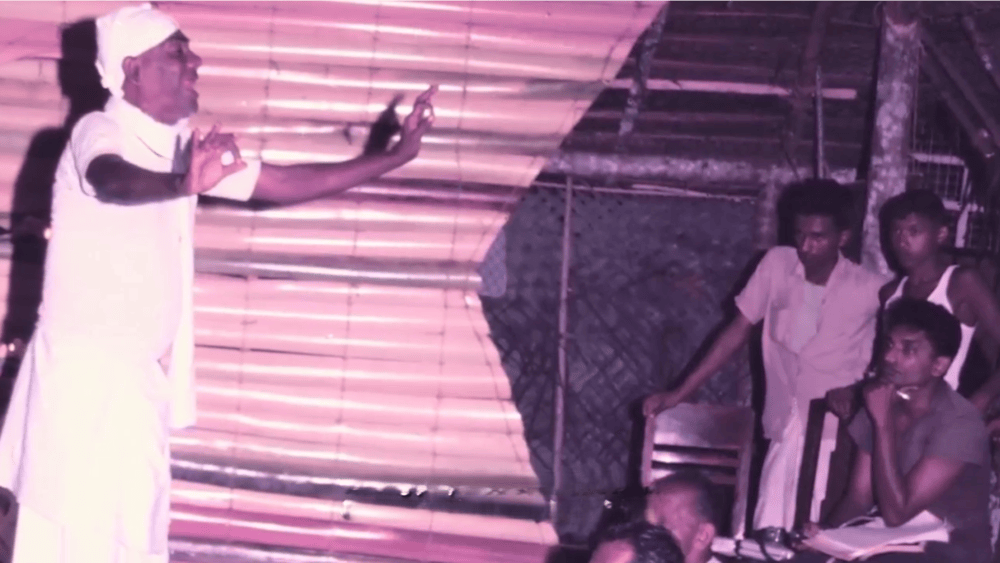
Gananath observing a ritual performance by Yahonis Pattini Kapu Mahattaya
CB: Speaking of the University of California, San Diego (UCSD), can we go back to the time you left Sri Lanka? One of the biggest brain drains in the Sri Lankan state university system happened in the 1970s. When did you leave Sri Lanka, and why?
In the ‘50s and ‘60s everyone who went abroad for graduate studies always returned to the university. So did we. But April 1971 was the first revolution I witnessed, and Peradeniya was the epicentre of it. These students were naïve, but they were also the best brains in the humanities. And they were the ones who suffered the brunt of it. Since Peradeniya was the hotbed of this attempted revolution, the government came down on the university like a ton of bricks. They decided to break up the university. Ironically, the brainchild behind the break up of the universities was the government’s left-wing coalition.
There were certain professors, especially in the sciences, who supported the Old Left and its government in its plan to undo the university constitution. But it was mainly the humanities that protested. The government dismantled the concept of the residential university, targeted the humanities and chucked the different departments to different parts of the island like Vidyalankara, Dumbara campus, and so on.
And there was a core group of people who started to protest these changes and Gananath was a part of it. Every other day they would get into their cars—Gananath used to do most of the driving—and they would rush to Colombo to meet various members of the Council and other government officials to convince them not to destroy the university. One day, Gananath returned home from one of these meetings totally despondent and said, “They’re doing it, they’re going to break up the university and I’m tired of banging my head against a wall. I want to leave”.
But I didn’t want to leave, I wanted to stay awhile longer and watch the situation. But he saw the writing on the wall. He felt that we would lose the rest of our lives, time, and scholarship to political violence. He wanted a free academic environment to work in. He had enough contacts abroad who were willing to give him a job. And that’s how we ended up at the University of California, San Diego and eventually Princeton University.
‘71 was the first trigger point that resulted in people leaving the country never to return. It continued with the war and we lost the best Tamil academics. But during this first wave of the brain drain, the entire Sociology Department and many in the social sciences and humanities left: Ralph Peiris, Tissa Fernando, A. J. Wilson, H. L. Seneviratne, Kitsiri Malalgoda, Laksiri Jayasuriya, etc. Stanley Tambiah left before us after 1958. It was the junior lecturers who were left behind. This generation and our colleagues who refused to leave fought for academic freedom in the best way they could. But it’s also from this point on that the UNP [United National Party] established the University Grants Commission which became an increasingly politicised body.
Then some of our friends like Ian Goonetileke, Ashley Halpé and Merlin Peris stayed behind and continued their service on a salary that was pittance. People like Ian Goonetileke were marginalised because he fought hard to keep the Peradeniya Library intact. You see, each department wanted to take their section of the library with them. But he fought this and eventually got thrown out. But he did save the library, the collection is still intact. Even though we left, Gananath deliberately chose to do most of his research in Sri Lanka, so we returned every year, and we brought our three children too. And we always knew that he and I would come back.
CB: After his retirement his scholarship had an emphasis on history and was focused on the obscure histories of the region he settled in. We can also see that he chose to publish locally with Perera-Hussein publishers, Sarasavi publishers, etc. How did his research change after his retirement?
I will not comment on theories, themes, and approaches in his work. I’ll leave that to his students and readers. After we retired in 2000 we returned to Kandy, where we began our careers together. He was no longer interested in introducing new groundbreaking theories and such. But he continued to challenge received views and attitudes on Sri Lankan history and society. He wanted to write particularly for Sri Lankan audiences. When we returned, he started to question general views and perceptions of this region (Kandy and Uva-Wellassa). One of the presumptions about Kandy is that it’s an insular Sinhala Buddhist monolith. But you and I know how diverse and complex this society has been for a long time. So he delved into the less explored archives, the kadaim poth, vitti poth, Lawrie’s Gazetteer and studies by Paul E. Peiris, Lorna Dewaraja and so on to reveal a Kandyan cosmopolitanism. He looked at how the Kandyan kingdom openly assimilated South Indian, Portuguese, Dutch, Catholic, Buddhist, and Muslim influences over the centuries. These influences are still evident in the food we eat and the jewellery we wear. Our jewellery for instance is from South India. Look at the old street names: Malabar Street, Hetti Veediya, Borawe Veediya, etc.
Then when we used to drive past Peradeniya Gardens, he would exclaim, “Why do people say that the Botanical Gardens was founded by the British? This used to be the kings’ pleasure gardens. Why not name it the Sri Vikrama Rajasinha Gardens!” Or when we drove around the (Kandy) lake he would say, “There are so many statues for different “national heroes” but none for the man who designed the architecture and landscape of this city”. He was of course talking about Sri Vikrama Rajasinha who had an architect’s mind and that he, together with Devendra Mulachari conceptualised and designed the city.
Finally, there are lots of papers he left unpublished. Most of it is on the 1818 Rebellion and the role of the Väddas in the uprising against the British. His interest in the Väddas began very early on in his career. When he went to America in the ‘50s to study anthropology, the search for “the primitive” was all the rage in that discipline. But he found that anthropology was steeped in various colonial frameworks which were projected onto our societies. He did not like the anthropological term and idea of “the primitive”, which in Sri Lanka was applied to the Väddas. When we returned to Sri Lanka in 2000, he wanted to go beyond the colonial records and the Seligman accounts. So he began to study the religious attributes, for instance the nä yakku,[11] of the Väddas and became interested in the role they played in the 1818 Rebellion. But initially he found nothing in the people’s stories and legends. He felt that the destruction of 1818 was so traumatic that successive generations have wiped it out of their memories as a form of coping mechanism.
There were of course a few memorials in the region but it wasn’t clear if they were connected to the Rebellion. But what was more interesting is the way these Vädda leaders were deified and worshipped as gods, often under different names. You see, deification was a method of memorialisation. So he started looking for clues about the Vädda leaders in the Rebellion in the rituals of deification. He focused on three important families: Godagedara, Kivulegedara, and Meegahapitiya. But he wrote these findings as short essays and tangential histories, not as the manuscript of a monograph. Even when we worked on The Creation of the Hunter (2022), Gananath no longer had the energy to edit his work. So Dayasisira[12] and I put those essays together for the book with his approval. As for his work on the 1818 Rebellion, at my age I’m not sure I have enough time left, or the energy to produce something from it. We’ll see…
CB: Would you like to share any final reflections on your life with him?
RO: Our shared interest in literature is what brought us together. It endured and shaped our careers. Even though his memory started to fade towards the end, he was able to recall vividly the poems he had heard and collected during his undergraduate years. The series of Sora Bora Kavi were a few among many of his favourites. Let me share just one of the beautiful poems he used to sing:
obat obat oba sora bora vævāṇō
an̆ḍā diya duvana mahavæli gan̆gāṇō
diya nosin̆deyi oba mahavæli gan̆gāṇō
nil mal bisav diya keḷinā vævāṇō[13]
Just a few weeks before he passed away, one morning I told him to come look at the view from our living room because the Mahaveli river looked beautiful, bending and flowing through the Dumbara Valley. He was too tired to get up from his chair, but he burst out with “riverrun, past Eve and Adam’s, from swerve of shore to bend of bay…”. I told him it sounded like James Joyce’s Ulysses. He said, “No! That’s not it.” He gave me a puzzle. After he passed away I told this to our son Asitha who looked it up online and said, “Ammi it’s the opening line of James Joyce’s Finnegan’s Wake.” This too is an author who stayed with him since his young days.
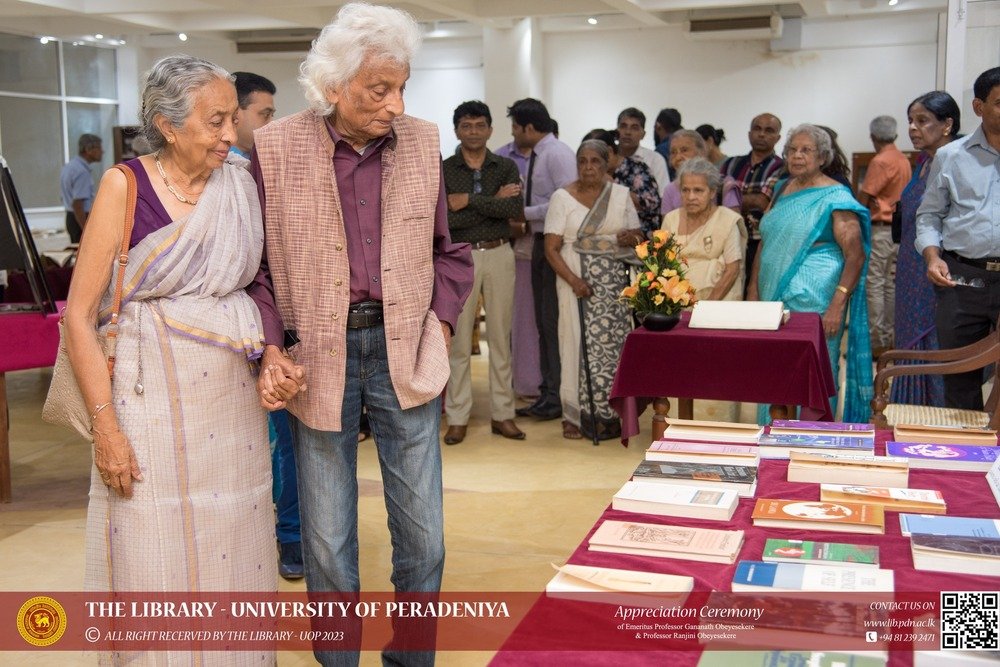
Gananath and Ranjini at Peradeniya, 2023
CB: Thank you Dr. Obeyesekere. Everything you have shared here reminds me of what I believe was his last public appearance, at a simple ceremony to mark the gift of his personal library to the University of Peradeniya in 2023. He didn’t deliver a speech. He simply read this excerpt from a poem by W. H. Auden titled “In Memory of W. B. Yeats”. He said then, that the poem is still relevant to the current state of affairs in the world.
[…]
In the nightmare of the dark
All the dogs of Europe bark,
And the living nations wait,
Each sequestered in its hate;
Intellectual disgrace
Stares from every human face,
And the seas of pity lie
Locked and frozen in each eye.
Follow, poet, follow right
To the bottom of the night,
With your unconstraining voice
Still persuade us to rejoice;
With the farming of a verse
Make a vineyard of the curse,
Sing of human unsuccess
In a rapture of distress;
In the deserts of the heart
Let the healing fountain start,
In the prison of his days
Teach the free man how to praise.
Ranjini Obeyesekere (BA., University of Ceylon and PhD., University of Washington Seattle) is Lecturer Emerita at Princeton University where she taught courses in South Asian literature, culture, and women’s studies.
Crystal Baines (BA., University of Peradeniya and PhD., University of Massachusetts Amherst) is a researcher at the Social Scientists’ Association and a lecturer at the University of Colombo.
Photo credits: Ranjini Obeyesekere; University of Peradeniya Library (2023)
References
Jennings, Ivor. (2005). The Road to Peradeniya: An Autobiography. (Ed.) Ian Goonetileke. Lake House Investment Ltd.
Obeyesekere, Ranjini. (1984). “The Bilingual Intelligentsia: Their Contribution to the Intellectual Life of Sri Lanka in the Twentieth Century.” In Percy Colin-Thomé and Ashley Halpé. (Ed.) Honouring E.F.C. Ludowyk (71-91). Colombo: Tissara Prakasakayo Ltd.
Obeyesekere, Gananath. (1967). Land Tenure in Village Ceylon. Cambridge: Cambridge University Press.
Obeyesekere, Gananath. (1984). The Cult of the Goddess Pattini. Chicago: University of Chicago Press.
Obeyesekere, Gananath. (2017). The Doomed King: A Requiem for Sri Vikrama Rajasinha. Colombo: Sailfish, Perera-Hussein Publishers.
Obeyesekere, Gananath. (2022). The Creation of the Hunter: The Vädda Presence in the Kandyan Kingdom: A Re-Examination. Colombo: Sailfish, Perera-Hussein Publishers.
Notes
[1] Poems, usually sung by farmers in the field during the night watch to protect the crops from wild beasts.
[2] See Ranjini Obeyesekere’s “The Bilingual Intelligentsia: Their Contribution to the Intellectual Life of Sri Lanka in the Twentieth Century,” in Honouring E. F. C. Ludowyk (1984). In this essay Ranjini Obeyesekere elaborates on the political, class, and linguistic shifts in mid-twentieth century Sri Lankan society that led to the formation of a bilingual intelligentsia and in turn a fervent resurgence of Sinhala literary activity between the 1950s and 1970s.
[3] Gammaḍuva literally translates to ‘hall or shed in the village’. The Gammaḍuva ceremonies are usually postharvest rituals or rituals held under the auspices of a deity. Obeyesekere’s nearly two-decade research, The Cult of the Goddess Pattini, is a comprehensive exploration of the gammaḍuva ceremonies held in honour of Goddess Pattini.
[4] Scrutiny: A Quarterly Review was a literature periodical edited by literary critics L.C. Knights and F. R. Leavis between 1932 and 1953 in Cambridge, England. It was a mandatory text in literature syllabi of the former colonies of Britain and played a key role in establishing Leavis as one of the foremost critics in 20th century English literature.
[5] A high ranking position in the village headman system in colonial Sri Lanka.
[6] Lunch packets or rice packets.
[7] “Enough enough, cross over to the other side now”.
[8] “Aney why Mr., we just wanted to have a bath and cool our bodies a bit and you’re asking us to leave already”.
[9] Kapu Mahattaya or Kapu Rala is a lay priest who serves at a Hindu/Buddhist shrine. Gananath Obeyesekere developed a close friendship with R. K. D. Yahonis Pattini of Rabaliya, and would often recall the senior Kapurala’s singing voice and performances with awe.
[10] ‘Killing and Resurrection’: a theatrical segment of the Pattini gammaduva depicting a series of incidents that occur in Pattini (Kannagi) and Palanga’s (Kovalan) lives. It is an enactment of their departure from Kaveri Patuna (Puhar) for Madurai, the murder of Palanga and the resurrection of Pattini as goddess. For annotated translations of the Sinhala poetic narrative of the drama see The Cult of the Goddess Pattini (1984: 245-273).
[11] Deified ancestors of the Väddas.
[12] Dayasisira Hewagamage served as Gananath Obeyesekere’s research assistant since 2000. He worked closely with Obeyesekere on the field and archival research of Obeyesekere’s post-retirement scholarship.
[13]
ඔබත් ඔබත් ඔබ සොර බොර වැවාණෝ
අඬා දිය දුවන මහවැලි ගඟාණෝ
දිය නොසිඳෙයි ඔබ මහවැලි ගඟාණෝ
නිල් මල් බිසව් දිය කෙළිනා වැවාණෝ
Oh You, You, oh You lake Sorabora
The Great Sand river, weeping, runs to you
Your water never dries out, O Great Sand river,
Blue lily queens sport in your waters clear. (Translation by Ranjini Obeyesekere)
You May Also Like…
A ‘Duty of Care’ to Animals: Two Decades of Struggle for Law Reform in Sri Lanka
Kasun Kavishka
In late April 2026, Sri Lanka welcomed Aloka, an Indian stray dog who walked along with US-based Buddhists monks in...
Polity Vol 13 No. 2 (December 2025)
ContentsGoverning in Anticipation of Backlash by EditorsThe Great Flood by B. SkanthakumarFCEJ Stands in Support of...
A Heart That Never Forgets
Binu Peiris
Over the high walls of the white mansions where our money lay, Our youth sped their way holding the tears of our...