
Plucking the Stars (நட்சத்திரங்களைப் பறித்தல்). Arulraj Ulaganathan. 2026.
B. Skanthakumar
Plucking the Stars (நட்சத்திரங்களைப் பறித்தல்) conjures memory from Arulraj Ulaganathan’s childhood on a tea plantation in Haputale, where he was born in 1992 and raised in a line room; as well as those of generations before him on a cruel incomplete 200-year passage from coolies to citizens. He wants, he says, to give “voice through my art to the silenced histories of the Malaiyaham [Hill Country]”. And so he does, in ways that stir and stay with us.
The artist’s second solo exhibition ran between 14 and 31 January 2026 at the Curado Art Space on Park Road in Colombo, spread across its second and third floors, which are accessible by stairs only. It was staged in collaboration with the ninth edition of Colomboscope; whose artistic director Natasha Ginwala crafted with the artist the useful notes for the catalogue from which I take my cues below.
Here are scenes from the upcountry of Ceylon/Sri Lanka. Of landscapes, flora, fauna, and built structures. But nowhere in the imagery of tourism marketing. This is not the tea garden in technicolour. There are no luxuriant bushes, neatly manicured. The rolling slopes are not carpeted in green. The sky above is not brilliant blue. The women are not props; in gaily-coloured sari or skirt and blouse, flashing toothy smiles, hands in constant motion: two leaves and a bud plucked and flung into the gunny sack on their back suspended from their forehead.
What strikes the visitor first, even before the composition and detail of the individual works become clear, is the monochrome palette. All (almost) is brown. The colour of the beverage made from the crop. The colour of the soil where bushes are grown; and the remains of those who work them are laid to rest. The mixed materials used—tea dust, teabags, tea export packing material, tea estate stationery (attendance records and pay slips)—are stained brown by tea.
This will be familiar to those who caught his 2024 exhibition at the Harold Pieris Gallery, A Life in Tea. Other motifs recur too, from the ingredients and substances used; to the bamboo and rattan tea basket; the tools of workers; the teacup; and the animal inhabitants of the hills.
However, these exhibits are new and sequenced as they are for the first time. He made them at night; after clocking off for the day as an art teacher in an international school in Abu Dhabi. Their number and complexity, produced over last year only, is already incredible. What makes this show significant and vivid is its imaginative, sometimes physical, scale; and searing political critique.
The artist’s subject is those made invisible by the trade in tea; Tamil workers, mainly women, and their families; whose “bodies, labour, and futures are continuously shaped by systems of oppression”, he announces.
Symbol Series
Fourteen portrait size paintings measuring 32 x 43 centimetres crowd the walls of the second level of the galley. This is the ‘Symbol Series’. It is described as an interrogation of the Malaiyaha Tamil political landscape. In fact, it is an indictment of political parties—including those linked to the trade unions of plantation workers—and the electoral system since 1947. The accusation is damning.
In essence, political oppression of the Malaiyaha Tamil community is a convergence of a failed political system, self-serving ruling elites and entrenched social discrimination [—] an ongoing betrayal of a labouring community whose contributions remain invisible.
No parties or electoral coalitions are named. Only their recognisable election symbols—elephant (United National Party); hand (Sri Lanka Freedom Party); rooster (Ceylon Workers’ Congress); bell (Janatha Vimukthi Peramuna); chair (People’s Alliance); sickle (Workers’ National Front); hoe (UpCountry People’s Front); torchlight (Tamil Progressive Alliance); betel leaf (United People’s Freedom Alliance); swan (New Democratic Front); lotus bud (Sri Lanka Podujana Peramuna); telephone (Samagi Jana Balawegaya); compass (National People’s Power–NPP)—are exposed; accompanied by a milestone year, usually for the worse.
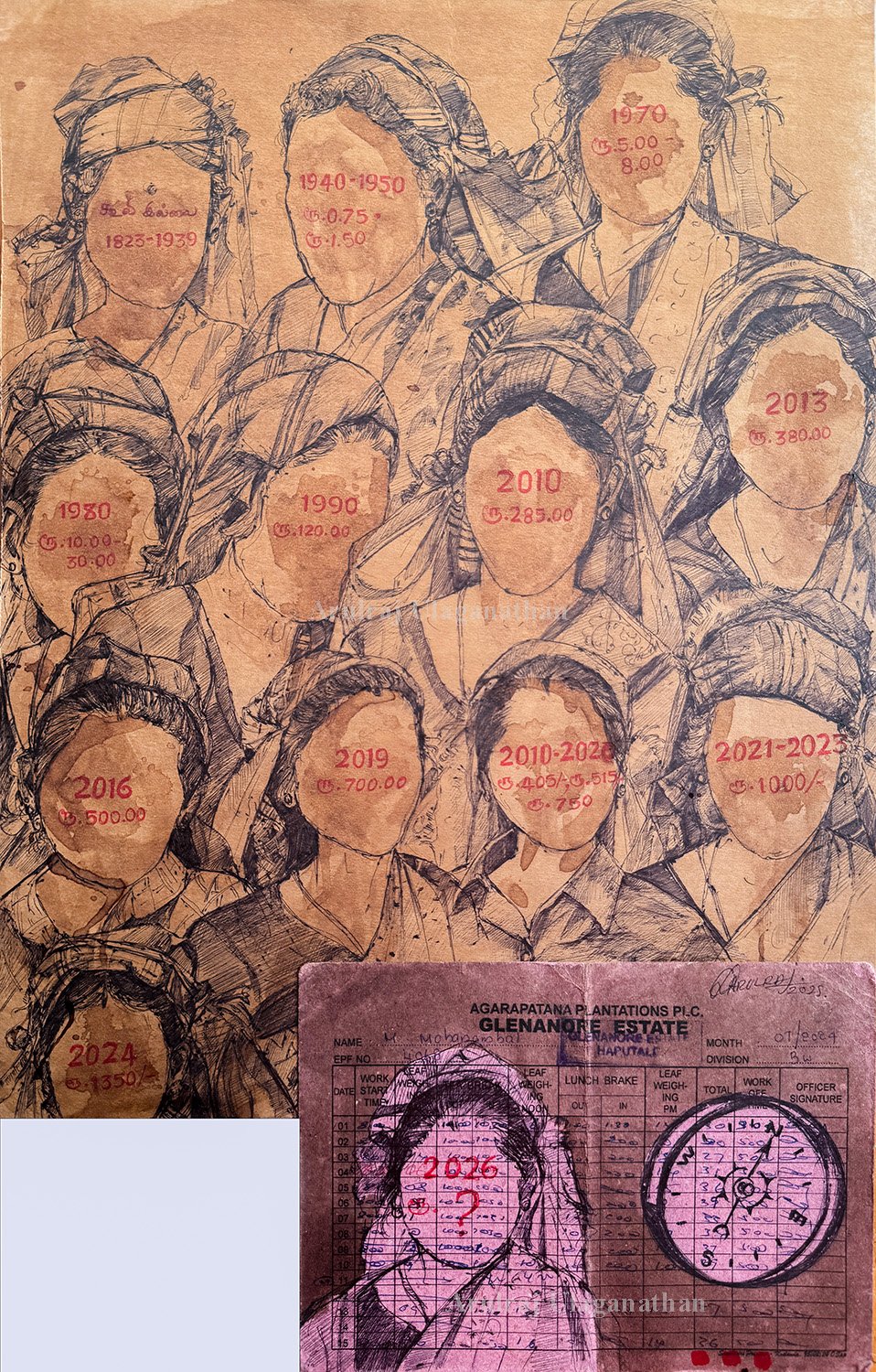
Chronologically the most recent is titled ‘Symbol 2019’. It bears the compass symbol of the party now in government, alongside the outline of a woman tea plucker, with “2026?” across her face. This is drawn on a used check roll, the monthly record book of worker attendance and weight of green leaf collected. This document is coloured maroon by Arulraj, for association with the ruling party. It is pasted over the right-hand side corner of the larger painting which has repetitive profiles of women workers. Across their featureless faces is the year or period of significant agitation over, or achievement of, a higher daily minimum wage; and the amount received.
In 2019, the demand was for Rs. 1000. The companies only conceded Rs. 750. The 2024 formula was Rs. 1350 basic plus Rs. 350 attendance incentive, honoured in the breach. In January 2026, the NPP government increased the wage to Rs. 1550; plus an attendance allowance of Rs. 200 from public funds. How much will they actually get in hand? Off-estate, the daily rate for farm work is between Rs. 2000 (female) and Rs. 2500 (male).
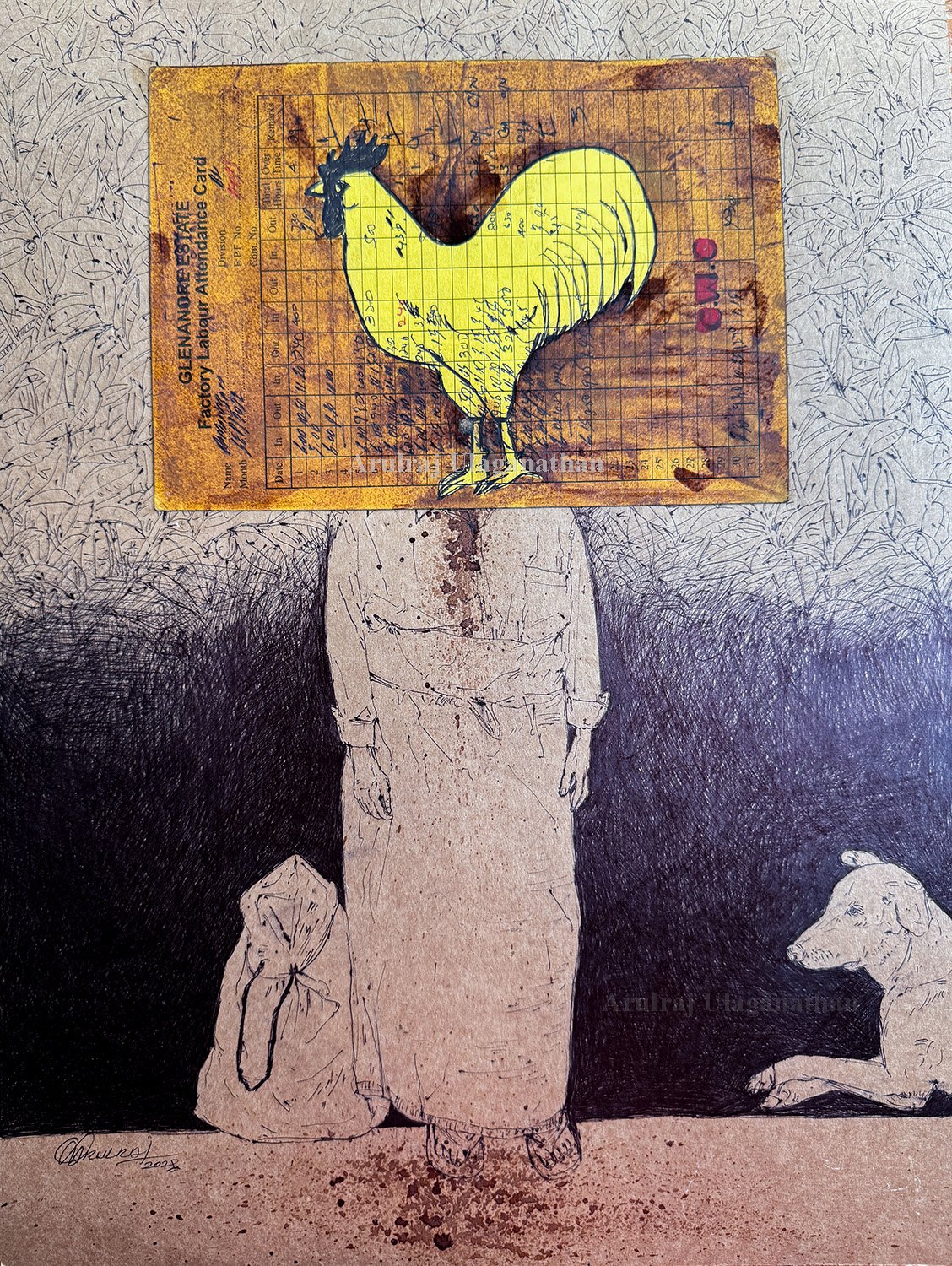
In another striking composition, ‘Symbol 1939’, the face of the woman worker is obscured by an attendance card for tea factory labourers. Painted on the card is the election symbol of the Ceylon Workers Congress (CWC), the oldest surviving and long dominant political party and trade union of plantation workers. The plump well-feathered rooster stands on the shoulders of the worker, at whose feet on the right is a gunny bag that appears empty and, on the left, sits a watchful dog. Splattered across her top and on the ground before her are stains from tea. Who has gained most from this bond between the community and the CWC since 1939—when its predecessor, the Ceylon Indian Congress, was formed on Jawaharlal Nehru’s advice?
The ‘Symbol Series’ on its own is a powerful statement. Each painting is its own story of discrimination, abandonment, and bad faith. Just as the materials used are mixed and coated over each other, so too are the narratives within their frame, expectantly waiting to be peeled and heard. Still, this is only a teaser for what awaits on the third floor.
The Tea Land
There are nine exhibits here. In the background, on a loop, an oppari is being sung. It is a lament by an old woman, interrupted at intervals by her coughing, memorialising the struggle and woes of her people in the tea land. The themes of the works are several but inter-connected. Foremost is the colonial construction of what we now know as the ‘Upcountry’ or Malaiyaham.
The artist’s intention in doing so, as he explains of ‘The Tea Land’ (150 x 117 cm) is not only to make us feel the wounds of history, but by reopening them, to feel their pain. In this collage, the surface is rugged and uneven; recalling that on which the people of the plantations are born to live, slog, and die. The packaging material bears the name of the estate and is stamped “Tea Produce of Sri Lanka”. There are roads and rail tracks that criss-cross this terrain, built by colonial fiat from ancestral labour, for circulation of goods and people from the coast to the highland and back. The mouth of a woman worker is stitched shut by these structures; her face creased in silent distress. On the margins are animals and their prints.
Across this exhibition, faces are rarely clear or even visible. In ‘The Tea Land 1823 – 2025’ (55 x 79 cm), the upper half of the canvas has a series of sketches of women workers in ballpoint pen and ink—Arulraj’s preferred tool and medium—whose eyes are smudged. These are overlaid in the lower half by images of two dogs in defecation. On the receiving end of the excreta are political party symbols, ‘national’ (that is, Sinhala nationalist) and Malaiyaha Tamil alike.
In ‘Ceylon Tea Land’ (114 x 79 cm), an older woman clasps a full-grown leaf in her right hand, signifying what the artist describes as “a forced dependency[,] a permanent umbilical bond between the Malaiyaha people and the plantation system”. Strapped around her waist is a mattakkaththi, the tool by which she prunes tea bushes. Her left hand is obscured by her ‘name (peyar) card’, the beginning and end of her identity on the estate.
Peeking out from the bottom right of the frame and embossed on that card, is the emblem of the state of Sri Lanka and its flag: a lion holding in its right forepaw a sword—a weapon whose sharp end points upwards towards the woman. Her head is covered by a larger sword wielding lion. The lion motif appears in many places in this exhibition, sometimes hidden or faintly visible. Dangling over her head, are many bare feet. “I place women’s feet beneath the tea plant to signify the foundation on which the plantation economy rests”, comments Arulraj.
This limb, rather than the calloused hands of women workers in recent photography exhibitions, recur in ‘Into Tea Forest 06’ (114 x 79 cm). Here as elsewhere, Arulraj returns to the landscape what was felled, uprooted, hunted and habitat destroyed, for coffee and later tea plantations. The forest and plant life; but also the animals—frogs, toads, serpents, macaque, loris, elk, wild pig and buffalo, leopard and elephant. Some make an appearance here, camouflaged in the foliage among the tea shoots.
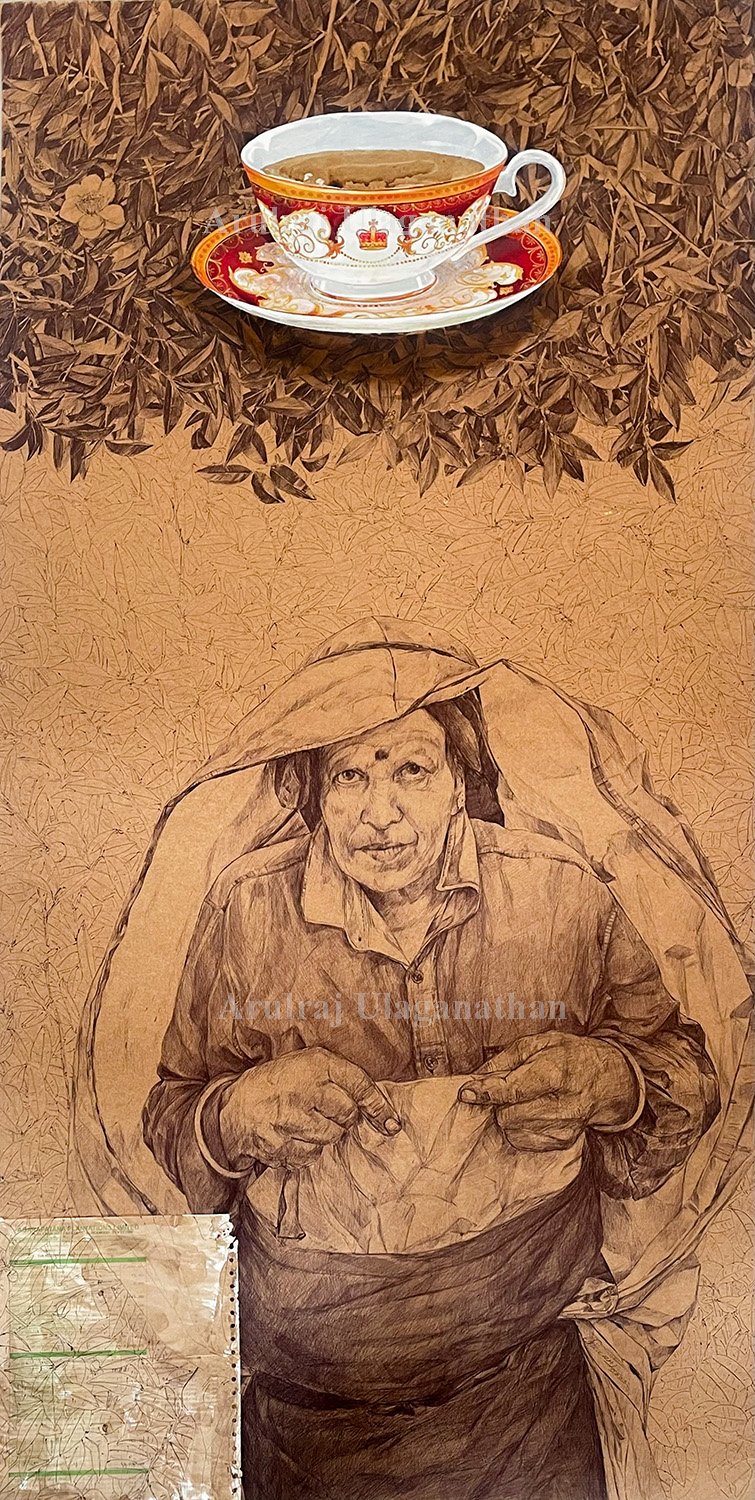
There is one painting where the face of a woman stooped in field work is life-like and her features distinct. There is no kolunthu or tender tea bud to be seen on her aged body. Their leaves are bunched and hang over her. Her forehead is marked with a pottu. Her hands are swollen from years of hard labour as a plucker. Lips pursed tight, her largeeyes directly return our gaze. It is the artist’s mother. On the bottom left corner of the frame is her salary slip, recording the monthly payment for days worked and the many deductions made for this and that.
Above her head is a fine bone china teacup, sitting on a matching saucer. Its content is the outcome of her exploitation. The British Crown, signifying the sovereign power, decorates it. Hence the title ‘The Colonial Tea Cup’ (152 x 79 cm). The allusion is to the commodification of tea for consumption in Britain and elsewhere; and colonialism, which needed a regular supply of immigrant workers to clear and tend the land; plant and prune the bush; pluck its leaf; process, prepare and pack the end product.
Perhaps most evocative are the two ‘line-room’ themed pieces. The smaller work is ‘Memory of Charring Line Room’ (55 x 79 cm). At its centre is an upside-down tea basket (koodai) from which dangle unshod human feet young and old, and the hind limbs of dogs too. Beneath them are overgrown, indicating neglect, tea bushes. The upper portion of the basket is charred black and the brown kraft paper is singed in places, with its right top corner incinerated. Visible through one exposed part of the basket is a row of line rooms.
Fire is not foreign to plantation residents. During the periodic post-colonial racist violence, including 1983’s ‘Black July’, their homes were a target of mobs, aiming to drive them out. Every year, old and faulty electrical wiring begins a blaze in one dwelling, spreading easily to adjoining ones, laying waste to the entire row. The residents are displaced, sometimes permanently; and disregarded by management, particularly if they no longer toil on the estate.
The largest work in this exhibition is ‘Memory of a Line Room’ (211 x 79 cm). These row-style 10’ by 12’ windowless units (layam) were built by British planters a century or over ago. They were supposed to shelter four labourers each, but as male workers were joined by women and children, and with other relatives living together, the average occupancy swelled threefold.
The colonial opinion of their wretched conditions was blithely expressed at the turn of the last century: “… it is obvious that they do not enjoy the luxury of much space; but their ideas of comfort are not ours, and they are better pleased to lie huddled together upon the mud floors of these tiny hovels than to occupy superior apartments” (Cave 1984/1900: 159). Little wonder why British rule in Ceylon was dubbed the ‘Planter Raj’. After 1948, the brown sahibs were no better in how they saw and related to Tamil workers.
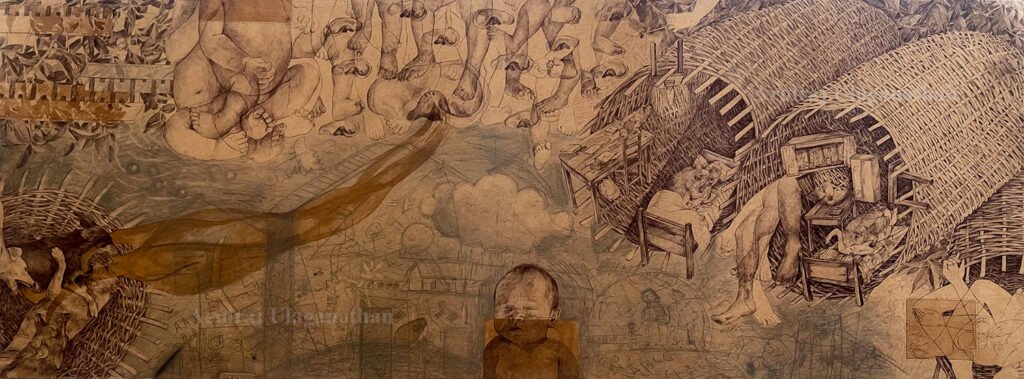
On the right of this long exhibit are two overturned tea baskets stunningly visualised by the artist as line rooms. Spilling out of them are the contents and inhabitants. A bed for one, bamboo mats, small almirah, writing table, shrine to favoured deities, domestic objects, and more. On those beds, frogs are coupling in the open. There is no privacy or respect. There are legs here too, but now of babies and infants, poking out from a basket, and above in the air. In the left bottom corner, four dogs in a koodai are brawling. They signify what happens within and between homes, without freedom and dignity. This is no place for children to grow and thrive, the artist underscores.
The composition is crowded. Layer over layer. Each bearing its own meaning. The sensation triggered is suffocation. Today the line room is emblematic of the despotic social conditions of plantation workers. Its construction causes trouble and strife within their walls and between neighbours. That well into the 21st century, over 162,000 line rooms shelter over 770,000 people is an outrage.
The final two exhibits are of identical dimension (114 x 79 cm), placed side by side, as if in a diptych. Their backgrounds are similar. It is the origin story of the plantations in a panoramic setting. The valleys and mountains are bare of tea bushes and people; with only the dry patana grassland to be seen; but already the hillsides are cut by winding paths for planting and transport of the crop. Their subject is a solitary elder seated on a rock at a high point. In the exhibit on the left is a woman. In the exhibit on the right is a man. Their faces are unseen. Their heads are covered by the koodai. Even so, they command attention, even obeisance.
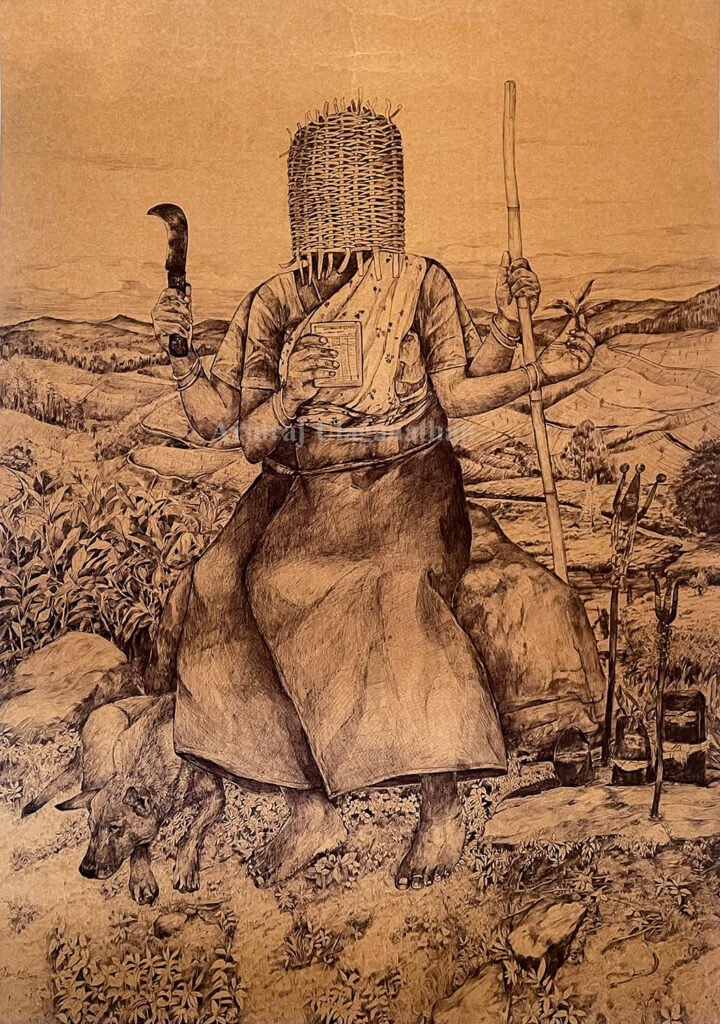
The woman before us in ‘Lord of The Hills’ (or Malaichamy as Arulraj describes her), dressed though she is in the garb of the woman worker, is not ordinary. She has four hands in the manner of a Hindu goddess. What she holds in them though, are symbols of the tea picker. Her upper left hand holds two leaves and a bud. Her upper right hand holds the name card. Her lower left hand clasps the varichu or long measuring stick by which the height to pluck from may be estimated. Her lower right hand wields the mattaththu kaththi or curved knife by which the plant is managed.
By her feet on the right lies a dog. Its presence signifies companionship and protection to the Malaiyaha Tamil woman. On the ground to her left are three roughly shaped black stones of rising height. These appear to be lingams for the worship of Siva. This is conveyed by marks of thiruneeru (ash) and pottu (vermillion) upon them; and the placement of two tridents in front.
While drawing from Hinduism, the artist invites recognition of folk spiritual practices that are not recognised in Brahminical tradition. Malaiyaha Tamils descend from oppressed castes (now designated as dalits) in India. Strangers in a strange land, they venerated their kula deivam (clan gods like Madasamy and Muniandi) while fashioning new demi-gods related to plantation production (Kolunthu Sami; Istore Sami; Roda Muni, Kampi Muni, etc.).
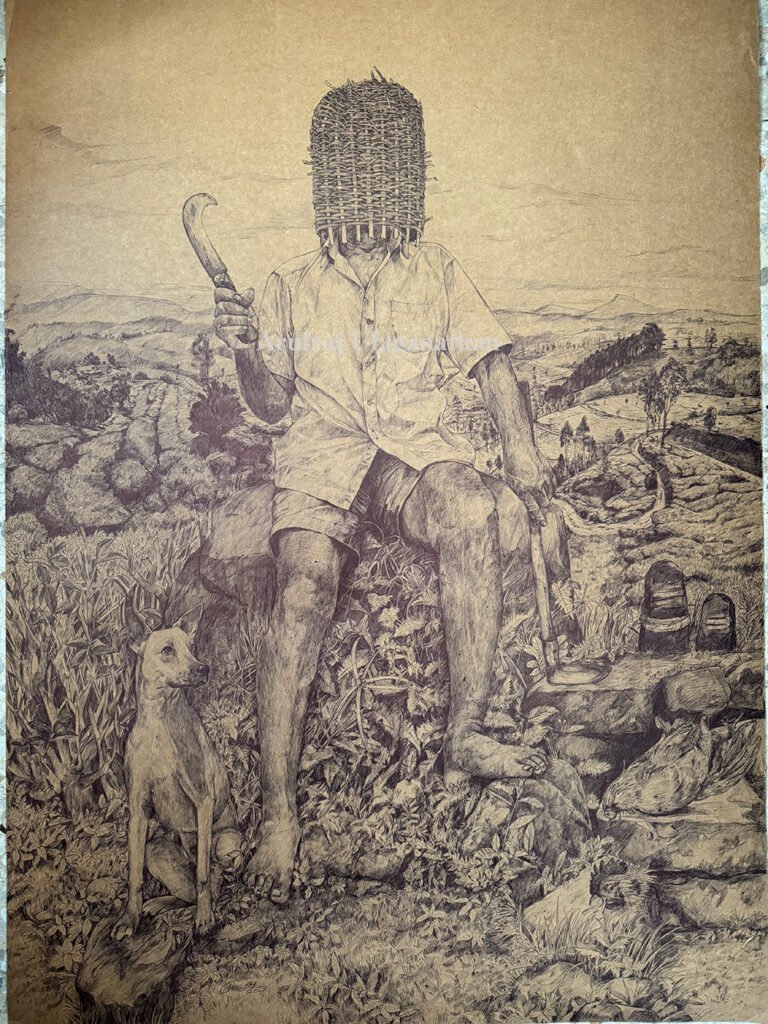
In ‘Lord of Kavathu’, the deity wears the garb of the male estate worker. He has two hands. This is not an external higher being. It is the embodiment of a labouring people. In his left hand, he holds a mammotty (hoe) to the earth. In his right hand, he holds aloft, the kavvaaththu kaththi (knife), with which the crop is safeguarded: the customary role of men on the plantations.
Behind him, on a lower elevation in the distance, a couple of rows of line rooms may be glimpsed. To his right is a watchful dog. To his left, on the ground, before black stones of falling height but with no trident in sight, is the carcass of a cockerel, its head severed from the body. An animal sacrifice has taken place. This guardian is non-Sanskritic. Its manifestation, says the artist, is a reclamation of his people’s marginalised history and culture moulded in Ceylon/Sri Lanka.
Is there anything more for him to create from the Malaiyaha Tamil experience after this exhibition, I naively ask Arulraj, who is on-site for its last week. “I have thousands more stories to tell”, he replies.
B.Skanthakumar is co-editor of Up-country Tamils: Charting A New Future in Sri Lanka (2019, International Centre for Ethnic Studies, Colombo); and a director of the Social Scientists’ Association (SSA).
Artwork photo credit: Arulraj Ulaganathan
Lead photo credit: Curado Art Space
Reference
Cave, Henry W. (1984). Golden Tips. A Description of Ceylon and its Great Tea Industry. New Delhi & Madras: Asian Educational Services. (Originally published 1900, Sampson Low, Martson and Company, Limited: London).
You May Also Like…
India’s Youth Protest and the Limits of Demand-Driven Mobilisation
Manoranjan Pegu
The recent protests ‘led’ by the Cockroach Janta Party (CJP) in India, have been seen as the latest addition to South...
This Government, That Opposition, and the Work Still Ours
Lionel Bopage
For sixty-six years, until his death in 2014, the legendary comrade Bala Tampoe led the Ceylon Mercantile Union...
Our support for the open letter: To Iran’s political prisoners, trapped ‘between two blades of a scissors’
Collective
As migrants and refugees in diaspora and in exile from Iran, who have our loved ones suffering in the Iranian state’s...