
A Critical History of Women’s Health in Modern Sri Lanka. Darshi Thoradeniya. Orient BlackSwan (New Delhi), 2024.
Carmen Wickramagamage
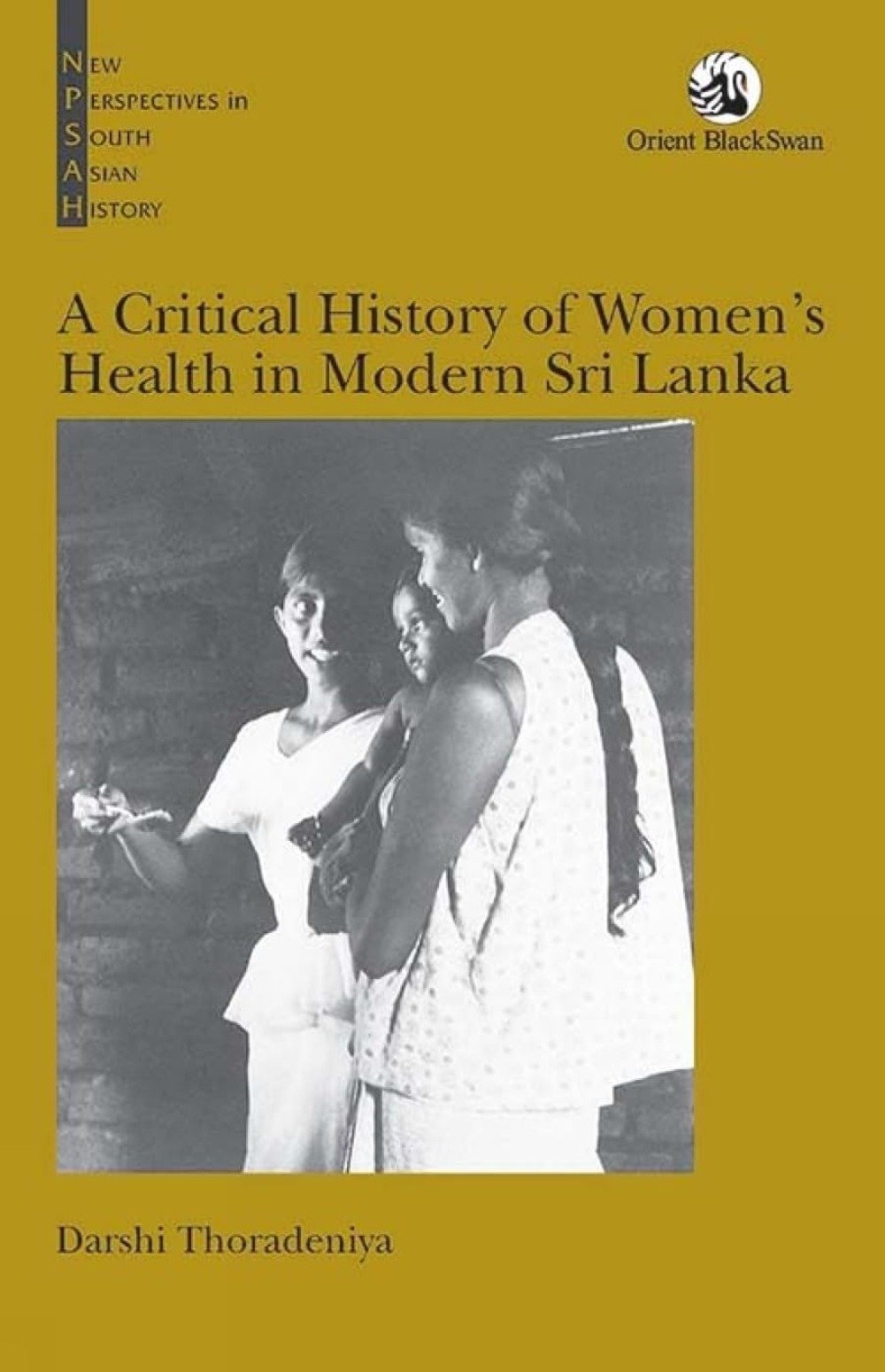
Darshi Thoradeniya’s book, A Critical History of Women’s Health in Modern Sri Lanka, unearths the submerged and complicated history behind Sri Lanka’s much-touted successes in “population control”, which enabled the country to reach replacement-level fertility six years ahead of schedule in 1994.
One side to the story, the upbeat and positive, is well known: Sri Lanka has been a poster-child in UN development circles for many years for its near-miraculous achievements in the Human Development Index (HDI), including maternal and child mortality and fertility rates, despite its low Gross National Income/Gross National Product (GNI/GNP).
But Thoradeniya raises a critical question: at whose expense, or at the disregard of whom, were these impressive gains made? She argues that it was at the expense of the women, and their “corporeal experiences and feelings towards motherhood and having a family” (2024: xxiv). She offers a searing critique of “the demographic and development approach [which treats] women’s health … as numbers in state statistics, reflecting the country’s performance within the linear prescribed progress towards development” (xxiv).
Surveilling and controlling women
Thoradeniya’s book then is not a celebratory reading of the “success” story but one that invites readers to adopt a more critical outlook towards Sri Lanka’s achievements vis-à-vis the standard indices of human development, particularly women’s wellbeing. She does so by putting women at the centre of a well-established narrative on modernisation and development via population control that she argues meant strictly surveilling and controlling women’s reproductive sexuality to accommodate national goals with nary a thought for their reproductive health or reproductive health rights.
Thoradeniya faults scholars from an array of disciplines including health economics, medical sociology, community medicine, and demography for focusing exclusively on numbers and failing to “question the public health system, the welfare state and the neoliberal market forces that have a profound impact on health as a basic right of women in Sri Lanka” (25). She goes further: By focusing on women’s health only in terms of their ability to reproduce, she argues that local scholarship was, and remains, very much aligned with the “population-development framework … as advocated by the West for more than five decades (xxiv). In other words, 77 years after gaining formal independence, the scholarship is yet to take a decolonial turn.
Thoradeniya’s approach, on the other hand, is clearly decolonial and feminist (though I believe she does not use the term “feminist” to describe herself in the book). She puts her training as a historian to good use in unearthing and scouring a diverse array of materials, primary and secondary, to support her thesis that Sri Lanka’s population control agenda emphasising birth control and family planning was marked by a blatant disregard for “women’s bodies, women’s experiences and women’s métis about their bodies” (xxiv), as she terms them.
She also outlines the social, economic, and political currents in post-independence Sri Lanka that enabled that agenda while making room for a few representative women’s voices and perspectives in a bid perhaps to restore women to a history that had turned them into subjects of a social experiment rather than assuring their status as full citizens.
Although she does not quite use the term, critical discourse analysis appears to be her primary analytical tool as evidenced by her acknowledgement of Foucault, especially his notions of biopower and biopolitics, as her key theoretical inspiration. Though she does not quote him in full, Foucault’s stipulation in Archaeology of Knowledge on the need to “disturb the tranquility” of “the pre-existing forms of continuity”, which is quoted twice, seems to underlie her basic approach to the topic in this book.
Population control
That Western funding agencies supported the family planning or population control programme of Sri Lanka is well known. But Thoradeniya does not see the interest in and assistance with population control in the low-income countries by the West, via various funding agencies such Ford, Rockefeller and SIDA, as altruistic and benevolent. In the post-Second World War global order, as Thoradeniya tells it, “under development” itself was a politically charged term and under-developed or “developing countries” were a battleground for control by the two power blocs, socialist and capitalist, led by the USSR and USA. In the Western world, not only was uncontrolled population growth perceived as coterminous with under development but the sole path to modernisation and development was presented as the capitalist model of economic growth. Sri Lanka became a test case for this thesis when it volunteered for the ‘Pill Trials’ in the 1960s.
Nevertheless, despite this very early embrace of the formula for development via population control, Sri Lanka was bafflingly slow to formulate a population policy (in fact, there was none until 1998), as highlighted by Thoradeniya. She attributes the delay to the state’s keenness to become “a development ‘model’ to South Asia by controlling and planning women’s health and silencing the woman’s body (both her corporeal experiences and reproductive rights)” (19-20).
Perhaps it was the growing opposition to population control by forces aligned with Sinhala Buddhist nationalism that led to the lackadaisical approach. Indeed, she points out that for a while the population control or family planning programme remained under the control of the Family Planning Association (FPA), a non-governmental organisation, while the state appeared to adopt a hands-off policy, confining itself to only (seemingly) disbursing the funds. It was not till 1965 that “family planning was accepted as a national policy” (23).
Global Pill Trials
One of the most intriguing chapters in Thoradeniya’s book for me was her carefully documented research into the Global Pill Trials, which exposes troubling shortcomings in the same that I for one had not been aware of. In the early days of the Pill Trials, when Sri Lanka became a social laboratory for the Pill, replacing India that had been the site of choice earlier, it was mandatory to include a routine health checkup plus a pap smear from the women who registered for the trials but, unfortunately, due to various bureaucratic bottlenecks, this did not happen. This was a serious lapse by any standard since the checkups monitored the possible side effects of the different oral contraceptives on the market to enable informed decision making by the researchers on the most effective Pill (81).
Thoradeniya does not go into how the lapse may have affected the volunteers’ reproductive health but she shows the somewhat ad-hoc manner in which Sri Lanka became a volunteer for the Trials: through “a chance encounter”, at a conference on family planning and population control in India, between the head of the FPA in Sri Lanka and an ardent proponent of the Pill (74). In the process, the book gives visibility to a pioneer woman gynaecologist, Dr. Siva Chinnatamby, who as head of the De Soysa Lying-in Home, a government maternal healthcare facility, and the Family Planning Association, a non-governmental organisation, played a lead role in the Trials. I had not heard of her until I read this book and was fascinated by her personal history as well as the trials and tribulations that she faced as an ethnic Tamil woman when the Sinhala Buddhist forces arraigned themselves against the Pill on the premise that it was an attempt to manipulate the ethnic composition of the country. Thus, a forgotten name among the early women activists has been restored to history by Thoradeniya in this book. On the other hand, the Pill Trials was the first instance that manifested both indifference to women’s reproductive health as well as reproductive health rights, which is Thoradeniya’s central thesis.
Women’s bodies as sites of culture wars
The fourth chapter of the book is of equal interest for providing an explanation as it were to the question of why Sri Lanka did not adopt the International Conference on Population and Development (Cairo, 1994) recommendation of reproductive health rights even as it moved to accommodate the recommendation of reproductive health through the establishment of Well Woman Clinics (WWCs). The chapter, appropriately titled “Motherhood in a Decade of Turbulence”, demonstrates with examples how women’s bodies became the site upon which “culture wars” were waged in the strife-torn post-colony of Sri Lanka. The ongoing civil war (1983-2009) required women not only physically but socially to reproduce the ‘nation’, by now disaggregated and understood along exclusive ethnic lines.
Any talk of handing control over to individual women to determine their reproductive sexuality was therefore anathema to all parties to the conflict. This explains why, despite chalking up many achievements of benefit to women in the HDI, Sri Lanka has failed to relax, despite periodic demands and campaigns, one of the most draconian laws in the world on induced abortion, which admits only one exemption: when medically necessary to save the life of the woman. For the same reason, reproductive heterosexuality, located within wedded motherhood, remains the cherished norm while women who are single, infertile, divorced, and/or widowed are made to feel implicitly “unwelcome” in Well Woman Clinics which are located in the same premises as the Mother and Child Health Clinics (144-45).
Of especial interest is Thoradeniya’s research into the social marketing campaign of the 1970s that renamed the condom as “Preethi” and the pill as “Mithuri” and came up with the catchy phrase “පුංචි පවුල රත්තරං” [“A small family is like gold”] in a successful attempt to sugar-coat the bitter pill of birth control, which had been presented to the Sinhala Buddhist masses by ideologues opposed to it as ‘vanda pethi’ and ‘vanda beheth’ [“infertility-causing pills/medicine”].
To what she says, I would like to add something culled from my own research into the same marketing campaign in the 2000s. I see the naming as gendered in that they encode entrenched gender norms relating to male and female sexuality: “Preethi” not only promises “pleasure” without risk to its male users but also frees sex from its implicit confines within monogamous heterosexual partnerships; “mithuri”, on the other hand, omits any mention of pleasure and locates the sexual act firmly within wedded motherhood by presenting the pill as a (female) friend who would enable its user to better space her pregnancies so as to be a better mother. The woman in the FPA poster in my possession looks young and fit, thus holding out the promise of good looks and shape despite motherhood. The ideal Lankan woman is still imagined as asexual: She has sex only for procreation purposes and as a wifely duty. This supports Thoradeniya’s thesis in the book which highlights the lack of regard for women as full human beings in Sri Lanka’s birth control/family planning campaign.
Thoradeniya’s comments on the power of social marketing to turn the tide in favour of birth control methods also reminded me of the following jingle played repeatedly on Sri Lanka Broadcasting Corporation in the 1970s (at a time when there was only one radio station): “පොඩි පවුලක් පොඩි පවුලක්/ලස්සන ලස්සන පොඩි පවුලක්” [“A small family is beautiful”]; a jingle to which I listened without much comprehension at the time, but which seems to have embedded itself in my memory, for it rose effortlessly to the surface when reading this book.
Thoradeniya’s book is thus a timely and valuable addition to a discourse on women’s reproductive sexuality dominated by a seamless tale of successes. She pries it open to reveal the ornate silences and missed opportunities that the dominant narrative conceals. It includes chapters on how Ceylon/Sri Lanka became a (human) development model and the history of population control and family planning from the 1930s to 1980s in addition to the chapters that I have discussed above.
Shortcomings and limitations
But there are some shortcomings and limitations, attention to which would have immensely enriched the book. One of these for me was Thoradeniya’s stated decision to focus only on Sinhala Buddhist nationalism and its utilisation of women’s bodies as a “marker of identity”.
While the increasingly militant and militaristic turn taken by Tamil nationalism, one could argue, reflected the failure in imagination of the nationalists at independence to assure “inter-group equality” instead of Sinhala Buddhist majoritarianism, the heightened ethnicisation of identities and the politics of population that ensued, affected women of all major ethnic groups with competing nationalisms jostling to secure their allegiance and compliance. As Coomaraswamy and Rajasingham have pointed out, referring to Sri Lankan Tamil women’s status under LTTE rule, “the struggle for a Tamil nation has resulted in an excess of governmentality and has become the main means through which politics in the Tamil nation is carried out today. The LTTE’s politics has surely come to operate in this mode” (cited in Rajasingham 2008: 122).
Though the Sri Lankan Muslim community did not attempt secession as an antidote to their growing marginalisation in post-independence Sri Lanka, research has shown that particularly since the 1980s, women of the community have had to bear the brunt of the identitarian politics that have infiltrated thinking in the community in the intervening years (Haniffa 2005, 2008, 2016). Although Thoradeniya initially justifies her exclusive focus by declaring “Sinhalese Buddhist nationalism [as] the dominant discourse in the state-building and nation-building of post-independence Sri Lanka” (2024: xxvii-xxix), later on in the book she admits to language limitations as one of the reasons for not adopting an intersectional approach (35).
Having named some of the noteworthy Sri Lankan women scholars in the field, Thoradeniya makes the somewhat inexplicable claim that “women’s health [has] appeared rarely, if at all, as a subject of analysis in the works of these scholars” despite “the centrality of women’s bodies and sexuality—and, by extension, their health—to these topics” (xxx).
However, from my limited acquaintance with the work of these scholars, many of them, though not in the direct way that Thoradeniya does, have addressed aspects to women’s reproductive health; for example, unwanted pregnancies due to illicit or clandestine alliances between women workers of the Export Processing Zones and members of the Sri Lankan military as well as other categories of men (Hewamanne 2008, 2009; Lynch 2008). Those focusing on migrant women workers (Gamburd 2000; Human Rights Watch 2007; Cousins 2018) have spoken of migrant women sexually abused and impregnated by their employers abroad with some having to return to Sri Lanka with the offspring of such alliances, a phenomenon which partly influenced the setting up of a safehouse close to the Bandaranaike International Airport as such women were unwilling to return to their families in that condition. Similarly, starting from Rachel Kurian (1998), scholars researching the status of women plantation workers (Philips 2003) have spoken of the toll that the combination of low wages and nature of their duties takes on their reproductive health, for example, miscarriages, low birth-weight babies, maternal malnutrition and dental caries. In my opinion, a more comprehensive and nuanced survey of the lie of the land with regard to existing scholarship on Sri Lankan women’s status and health would have enabled Thoradeniya to more clearly demarcate her contribution to the field.
Implied critiques
One of Thoradeniya’s implied critiques is directed at the policy makers whom she argues remain in neo-colonial intellectual servitude to their erstwhile imperial masters despite long years of independence and efforts at decolonisation. In support, she points to their training in Western research institutes such as the Institute of Development Studies (IDS) of the University of Sussex. While a “hidden curriculum” cannot be discounted, one wonders if such a bald characterisation of both the IDS’s agenda and purpose as well as the mindset of those trained therein is fair and serves any useful purpose. It certainly would have helped if Thoradeniya had provided examples of such willing servitude in terms of policy formulation and, more to the point, elaborated on what would or could have been an alternative, authentically Sri Lankan way of thinking and executing development programmes; unless hers is a critique and rejection of “development” per se. In the absence of such, her stance cannot help but come across as “nativist” in some instances.
I am unconvinced if pioneering “white western” women in the field of women’s health and women’s welfare such as Mary Rutnam née Irwin, could be characterised as “white imperial women” (2024: 44). While women like Mary Rutnam may have been limited to some degree by contemporary thinking, it is a fact that they went against the normative role assigned to “white women” in the colonies, i.e., as “kin of colonial officials”, by arriving in the colonies unaccompanied and independently to promote causes such as female education and health. We indeed owe them a debt of gratitude for their tireless efforts on these fronts. In Rutnam’s case, she paid a heavy price by not being allowed to join the colonial health service for committing the “cardinal sin” of miscegenation in marrying a native male: Samuel Christmas Kanaga Rutnam. The contribution of these white western women is already well documented in Kumari Jayawardena’s The White Woman’s Other Burden (1995), which brings light to bear on the diverse roles played by these women in many different sectors on behalf of the local women.
In several places in the book, Thoradeniya provides either partial or incomplete information. For example, she cites the tea plantation economy as the source of wealth that led to the emergence of a native bourgeoisie. But in addition to tea, coconut and rubber were important cash crops in the colonial commercial agriculture sector; and arrack “renting” was a key contributor to the wealth and status of the local bourgeoisie in the maritime provinces, some of whom went on to become well-known nationalist leaders and philanthropists. Graphite mining was another. Kumari Jayawardena’s book, Nobodies to Somebodies (2002), elucidates this rise.
Thoradeniya is also quick to attribute the youth unrest that led to the 1971 insurrection to the lack of English language skills. While this would certainly have been one factor as the first generation of monolingual students started entering university in 1960, I am not sure if it was the only underlying factor for the under- and un- employment of youth in Sri Lanka. The sluggish expansion in the production base has also been cited as another reason for youth failing to obtain jobs commensurate with their qualifications.
Shortcomings and limitations were also observable at the level of stated intentions, style, and writing. First of all, Thoradeniya states in the introduction that the book is intended for an undergraduate readership (2024: xvii), but when one delves into the book this intention is not always evident in the way she organises the book. A book meant for undergraduates should adopt a standard textbook format with a tone and style more cognisant of that readership along with more background information and detail than Thoradeniya does. The book caters more, I felt, to a reader such as I, who comes to the book with a certain knowledge base and familiarity as regards the many dimensions to women’s roles and the gendered status-quo in Sri Lanka. The book certainly fills a gap in my knowledge base. On the other hand, I am not sure how well an undergraduate student without such background information would comprehend its content, motives, and politics. For, it is a fact that the book has a political agenda, as much as an intellectual one, in aiming to draw the attention of the readership to the all-important question of women’s reproductive health rights, which she rightly argues has always been pushed under the carpet.
The book began its life as Thoradeniya’s PhD thesis, for which the research appears to have been done in the 2009-2010 period, but published in 2024. It was not clear to me if that research has been updated and supplemented by what had transpired in the intervening years. It seems not. For example, Thoradeniya mentions the proposal to pay LKR 100,000 per every third child of military families in the immediate post-civil war budget of 2009/2010 (177) but there is no evidence that this budgetary provision was ever implemented or that military families obliged. The very fact that this detail has been consigned to the “Epilogue” which details her PhD research experience in 2009 suggests that this is where the research stopped as also evident from the following statement: “Further, after ending a 26-year-long ethnic conflict, I believe that this is the right moment to release the woman’s body from the nation-building project of post-independence Sri Lanka and empower women by granting them reproductive rights” (173).
Water under the bridge
But much water has gone under the bridge, as it were, since then, including the emergence of intense anti-Muslim sentiments from 2013 or so with the rise of the Bodu Bala Sena and culminating in the Beruwela and Digana riots and the Easter Sunday bombings of 2019. These were supplemented by protests, around the same period, at various government health facilities offering free sterilisation services to women who were deemed to have completed their child-bearing obligations and quotas. Behind the hostility towards the new-found “enemy”, the minority Sri Lankan Muslim community, were accusations by extremist Sinhala Buddhist nationalist forces of deliberate attempts to change the ethnic composition of the country via ‘vanda koththu’, ‘vanda toffees’, and ‘vanda’ medicine-laced undergarments earmarked for Sinhala Buddhists [vanda=infertility-causing]. At the other end, claims were rife of an exponential percentage-wise increase in the Sri Lankan Muslim population vis-à-vis the other two major ethnic groups. This ongoing ethnicised fear-mongering, though currently less intense, should have formed part of a book which focuses on Sri Lankan women’s reproductive sexuality, reproductive health, and reproductive health rights.
There were many rhetorical questions throughout the book which I felt could have been converted to statements to enable them, stylistically, to meld with the rest of the paragraphs in which they are embedded.
Additionally, the book would have benefited greatly from expert copy-editing and proof-reading. There are repetitions and sentence-level errors that take away from the valuable contribution the book makes. For instance, a significant factual error crept in on page 130, when Richard de Zoysa’s killing is attributed to the Janatha Vimukthi Peramuna (JVP) during the reign of terror between 1988-1990. While nobody has been indicted in a court of law thus far, all evidence available points to forces aligned with the ruling United National Party. Similarly, referring to an article published in the newspapers, Silumina and Dinamina in 1970 critical of the birth control programme which described the oral contraceptives as “vanda pethi” designed “to reduce the Sinhala race to a minority”, Thoradeniya describes them as “Government newspapers”. However, their publisher the Associated Newspapers of Ceylon Limited (ANCL–commonly known as the ‘Lakehouse Group’) was nationalised only in 1973.
Thoradeniya sometimes telescopes facts as, for example, when discussing the politics of motherhood in the 1980s. She claims that the Sri Lankan state had to deal with, and was losing, armed uprisings in both the north and east as well as in the south, leading to a “state of anarchy” (126). But it is a fact that, under the Indo-Lanka Accord of 1987, the Indian Peace-Keeping Force (IPKF) had been brought in and was left to deal with the LTTE, allowing the Sri Lankan state to concentrate on the armed uprising in the south, which it crushed brutally.
Thoradeniya’s brief account linking the youth uprising to the 200 Garment Factory Programme (GFP) also does not do justice to history (126). Premadasa had appointed a commission of inquiry to look into the causes of the youth uprising and one of the recommendations was to generate employment as a means of alleviating the discontent. But as Caitrin Lynch (2008) has pointed out, there was a mismatch between the employment offered by the 200 GFP and the Commission recommendations, as the majority of workers who came to be employed in the factories were (young) women which did not quite address the discontent of the male youth who played major roles in the uprising. Certainly, Premadasa’s paternalistic attitude was clear in his address to those gathered at the inaugural ceremony as documented by Lynch, which aimed to keep village women ‘pure’ by keeping them closer to home and under the surveillance of their parents via employment in factories located in the rural areas.
I was also left wondering if the title is a little misleading for it says “women’s health” but the emphasis is on the disregard for women’s reproductive health and women’s reproductive health rights in the single-minded pursuit by the state of the birth or population control agenda. “Women’s health”, after all, encompasses a broader range of ailments, including but not limited to reproductive health issues. The book, therefore, could more accurately be described as a critical history of Sri Lanka’s population control programme which adopted an instrumental approach to the women who were central to that endeavour.
Thoradeniya concludes her book by voicing hope for the future: “This is the right moment to challenge the national responsibilities that the woman’s body has carried so far and to create a new empowered individual human body for women” (2024: 173). Reading this book at the tail-end of 2025, I can only echo her sentiments, though I am left wondering whether “the right moment” will ever arrive or whether it will always remain, for those striving to make it so, a Sisyphean struggle.
Carmen Wickramagamage (PhD., University of Hawaii) is a senior professor in the Department of English, University of Peradeniya.
Image Credit: Orient BlackSwan
References
Rajasingham, Nimanthi. (2008). “The Politics of the Governed: Maternal Politics and Child Recruitment in the Eastern Province of Sri Lanka.” In Radhika Coomaraswamy and Nimanthi Rajasingham (Eds.). Constellations of Violence: Feminist Interventions in South Asia (121-148). New Delhi: Women Unlimited.
Cousins, Sophie. (2018). “Recruiters order Sri Lankan women to take birth control before working in Gulf.” The Guardian (6 April): https://www.theguardian.com/global-development/2018/apr/06/recruiters-order-sri-lankan-women-to-take-birth-control-before-working-in-gulf
Gamburd, Michelle. (2000). The Kitchen Spoon’s Handle: Transnationalism and Sri Lanka’s Housemaids. Ithaca: Cornell University Press.
Haniffa, Farzana. (2005). “Under Cover: Reflections on the Practice of ‘Hijab’ amongst Urban Muslim Women in Sri Lanka.” Gender, Society and Change (61-87). Colombo: Centre for Women’s Research.
Haniffa, Farzana. (2008). “Piety as Politics Amongst Muslim Women in Contemporary Sri Lanka”. Modern Asian Studies, 42 (2/3): 347-375.
Haniffa, Farzana. (2016). “Sex and Violence in the Eastern Province: A Study in Muslim Masculinity”. In Kumari Jayawardena and Kishali Pinto Jayawardena (Eds). The Search for Justice: The Sri Lanka Papers (193-236). New Delhi: Zubaan.
Hewamanne, Sandya. (2008). “City of Whores: Nationalism, Development, and Global Garment Workers in Sri Lanka”. Social Text, 26 (2): 35-60.
Hewamanne, Sandya. (2009). “Duty Bound? Militarization, Romances and New Forms of Violence among Sri Lanka’s Free Trade Zone Factory Workers.” Cultural Dynamics, 21 (3): 153-184.
Human Rights Watch. (2007). “Abuses against Sri Lankan Domestic Workers in Saudi Arabia.” Available at https://www.hrw.org/reports/2007/srilanka1107/1.htm
Jayawardena, Kumari. (1995). The White Woman’s Other Burden: Western Women and South Asia during British Rule. London: Routledge.
Jayawardena, Kumari. (2003). Nobodies to Somebodies: The Rise of the Colonial Bourgeoisie in Sri Lanka. London: Zed Books.
Kurian, Rachel. (1998). “Tamil Women on Sri Lankan plantations: Labour Control and Patriarchy.” In Shobita Jain and Rhoda Reddock (Eds.). Women Plantation Workers: International Experiences (67-88). London: Routledge.
Lynch, Caitryn. (2008). “Good Girls or Juki Girls? Learning and Identity in Garment Factories.” Anthropology of Work Review, XIX (3): 18-22.
Philips, Amali. (2003). “Rethinking Culture and Development: Marriage and Gender among the Tea Plantation Workers in Sri Lanka.” Gender and Development, 11 (2): 20-29.
You May Also Like…

Image-Based Sexual Abuse, and Consent, in the Digital Age
Sely Liyanage
The rapid development of digital technologies has created new forms of content and new forms of harm. Some content is...
India’s Youth Protest and the Limits of Demand-Driven Mobilisation
Manoranjan Pegu
The recent protests ‘led’ by the Cockroach Janta Party (CJP) in India, have been seen as the latest addition to South...
This Government, That Opposition, and the Work Still Ours
Lionel Bopage
For sixty-six years, until his death in 2014, the legendary comrade Bala Tampoe led the Ceylon Mercantile Union...