
Breaking the Spell of an Imperial Photo Album: The Unlikely Beginnings of ‘Colombo Histories’
Sujit Sivasundaram
Where one is based in the world, one’s own positionality, the perspective with which one is writing, is crucial to the way research and its politics takes shape. For me, the experience of having grown up in Colombo and in tumultuous times in the 1980s, while now being in diaspora in a privileged university, has had an undoubted bearing on the way I write. But the disjuncture between those sites and experiences can be awkward and even odd when one is faced with historical materials.
Here, I write about an album that was surprisingly crucial in creating the frame of the ‘Colombo Histories’ project. The push and pull of familiarity and distance which characterised my engagement with it over the years is what I reflect on now. I tried to avoid the album at first but then had to interrogate it. When speaking at the Social Scientists’ Association in Colombo in September 2025, I breezily showed images from it, only to be invited to to take the photographs more seriously and write a proper reflection on it here. This album of Lanka is imperial, it is in various ways depopulated, it is technical and mechanistic, and it is modernist in the fullest definition of that concept. This is why I often found it boring and why I still try to avoid top-down sources like this, but the album opens a way into the past which is revelatory and which is one I had not considered till I started to look at it closely.
And even now, the more I look the more I see how to create new historical questions. I wonder if the displacements and looting of the material cultures of Sri Lanka over so many places and to the West, mirrors the shifting forms of interest, disinterest, closeness, and distance, demonstrated and experienced by the Sri Lankan scholar in diaspora. Depending on their institutional placement, that scholar moves across different sites of intellectual practice and engages with the Sri Lankan archive in various places, within the island and elsewhere, and in disjointed research trips to find this material where it has ended up (Schrikker et al. 2021). Here, I work with the album to show how a specific source like this can be deconstructed and turned around. Microhistories such as this, working outwards from particular bits of stuff in the archive, can be critically generative in approaching the island from its literal margins without aiming for the view from above or for an all-encompassing history of Sri Lanka (Hartman 2019; Pinney 2009; Azoulay 2011).
I have always engaged with the sea from my childhood in Wellawatte when I walked on the beach close to the south of the canal. That beach is now heavily eroded and has almost disappeared. Over the pandemic, when in quarantine, I looked out at the coastline of the city and was amazed by the Colombo Port City project in progress. At first, I thought it was unprecedented. But then I remembered this album in the far distant library in Cambridge. Then it clicked. And it clicked for its visual symmetry: the album was like the vista I could see out of my window while gazing at a new arm stretching into the sea. It was all happening again.
Finding and teaching Sri Lanka in Cambridge and ‘Colombo Histories’
Together with many others, I am in the midst of a large collaborative research project on the long history of the city of Colombo.[1] There are various reasons why I decided a project like this could be useful. Among these is a desire to make space for a more dialogic mode of research and writing, and academic work, between Sri Lanka and the Global North in the discipline of History. Now that it is in progress and in its second year, it has been a pleasure to be surrounded by scholars of Sri Lanka, in a space such as Cambridge that is often so white. Another personal motivation driving the project, was the sense that my book on Sri Lanka, Islanded, could have paid more attention to the lowlands and that there is much to be gained by turning the nationalist history of Lanka, and the idealisation of particular sites of the historical imaginary, including Kandy which was central to that book, inside out (Sivasundaram 2013). Who after all thinks first of Colombo in thinking of the history of the island? But in addition to these reasons was something, and it really is a ‘thing’, that was odd and is still odd, though interesting too.
It is the album I tried to ignore. In writing these reflections, I have returned to it and I am in Cambridge’s University Library looking at it now many years since I first encountered it. When I first saw it, the librarian of the Royal Commonwealth Society collections, which are housed at this library, brought it out from the stores, for a class I organised every year for third year undergraduate historians. The class was on Sri Lanka. In these yearly visits, for finalists taking a course named for Greg Dening, the historical anthropologist of the Pacific, and after one of his books, Islands and Beaches (1980), we went to the library’s collections and inspected and debated some samples from the significant collection of Sri Lankan photographic materials.[2]
When I designed the undergraduate class, my pedagogic rationale was to recover how photographs reveal social structures, of caste, ethnicity, gender and monarchism, among other variables. I was interested in how photographs are relics of encounter and its violence across a beach. But some students were rather taken by this particular album. I was non-plussed and even tried to direct them away from it to my interest in historical debates: for instance about the racial science of photography in South Asia; or to how modes of rule are made theatrical by images; or how social structures are visualised or reinvented by this new technology of the 19th century, the camera. All of those concerns, it seemed, were clearer in other photographs and albums on the desks for students to inspect. But no luck. They were mesmerised by this album, which has on its cover in gold and in capital letters, COLOMBO HARBOUR, COMPLETED 1885.
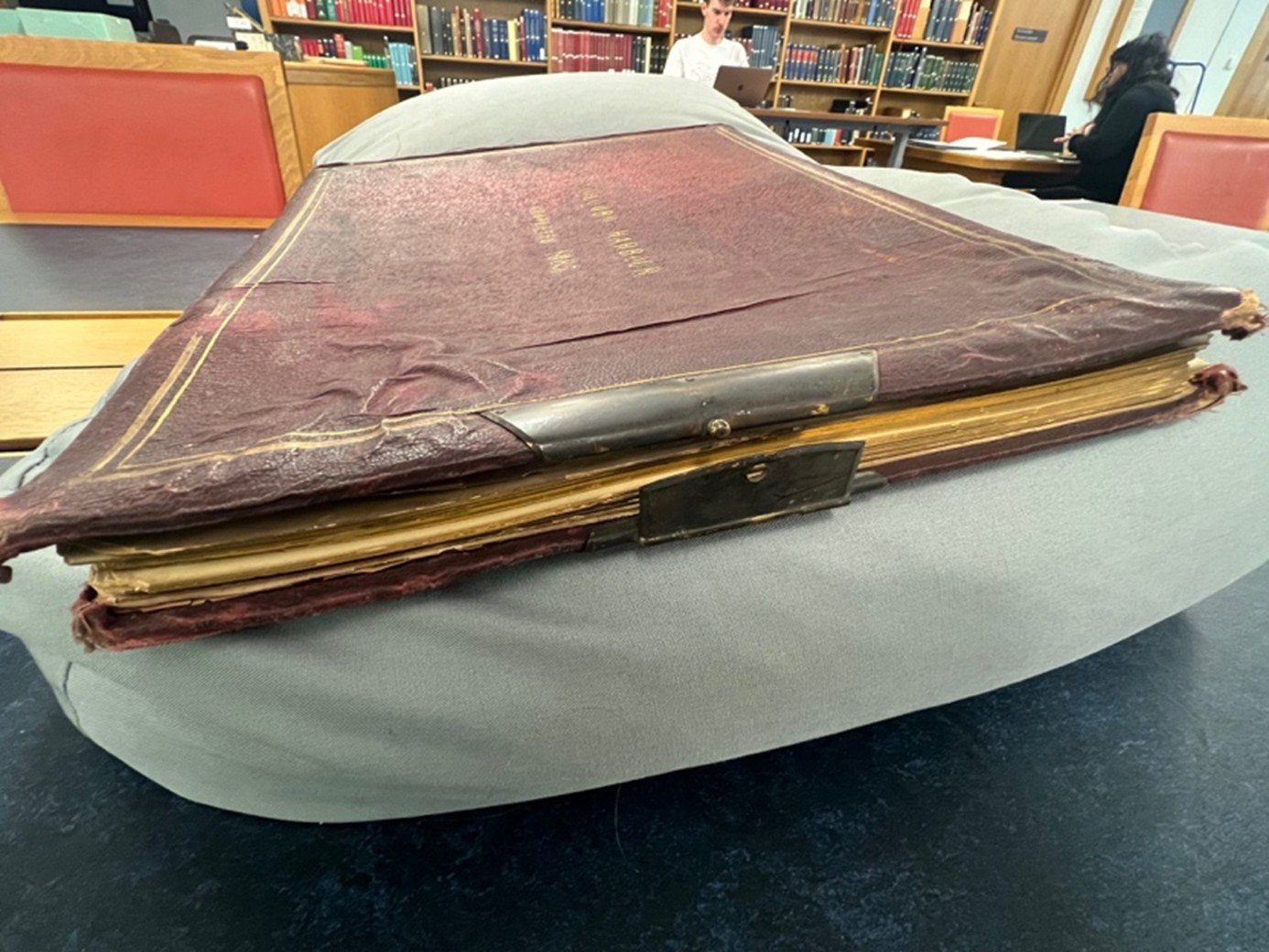
Though it was not so when I taught the class, this album is now digitised and more accessible to students and publics outside Cambridge and in Sri Lanka.[3] Yet the historian in me still believes that there is something to be gained by looking at the physical thing which is why I decided to write this piece in its presence. The cover was initially all red, rather fitting given that all-red was the imperial British colour, but it is now quite browned and even black, which too may be fitting. Its cover is made of much faded and perhaps water-damaged leather. At its end is a lock designed I guess to keep the pages together and safe but also as a signifier of the prestige of the album as a colonial souvenir (Figure 1).
Figure 1: Side view of ‘Colombo Harbour Completed (1885)’ in the Cambridge University Library’s Special Collections Room; classification number, Y303.
This large album was a gift from Sir John Coode, the man who designed Colombo’s first breakwater, as consulting civil engineer, to Sir W.C. Sargeaunt, the Crown Agent for the Colonies, the officer who in London represented the commercial and financial interests of Crown Colonies, including Ceylon. In other words, Sargeaunt was someone Coode wished to please. Coode advised on harbour designs for many different colonies: ranging from St. Lucia and Trinidad to Sierra Leone, Newfoundland, Port Adelaide and Penang and many others.[4] He had a career in imperial infrastructure.[5] Before this, however, his first port project was in Portland on the English south coast, where he used convict labour, like in Colombo. There too, also like in Colombo, a member of the royal family laid the first stone. Coode had expertise for sure, but he also pleased his bosses well: he was knighted in 1872. Later in 1892, the album which Coode gifted was deposited in the Library of the Royal Colonial Institute and bears the stamp of that library and its rules. Much later, with the Royal Commonwealth Society’s other collections, it made its way to Cambridge.[6]
The reason the students were rather engrossed by this album in the years when I first taught on Sri Lanka in Cambridge in the early 2000s is easy now to remember: the images are spectacular and dramatic (Ryan 1997). They are albumen prints taken by Skeen and Company. Mr W. Skeen was the Government Printer of the island and he bought a photographic studio for his son Mr. W. H. Skeen.[7] It became well known for panoramic landscape images of Lanka and worked closely with the Surveyor’s Department. The Skeens moved out from the island to establish a photograph service in Burma too.[8] The photographs in the album have an easy-to-follow start to finish logic. Once you start turning the pages you want to see where the sequence goes. The first image is a sea of people, likely including elites, given their dress, gathered to mark the laying of the first stone of the breakwater by the Prince of Wales. The last images show the completed breakwater from various vistas.
Changing interpretations of the album
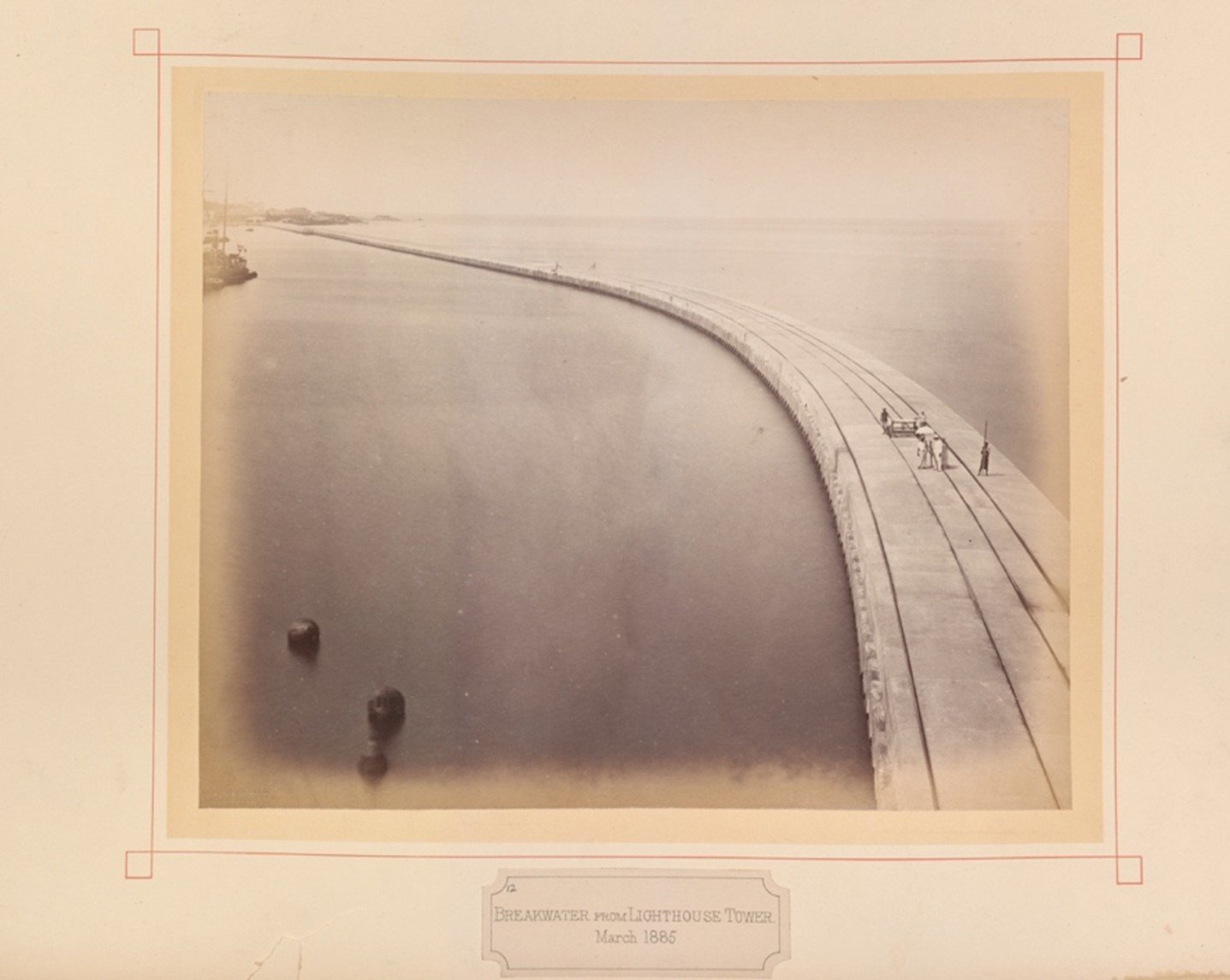
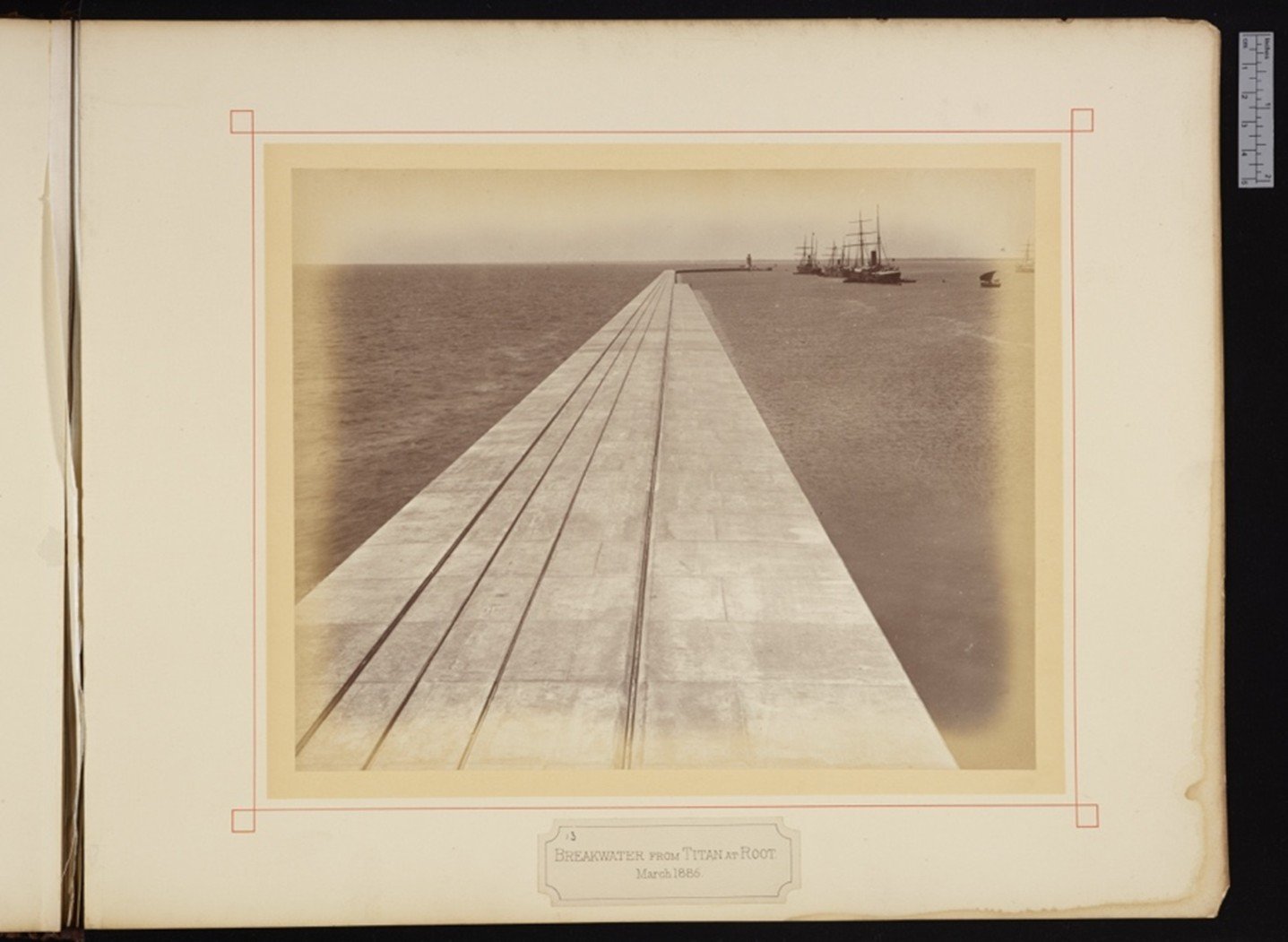
Except for one image which shows a wave breaking, which will return to view, there is an eerie stillness to the waters of Colombo, juxtaposed against the bits of kit building the breakwater. This stillness seems magical in black and white exposure. Of course, that aura is staged. The breakwater is a line and some of the images take the eye on a voyage of linearity, given that they invite the viewer to follow the breakwater into the sea, or towards land if taken from the opposite direction. This style arises from the Skeens’ practice of landscape photography. Some of the photographs in the album are aerial shots or taken from above, in keeping with the interventionist logic of breakwater making at the borders of land and sea and on the beach. For historians of Sri Lanka and for me when I first looked at them, I did not consider the breakwaters to be an important subject in Sri Lankan historiography. By 1885, a south-west breakwater was constructed at Colombo Port. More construction followed in the late 1890s and early 1900s. A north-east and north-west breakwater were built. The more I have worked around the album, and in sources beneath and adjacent to it, the more I’ve realised that these images do not simply stand for colonial infrastructural power.
At first, I was struck by the evacuation of people in these images in the sense that the subject of the album is the breakwater itself. The most interesting images, and I say so from having shown these to several audiences, are the almost dreamy and hyper modernist ‘Breakwater from Lighthouse Tower’ and ‘Breakwater from Titan Root’ (Figures 2 and 3). Yet, I knew that I had to start thinking about the people who had been erased and in turn to consider the labour that went into building the breakwaters. I have written twice about the breakwaters in wider papers and most recently emphasised the quarrying of granite, the transporting of the granite to the site of the breakwater, the setting of the foundation of the breakwater, the diving under sea, and other such gruelling tasks, which when the first phase of the project was completed allowed twenty five steamers to moor in the harbour (Sivasundaram 2017, 2025). In further archival work after those publications appeared, I have stumbled on yet another long run of documents in the Sri Lanka National Archives. The archive of the breakwater is endless.
Figure 2: ‘Breakwater from Lighthouse Tower’
Source: ‘Colombo Harbour Completed.’
Figure 3: ‘Breakwater from Titan at Root’
Source: ‘Colombo Harbour Completed.’
The labouring convicts and their families
I am now especially interested in the conditions of the convicts who were used to dig the stone, under supervision of the Prison Department, and their dehumanising conditions. Free labour, under supervision of the Breakwater Department, was also employed on this project. The stone diggers supplying the project worked in Mahara at a quarry. The terms of their work are evident in innumerable papers which I will write on elsewhere. Sometimes the casualties appear just as cursory notices amongst technical papers but they appear with very regular intervals. As one instance, take this note from Charles Good, Acting Resident Engineer, and dated 18 July 1878:
I have the honor to report that this morning a cooly received injuries on these works from which he subsequently died, by being accidentally crushed between the buffers of two locomotives.
I am sir, Your obdt. servant. Charles Good.[9]
There is nothing more about this deceased labourer in the archive. However, in this very file, Good reported the numbers of workers from November 1877 and April 1878: there were 18 European foremen and divers, 326 freemen, and 277 convicts employed on the project.[10] The efficiency of stone-making and the statistics around working hours were of more interest than fatalities. From a totally different perspective and reality, note this 1881 petition from the wife of a deceased “loader”, who died while “blasting”:
The humble petition of ‘Verai’ at present residing at Mahara, most humbly sheweth.
That your honor’s petitioner is the wife of loader Ramasamy who was killed on the 2nd inst. by a stone from the blasting.
That your honors petitioner is a perfect stranger to this place her country being Thendakallu 10 days journey from Tuticorin and now that her husband is dead she and her child have no means of passing their days.
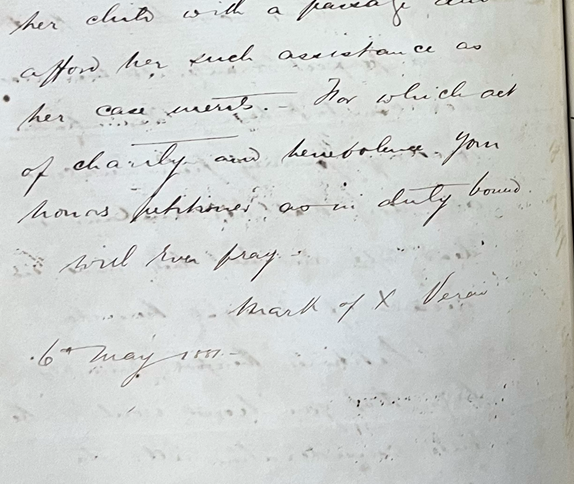
Petitioner therefore humbly begs that your honor would take into consideration all the circumstances connected with her case and be pleased to recommend her to Government for such aid as may seem best in their eyes. She further humbly begs to submit that your honour was fully satisfied with the manner in which her late husband discharged his duties and she is desirous of returning to her country that the Government be requested to furnish her and her child with a passage and afford her such assistance as her case merits. For which act of charity and benevolence your honor’s petitioner as in duty bound will ever pray.
Mark of X Verai.[11]
Figure 4: Letter signed, ‘Mark of X Verai’
Source: Lot 6/6274, Sri Lanka National Archives
The letter is tragic and sincere, but it is also inauthentic because even the mark of X does not appear on the paper in her hand. It is written in by the person who transcribed it. The phrasing also reverts to imaginings of imperial humanitarianism: note, “charity” and “benevolence”. This indicates a script that has been taught or imposed. The idea of ‘country’ itself is interesting to me as someone who wrote Islanded and argued that the British applied a notion of who belonged where and who was a migrant and who was a resident, a partitioning of the island from the mainland. Yet this letter is as far as we come in getting close to this woman and her circumstances.[12] Elsewhere, this transfer and management of people in work and death, took a peculiarly ethnographic character. This is where something which many Lankan people know too well enters the picture. In the breakwater papers, from time to time, identity ‘papers’ for workers and their families appear amongst the bureaucracy. These are akin to 20th-century ID cards, which in the midst of the security blocks of the civil war, we found crucial for passing and moving.
Ethnography, gender, and sexual violence
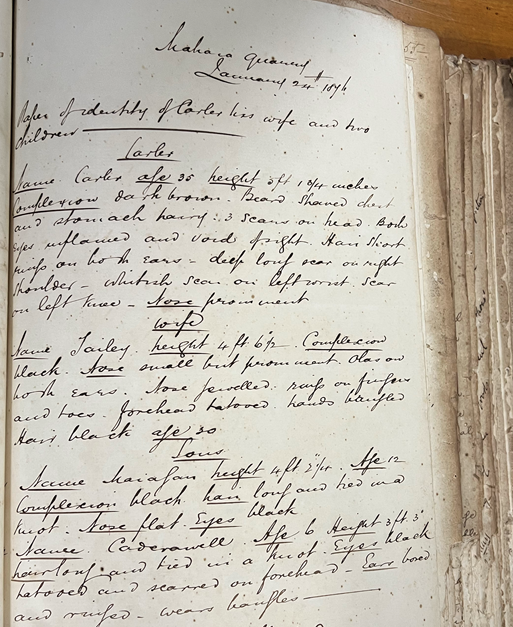
In January 1876, it was reported that a man called “Carler” had lost his sight at Mahara. Now, it was alleged, he “has no wish to stay in this country”. He wished to go to Negapatam together with his wife and two children aged 12 and 6 years.[13] There then followed, alongside another such ‘identity paper’, a sheet which is highly physiognomic and which is in conversation with the anthropometric sciences of measurement and typology of the era which are known to historians of anthropology as part of racist scientific classificatory stems. (Sivasundaram 2015). I will not reproduce the text here given the nature of the close examination of “Carler” and his family, but invite you to critically read the image which follows (Figure 5):
Figure 5: Identity papers for Carler, his wife and sons, signed Alex Milligan, Foreman
Source: Lot 6/5140, Sri Lanka National Archives
In this context of ethnographical typology, exploitative use of labour and gendered division of work, it may not be a surprise that sexual scandal erupted too. In essence, it involved claims that two European workers in Mahara were “keeping 2 Tamil women and that one Anthony was keeping them in house for Milligan and Henghan”. It was Milligan who signed the identity paper above and this provides a further disturbing context for his examination of the bodies of people of colour. Without entering into the specific allegations and counter-allegations that then entered the archive, if men’s bodies were then so exposed and coerced alongside machines, it is also the case that this project manipulated women’s bodies.[14] But they too, made their stand at the margins of the archive even if the sign of X was copied for them.
Historians and theorists of Lanka have blazed a path in keeping gender in clear view in our writings and this is evident in a university like that at which I sit where people read the work of Sri Lankan scholars of feminism and gender (K. Jayawardena 2016; De Mel 2001; J. Jayawardena 2002; de Alwis 2002). If so, work at the bridge of land and sea, those who have studied oceans argue, is especially gendered. For most sailors and harbour workers are men and the sea is one of the most masculinised spaces of work in the modern world. In this light, the appearance of gender violence in the archive is very much in keeping with the nature of the breakwater’s progress and ends.
The prison escape, the breakwater instruments, and the escape’s breaking
As I started working forward in time in Lot 6 in the National Archives in Colombo, I realised more and more that the breakwater’s story leads to the hinterland of the city from where stones arrived. These stones had to arrive in rapid and timetabled sequence. The lots of stones were corroborated by papers, now assigned into lots in the colonial archives. But the prison itself was not a stable site. I had to look away from the numbered lots to discover this.
For, in newspapers from all corners of the globe and printed materials which are digitised, there is reportage of a dramatic incident that occurred in the Mahara quarry in June 1902, “at about 2pm”. According to the Colonial Report for 1902, the prison guard was “surprised by the simultaneous rush of about one hundred prisoners from the working party at the Mahara quarry” (1903: 41). What this party had in hand is revealing given the appearance of so many machines and implements in the album. The instruments of breakwater making were turned to the opposing ends of rising up against the institution of the colonial prison. The prisoners were “armed with crowbars and other implements used in stone cutting and dressing”. And “overpowering the officers, 79 prisoners made their escape”. “A deputy jailer was knocked down and deprived of his revolver by one of the ringleaders, while four overseers were beaten, wounded, and disabled by other prisoners”. Violence ensued. The escaping men were shot at by the guards. These shots had the effect, it is reported, “of preventing the other prisoners who were working in the quarry, and who no doubt were in the conspiracy, from following their more daring comrades”. An Adelaide newspaper carried an article in July 1902 entitled, ‘Daring escape from a Prison’ and also ‘Excitement in Ceylon’. The passage below from that periodical is worth noting:
Bempy, in a dying deposition admitted that he was the ringleader, and that he persuaded the others to join him in regaining their liberty. He said that they were expecting a remission of their sentences in connection with the coronation, but not hearing anything about the anticipated pardon they determined to escape and it was resolved that he was to arrange the mode of escape.
“Bempy” eventually died of the wound inflicted on him by the guards.
The quarry and prison are not the only places to which the breakwater leads. Elsewhere, I have written in detail of how comparable events of protest, definition and solidarity, arose among displaced fishing communities, and around another site which was inter-related to the development of the breakwater (Sivasundaram 2025). This is the Fishery Harbour which had to be built, as a result of the harbour development, and to site the fisherfolk who were without a beach due to the construction work. There I have been interested in emerging senses of Sinhala and Tamil.
Elsewhere, I am also working on the infrastructure around the Beira Lake’s changing shape and this too was tied up in this era with the breakwater project. In this era, there were also issues connected to the supply of water to the city, the recurrent problems of flooding in a wetland, and the need for canal-making, where once again modes of community and protest arose.
In each of these cases, I am struck by how infrastructure of this kind necessitates labour and displacement, but these conditions in turn are met and resisted, even as senses of ethnicity, origin, religion, habitation, and caste, come to coalesce at the place where infrastructure hits the ground, or I should say, the water. On caste especially, given welcome interest to this in recent writing on Sri Lanka, I am interested in the caste of the digger as one further context for interpreting the labour of the breakwater (Balmforth 2020; Fernando 2026). The album that was odd and boring at first leads to central issues of concern to social historians of the island and presents another way to think about their consolidation and dissonance.
Looking closely, again.
Now back in Cambridge, I have returned to the album with a magnifying glass as the workers are in such minute profile. I am observing the people ever more closely in the images with a renewed sense of the significance of the social conflicts that the album brought me to in archives in Sri Lanka (Figure 6). Are they in some manner all ‘Bempy’ or at least ‘Bempy-ised’ in discourse? After all, this name is surely incorrect. In ‘Breakwater Looking Landwards’, all the workers have clearly been told to stand to attention for the photographer. Yet, critically, some could not hold their pose and are blurry. Standing on an insecure platform like this of stone and rubble on the sea seems precarious: yet they stand barefoot. Some have their heads wrapped in cloth, perhaps indicating South Indian origin. Broadly, these labourers allow us to stretch the historical literature on the Malaiyaha community to contexts which are often misplaced and beyond the plantation but where other coerced forms of work operated using South Indian labour (Jegathesan 2019).
Figure 6: Looking with a magnifying glass in the Cambridge University Library’s Special Collections Room, April 2026
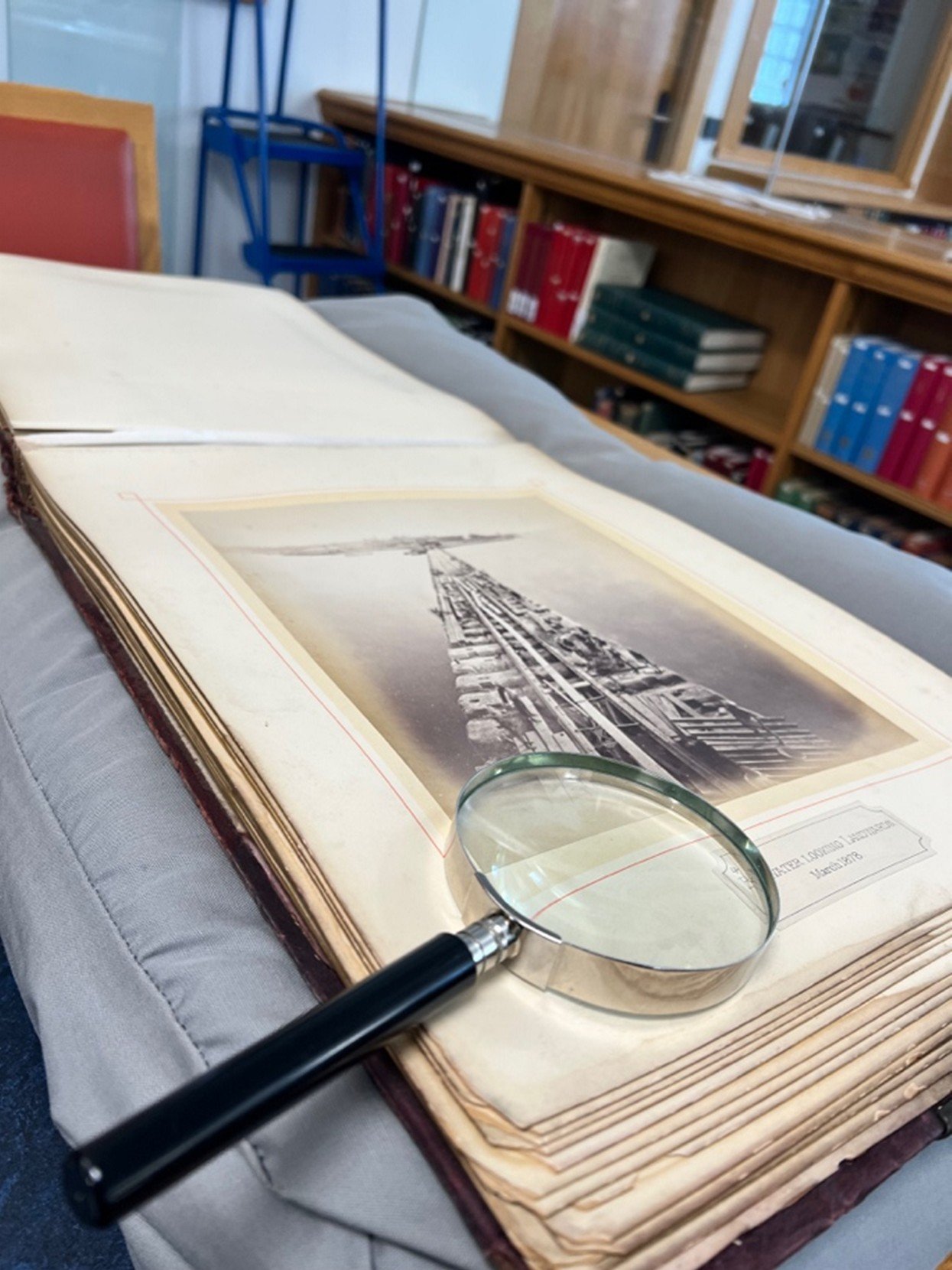
Note: The album is opened to the image described in the paragraph and shows workers standing straight at attention.
Hierarchies of command and superintendence appear in the differing manner of their clothing. The rubble arising from the breakwater sits next to these straight-posed labourers, all men. At the front of this specific photograph, extraordinarily, given the passage of time since it was taken, even the bits of dust arising from the construction can be made out. Beyond is the city, which is also a shadow. Underneath these workers is the sea looking like sheen. The photograph creates a spectacle and makes the labourers themselves a typology, and perhaps an ethnographic typology in keeping with the identity papers just reproduced, but the nature of this image means that it does not capture them wholly. The out-of-focus bodies suggest the incomplete power of the photograph to take hold of the labourers on the breakwater or to enact ethnographic capture. Though the labourers are incidental when shown here, to the carriage of the line, and the way the line juggles the geography of the city and the coast by 90 degrees, allowing us to look into the island of Sri Lanka from the sea and as invaders do, these labourers do not allow themselves to be simply photographed. Like the prison escapees, these men are not up for simple control.
Photographic reception, or mythification, and the origins of tourism through Lanka
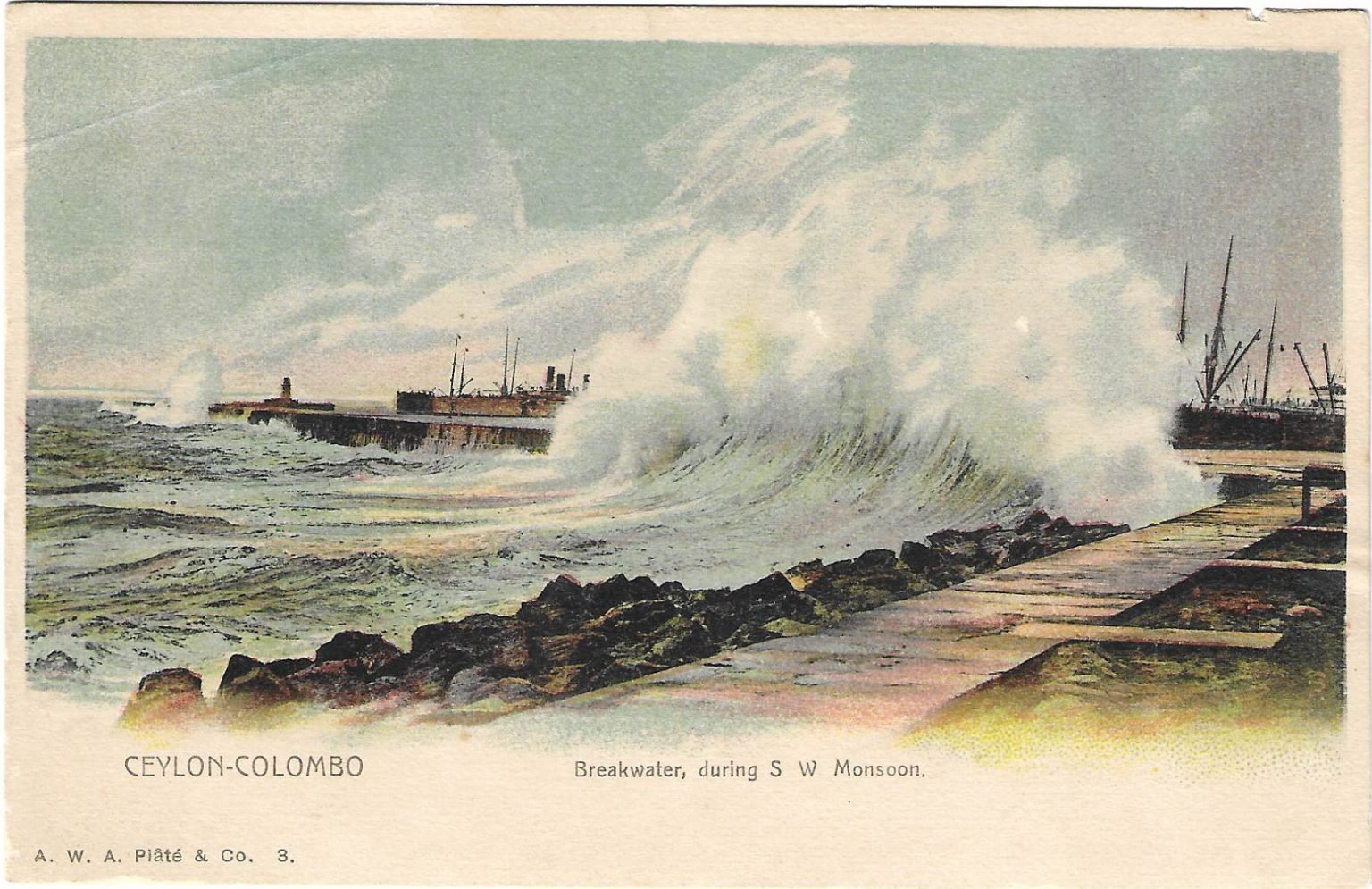
Before I got into the archives to follow prison labour or fishing labour, I was troubled by the elitism of the album. In my training, by the supervisors of my PhD, in Cultural History, which is one method that was foundational to my graduate study, I had been instructed to focus on reception. I made the plunge and looked online and was shocked, yet again, partly because of my early perspective that the breakwater was boring or insignificant to the history of the island. I found dozens and dozens of images of the Colombo breakwater. They were for sale on popular shopping sites like e-bay. The Colombo breakwater, it appears, was a staple view, among many others, of the postcard boom of the British empire. It was among what tourists wanted to see. The most popular such image of the breakwaters was not of its construction but of the breaking of a wave over it. (Figure 7). As noted before, in the album itself, ‘Breakwater During S.W. Monsoon’ is unusual because it is the only photograph where the sea is visibly churned. The monsoon and the nature of the sea was of great interest to colonists, settlers and travellers, but so was the marvel of modernist infrastructure and what it could do in the sea. Digital searches in English language newspapers reveal that the breakwater in Colombo was of significant interest to global readers. It was a known site and object even if initially uninteresting and unknown to me.
Figure 7: ‘Breakwater During the S.W. Monsoon’
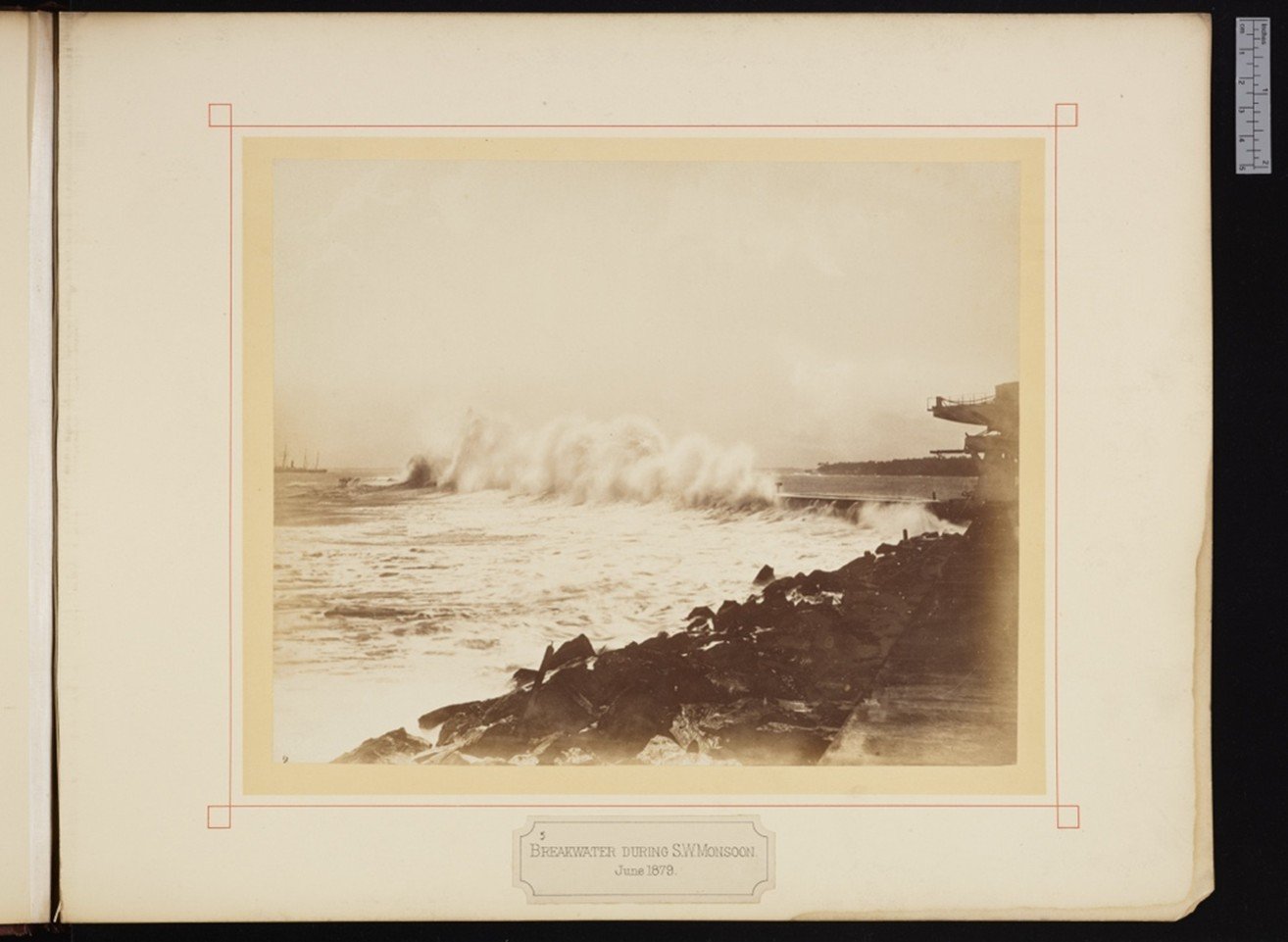
Source: ‘Colombo Harbour Completed.’
Yet, 19th-century colonial knowledge and engagement with Lanka was shallow. One could argue that the aestheticisation of the breakwater as part of a tourist gaze, went not only with the erasure of labour and the violence of events such as those at Mahara, but also with the lack of more sustained engagement with the island. Tourists then and now, pass on itineraries and those itineraries, across the sea or over air, are too narrow or scripted. Take a postcard which has recently been acquired from a Dutch collector and is now part of the Colombo Histories Project’s own archive and which we hope to digitise. (Figure 8). It is from Platé and Co. It juxtaposes the breakwater against an orientalist image of a woman in saree, in a rickshaw, pulled along by a man, with banana palms and coconut trees in the background. In other words, the exoticisation of a woman of Lanka is perfectly a piece with the breaking of a wave. Both indicate modernity. In coloured versions of the image, the tale-telling and mythification of the breaking wave got even more elaborate as the decades passed. The white wave rose into the sky as a plume, higher and higher it went. (Figure 9). Despite all the careful mapping and plotting, and the establishment of precise timetables for stones to come to the shore from the quarry, in these postcard images which suggest the repeated circulation of elite photography among a wider set of middle class elites, the feat of the breakwater still fell back into a story. That story evolved over time in various copies of the image of the breaking of the wave.
Figure 8: Platé and Co. postcard
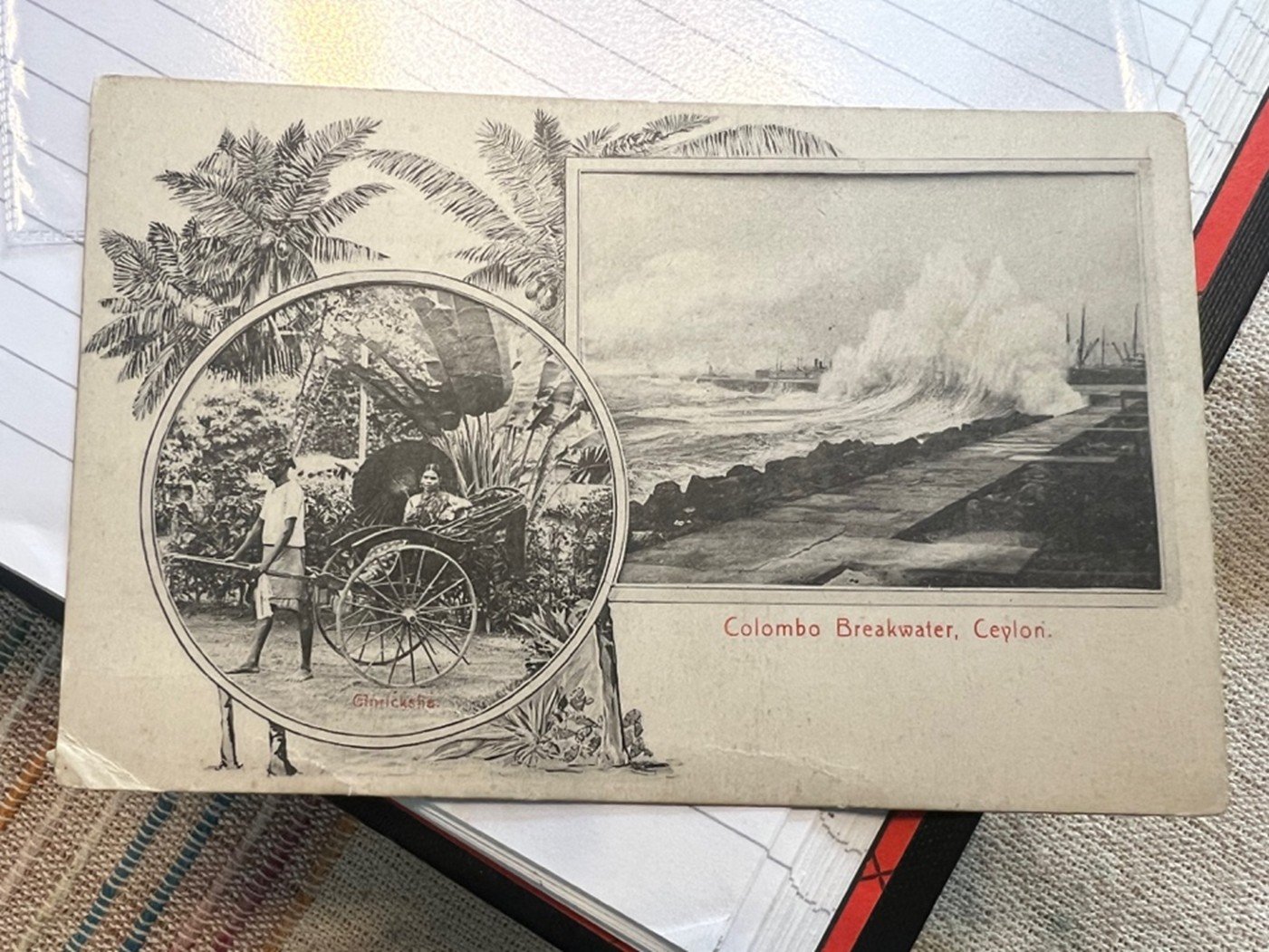
Source: Colombo Histories Project Archive
Figure 9: Montage of postcards of the wave crashing over the breakwater
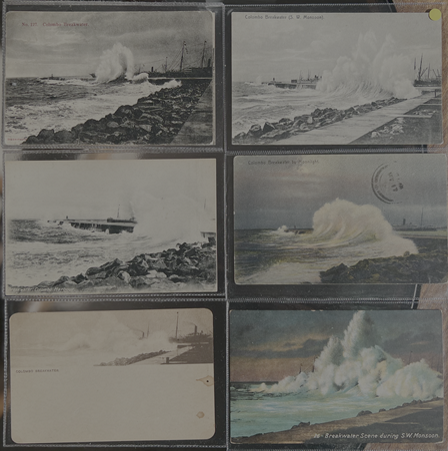
Note: These postcards show the wave rise higher and higher in more colour. The mythification of the representation of this wave is evident by postcard no.26 in colour.
Incidentally, one could argue that Colombo was part of the origins of the history of global tourism, because of its place on shipping lines in the early 20th century (Sivasundaram 2017). The word ‘transit’ itself arose from people jumping ships in places like Colombo. Ships came here from Egypt and then connected with Southeast Asia and Australia or around India. The Egyptian context was crucial too to the origins of global tourism. Where tourists gazed in Colombo at the breakwater, in Egypt they were amazed by the Suez Canal. This seems extraordinary given the culture and history of Egypt which lay beyond the Canal which far outcompeted the techno-modernity of a canal. The populism that took hold of breakwater images, making them circulate so widely, generated a muddle. People got confused about locales or didn’t care exactly from where they sent breakwater pictures to their relatives. Some of us in diaspora are sometimes in situations where we have to explain where Lanka is on the map. Postcards of the Colombo breakwater were sent from various parts of the Indian Ocean world: one did not need to send a postcard from the specific place where the image of the postcard arose.
As the tourist gaze proceeded, it jumbled places, sites, and cultures. This argument once again provides a context for why sources like this are disorienting now for the Sri Lankan scholar in diaspora who wishes to interrogate them. Sri Lanka has been dispersed in the world in crazy patterns that are confusing but which demonstrate the role of capital in transforming it, for instance in the case of tourism. And empire’s role appears too, exemplified by infrastructure, for empire makes mobility into and across the island possible, and this too has generated dispersal of Sri Lanka. I love running into Sri Lankans in unexpected places in the wider world, but this is now our plight. We, like the remains of empire and its archives, are dispersed.
Yet more photographs, but in Lanka not Cambridge
The bureaucracy of the colonial archive can be tedious and working through papers of requests for leave or pay rises, or complaints about the weather or of stone sizes, can be boring. Just as much as the album I was sitting next to as I wrote a large chunk of this piece generated opposing feelings in me, the Sri Lanka National Archives’ Lots can do so too. Yet one day when I was working through the breakwater papers something odd happened again. I turned the page of a file and there they were: yet more photographs of the breakwater pasted into colonial documents. They appeared as accompaniments to the Resident Engineer’s Report of 1879 for instance. At one moment, a whole lot of images rolled out of the page. (Figure 10). Among these is ‘‘‘Breakwater Pier” during the Monsoon of 1880’. (Figure 11). This image, clearly taken at the same time as those for the album, makes the breakwater seem the site of a ghost drama or a political murder (Schubert 2024). Equally denuded of people and much less dramatic, when compared with the album’s images, is the next photograph which shows the lapping water at the breakwater (Figure 12). It seems closely related but different to the image that became iconic of a huge wave breaking. But here there is only a foamy surf and a visible dampness on the surface of the breakwater.
Figure 10: Photographs from the same sequence of images but not in the album roll out of the file in Lot 6/6000
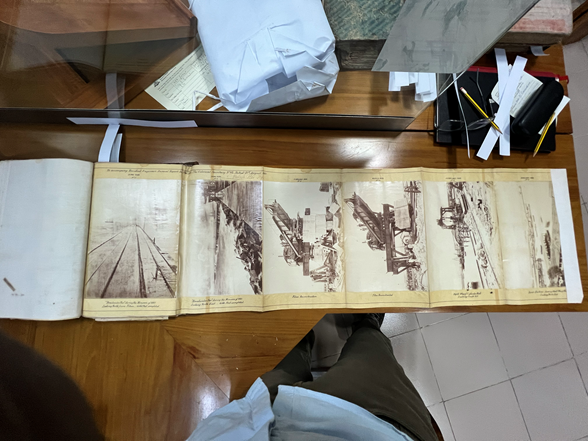
Source: Sri Lanka National Archives
Figure 11: ‘‘‘Breakwater Pier’’ during the Monsoon of 1880’, noting that 1463 feet complete
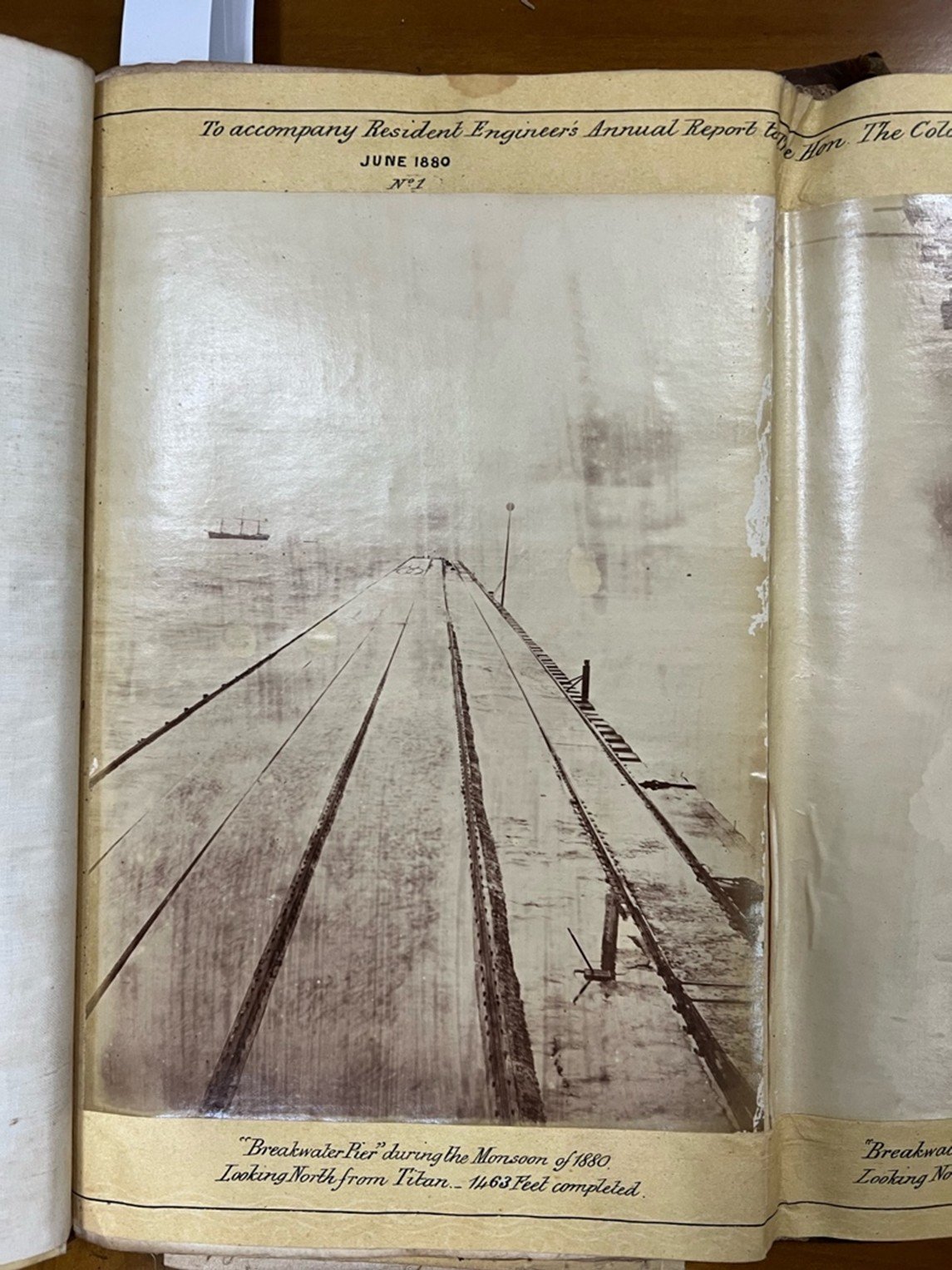
Source: Lot 6/6000, Sri Lanka National Archives
Figure 12: ‘‘‘Breakwater Pier’’ during the Monsoon of 1880’
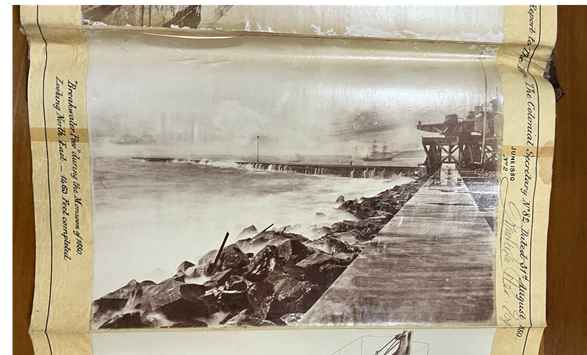
Source: Lot 6/6000, Sri Lanka National Archives
These newly found photographs were of the same shoot one might say. But they had no leather cover or lock for safety. They had weathered differently in the sense that they were somewhat faded and dotted with damage of some kind, perhaps again from exposure to the elements in Colombo storage. Another photograph from the Sri Lanka National Archives simply shows piles of rock and other debris (Figure 13). In the file, these images sit alongside a very long map of the habour works (Figure 14). These various images, in contrast to those that made the selection for the album, were not for display. They were technical digests and evaluations of progress and are set out as such too.[15] They suggest the staged means through which albums such as that in Cambridge are crafted and how the archives of Sri Lanka take divergent paths and how their dispersal comes to be. Putting it all together takes effort but even when you put it together the material doesn’t answer all the questions you may pose to it.
Figure 13: ‘Colombo Harbour & Breakwater Pier Looking North East’, showing just a pile of rubble
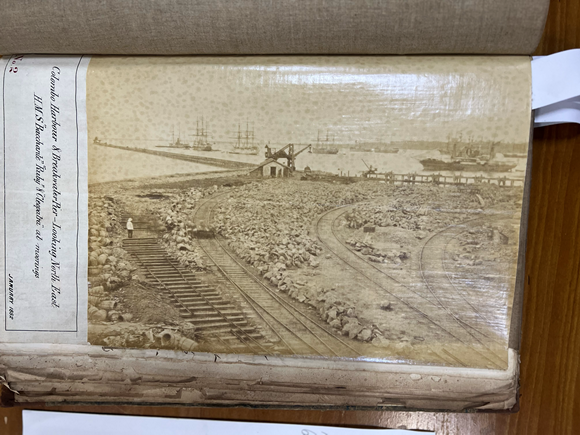
Source: Lot 6/6514, Sri Lankan National Archives
Figure 14: ‘Colombo Harbour Works, General Plan’
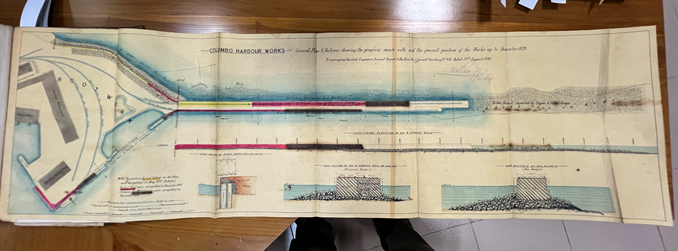
Source: Lot 6/6000, Sri Lanka National Archives
The sea and the beach and thinking with sand and dredges
Watching the dredging in progress at the Colombo Port Development project close to Galle Face Green where I used to walk with my grandfather as a child, I was struck a few years ago at the quantities of sand involved and which were being moved and thrown into the air. One estimate is that 65 million cubic meters of sand will need to be dredged and dumped into the sea to complete the project (Safi 2018).
It was this watching that first alerted me to the historical interest in tracking sand as a historical subject. I had no idea till I started to read and look, and with the memory of this album and the breakwater at the back of my head, that sand is the second most consumed thing from nature, following water, and the most mined substance (for instance see Siriwardane-de Zoysa and bin Salleh 2022). It is travelling on all manner of pathways across the Indian Ocean and as ballast too at the bottom of ships taking goods here, there, and everywhere.
Then it occurred to me that the breakwater project has another context, not towards Mahara or Modera, but out in the Indian Ocean. It is tied to Egypt not only by the passage of the elite tourist gaze. I have now argued in work in progress that the Suez Canal as a project shaped the growth of Colombo’s harbour. Since I had been interested in people and social histories, I had ignored the titanic machines in the photographs. It is time to consider them here specifically in relation to all this sand work which is in our faces right now.
Machines did various things on the breakwater project and amongst these was the crucial task of dredging the ocean enclosed by these arms in the sea to allow ships to moor in deeper waters. From 1880, a dredge called ‘Merak’ was deployed. Interestingly, material excavated by the dredging was used to reclaim land on the shore. From 1880 to 1932, over 13 million cubic yards of stuff were removed from Colombo’s seabed (Owles 1933). One colonial engineer commented on the port’s seabed noting that it consisted of “sand, with some very small patches of mud” (Kyle 1887: 91). Borings demonstrated that it could be dredged to 30 feet. Nothing but sand would be encountered on this deeper bed. The early decades of the 20th century saw the depth of the sea in the harbour further and further increase. Technically, one aspect of the relation between Colombo and the Suez Canal came through depth measurements. The depth of ships going through the Suez Canal, set the bar for what was deemed necessary as a depth for Colombo’s harbour and other Indian Ocean ports.
But this engineering had to withstand the full swell of waves and the tempestuous monsoon winds at this central location in the Indian Ocean; bits of Colombo’s breakwaters could be easily broken by the elements and washed away. Various environmental effects followed the obstruction of the established circulation of sand and water on the shoreline of Sri Lanka. After all, Colombo does not have a large natural harbour. In sum, the sand dredging was vital to making it possible for a harbour to come to be here on the western coast of the island. This engineering is not something that happened just now. It too has a history.
Note the question of Lankan engineer Stephen William Dassenaike, who also served on the State Council of Ceylon, to Mr. T. A. Owles of the Harbour Engineer’s Department in Colombo. Where does the silting of the harbour arise from: does it occur “over the south-west breakwater” or does it emerge “through one or other of the openings” which lie between the breakwaters? (Owles 1933). Dismissing the question, Owles replied that the silting in the new harbour at Colombo was not “serious”. But there was indeed a general “littoral drift” of sand across this coastline. This ‘drift’ was interrupted by the British imperial breakwater programme and so sand was now accumulating against the south-west breakwater. In other words, nature could not be managed and colonised like this. Infrastructure and dredging worked against the rhythms of sea and sand.
From another angle, the growth of the city also saw sewage pumped into the sea; where breakwaters were enclosing and changing the rhythms of water circulation, this could be a bothersome and unhealthy problem. I recall how friends who have swum in the waters close to the new arm of sand in the Port Development project complain of the problems of sewage in the sea. Elsewhere, in the period of the breakwater-making, the clogging of the mouth of the river Kelani, through the formation of a sandbar, and also more congested trade and traffic, for instance, by traders in timber or fishermen, contributed to perennial flooding in the city. I note too that the 2004 tsunami across the wider Sri Lankan coast is thought to have been exacerbated by sand mining.[16] The tragedy of sand mining and extraction for people is movingly captured in the award-winning documentary, Lost World.[17]
The ruins of our world
It follows directly that we are in the ruins of modernism and its connections to capitalism and imperialism. And this repetitive logic, from the British breakwaters to the new ones now in construction, indicate that similar programmes of attempted control, intervention and labour are necessary to make Colombo work as a city at the centre of the Indian Ocean. Yet the symmetry, between then and now, hides how the social, environmental and political conditions leave little space for us to be out-of-focus and to be blurred and even ghostly in response to these programmes. Note for instance the dramatic torpedo of the Iranian ship off the coast of Galle on 4 March 2026. Note the geopolitics of a new age of empire and superpower rivalry or what is occurring in the Middle East. Note the re-entry of war of unprecedented scale into our world. Note the climate effects of sand mining. These presents remind me of the period of high imperialism when the Suez Canal was cut, the breakwaters were built and where Africa was partitioned by Europeans or the conditions were set for the First World War. But our moment seems ever more catastrophic and claustrophobic by way of its technologies of war, extractive consumerism, and unequal world-making. Photography is rarely out of focus any more: images are instantaneous, easily reproduced and circulated, and are part of the technology of bombing too, in Gaza or Lebanon or elsewhere. The ships of high imperialism are still doing their work, for instance now taking oil rather than coal to all corners of the globe, via the Strait of Hormuz or through the Suez or even via Colombo. But they are burning. And the island is short of fuel.
Breaking the spell?
I am hoping that writing this piece will somehow serve as an exorcism of the demon of the breakwater and the hold this album has had over me. But I doubt that it will be so. I know that there are other questions hiding in these images. I know there are still sources from the breakwater archive, even on my computer where I have many notes and records from Colombo’s archives, which are waiting for me to analyse further. The different and telling paths which the photographs have taken and the fact that these many paths in turn lead into much broader questions of expertise, capital, labour, environment, empire, gender, sex, globalisation and travel, mean that I expect that I shall encounter them soon somewhere in a way that I did not expect.
Scattered archives, scholars and people, and the present
Such is the life of a historian tracking archives and trying to bring together an inchoate island, over which there has been so much connectivity, and from its margins. And that marginality is literally so. For the breakwater is at the edge of the island and a bridge into the wider world. The place of Lankans in the world today is scattered too as they are affected by processes of migration, displacement, belonging, and unbelonging, and unequally so. And that too is the nature of the historical archive itself which also is fragmented and limited. One can get close to these workers but only so far because of how the images encircle them.
The archive runs dry at some point and this means that rigorous history will critique totalising, colonised, or nationalised narrations. Such archivally-reflexive history, needs to wrestle with the every-day tussles, of brickmaking, stone-cutting, and prison escapes too, and work outwards to other contexts well beyond the island. It needs to work from below for sure, in thinking of work and people, but even further below is the sand and the water and the land. Such analysis of historical remains, rooted in present politics and concerns, and in the nature of the archive and its travels, is what I hope the ‘Colombo Histories’ project will support. It is a form of history which is always prone to being unsettled and further decentred. It cannot be monopolised nor can gate-keeping operate over it.
The breakwater album shows that there is no singular way of doing history or telling history and that to counter the archival elitism and elision, the historian needs to imagine Lanka again and again. That imagination can begin with what may seem boring and insignificant, because it allows us to reconsider the usual ways in which we tabulate the pathways and itineraries of Lanka, according to kings, governors, or presidents; or courts, commissions, and elections; or religions, plantations, and texts. There are so many other topics like breakwater-making to be deconstructed. And it is exciting to see so many joining the enterprise of rewriting and rethinking histories of the island and their beyond. As more and more people, with so many new experiences and with new generational positions, join the field, and as new political contexts for writing emerge, it is undoubtedly the case that the histories of Lanka will change again and yet again.
Sujit Sivasundaram is professor of World History and fellow of Gonville and Caius College, University of Cambridge. He is the author of the prize-winning Waves Across the South: A New History of Revolution and Empire (Chicago University Press, 2021).
Lead photo source: KHK global dis:connect collection
Acknowledgement: The editors are thanked for their enthusiasm in receiving this piece and careful work on it over several months. It was finalised prior to the events at Mahara prison earlier this month. I also thank all those who attended my talk at the Social Scientists’ Association last year and encouraged me to write further on the images. Andi Schubert is thanked for his detailed comments and challenges. Finally, I thank the Director of the National Archives of Sri Lanka, Dr. Nadeera Rupesinghe, and the librarians of the University Library of Cambridge for permission to reproduce materials.
References
The Register (Adelaide). (1902). “Daring Escape from a Prison”. (28 July).
Azoulay, Ariella. (2011). From Palestine to Israel: A Photographic Record of Destruction and State Formation, 1947-1950. London: Pluto Press.
Balmforth, Mark. (2020). “In Nāki’s Wake: Slavery and Caste Supremacy in the American Ceylon Mission”. CASTE, 1: 155-174.
Beare, T. H., and Alan Muir Wood. (2004). “Coode, Sir John (1816-1892)”, in Oxford Dictionary of National Biography. Available at https://www.oxforddnb.com/display/10.1093/ref:odnb/9780198614128.001.0001/odnb-9780198614128-e-6133.
Colonial Reports–Annual. No. 396. Ceylon Report for 1902. (1903). London: Darling & Son. Available at https://babel.hathitrust.org/cgi/pt?id=umn.31951d02089966o&seq=5
De Alwis, Malathi. (2002). “The changing role of women in Sri Lankan society”. Social Research: An International Quarterly, 69 (3): 675-691.
De Mel, Neloufer. (2001). Women and the Nation’s Narrative: Gender and Nationalism in Twentieth Century Sri Lanka. Delhi: Kali.
Dening, Greg. (1980). Islands and Beaches: Discourses on a Silent Land, Marquesas, 1774-1880. Carlton, Vic.: Melbourne University Press.
Dusinberre, Martin. (2017). “Japan, Global History, and the Great Silence”. History Workshop Journal, 83: 130-150.
Fernando, Tamara. (2026). Shallow Blue Empire: A History of Pearl Diving in the Indian Ocean, 1850-1930. Cambridge, Mass.: Harvard University Press.
Hartman, Saidiya. (2019). Wayward Lives, Beautiful Experiments: Intimate Histories of Social Upheaval New York: W. W. Norton.
Jarvis, Andrew. (2011). “‘The Myriad-Pencil of the Photographer’: Seeing, Mapping and Situating Burma in 1855”. Asian Studies, 45 (4): 791-823.
Jegathesan, Mythri. (2019). Tea and Solidarity: Tamil Women and Work in Postwar Sri Lanka. Washington: University of Washington Press.
Jayawardena, Janaki. (2002). “Cultural Construction of the ‘Sinhala Woman’ and Womens’ Lives in Post-Independence Sri Lanka”. Doctoral Thesis, University of York, UK.
Jayawardena, Kumari. (2016). Feminism and Nationalism in the Third World. London: Verso Books.
Kyle, John. (1887). “Colombo Harbour Works, Ceylon”. Minutes of the Proceedings of the Institution of Civil Engineers, 87: 76-91
Lambert, David, and Alan Lester (Eds.). (2006). Colonial Lives Across the British Empire; Imperial Careering in the Long Nineteenth Century. Cambridge: Cambridge University Press.
Markar, Imaan. (2026). “Urban Vignettes: Reading Colombo’s History Through an Ephemeral Archive”. ColomboHistories Blog (13 April). Available at https://colombohistories.org/2026/04/urban-vignettes-reading-colombos-history-through-an-ephemeral-archive/
Obeyesekere, Gananath. (1992). The Apotheosis of Captain Cook: European Mythmaking in the Pacific. Princeton, N.J: Princeton University Press.
Obeyesekere, Gananath. (2005). Cannibal Talk: The Man-Eating Myth and Human Sacrifice in the South Seas. Berkeley, C.A.: University of California Press.
Owles, T. A. (1933). “Colombo Harbour Works”. In Transactions of the Engineering Association of Ceylon, 320-346.
Pinney, Christopher. (2009). The Coming of Photography in India. London: The British Library.
Pinney, Christopher, and Nicolas Peterson (Eds.). (2003). Photography’s Other Histories. Durham, N.C.: Duke University Press.
Ryan, James. (1997). Picturing Empire: Photography and the Visualization of the British Empire. Chicago: University of Chicago Press.
Safi, Michael. (2018). “Sri Lanka’s ‘new Dubai’: Will Chinese-built city suck the life out of Colombo?” The Guardian (2 August): https://www.theguardian.com/cities/2018/aug/02/sri-lanka-new-dubai-chinese-city-colombo.
Schaffer, Simon. (2019). “Traveling machines and colonial times”. Archives de sciences sociales des religions, 187: 171-190.
Schrikker, Alicia, and Doreen van den Boogaart (Eds.) with Ganga Dissanayaka, Chamikara Pilapitiya, Senarath Wickramasinghe, and Asoka De Zoysa. (2021). Weapons of Persuasion: The Global Wanderings of Six Kandyan Objects. Colombo: Tambapanni Academic Publishers.
Schubert, Andi. (2024). “Restless Somnambulists: Reflections on Violence, Accountability, and Historical Practice from Sri Lanka”. History Workshop Journal, 97: 53-76.
Siriwardane-de Zoysa, Rapti, and Jalaludin bin Salleh. (2022). “Sanded: Sedimented Pasts and Shored Futures in ‘Outer’ Singapore’’. In Rapti Siriwardane-de Zoysa, Kelvin E.Y. Low, Noorman Abdullah, and Anna-Katharina Hornidge (Eds.), Coastal Urbanities: Mobilities, Meanings, Manoeuvrings (180-201). Leiden: Brill.
Sivasundaram, Sujit. (2013). Islanded: Britain, Sri Lanka and the Bounds of an Indian Ocean Colony. Chicago: University of Chicago Press.
Sivasundaram, Sujit. (2015). “Imperial transgressions: the animal and human in the idea of race”. Comparative Studies of South Asia, Africa and the Middle East, 35 (1): 156-172.
Sivasundaram, Sujit. (2017). “Towards a critical history of connection: The port of Colombo, the geographical ‘circuit,’ and the visual politics of new imperialism, ca. 1880–1914”. Comparative Studies in Society and History, 59 (2): 346-384.
Sivasundaram, Sujit. (2025). “Breaking the sea and digging the earth: wetland infrastructures and social conflicts in late modern Colombo”. Urban History, 1-26.
Wright, Arnold (Ed.). (1907). Twentieth Century Impressions of Ceylon. London: Lloyd’s Greater Britain Publishing.
Notes
[1] For the website, aims, and progress of the project and to join the mailing list, please see colombohistories.org.
[2] See also Obeyesekere (1992 and 2005) for a relevant context for why Pacific studies matters to Lanka.
[3] The album can be visited online here: https://cudl.lib.cam.ac.uk/view/PH-Y-00303-C/1, accessed 17 April 2026.
[4] For Coode’s biography, see Beare and Wood. (2004).
[5] For careering imperialists, see Lambert and Lester (2006).
[6] For machines and empire, see for instance, Schaffer (2016).
[7] For details on Skeen and Co., see Wright (1907: 451ff).
[8] For relevant context of photography, see for instance, Jarvis (2021) or Markar (2026).
[9] Letter dated 18 July 1878, from Charles Good, Acting Resident Engineer to the Colonial Secretary, Lot 6/5516, Sri Lanka National Archives, Colombo.
[10] Letter dated 30 July 1878 from Charles Good, Acting Resident Engineer to the Colonial Secretary. Lot 6/5516, Sri Lanka National Archives, Colombo.
[11] ‘The humble petition of Verai at present residing at Mahara’, dated 6 May 1881, Lot 6/6274, Sri Lanka National Archives, Colombo.
[12] For the silence of the archive see Dusinberre (2017).
[13] Letter dated 25 January 1876, from John Kyle to the Colonial Secretary, Lot 6/5140, Sri Lanka National Archives.
[14] ‘Statement of witnesses in reply to the charges made by Doctor Chellapah’, Lot 6/4081, Sri Lanka National Archives.
[15] These photographs are found in Lot 6/6514 and Lot 6/6000, Sri Lanka National Archives.
[16] For a wider Asian context for this, consider Singapore as a city which has expanded due to the sand trade and land reclamation.
[17] It can be watched here: https://emergencemagazine.org/film/lost-world/, accessed 17 April 2026.
You May Also Like…
Mining Heavy Mineral Sands: Deepening Dependency, Not Enhancing Leverage
Amali Wedagedara
The decision to mine mineral sands along two-thirds of Sri Lanka’s coastline is fuelling anxiety and tension among...
The Art of Witness: Memory and Resistance in Sri Lanka
Yolanda Foster
When I first arrived in Colombo in the 1990s, I was in my twenties and had just begun a volunteer role with Peace...
‘Border villages’: Emergence, Salience, and implications for ‘Community’ in Sri Lanka
Viyanga Gunasekera
Despite Sri Lanka being an island and not sharing land borders with another country, the term ‘border villages’...