
A ‘Duty of Care’ to Animals: Two Decades of Struggle for Law Reform in Sri Lanka
Kasun Kavishka
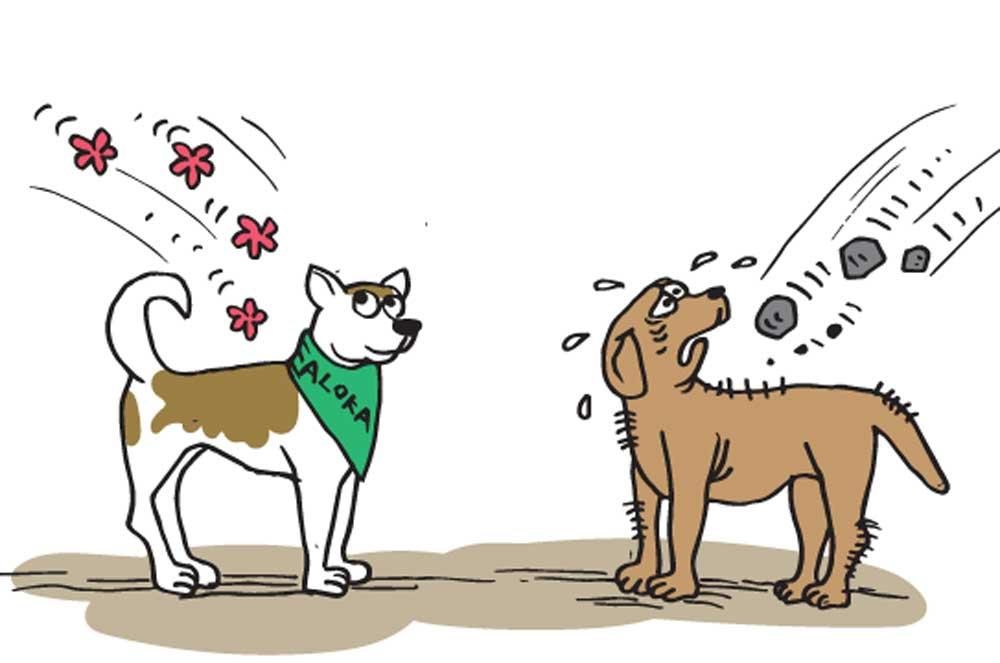
In late April 2026, Sri Lanka welcomed Aloka, an Indian stray dog who walked along with US-based Buddhists monks in the corporate-sponsored and state-endorsed ‘Walk for Peace’, escorted by army commandos and veterinary ambulances (Faiz 2026). The same state that celebrated Aloka preserves an archaic legal framework that leaves the country’s own 2.5 million stray dog population entirely defenceless.
The tragic irony of this situation was exposed that same month by the disturbing incident of animal cruelty reported from Kalawewa where 10 stray dogs were poisoned (Samarawickrama 2026). This was not an isolated incident, but rather a startling reminder of a longstanding and widespread issue in Sri Lanka. In March 2022, a mass poisoning incident was reported at Animal SOS Sri Lanka Sanctuary in Ahangama, where 30 dogs died and about 60 more were in critical condition. According to social media posts from the Sanctuary, they are still waiting for justice and are struggling to get toxicology reports from the police (Animal SOS Sri Lanka 2026). In 2019, a dog was burnt alive in Negombo while in an outdoor kennel (Perera 2019).
This cruelty is not limited to domestic animals. In 2018, an investigation was launched by the police to find perpetrators who had beaten a leopard to death (Reuters 2018). In 2016, a public outcry about social media posts of a sea eagle being “skinned alive and its legs cut off” led to the arrest of two suspects (Ada Derana 2016). All of this is in addition to the disturbing amount of violence against elephants in the wild and in captivity reported each year that is often dismissed as mere collateral damage in the human-elephant conflict. According to the Wildlife Conservation Department, in 2024 and 2025, 388 and 314 elephants respectively have died due to causes like gunshot injuries, electrocution, ‘hakka patas’ (jaw bombs or jaw breakers) and train collisions (Fernandopulle 2025).
Although many state-actors are more often than not preoccupied with boasting about the country’s avihinsavadi (non-violent) culture, the ground reality contradicts this rhetoric. It is true that Sri Lanka has a rich history of animal protection. For instance, kulu wewa (“forest tanks”) were specifically built in upper catchment areas of jungles as a water source for wild animals (Weeramantry 1997: 99). However, this heritage has deteriorated to the point where Sri Lanka is completely excluded from the World Animal Protection Index. Despite the increasingly alarming number of animal cruelty incidents that are being reported in Sri Lanka, the legal and socio-political response remains abysmal due to ineffective and outdated colonial legislation, and cultural hypocrisy.
However, two decades of legislative deadlock may finally be at an end. As of late June 2026, the Cabinet of Ministers approved the gazetting of the newly drafted Animal Welfare Bill (The Morning 2026). As this new legal framework for animal welfare advances, it is important to understand why the existing laws need reform; and to ask whether the new Bill will in fact provide long-awaited protection for animals.
Prevention of Cruelty to Animals Ordinance No. 13 of 1907
The primary legislation governing animal welfare particularly pertaining to domestic animals in Sri Lanka is the Prevention of Cruelty to Animals Ordinance No. 13 of 1907. The Ordinance clearly sets the limits of its application by defining “animal” to mean “any domestic or captured animal and includes any bird, fish or reptile in captivity”. The Ordinance specifically criminalises active physical animal abuse like cruelly beating, abusing and torturing animals. Additionally, there is also an attempt to move beyond active physical abuse by criminalising acts of negligence and exploitation like leaving animals to starve, mutilation, killing animals in unnecessarily cruel ways, or even abandoning sick or disabled animals to die on the street. So at a glance, this colonial relic last amended in 1955 appears to be a comprehensive legal framework that is perfectly capable of addressing animal cruelty.
However, when examining the statute more closely one thing becomes clear. Its comprehensiveness is a mere illusion that hides a toothless mechanism of accountability. First, since the scope of application is limited to domestic or captive animals it only covers a limited number of animals. Urban wildlife including stray animals and livestock are not covered by the 1907 legislation.
Secondly, the Ordinance fails to address modern dimensions of animal abuse and exploitation like animals used for cosmetic and medical research, or the living conditions of zoo animals who are often used for performances. Moreover, it fails to address how animals are used for rides and in processions.
This statutory framework completely ignores the systemic cruelty found within modern agricultural and entertainment industries like hens kept in cramped battery cages so that they keep laying eggs only to be slaughtered after; oxen brutally beaten by cart drivers; and animals suffocating to death in tightly packed lorries (Tharika 2019: 81-82). The law is also blind to the commercial exploitation of wildlife for tourism, like captive sea turtle hatcheries and commercial elephant rides (83). It is within these unregulated, commercialised spaces that cruel puppy breeding mills, where pedigree dogs are forced to produce “litter after litter”, thrive and underfed ponies are forced to “walk with heavy weight adults with no mercy” (Thilakarathne 2023: 179).
Thirdly, there is an absurd statute of limitation where a report must be filed within three months of the commission of the offence. Fourthly, even if a person is convicted under this Ordinance the maximum fine they would be liable for is merely one hundred rupees (last revised in 1955) or a prison sentence that may extend to three to six months. The fines and prison sentences provided are grossly inadequate to the point where it can be argued that it encourages a culture of impunity where people can easily get away with gross acts of animal abuse.
Fauna and Flora Protection Ordinance No. 2 of 1937
The Fauna and Flora Protection Ordinance (FFPO) No. 2 of 1937 is also legislation that provides protection to animals; and unlike the 1907 Ordinance, it allows substantial fines and prison sentences for offences. However, the scope of this Ordinance is very narrow as it only covers animals like wild elephants and leopards. Furthermore, this Ordinance should not be mistaken for animal welfare legislation. Its Preamble explicitly states that it is “an ordinance to provide for the protection, conservation and preservation of the fauna and flora of Sri Lanka; for the prevention of the commercial exploitation of such fauna and flora; and to provide for matters connected therewith or incidental thereto”. Therefore the primary aim of this Ordinance is conservation rather than a concern for the welfare of animals or affirming their sentience.
The FFPO provides protection to animals under two very specific criteria: geographical location and taxonomy. The Ordinance explicitly prohibits harming any wild animal that is within any national sanctuary or national park. Further it also lists a selected number of animals as “protected animals”: whereby, harming those animals anywhere in the island is illegal. So under the FFPO whether an act of violence against a wild animal is considered cruelty solely depends on where the animal is located, and to what species it belongs.
Furthermore, this narrow approach to conservation in fact contradicts our obligations under international environmental law. Sri Lanka is a signatory to major global treaties like the Convention on Biological Diversity and the Convention on the Conservation of Migratory Species of Wild Animals; and as Selvaras (2025) points out, the state is obligated to protect habitats and actively promote sustainable coexistence of humans and wildlife. But this is frequently ignored by the state as many mega-development projects are pushed through without doing proper environmental impact assessments (35). This ultimately forces wild animals into agricultural areas therefore artificially manufacturing the very human-wildlife conflict the farmers are left to fight. This lack of strong legal enforcement leaves wild animals in a defenseless position that severely compromises their welfare.
On 5 December 2024, K.D. Lalkantha, Minister for Agriculture, Livestock, Irrigation and Lands faced backlash from environmental activists after making a public statement that farmers are allowed to take “any possible action” against wild animals destroying their crops, implying a lack of legal repercussions for killing wildlife (Parliament of Sri Lanka 2024).[1] As Gamage (2025) points out, in this statement the minister not only frames the wildlife issues as a form of “terrorism” but also directly contradicts with the government’s own environmental protection commitments outlined in both the National People’s Power (NPP) manifesto and their environmental and sustainable development policy manifesto Mihikatha (“Earth”), where there is a heavy emphasis on “[a]n ecological environment that supports human health and biodiversity…” (42).
The prevailing attitude of policymakers and the flaws of the FFPO underscore the desperate need for a comprehensive Animal Welfare Bill.
Penal Code of Sri Lanka
The broader Sri Lankan criminal law framework also provides a somewhat ineffective legal framework to penalise animal cruelty under sections 411 and 412 of the Penal Code (PC).
These two sections of the PC cover crimes of committing mischief by killing, injuring or maiming animals. While these sections do provide substantial punishments for animal cruelty compared to the 1907 Ordinance; from a jurisprudential angle, the categorisation of animal cruelty under mischief is fundamentally flawed. The PC defines mischief as a property crime which primarily concerns penalising actions that cause willful damage to another person’s assets. By categorising animal cruelty under mischief, the PC has completely stripped the animal of its sentience.
According to the PC, it is a crime to kill, injure or maim animals because it causes willful damage to another person’s valuable asset, not because it is a sentient living being capable of feeling pain and terror. Further, according to these sections the severity of the crime is entirely dependent upon the economic utility of the animals in concern. For instance, injuring an elephant would guarantee a severe prison sentence, compared to injuring a dog. Further, these sections also fail to provide protection for stray animals. The specific mens rea required for the offense of mischief is the malicious intent to cause a wrongful loss to the owner. As stray animals are without owner/s, they are defenceless. So the PC does not really provide any animal-centric provisions to protect them against cruelty. It simply provides a mechanism to penalise damage to private property, as the focus is entirely on the “proprietor” and their “assets”.
Animal Welfare Bill
The present law governing animal protection and welfare in Sri Lanka is clearly ineffective in protecting domestic, wild or stray animal populations. There have been several attempts to amend the laws and introduce new animal welfare legislation over the years. Until recently, there were two main versions of the Bill: the 2006 draft and 2022 Bill. On 20 July 2026, a new version was gazetted. Many animal rights activists argue that the 2022 Bill is a diluted version of the 2006 draft originally proposed by the Law Commission. Unfortunately, the 2026 Bill has retained many of these dilutions.
The most notable aspect of the proposed Bill is the broader definition given to an “animal” to encompass “any living being other than a human being and includes domestic animal, farm animal, animal in captivity, wild animal, companion animal, aquatic animal, stray animal and food animal”.
This addresses one of the main shortcomings of the 1907 Ordinance and the FFPO, by creating a more universal definition of animals. In fact, the definition adopted by Sri Lanka is broad even compared to other jurisdictions. The UK’s Animal Welfare Act 2006 defines animals as any “vertebrate other than man” with the power given to national authority to extend the definition “to include invertebrates of any description”. This expansion of definition can be attributed to what Munasinghe (2025: 11) describes as “a post-anthropocentric paradigm shift”. It challenges the outdated, Enlightenment era anthropocentrism found in the 1907 Ordinance, where an arbitrary distinction is made on human/animal duality in order to justify the perspective that animals are merely property of humans. Hence, by adopting a broader definition that covers a diverse group of non-human life, the Bill signals a renewed recognition of the sentience of animals.
Additionally, the new Bill explicitly recognises both physical and mental suffering of animals as opposed to the 1907 Ordinance that focuses only on physical cruelty. This aligns with the internationally accepted standard for animal welfare by the World Organisation for Animal Health (WOAH) which has defined animal welfare as “the physical and mental state of an animal in relation to the conditions in which it lives and dies”.
Furthermore, it also replaces the lenient penalties found in the 1907 Ordinance with more substantial penal sanctions. For instance, according to the 2022 Bill, acts of cruelty against pregnant animals carry a severe fine up to Rs.125,000 with prison sentences that extend up to four years. While this itself was a vast improvement from the Ordinance, in the newly gazetted 2026 Bill, the maximum fine has been raised up to Rs.500,000 for the same offence.
The 2006 draft and “Duty of Care”
The 2006 draft explicitly proposed to include the concept of ‘duty of care’ towards animals in the statute. The inclusion of the duty of care in animal protection legislation is a revolutionary move as it fundamentally changes how jurisdictions approach animal welfare. Traditional animal protection laws are reactive and address intentional cruelty towards animals. However, the duty of care imposes a positive legal obligation on owners to actively ensure that the welfare needs of the animal under their care are met. So even without actively harming animals, the simple act of not providing the standard of care is sufficient to prosecute them. This is a preventative approach towards animal welfare that can provide proactive protection to animals before any significant harm is done. Other jurisdictions like the UK and Australia have codified a specific duty of care in their animal welfare legislation.
The 2022 version of the Animal Welfare Bill has surprisingly left out this concept. The Convenor of Animal Welfare Coalition and Attorney-at-Law, Vositha Wijenayake emphasises that the duty of care concept was an integral part of the 2006 draft of the Bill, warning that “it is also necessary that we ensure that we do not leave gaps that would hinder the effective and efficient implementation of the law” (Gajadeera 2016). Therefore, abandoning the duty of care concept essentially preserves the outdated reactive approach to animal welfare taken by the 1907 Ordinance. However, the newly gazetted 2026 Bill has reintroduced this concept, recognising it as a core object of the Act.
2006 draft vs 2022 and 2026 Bills
Additionally, there are several other regressive changes that can be identified. Most notably the complete replacement of the proposed centralised National Animal Welfare Authority with an Animal Welfare advisory committee. According to the 2006 draft, the authority had a wide range of powers including acquiring property to establish animal shelters and independently instituting criminal prosecutions; whereas the advisory committee proposed in both 2022 and 2026 Bills is merely limited to advising the minister. Further the 2006 draft proposed appointing specialised, mobile animal welfare inspectors to execute investigations. The 2022 and 2026 Bills explicitly restrict this by defining animal welfare officers as “any government veterinary surgeon”.
Further, some of the substantive protections provided by the 2006 draft were first diluted in the 2022 Bill and remain compromised in the 2026 Bill as well. For instance, the 2006 draft provided strict restrictions in slaughtering food animals, specifically total prohibitions on slaughter of buffaloes as well as a complete ban on slaughtering quadrupeds in public places or private residential spaces.
The 2022 and 2026 Bills remove these specific protections by referring back to archaic legislation like the Butchers Ordinance and the Animals Act. This proposed blanket ban specifically on cattle slaughter, while it may have been rooted in compassion, clearly carries undertones of Sinhala-Buddhist majoritarian sentiments. Many critics have pointed out how these blanket bans are “a leftover of the communal politics of the last century” (Harees 2020), and that it disproportionately impacts minority communities, particularly Muslims who are heavily involved in the meat industry. This communal friction erupts online from time to time; for instance, following Ramadan in 2026 there was a noticeable hike in social media content spotlighting incidents of cruel cow slaughter, a rather thinly veiled attempt to fuel anti-Muslim sentiments by weaponising isolated incidents of animal cruelty.
However, as Islamic scholars point out, these instances of animal cruelty do not actually stem from religious doctrine but rather from a failure to enforce proper ethical standards through comprehensive welfare legislation. In fact, when comparing the 2006 draft of the animal welfare Bill with Islamic law, it can be deduced that Shariah explicitly codifies strict animal welfare mandates like making sure animals are rested post-transport, ensuring immediate and painless death and even keeping knives and slaughtering of other animals hidden from their sight (Long, Razick and Saujan 2023)
A ban also runs the risk of driving the meat-slaughter market underground, into an unregulated sphere. However, the 2022 and 2026 Bills reverting back to the legacy ordinances was not the most appropriate remedy. Instead, the drafters should codify modern internationally accepted humane slaughter regulations. Over the years, many animal rights activists in the country have advocated the implementation of such guidelines to minimise the pre-slaughter suffering of animals as a compassionate alternative to the Butchers Ordinance. Ultimately, the lawmakers should be focused on how an animal lives, and how (rather than whether) it dies.
Furthermore, there are some gaps and omissions in the 2006 draft that were not addressed by the 2022 Bill (Tharika 2019) and the 2026 Bill fails to address these as well. Firstly, the Bill fails to address the issues related to rehabilitation of animals orphaned or distressed by natural disasters like floods and landslides. Secondly, it does not provide any specific provisions mandating medical intervention for animals injured in road accidents. Thirdly and more importantly, it does not provide any regulatory frameworks to the highly contentious and culturally sensitive practice of using elephants in Buddhist temple ceremonies like peraheras (“ceremonial processions”).
The stark contrast between the supposed reverence for and the cruelty endured by captive elephants in temples is recounted by Seethawaka (2024) from her field research in the 2023 Kandy Esala Perahera. She observed how visibly agitated elephants were bound tightly in the temple premises with chains and ropes. Further, she also notes how these elephants are forced to wear “heavy padded clothes with electric bulbs” and walk “barefoot on tar roads in the scorching heat” (89).
In fact, it can be argued that the Bill actually creates a loophole for this practice. Section 18(a) of the 2022 Bill and section 19 (a) of the 2026 Bill explicitly states that “restricting movements of elephants in public places, done by a Veterinary Surgeon or a person qualified to do such practices” is not an offence. There are two issues with this provision. Firstly, the ambiguity related to who is a “qualified” person can be broadly interpreted to include traditional mahouts who are responsible for “controlling” elephants in public processions. Secondly, these elephants do not voluntarily appear in public places; they are essentially chained and forced to participate in parades (Seethawaka 86). Therefore, this provision effectively legalises the tethering of captive elephants for use in peraheras (“ceremonial processions”).
Prospects for meaningful reform
The initial drafting process of a new Animal Welfare Bill started way back in 2000 when Attorney-at-law Senaka Weeraratna was invited by the Law Commission of Sri Lanka to do so. By June 2006, the Law Commission submitted a comprehensive and finalised Animal Welfare Bill to President Mahinda Rajapaksa. Thereafter this draft was presented to Parliament as a Private Member’s Bill by Athuraliye Rathana Thero MP in October 2010. However, with the subsequent dissolution of the parliament, the Bill fell off the Order Book. In 2016, a Bill that incorporated some changes suggested by the public was approved by the Cabinet of Ministers and passed to the Legal Draftsman’s department. In March 2022 the Animal Welfare Bill was received for the first reading in Parliament and advanced to the second reading. Yet again the Bill went through more amendments and parliamentary caucuses.
While the Cabinet’s June 2026 green light and subsequent gazetting of the Bill does give some hope that the long-awaited Bill might finally be passed by the parliament, the 2026 version of the Bill presents a complex reality. While it is a substantial and welcome improvement, that it retains most of the diluted elements of the 2022 Bill, instead of re-introducing the progressive elements of the 2006 draft, is disappointing. For Sri Lanka’s animal welfare laws to truly progress beyond merely updating the penal sanctions, lawmakers should proactively adopt a framework that focuses on the sentience of animals and their capacity to suffer, while also remaining sensitive to the country’s plural social and economic realities.
Kasun Kavishka is an undergraduate in the Faculty of Law at the University of Colombo.
Image source: https://bit.ly/4w3qh2o
References
Ada Derana. (2016). “Two men arrested for torturing eagle remanded”. (10 March): https://www.adaderana.lk/news.php?nid=34510
Animal SOS Sri Lanka. (2026). “No justice for the beautiful souls who were cruelly poisoned by criminals…” [post]. Facebook (9 February). Available at: https://web.facebook.com/animalsossrilanka.org/posts/no-justice-for-the-beautiful-souls-who-were-cruelly-poisoned-by-criminals-that-r/1385605386943887/
Animal Welfare Bill. (2022). Available at: https://documents.gov.lk/view/bill/2022/2/174-2022_E.pdf
Animal Welfare Bill (2026). Available at: https://documents.gov.lk/view/bill/2026/7/48-2026_E.pdf
Animal Welfare Bill Proposed by the Law Commission of Sri Lanka. (2006). Available at: https://lawcom.gov.lk/images/stories/reports/the_animal_welfare_bill_2006.pdf
Faiz, Nuha. (2026). “Does Aloka Know Sri Lanka’s 2.5 Million Dogs Have No Animal Welfare Law?” The Sun (April 30): https://www.thesun.lk/top_story/Does-Aloka-Know-Sri-Lankas-2-5-Million-Dogs-Have-No-Animal-Welfare-Law/554-305187
Fernandopulle, Sheain. (2025). “Over 400 dead as human-elephant conflict turns deadlier”. Daily Mirror (7 October): https://www.dailymirror.lk/breaking-news/Over-400-dead-as-humanelephant-conflict-turns-deadlier/108-321553
Gajadeera, Thimal. (2016). “Duty Of Care A Much Needed Inclusion In The Animal Welfare Bill Of Sri Lanka”. Colombo Telegraph (16 July): https://www.colombotelegraph.com/index.php/duty-of-care-a-much-needed-inclusion-in-the-animal-welfare-bill-of-sri-lanka/
Gamage, Sakuna M. (2025). “Human-Wildlife Conflict in Sri Lanka: Media Narratives, Political Contradictions and the Need for Sustainable Co-existence”. LST Review, 33 (351): 40-53. https://civitaas.org/content_images/Vol-33-Issue-N-351-March%202025-English.pdf
Government of Sri Lanka. (1883). Penal Code of Sri Lanka No. 02 of 1883. Available at https://www.srilankalaw.lk/p/878-penal-code-ordinance.html
Government of Sri Lanka. (1907). Prevention of Cruelty to Animals Ordinance No 13 of 1907. Available at https://lankalaw.net/wp-content/uploads/2025/02/1956Y12V475C.html?srsltid=AfmBOoonmvBQeKS7dM_CZRHSsr-Kaz0qh076iS3pQZcGdudgAO7B3__j
Government of Sri Lanka. (1937). Fauna and Flora Protection Ordinance No 2 of 1937. Available at https://lk.chm-cbd.net/documents/fauna-and-flora-protection-ordinance-no-2-1937
Harees, Lukman. (2020). “What’s At ‘Steak’ In Sri Lanka? The Hypocrisy Of ‘Beef Politics’!” Colombo Telegraph (12 September): https://www.colombotelegraph.com/index.php/whats-at-steak-in-sri-lanka-the-hypocrisy-of-beef-politics/
Long, Ahmad Sunawari, Ahamed Sarjoon Razick, and Iqbal Saujan. (2023). “Islamic Law on Animal Rights and Welfare in the Sri Lankan Context: An Islamic Analysis on the Animal Welfare Bill of 2006”. Samarah: Jurnal Hukum Keluarga dan Hukum Islam, 7 (2): 1194- 1218. https://doi.org/10.22373/sjhk.v7i2.16020
The Morning. (2026). “Animal Welfare Bill to be gazetted.” (24 June): https://www.themorning.lk/articles/oOItZffSpy9fDG1d4qmI
Munasinghe, Vidura. (2025). “The Paradox of Seeking Refuge in Outdated Anthropocentrism while Imagining a Futuristic World”. LST Review, 33 (351): 6-14. https://civitaas.org/content_images/Vol-33-Issue-N-351-March%202025-English.pdf
Parliament of Sri Lanka. (2024). “Parliament Live – 05.12.2024”. YouTube (5 December). Available at: https://www.youtube.com/watch?v=lWVvb-LU9TE&list=WL
Perera, Richard Walter. (2019). “In Charlie’s name’ – activists demand urgent vote on animal bill”. The Sunday Times (6 January): https://www.sundaytimes.lk/190106/news/in-charlies-name-activists-demand-urgent-vote-on-animal-bill-328643.html
Reuters. (2018). “Sri Lankan court remands villagers in custody over beating to death of leopard”. (24 June): https://www.reuters.com/article/world/asia-pacific/sri-lankan-court-remands-villagers-in-custody-over-beating-to-death-of-leopard-idUSKBN1JK0P6/
Samarawickrama, Chathuranga. (2026). “Probe launched after poisoning of 10 dogs in Kalawewa”. Daily Mirror (21 April): https://www.dailymirror.lk/print/breaking-news/Probe-launched-after-poisoning-of-10-dogs-in-Kalawewa/108-338282
Seethawaka, Dulki. (2024). “Punished on Religious Grounds: A Critical Analysis on the Legal Protection Granted for Temple Elephants in Sri Lanka”. In Federico Dalpane, Maria Baideldinova (eds.). Animal Law Worldwide: Key Issues and Main Trends Across 27 Jurisdictions (377-397). Berlin: Springer Nature.
Selvaras, Janaha. (2025). “Placing Sri Lanka’s Wildlife Obligations in the Context of International Law: International Legal Dimensions Arising from the ‘Human-Wildlife Conflict’.” LST Review, 33 (351): 27-39. https://civitaas.org/content_images/Vol-33-Issue-N-351-March%202025-English.pdf
Tharika, S.G.D. Dulki. (2019). “Analysing the Necessity of Reforming Animal Welfare Laws in Sri Lanka”. GARI International Journal of Multidisciplinary Research, 5 (3): 78-90. https://www.research.lk/journal/view-pdf/analysing-the-necessity-of-reforming-animal-welfare-laws-in-sri-lanka
Thilakarathne, W.G.T.Y. (2023). “A Long Waiting Hope of Integrating Animal Interests into our Legal System: A Critical Analysis on Animal Welfare Laws of Sri Lanka with Special Reference to Domestic Animals”. Proceedings of SLIIT International Conference on Advancements in Sciences and Humanities, (1-2 December): 176-182. https://doi.org/10.54389/RSUO1704
Weeramantry, C.G. (1997). “Gabčíkovo-Nagymaros Project (Hungary/Slovakia) (Separate Opinion)”. International Court of Justice (88-119). Available at: https://www.icj-cij.org/sites/default/files/case-related/92/092-19970925-JUD-01-03-EN.pdf
Wickramasinghe, Kamanthi. (2018). “Animal welfare groups fight to bring about humane animal slaughter: Saving a life before the butcher”. Daily Mirror (18 July): https://www.dailymirror.lk/News-Features/Animal-welfare-groups-fight-to-bring-about-humane-animal-slaughter-Saving-a-life-before-the-butcher/131-152840
World Organisation for Animal Health. (1968). “Terrestrial Animal Health Code”. Available at https://www.woah.org/en/what-we-do/standards/codes-and-manuals/
Note
[1] “…තමන්ගේ වගාවට හානි කරන මේ සත්තු තමන්ගේ වගා භූමියේදී අර වගාවට වෙන වෙනත් හානි සම්බන්ධයෙන් කටයුතු කරනවා වගේම වගාවට වන් හානි සම්බඳයේදි තමන්ගේ ඉඩම තුලදී ගොවි පල තුලදී ඕනෑම ක්රියාමාර්ගයන් ගැනීමට ගොවි ජනතාවට කිසිම නීතිමය බාධාවක් නැහැ. ගන්න පුළුවන් ඕනෑම ක්රියාමාර්ගයන් ගන්න කියලා අපි ඒක පැත්තකින් කියනවා…”
You May Also Like…

India’s Youth Protest and the Limits of Demand-Driven Mobilisation
Manoranjan Pegu
The recent protests ‘led’ by the Cockroach Janta Party (CJP) in India, have been seen as the latest addition to South...

This Government, That Opposition, and the Work Still Ours
Lionel Bopage
For sixty-six years, until his death in 2014, the legendary comrade Bala Tampoe led the Ceylon Mercantile Union...

Our support for the open letter: To Iran’s political prisoners, trapped ‘between two blades of a scissors’
Collective
As migrants and refugees in diaspora and in exile from Iran, who have our loved ones suffering in the Iranian state’s...