
A Bridge Between East and West
Richard F. Gombrich
My love and admiration of Gananath are so rooted in my view of my own life that if I failed to respond to this invitation to write something about him, I would find my failure unforgivable, regardless of the infirmities of age and memory. Whatever other people may think of the work I shall be leaving behind me, the publications which give me most pride and satisfaction I owe largely, not only to what I have learnt from him, but also to his practical help and to his years of encouragement and friendship.
My first meeting with Gananath came at an ideal moment. After my BA at Oxford, I was luckily awarded two years of graduate study at Harvard, after which I returned to live with my parents in Hampstead. I had only a superficial knowledge of Buddhism, but just enough to be puzzled by how it looked when practised by a society. My luck continued: I was given a British government scholarship to spend a year among Buddhists in Sri Lanka.
At this moment my parents met a new neighbour, Dr. E. F. C. Ludowyk, a professor of English who had just retired from teaching at the University of Ceylon. Ludowyk told them that an exceptionally intelligent Sinhalese student had recently completed a doctorate in anthropology at the University of Washington in Seattle and was breaking his journey home by visiting Cambridge University. This was probably because the Cambridge anthropologist Edmund Leach had recently published research into Sri Lankan customs. Gananath’s thesis was to become his somewhat atypical first book, Land Tenure in Village Ceylon (1967).
Prof. Ludowyk arranged for me to meet Gananath in Cambridge over lunch. This encounter was unforgettable. Having studied Indology from many angles, I “knew” that a respectable adult male was likely to be a vegetarian and a teetotaller. I think I managed to conceal my surprise when my host ordered a beefsteak and a glass of red wine. This was made all the easier by his relaxed friendliness and his willingness to give me a whole stream of interesting and useful information. Maybe it was over beefsteak and wine that he first earned the reputation from fellow anthropologists of being “a bridge between East and West”; later he was described in the New York Times as follows: “His wide-ranging work drew on field research in… Sri Lanka as well as his extensive study of English literature and Christian mysticism” (Risen 2025).
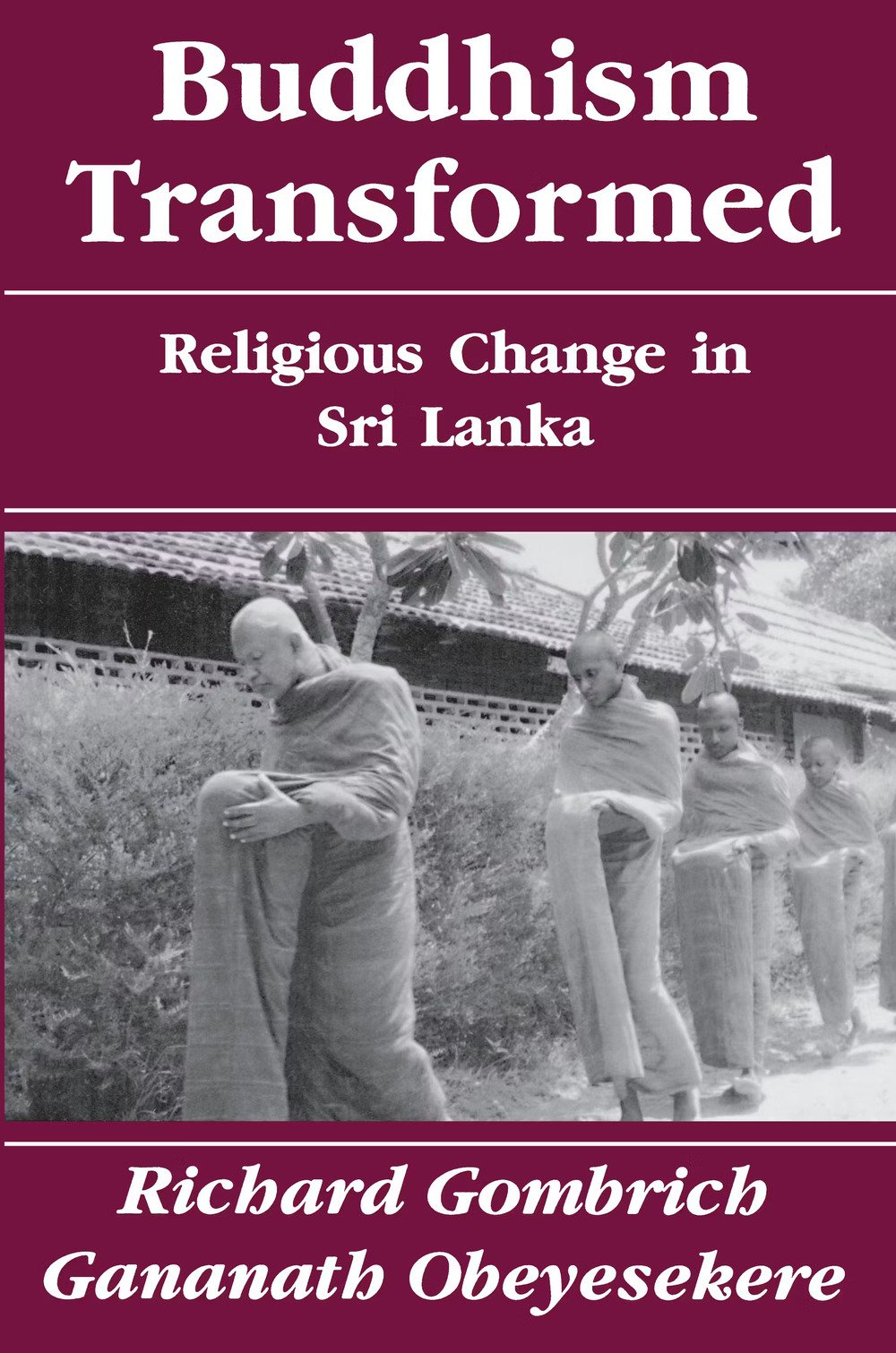
At that lunch I became Gananath’s first foreign student/disciple, and he became my completely trustworthy guide whenever I had the good sense to consult him. As for his writing, I have invariably found that it appeals equally to the intellect, and to the connoisseur of culture. Over the years he never let me down in any matter great or small, whether coming to Oxford to attend my daughter’s wedding, or spending several weeks in Kandy to join me in composing line by line the final chapter of Buddhism Transformed, which, even though it is not mentioned by Google in their list of his books, I still consider our most original (and liveliest?) product.
Richard F. Gombrich was Boden Professor of Sanskrit at the University of Oxford from 1976 to 2004 and is the founder-president of the Oxford Centre for Buddhist Studies; author among other works of Precept and Practice: Traditional Buddhism in the Rural Highlands of Ceylon (1971, Oxford: Clarendon Press).
Image source: Princeton University Press
References
Gombrich, Richard F. and Gananath Obeyesekere. (1988). Buddhism Transformed: Religious Change in Sri Lanka. Princeton: Princeton University Press.
Obeyesekere, Gananath. (1967). Land Tenure in Village Ceylon. Cambridge: Cambridge University Press.
Risen, Clay. (2025). “Gananath Obeyesekere, 95, Dies; Anthropologist Bridged East and West”. New York Times (30 March): https://www.nytimes.com/2025/03/30/world/asia/gananath-obeyesekere-dead.html
You May Also Like…
‘A literary man interested in anthropology’
Ranjini Obeyesekere interviewed by Crystal Baines
Dr. Ranjini (Ellepola) Obeyesekere is one of Sri Lanka’s leading translators, and among its first female theatre...
Conversion and Tradition: The Religious Public in Millennial Sri Lanka
Geethika Dharmasinghe
A proletarian ethic parallel to the bourgeois ethics of Protestant Buddhism has not developed in the city’s working...
A Tale of Two Islands
Anne M. Blackburn
As long as I have studied Buddhism and Southern Asia, Gananath Obeyesekere has been a guide and interlocutor, always...