
Aloysius Pieris, S.J.: Visionary Activist
Elizabeth J. Harris
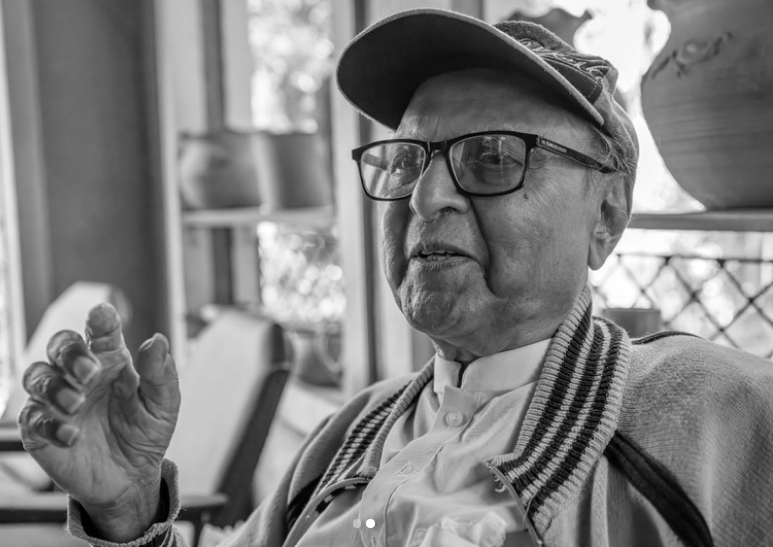
Aloysius Pieris, S.J. died at 6 a.m. on 22 March 2026, at Tulana, the centre in Dalugama/Kelaniya that he founded in 1974 to facilitate research, interreligious encounter, and liberative action. In an appreciation that I wrote for the European Network for Buddhist-Christian Dialogue soon after his death, I noted, “He would have been 92 on the 9th of April. During his life, face-to-face and through his writings, he touched the lives of thousands, as mentor, pastor, teacher, friend, academic adviser, indologist, liberation theologian and humanitarian”.[1] I was one of those whose lives he touched. I first met him in 1984 and was his research assistant for several years. He became a friend and mentor.
In this short appreciation, I will focus on his scholarly writing, with particular emphasis on his revisioning of how people of different religions should relate to one another, in the postcolonial, multi-religious, and conflict-ridden context of Sri Lanka. From the outset, however, I must stress that Pieris never separated his scholarship from praxis. Theory held meaning for him only if liberative action flowed from it.
Key to Pieris’s ability to ‘revision’ was his ability to think and work within both the languages of the West and those of the East, and within two religions, Christianity and Buddhism. In a major interview with Georg Evers in 2000, he stated, “I was destined to travel along the invisible margin between East and West” (Pieris 2001: 15). When he joined the Society of Jesus in 1953, at the age of 19, he already knew Latin and Pali (Pieris 2001: 14). He would add Greek, Sanskrit, and several contemporary European languages to these. He studied in Naples but also at the University of Sri Lanka, becoming the first Roman Catholic priest to do a doctorate in Buddhism at a Sri Lankan university.[2] This movement between two religious worlds led him, in his own words, “to be the buffer between the two poles of incomprehension [Buddhist suspicion and Christian attacks] and to take punches from both sides” (Pieris 2001:18). It also made him keenly aware of the mistrust of Christians that the British colonial period had nurtured within Sri Lankan Buddhists and Hindus, mainly because of the contempt for Buddhism and Śaivism shown by evangelical Protestant Christian missionaries.[3]
Factors such as the Second Vatican Council (1962-1965), the youth insurrection in Sri Lanka in 1971, and the practice of Buddhist meditation under a Buddhist monk in the late 1960s also profoundly influenced Pieris, making clear to him that his involvement as a Jesuit should be twofold: “the path of interior liberation from greed, provided by Buddhist meditation and the path of social liberation from poverty promised by Marxist revolutionaries” (Pieris 2001: 19). These two paths conditioned the choices he made throughout his life.
His scholarly thought was published in several hundred articles, three edited collections of articles, and at least eight books. The content of this considerable output falls into the following broad areas: the Buddhist scholasticism present in the Abhidhamma; an Asian theology of liberation; the theology of religions, the reinterpretation of key religious terms such as mysticism and evangelism; the combining of praxis and interiority. These fall within the three main areas of research that informed Tulana from the start: classical indology; anthropology and contextual studies; Christian theology. In Pieris’s life, all were rooted in formal and informal interreligious encounter and experience. His research into Abhidhamma for instance, was nurtured by dialogue with Buddhist scholars (Pieris 2004: xiii-xix). Those who have written doctorates on Pieris’s work might take issue with the omissions in this list,[4] but then no list could do complete justice to his work.
To start with Indology, Pieris could write with empathy and academic understanding about the Theravada Buddhism of Sri Lanka at several levels, from everyday religious practice to high philosophy.[5] However, he considered his main contribution to have been within the study of Abhidhamma, particularly his work on the commentaries of Ācariya Dhammapāla, who worked a century after Buddhaghosa. His doctorate (1982) was entitled, Some Salient Aspects of Consciousness and Reality in Pāli Scholasticism as Reflected in the Commentaries of Ācariya Dhammapāla. In 2004, he published Studies in the Philosophy and Literature of Pāli Ābhidhammika Buddhism (Pieris 2004), which drew together some of the articles he had written on the topic, and one of his last publications was, A monograph on the Cardiac Theory of Consciousness and Body-Mind Relationship in Post-Canonical Pāli Scholasticism (Pieris 2024). The heart of these publications was rigorous, comparative exegesis of the terms used in canonical literature and post-canonical commentaries for the senses, the mind and consciousness, with particular emphasis in Dhammapāla. This body of work remains an original and significant contribution to Buddhist Studies, which is known internationally.
Moving to Pieris’s Asian theology of liberation, I once asked him what kept him within Christianity, given his knowledge of and empathy for Buddhism. His answer was, “a God who sides with the poor; no other religion has this”. In his writings, he continuously stressed that God, as represented in the Bible, had made a defence pact with the poor, namely with those who were the victims of the greed of others. This was an ‘irrevocable’ pact, which passed judgement on the modes of domination present within the churches of Sri Lanka. This foundational position drove his theology and his practice. The first collection of his articles, published in the West, was entitled, An Asian Theology of Liberation (Pieris 1988a). The articles show a younger Pieris arguing that the main difference between South American liberation theology and the Asian context was religious plurality. So, an Asian liberation theology, of necessity, had to engage with the different religious traditions of Asia. One of his first calls was for Christians in Asia to be baptised rather than to baptise. He cited Jesus’s decision to be baptised by his predecessor, John, in the river Jordan, an action that linked him both with John’s prophetic asceticism and with “the ‘religious poor’ of the countryside”, who flocked to John (Pieris 1988a: 46). Likewise, Christians in Asia, Pieris argued, had to divest themselves of power and immerse themselves in religions such as Buddhism and Hinduism.
Springing from this came the argument that still tends to define his thought in the writings of others: that Christianity and Buddhism complement one another and can teach one another to reclaim what has been lost within their respective traditions. Never did Pieris reduce the individual identities of the different religions in Asia. Each religion had its own ‘unrepeatable’ character, conditioned by its core experience. Christianity’s core experience was agape, self-giving love, as shown in the crucifixion of Jesus, and Buddhism’s was gnosis, wisdom, shown in the enlightenment of the historical Buddha. Both, he argued were necessary:
What must be borne in mind is that both gnosis and agape are necessary precisely because each in itself is inadequate as a medium, not only for experiencing but also for expressing our intimate moments with the Ultimate Source of Liberation. They are, in other words, complementary idioms that need each other to mediate the self-transcending experience called “salvation”. (Pieris 1988b: 111)
This basic argument developed into a praxis through which Pieris asked Buddhist artists, who were committed to the empowerment of the poor, to help Christians interpret Christianity. By the time of Pieris’s death, Tulana was filled with works of art that were, in essence, trans-religious. One of the first was a mural by Buddhist monk, Hatigammana Uttarananda, of Jesus, the master, washing the feet of his followers. He had been asked by Pieris to read parts of the New Testament and to choose something that stood out for him as unique to Christianity, something that could teach Christians more about their religion. Pieris described Uttarananda’s achievement in the following way:
Thus something that has also appeared unique about Christ has been discovered for us by this monk: that Jesus makes sense in Asia only when he scandalises feudal society by manifesting himself as the one who becomes the slave of the slaves of this earth. (Pieris 1996: 134)
Pieris, therefore, allowed a Buddhist monk to judge, through art, structures of power in the Christian churches. A much later work of art lamented all those killed in the ethnic conflict. Created by Chandragupta Thenuwara and named ‘The Wall—in the presence of absence’, it was formally “opened” in April 2014. The wall is built of 10 x12-inch blocks, each of which carries a “negative” image of an actual person who was lost during the war—”disappeared, killed, dead”—from all Sri Lanka’s religious and ethnic groups. At both ends of the wall is a reflective mirror, which elongates the wall and signifies “the endlessness of this tragedy”.[6] It gives voice to Pieris’s sadness at the loss of innocent life in the war, because of multiple levels of greed and short-sightedness.
Moving to the reinterpretation of terms connected with Christianity, I will mention three. The first is ‘evangelism’. In the early 1990s, Christian churches were talking globally about a decade of evangelism, running up to the year 2000. In Sri Lanka, the issue of ‘unethical conversions’ had surfaced periodically since the post-independence period. In this context, Pieris argued that it was not the churches that needed to evangelise the people of a country such as Sri Lanka; it was the poor who needed to evangelise the church. He wrote: “It is only an apostle of Christ that believes and proclaims the doctrine that God calls the victims of our greed to be God’s trusted and equal partners in ushering in God’s Kingdom” (Pieris 1996: 153). In non-theological terms, in writings such as this, Pieris gives agency to those who are the victims of global capitalism and corporate greed.
Linked to this was a re-writing of what Christian theology calls ‘Christology’. Christian liturgies encourage Christians to think that they are ‘the body of Christ’; they are the ones who should embody the principles that Jesus advocated. Pieris offered something different. The ‘body’ of Christ in the world were the poor, the victims, the slaves, most of whom were not Christian but of other religious traditions. The role of Christians was to align with them, to adopt forms of voluntary poverty, and to work for their empowerment and liberation.
The term, ‘mysticism’ was another that Pieris sought to reinterpret. As previously noted, Pieris practised Buddhist forms of meditation. He probably meditated daily. In an interview he gave in 1995 for a series of programmes on Buddhism that I wrote and presented for the BBC World Service, he said this of the aim of meditation:
The ultimate goal of meditation is greedlessness, taṇha nirodha [the cessation of craving], which is really a definition of nibbāna [….] It’s not just an ego trip to another world. It is simply a hard, committed, continuous uninterrupted effort at eradicating the egocentric building of a world around yourself. (Harris 1998: 68)
Meditation, for Pieris, was not linked to spiritual ‘highs’ or to individual wellbeing but to the eradication of greed, something that could lead to societal transformation. In a manual he published in 2000, entitled Mysticism of Service (Pieris 2000), he criticised spiritual practice that saw prayer as an end in itself, resulting in ‘peak’ experiences. ‘Mysticism’, he argued, should be linked to the service of others and to ‘being in God’s company’, through doing what God was interested in: the empowerment of the poor and the eradication of greed and the love of money. Mystical prayer was important but as a means of uniting the human will with God’s will.
Pieris’s lifetime goal, therefore, was that the poor and the victimised should be empowered, in a direct line with the Marxist influences within his youth. In pursuit of this, people of all religions could be co-collaborators, inspiring and challenging each other towards ever more liberating truth. Abstract religious philosophy, therefore, had no appeal to him. Even his expertise and indeed fascination with Abhidhamma was linked to his conviction that the human mind was key to whether societies were compassionate or greed-filled, life-giving or life-threatening.
Aloysius Pieris, however, will not only be remembered for his scholarship but also for his compassion and humanity. As Robert Crusz pointed out in an appreciation he wrote for the Daily Mirror, Pieris saw his greatest achievement as co-founding a school for the hearing-impaired in Dalugama, where education was given free to the children, most of whom were from poor Buddhist families (Crusz 2026: A9). During the war, Tulana was a refuge for some who were threatened by the powerful. Many of those who came to Tulana will also remember the time Pieris was willing to give them. As Pieris said in his interview with Evers, he learnt at a young age from the Jesuits who gave time to him as a child that ‘Time is Love’ (Pieris 2001: 9). Giving time to those in need and to those who wanted to learn from him was an essential part of his being in this world. He will be greatly missed but will continue to be an inspiration for many.
Elizabeth J. Harris retired as Associate Professor in Religious Studies at Liverpool Hope University and is presently Honorary Fellow in the Edward Cadbury Centre in the Department of Theology and Religion in the University of Birmingham as well as President of the UK Association for Buddhist Studies.
Image source: https://www.instagram.com/p/DRriHqsErff/
References
Crusz, Robert. (2026). “Scholar and Humanitarian: Rev. Fr. Aloysius Pieris S.J. passes away”. Daily Mirror (23 March): A9.
Harris, Elizabeth J. (1998). What Buddhists Believe. Oxford: Oneworld.
Harris, Elizabeth J. (2006). Theravāda Buddhism and the British Encounter: Religious, missionary and colonial experience in nineteenth century Sri Lanka. London and New York: Routledge.
Kang, In-gun. (2012). Buddhist-Christian Dialogue and Action in the Theravada Countries of Modern Asia: A Comparative Analysis of the Radical Orthopraxis of Bhikkhu Buddhadāsa and Aloysius Pieris. Heythrop College, University of London: doctoral dissertation.
Pieris, Aloysius. (1988a). An Asian Theology of Liberation. Maryknoll, NY: Orbis; and Edinburgh: T & T Clark.
Pieris, Aloysius. (1988b). Love Meets Wisdom: A Christian Experience of Buddhism. Maryknoll, NY: Orbis.
Pieris, Aloysius. (1996). Fire and Water: Basic Issues in Asian Buddhism and Christianity. Maryknoll, NY: Orbis.
Pieris, Aloysius. (2000). Mysticism of Service. Gonawala-Kelaniya: Tulana Jubilee Publications.
Pieris, Aloysius. (2001). “Religiousness and poverty – the collective effort of Asian theology. Interview with Aloysius Pieris, S.J., Sri Lanka, conducted by Georg Evers”. Yearbook of Contextual Theologies 2001.
Pieris, Aloysius. (2004). Studies in the Philosophy and Literature of Pāli Ābhidhammika Buddhism. Colombo: The Ecumenical Institute for Study and Dialogue.
Pieris, Aloysius. (2024). A Monograph on the Cardiac Theory of Consciousness and Body-Mind Relationship in Post-Canonical Pāli Scholasticism. Gonawala-Kelaniya: Tulana Jubilee Publications.
Notes
[1] See “Aloysius Pieris S.J. (1934-2026): A Personal Appreciation and Obituary”, available at https://www.buddhist-christian-studies.org/node/147
[2] With Georg Evers, he shared that, if he had “had the freedom to choose a career in the Society of Jesus” he would have chosen “music and mathematics, with an eye on youth work through dance and drama, music and art.” (Pieris 2001: 17). The Society, however, urged him towards Indology.
[3] Pieris encouraged me to choose the encounter between the British and Buddhism in the colonial period in Sri Lanka as my doctoral dissertation because of the importance of this topic to contemporary interreligious relations. I completed the doctorate in 1993 and published a book on the theme in 2006.
[4] One of the best doctorates on Aloysius Pieris is In-gun Kang (2012).
[5] See the articles in Pieris 1988b, for instance “The Spirituality of the Buddhist Monk”, pp. 61-72.
[6] Phrases taken from the information given to participants when ‘The Wall’ was opened and commemorated on 9 April 2014. Those present were invited to light a candle within one of the negative image spaces.
You May Also Like…
India’s Youth Protest and the Limits of Demand-Driven Mobilisation
Manoranjan Pegu
The recent protests ‘led’ by the Cockroach Janta Party (CJP) in India, have been seen as the latest addition to South...
This Government, That Opposition, and the Work Still Ours
Lionel Bopage
For sixty-six years, until his death in 2014, the legendary comrade Bala Tampoe led the Ceylon Mercantile Union...
Our support for the open letter: To Iran’s political prisoners, trapped ‘between two blades of a scissors’
Collective
As migrants and refugees in diaspora and in exile from Iran, who have our loved ones suffering in the Iranian state’s...