
‘Just A Phase’: The forgotten lunar calendar
Sharni Jayawardena
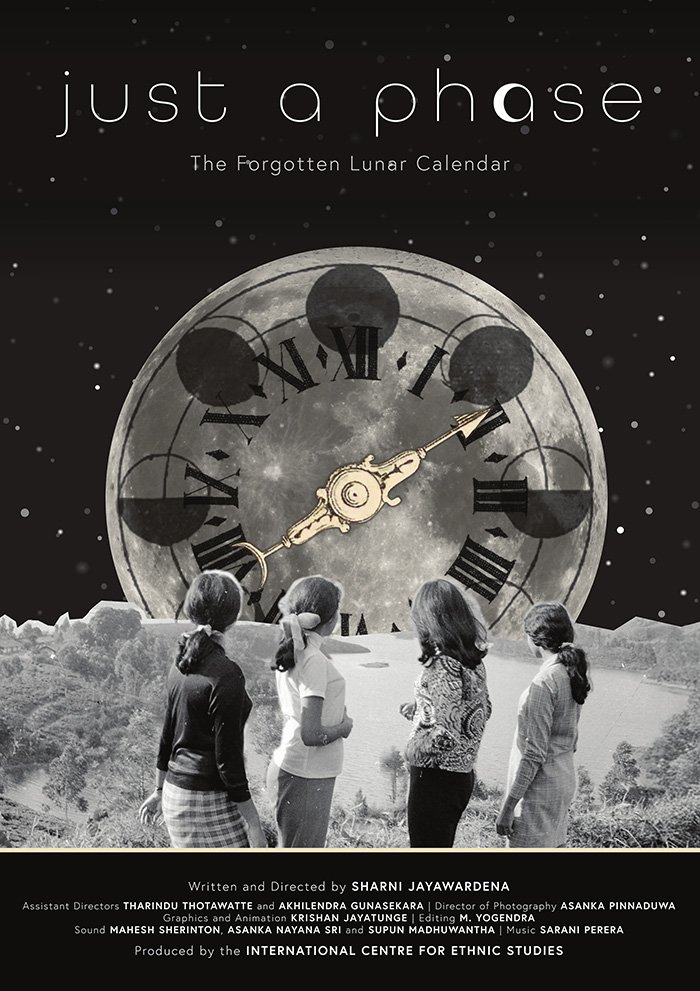
In December 1965, Ceylon made the singular decision to switch calendars—from the Gregorian to the lunar—a perplexing move that may seem more intelligible when viewed against the backdrop of a postcolonial state attempting to reclaim and revive suppressed identities and subdued narratives.[1]
The Holidays Act No. 17 was a bold, if ill-conceived, measure to reconfigure the calendar to resonate with the country’s dominant religious community—an exercise in nation-building driven by political motivations. Anchoring the weekends to the four phases of the moon may have been, in part, a gesture towards asserting a more culturally authentic[2] sense of time; yet, for all its symbolic weight, it set in motion a way of tracking time—or rather, taking time out—which was, for its time and place, both aberrant and insular.
The lunar calendar and the calculus of power
From January 1966 to September 1971, weekends were no longer tethered to Saturdays and Sundays. Instead, each of the moon’s four phases—the Sathara Poya—from Amawaka, the new moon, to Purapasaloswaka, the full moon, became a Poya holiday. The day before was pre-Poya—a half-day holiday. Together, they formed the new weekend. The days between the Poya weekends were named, curiously, P1, P2, P3, and so on, typically resulting in five working days.
But the lunar month spans 29.5 days, complicating things. An extra day occasionally slipped in and lodged itself unceremoniously into the workweek as P6. It was meant to prevent the calendar from drifting out of sync with the solar year but was dreaded by both workers and students, who faced six interminable days of labour or study in an eight-day week.
The new calendar posed some other sobering challenges: weekends were misaligned with global norms, international trade and travel became more complicated, and Christians were unhappy that Sunday, traditionally a day of rest and worship, was now a day of work.[3]
The executor of this unorthodox calendar was the enigmatic Dudley Senanayake, whose role in the five-year experiment is often mistakenly attributed to another prime minister, Sirimavo Bandaranaike, who is more commonly associated with nationalistic reforms. Senanayake, the son of Ceylon’s first prime minister, D. S. Senanayake, was likely propelled by a convergence of pressures, chief among them the influence of the Buddhist lobby. The group’s clout was overwhelmingly evident on the full moon day of August 1964, when large numbers of Buddhist public servants took leave from work to visit temples and observe sil,[4] compromising government services. The message was clear: full moon poya days were not intended for work, and this calculated act of protest would recur until that truth was formally acknowledged.
The year also saw Sirimavo Bandaranaike’s government lose its parliamentary majority. In the run-up to the general election of 1965, both leading political parties signalled their intention to embrace the lunar cycle by designating, not just the full moon day, but all four Poya days of the month public holidays—effectively abandoning the Gregorian weekend. It was evident that any loss of Christian votes resulting from the move was viewed as politically inconsequential.[5] Paradoxically, Senanayake’s United National Party (UNP) was accused at the time of maintaining covert associations with Christian factions.
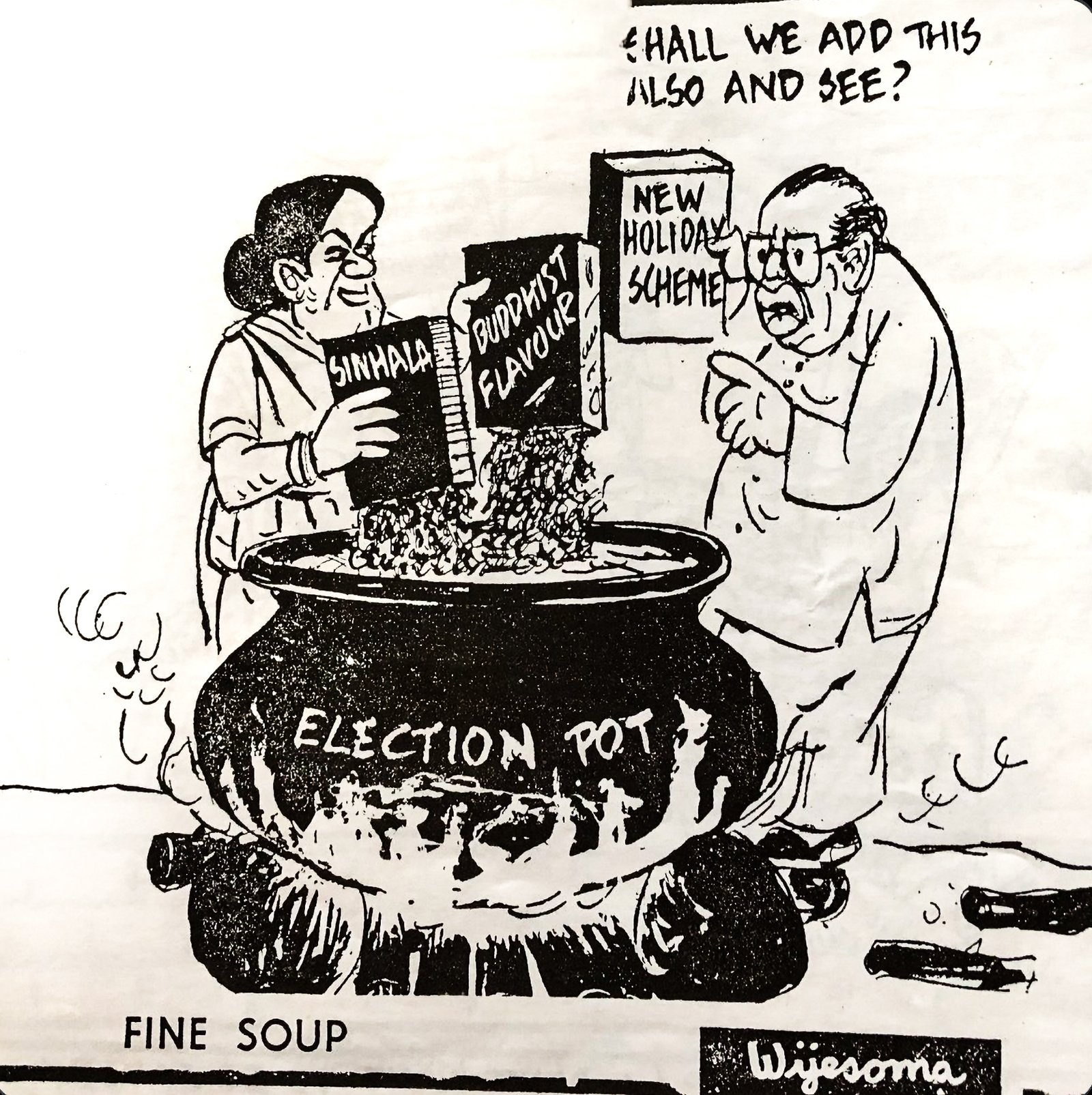
Cartoon by W. R. Wijesoma (circa. 1965)
The election produced a hung parliament, with no party securing a clear majority. The UNP, led by Dudley Senanayake, emerged as the largest party, but the Ilankai Tamil Arasu Kachchi (ITAK), more familiarly known as the Federal Party, held the balance of power with its 14 seats. Senanayake secured the party’s support through the Dudley–Chelvanayakam Pact, enabling him to form a government that included a broad spectrum of political ideologies. The Opposition mockingly dubbed it the hath havula—the seven-party coalition—denouncing it as a tenuous yet treacherous amalgam that undermined democracy and the interests of the majority of the island’s people.
As critics of the coalition exploited ethnic anxieties to undermine its legitimacy, contradictions within leftist politics at the time further inflamed communal tensions. The Trotskyist Lanka Sama Samaja Party, for instance, opposed Prime Minister Senanayake’s alliance with the Tamil Federal Party, criticised the (ultimately unrealised) Dudley–Chelvanayakam Pact,[6] and coined the slogan Dudleyge badē masāla wadē,[7] implying that the prime minister’s accommodating stomach had ingested the Tamil agenda. Furthermore, Senanayake’s decision to keep the pact’s specific details confidential backfired, prompting accusations that he had secretly agreed to divide the country. Mounting resistance, fuelled by opposition politicians and other factions, became more combative and scuttled its implementation.
|
We 8th graders used to sit on straight-backed wooden chairs that had woven rattan seats. The holes through which the rattan was passed were a haven for bed bugs. This meant they had to be sprayed regularly with Flit, a popular insecticide. So, instead of sitting inside our classrooms listening to some boring lesson, we got to take our chairs outside and play with the Flit pump! Our classroom was located near the Galle Road from which we were only separated by a low wall. Suddenly, we heard the chanting of slogans and a huge mass of people came marching down the road. Soon, protesters were standing on our school wall and the next minute, they had all charged into our school! We ran screaming into our classrooms, leaving our chairs behind. Our teacher quickly shepherded us to the safety of the hostel, where the rest of the school had gathered. The school grounds were now overflowing with protesters, quite a few of them Buddhist monks. Police bearing rifles and wooden shields followed them. A helicopter overhead was dropping tear gas and we could see some protesters falling to the ground and being carried into the corridors to be revived. The news on the radio that evening reported that a monk had been killed on our school verandah, but I was sceptical that he had died inside our school. However, there now stands a memorial to this monk, on Galle Road, several yards from our school. Whenever I visit Sri Lanka and see rattan chairs in my relatives’ homes, I recall that happy day which ended in tragedy. Gita Wijesinghe Pitter |
 The Rattan Chair
The death of the Buddhist monk during the demonstration against the Dudley-Chelvanayakam agreement set the stage for a searing piece of political theatre. As political scientist Jayadeva Uyangoda recollects, lawyer and politician Prins Gunasekera—a sharp debater who fused leftist ideology with Sinhala nationalism—brandished the monk’s blood-stained robe within the parliamentary chamber in a demagogic act that sought to ignite raw emotion. The incident was an example of how religious identity and the ‘calculus of power’ converged to shape the nation’s postcolonial landscape.
The long road to 1966
There is no denying that the moon, the earth’s only natural satellite and closest neighbour, has captivated mankind for millennia. In its many phases, the moon shaped religious and cultural rituals,[8] [9] [10] [11] breathed life into mythology and superstition, inspired poets, writers, artists, and musicians[12] [13] [14] [15] and guided both routine and ceremonial activities through its influence on notions of auspiciousness.[16]
In his 1956 book The History of Buddhism in Ceylon, Venerable Walpola Rahula—scholar, writer, and monk—states that, “In ancient Buddhist Ceylon, the poya days were public holidays.” The full moon, the two quarter moons, and the new moon were days devoted to religion—known as Uposatha days—when people renewed, rhythmically, their commitment to the dhamma. He further notes that the 10th-century Badulla stone pillar with medieval Sinhala inscriptions reveals that all forms of trading were forbidden on these sacred days, and that violators of the law were required to offer a certain measure of oil to the great monastery of Mahiyangana for the lighting of lamps. Those who failed to do so would be fined in accordance with former customs (pera sirith). This was a clear indication, the writer infers, that Poya-day prohibitions in Ceylon predate the 10th century. He elaborates that historical records show that it wasn’t only trade that was restricted on poya days; there is evidence that fish, meat, and liquor were prohibited from entering the city during the reign of King Aggabodhi VIII of Anuradhapura in the early 9th century.
In the mid-20th century, the moon over Ceylon illuminated the country’s uneasy interplay of ritual, religion, and politics. On the full moon day of May in 1953, three years before he was elected prime minister, S. W. R. D. Bandaranaike addressed the nation in a radio broadcast:
This day on which the Buddha was born, attained Enlightenment and passed away, is not only sacred to all Buddhists generally, but has a special significance for the Sinhalese race, because of the Vesak Full-Moon Poya Day landing of Vijaya in Sri Lanka. We are told by the Mahawamsa that the Buddha himself entrusted the care of this land and the nascent race to God Sakra.[17]
The Buddhist Committee of Enquiry, or the Buddhist Commission, was established in 1954 by the All Ceylon Buddhist Congress, a prominent lay organisation. Comprising an equal number of monks and laymen, the committee was tasked with evaluating the status of Buddhism in Ceylon and proposing measures to revitalise it to engage with the contemporary world. Donald K. Swearer (1970) notes that a significant proportion of the report’s content focused on the historical marginalisation of Buddhism under colonial rule, but the section most relevant to Buddhist lay life appeared under the heading, ‘Contemporary Social Conditions’. Swearer notes that the report lamented the moral tone of the country and recommended a revolutionary displacement of “Western materialistic social and individual values” and the establishment of “genuine values founded on the Buddha Dhamma” (1970: 261).
To fulfil this revolution, a number of specific recommendations and suggestions were made including … making Poya days public holidays and scheduling the working hours of government departments and offices from 8:00 a.m. to 3:30 p.m. The last recommendation was based on the conviction that a Buddhist mode of living includes rising early, the diligent execution of one’s duties, and retiring early.
The recommendations, though distinct in context and emphasis, echoed some aspects of the 1898 Daily Code for the Laity (ගිහි දින චර්යාව) formulated by Buddhist revivalist and reformist Anagarika Dharmapala, which listed 200 rules under 22 headings on how lay Buddhists should behave. One notable instruction for women was that they should view observing sil on Uposatha (poya)[18] days not as a burdensome duty but as a regular practice. He also advocated for establishing village protection societies and urged every member of the community, including the village headman, to observe sil on full moon days and visit the temple at least once a week.
In 1956, to coincide with the Buddha Jayanthi—marking 2500 years since the Buddha’s passing—the government approved a proposal to declare all full moon days public holidays, beginning with Vesak in May, the full moon day that marks the Buddha’s birth, enlightenment and Parinibbāna. In 1959, this schedule was scrapped and replaced with a plan that granted government employees 10 extra days of leave for religious observances. But that too did not last. By March that year, there was yet another revision: 13 fixed public holidays were retained, and casual leave was raised from 14 to 21 days (Divaina 2024).
A failed coup attempt in 1962 to overthrow Prime Minister Sirimavo Bandaranaike’s Sri Lanka Freedom Party (SLFP) government, led by a group of predominantly Christian, upper-class police and military officers, prompted the formation of the Bauddha Jathika Balavegaya (BJB, National Buddhist Force). A year later, the BJB published a critique of the Catholic Action Movement[19] titled Catholic Action: A Menace to Peace and Goodwill. The study alleged that the Catholic Action Movement had covertly secured key positions in the military, police, and civil administration, as well as in agriculture, commerce, and industry, thereby accumulating significant wealth, power and influence. It also accused the movement of undermining Buddhism by infiltrating its strongholds, ridiculing its practices, and promoting behaviour deemed contrary to Buddhist values.
Reclaiming sacred time
In November 1965, when Home Affairs Minister W. Dahanayake introduced the Bill that would become the Holidays Act No. 17, he traced, chronologically, the decline of the primacy of Poya days. The shift began on 1 November 1770, he pointed out, when Dutch governor Iman Willem Falck supplanted the traditional Poya holidays with Sundays. This was cemented in 1817 by British governor Robert Brownrigg, who made it a permanent practice. Nearly sixty years later, in 1884, a partial concession was made when the full moon day in May was declared a public holiday, largely due to the efforts of American theosophist Colonel Henry Steel Olcott (Parliament 1965, November 19: 2901).
The Opposition endorsed the proposed Act in 1965 but clashed with the Home Affairs minister over several of the Bill’s clauses. They contested his authority to make amendments to the Act, bypassing Parliament. They criticised the lack of guarantees to protect workers from potential loss of wages and other entitlements. They rebuked the minister’s vagueness about how Poya days would be defined and determined—yet another responsibility the Bill assigned to him. Member of Parliament Bernard Soysa voiced his exasperation by drawing, perhaps reflexively, on his colonial literary inheritance. He quoted a line from England’s first poet laureate, John Dryden’s 1681 satirical poem Absalom and Achitophel: “In the course of one revolving moon, was poet, fiddler, chemist and buffoon.” “That degree of versatility,” Soysa observed dryly, “is possible for the Hon. Minister of Home Affairs” (Parliament 1965, November 19: 2954).
In December 1965, approval for the Bill, redefining Ceylon’s weekends, received a unanimous vote in the House of Representatives, crossing party lines, with just one dissenting vote in the Senate. Senator Vernon Dissanayake stood alone in opposition, declaring the Bill ‘indefensible’ and ‘hypocritical’:
My argument is that all civilised human beings have got a certain routine. We are advancing towards socialism; we are not going backwards. In my humble opinion, this is an attempt to take us back to medieval times … We have got accustomed to a certain routine. The phases of the moon do not come into the picture at all. … My suspicion is that under the guise of a religious revival, you are trying to perpetuate some alleged rights. … This seems to be a novel way of making Ceylon a theocratic state, by bringing the Mahanayake Thero into the administration in an insidious way to advise the Minister. …This is a perfect example of politicians making use of religion for their own ends. (Parliament 1965, December 9: 3272-3281)
Senator M. Tiruchelvam,[20] a member of the ITAK, also the minister of Local Government, disagreed:
We are the inheritors of an ancient culture and an ancient tradition. … Traditionally, for centuries, the people of this country have set apart the Poya day as a day of rest and a day of worship. If they do not wish to follow the Gregorian calendar and now wish to revive an ancient tradition and revert to what they have done in the past, that is, adopt a system of holidays by referring to the phases of the moon, I don’t think it is fair to say that the Government of this country, which is responsive to the desires of the people, and is seeking to introduce legislation to give effect to such aspirations, is being hypocritical. … When we came under foreign domination, against our desires, to the bewilderment of the majority of the people in this country, the Government decided by legislation that the day of rest should be the holy day of one section of the community. … They said ‘We have a traditional day of worship, a traditional day of rest. Why should it be changed?’ … This state of affairs is now being changed by the National Government. (Parliament 1965, December 9: 3266-3269)
Senator Tiruchelvam, it is evident, saw the move to align public holidays with traditional lunar observances as part of a broader postcolonial demand for redress—an attempt to reclaim cultural agency and restore a sense of temporal sovereignty long disrupted by colonial rule.
Appointed by the governor general as one of six representatives for the Moor community in the House of Representatives, Sir Razeek Fareed was apprehensive about the possible impact on Muslim religious practices:
There is one point I would like to have clarified. It is in regard to the Hadji festival. Supposing the Poya Day falls on the day of the Hadji festival, that would mean we would not be able to perform animal sacrifices and other rituals associated with the festival. If the Poya falls on the day after—and there is another half-day holiday on the day prior to the Poya day—Muslims would find themselves in an awkward situation. Our religious observances will suffer.[21] (Parliament 1965, November 19: 2914-2915)
The Home Affairs minister, W. Dahanayake, casually sidestepped the concern: “May I say that the slaughtering of animals is a matter within the purview of the local authorities? It is not relevant to the discussion of this bill” (Parliament 1965, November 19: 2915). Yet, he zealously embraced what he viewed to be the Act’s far-reaching significance, proclaiming that it would not only be inscribed in legal documents but also “etched in gold in historical records”. To him, the declaration of Poya days as holidays was not just a policy change—it was a step towards what he envisioned as a transformative societal shift to a more indigenous way of life: “By making the Poya days holidays, I anticipate that we are creating a social revolution.”[22]
W. Dahanayake’s optimistic prediction did not materialise. Yet, questions continue to hang over the Act: What was the degree of isolation and the level of intent that made this gesture to the past possible? What were the catalysts and reinforcements? What does this reveal about how we adapt, create and exist as a nation? And what might explain the collective amnesia and ignorance that shrouds this historical experiment?[23]
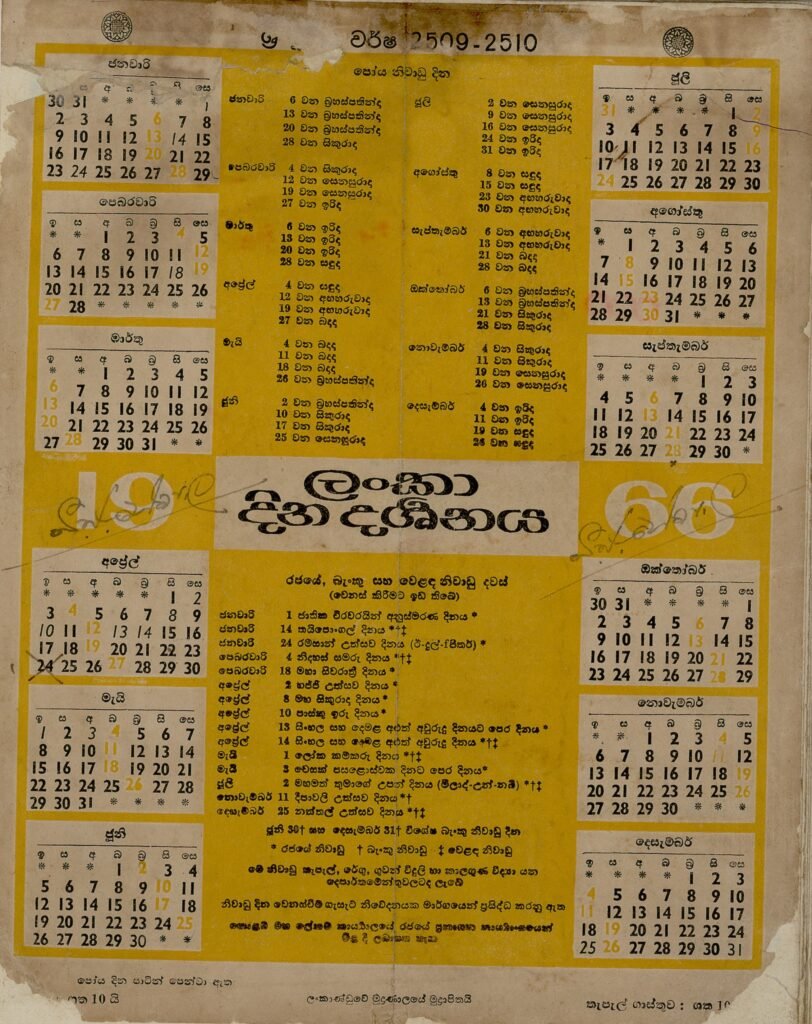 Desk calendar 1966 (source: Sri Lanka National Archives)
The Ceylon Today[24] magazine’s May/June 1968 issue features an article on ‘The Introduction of the Poya Holiday’, with the writer H. D. Wijayadasa stating, “In a country where the majority of the people follow a particular religious tradition, it is incumbent on the administration to provide such conditions for the uninhibited practice of their ideals.”
Madihe Pannaseeha Thero, who was the Mahanayaka (chief prelate) of the Amarapura Nikaya from 13 July 1969, until his passing on 9 September 2003, devotes an entire chapter of his autobiography (2003) to the relentless efforts—sustained over a decade and buttressed by other crusaders of the cause—to secure the Poya weekend. He recounts how, with victory in sight, their hard work was almost derailed when a group of ruling party members proposed retaining Sundays as public holidays in addition to the four Poya days each month. “We understood that if this were to happen, the benefits people stood to gain from the Poya holidays would be diminished and our economy would experience setbacks in so many ways.” Ultimately, just a few months later, the single-minded determination of the Poya holiday proponents triumphed.
The government offered Christians a statutory two-hour leave concession on Sundays, but many churches advised their congregations to attend services early or late in the day. The Ceylon Daily News of 4 January 1966, reported that many Catholics chose to forgo the leave granted to them, as it might jeopardise their chances of employment and prospects for promotion. Both Catholic and Anglican churches adjusted service times to accommodate the new calendar. St. Lucia’s Cathedral rescheduled and added services with working people in mind, holding masses at 5, 6, and 7 a.m., as well as 6 and 7 p.m. At the Cathedral, formalities traditionally reserved for Sundays, such as betrothals, were shifted to Poya days. Most Anglican churches scheduled services early in the morning. At St. Michael’s Church, Polwatte, mass was held at 6 a.m., followed by the main Holy Communion service at 7.15 a.m .
The lunar lapse, the moon mission, and the moral compass
In 1955, a decade before the new calendar was introduced, science fiction writer Arthur C. Clarke chose to make Ceylon his home. Widely regarded as a visionary, he conceptualised the use of satellites in geostationary orbits to transform global communication. Described also as a prognosticator, he was accustomed to foreseeing what was to come. Yet even he was taken by surprise when Ceylon made so extraordinary a decision:
In 1966, the island of Ceylon cut itself adrift from the rest of the world. It abandoned the seven-day week and reverted to the traditional Buddhist calendar, based on the phases of the moon.
The result was instant chaos. Only astronomers could make long-range appointments; it was useless planning to meet anyone on, for example, Monday week, since Monday (or any other day) might be Poya, and all offices and shops would be closed. This was merely an inconvenience as far as the country’s internal affairs were concerned, but it caused utter confusion in all dealings with the outside world. Once every six weeks or so, as the moon drifted across the constellations, the Poya Day fell on a Sunday and the Ceylonese were briefly in step with the rest of humanity. But most of the time, the tea-brokers of Mincing Lane could telephone their Colombo offices only three or four days of every week, and they were never quite sure which days those would be.
… Despite its cost to the country, and the grumblings of the businessmen, no politician dared to attack this exercise in nostalgia; yet before it had completed its fifth year, it was quietly abolished and Monday, Tuesday, Wednesday re-entered the Ceylonese vocabulary. The sudden ending of the Poya calendar was a small but significant byproduct of a national tragedy which proved that there was no way back into the past, and that the real or imagined qualities of one’s ancestors have little relevance to unemployment, adverse trade balances, and the other problems of modern life.[25] (Clarke 1983)
In Ceylon, Clarke’s influence may have been muted, but his book The Exploration of Space was reportedly provided as background reading to U.S. President John F. Kennedy, helping persuade him that a manned mission to the moon in the not-too-distant future was within the realm of the possible (Das 2008). Yet, in 1969, when NASA requested messages of goodwill and peace from heads of state to be placed on the moon’s Southern Sea of Tranquillity by Apollo 11, Prime Minister Senanayake politely declined, without explanation: “The Government of Ceylon, while thanking NASA for its kindness in requesting such a message, has decided not to send such a message” (Gunawardene 2009).
The reason for this polite refusal remains unknown, but an article in the Lankadeepa of 29 January 1962, just seven years before the first moon landing, may offer some clues. Its headline was dramatic: “Before man reaches the moon, the world will be destroyed by science”—followed by the subheading, “Dudley highlights the consequences of moral decline”.
Senanayake, who was then the leader of the Opposition, warned that powerful states were using scientific advancement to dominate the world, and that their desire to reach the moon arose from the same resolve. He remarked that if moral conduct did not advance alongside economic and scientific progress, the result would be the decline of society.
Welfare, warfare, and worship
Just a few months after the Apollo 11 moon landing, Ceylon shifted its focus to the 1970 general election. Dudley Senanayake entered the election at a disadvantage, having had no option but to scale back on the subsidy[26] on Ceylon’s staple food a few years earlier due to poor paddy harvests in Burma, the country Ceylon turned to as local rice production failed to meet consumer needs. He reduced the two-measure rice subsidy to one—but made it available at no cost. His good intentions, however, were negated by the grand promise of the full two-measure quota “even from the moon” made by the leader poised to replace him.[27] [28]
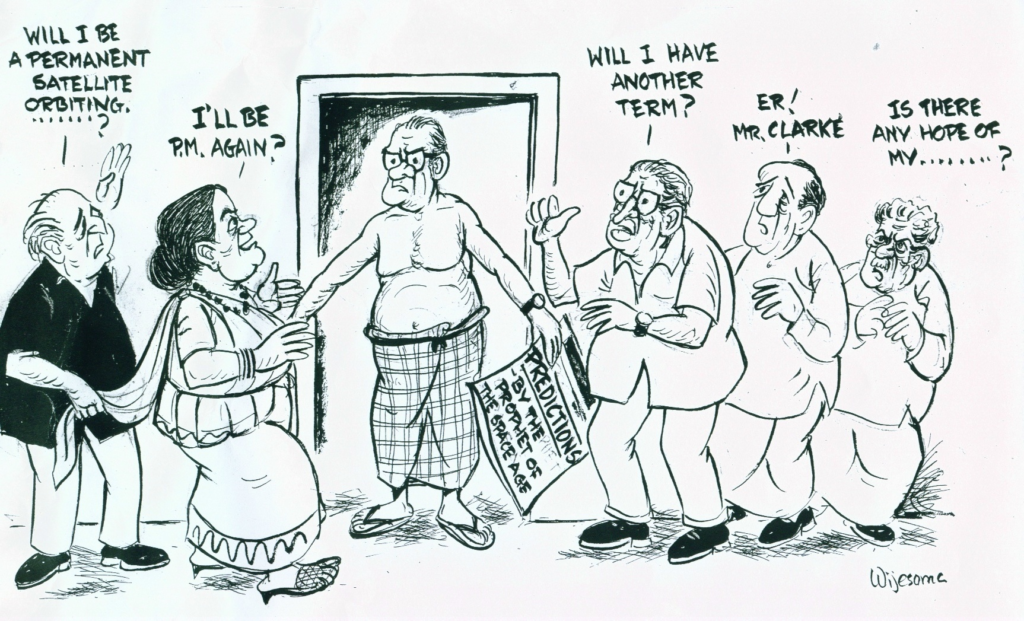
Cartoon by W. R. Wijesoma (Sunday Observer, 1969)
The moon had been drawn into the country’s political imagination most definitively from the early 1960s. However, urgent tensions simmered beneath the surface, calling for attention yet left largely unattended. Among them were the rumblings of the Janatha Vimukthi Peramuna (JVP), a youth-based Marxist movement. Even the rebellious JVP, in its online chronicles, traces its beginnings by invoking the full moon day on which the Buddha was born and linking it to the party’s own birth (People’s Liberation Front n.d.).
The United Front coalition led by Sirimavo Bandaranaike was elected to power in May 1970. One year later, in April 1971, the government faced an armed revolt by the JVP, quelled within two months. Immediately after, in July 1971, the prime minister moved to revoke the Holidays Act No. 17 of 1965. The muted public response to the Act’s abolition suggests scant popular demand for the Poya holidays in the first place—though, admittedly, it could also betray a society immobilised by the shock of an insurrection.[29]
The newly drafted Holidays Bill No. 29 of 1971 declared Sundays and full moon Poya days public holidays. Moreover, it imposed certain restrictions on Poya days: banning the slaughter and sale of animals and requiring certain businesses—meat stalls, taverns, liquor shops, cinemas and nightclubs—to remain shut. The tabloid Sun newspaper, in an article titled ‘Return to Piety’ (14 August 1971), appeared to step outside its usual register. It conveyed optimism about the transition to the new holiday system—with a caveat: without proper enforcement, the Poya prohibitions could undermine public morality and the credibility of the state.
In the past, religious holidays can be better described as a riotous rake’s progress, rather than a pious pilgrimage to piety, and the State deserves the thanks of a grateful public for the action it has taken … However, … illicit traffickers in liquor, and others whose claims to sanctity can only be described as marginal, may be inclined to turn the winds of religious renaissance conjured up by the State as a windfall for themselves … This possibility must be resolutely guarded against … The Government must take all necessary steps to ensure that taverns, and all places where liquor is exposed for sale, remain closed on Full Moon Poya Day, bearing in mind that if any opportunity, however small, is afforded to those so minded to flout the law, it will not only reduce the abstention rules to a screaming farce, but bring the State itself to ridicule in the estimation of the public. This can best be done by keeping all such premises under close Excise surveillance to ensure that consignments of liquor are not spirited away to be sold later in the black market, at exorbitant prices.
Experience has demonstrated that laws that are not or cannot be rigorously implemented, not only defeat the purpose they are intended to serve, but have a most damaging effect on public morality, by forcing the public to do in stealth, what they have been accustomed to do openly.
The weight of nostalgia and the test of time
Prime Minister Sirimavo Bandaranaike conceded that although she too had initially approved of the previous Act, it had proven ineffective and counterproductive. Her lengthy statement delivered in the House is heavy with hindsight:
The Maha Sangha and Buddhist leaders requested Poya holidays with the expectation that at least once a week, Buddhists would have the opportunity to visit temples, observe sil, and follow Buddhist practices properly. This belief was widely held. Poya holidays were granted, and they were tried out for five years. However, based on our experiences during those five years, we now regretfully must admit that Buddhists did not derive any real benefit from it. This is something that most people acknowledge today. (Parliament 1971, July 9: 1658-1688)
The prime minister noted that leading prelates of the Malwatte, Asgiriya, Amarapura, and Ramanna chapters were consulted and broadly supported a return to Sunday holidays. Some senior monks, she said, observed that the lunar system had failed in its spiritual purpose, even contributing to increased “sinful activities” rather than devotion. She underscored the futility of imposing religious observance on the young, noting that they naturally seek recreation on their days off and that the state neither has the right nor the power to dictate their leisure. She further conceded that, by diverging from the international Sunday–Saturday weekend, Ceylon was left with only three and a half effective working days to engage global markets, resulting in significant losses in tea, rubber, and coconut exports—the backbone of the national economy. Addressing potential communal tensions, Bandaranaike also clarified that the move was not a concession to the Catholic Church but an independent government decision grounded in practical necessity, not external pressure or secret agreements.
B.Neminathan, representing ITAK from Trincomalee, backed the government’s proposal:
We support this move of the government for one reason, as we sincerely feel that it is a move for the future, the better economy of the country. … It has been my view that every government since Independence had forgotten the interests of Ceylon in the interest of continuing in office or getting the reins of office the next time. … It is the first time that any government after Independence has forgotten political expediency in the interests of Ceylon’s future. … It was said that the Poya holidays did not in any way help the Buddhists though it was meant for them, but I boldly say that it did help the Hindus. Invariably, every full moon or new moon happens to be a religious day for the Hindus. Before the Poya days were made holidays we observed those religious days, but we did not have a holiday for it. Since the Poya days came in, the Hindu workmen were able to carry out their religious duties without applying for leave, but even if the Poya days are taken off, we Hindus will continue to observe these days as religious days. (Parliament 1971, July 9: 1746-1747)
The thread of philosophical musings and sardonic remarks running through the House debate on Holidays Act No. 29 openly acknowledge the ideological underpinnings of the actions—and Acts—that determined public holidays:
J.R. Jayewardene, Leader of the Opposition:
We don’t need a Poya holiday to become a good Buddhist.
Sirimavo Bandaranaike, Prime Minister:
Why, then, did we declare all four Poya days of the month as public holidays, leading to huge economic losses?
T. B. Illangaratne, Minister of Foreign and Internal Trade:
To attain political Nibbana.
Sirimavo Bandaranaike, Prime Minister:
But that too did not come to pass. (Parliament 1971, July 9: 1633)
Sharni Jayawardena is a documentary photographer and filmmaker.
References
Ayub, M.S.M. (2022). “Back to the seventies? Remembering the famine-like situation that prevailed fifty years ago”. Daily Mirror (28 January): https://www.dailymirror.lk/print/opinion/Back-to-the-seventies-Remembering-the-famine-like-situation-that-prevailed-fifty-years-ago/172-229966.
Ceylon Daily News. (1966). “Churches Alter Service Times”. (2 January).
Ceylon Daily News. (1966). “Catholics and Two-hour Leave Concession”. (4 January).
Clarke, Arthur C. (1983). “The Sea of Sindbad”. In Handbook for the Ceylon Traveller, 2nd ed. Colombo: Studio Times.
Cumming, Constance. (1901). Two Happy Years in Ceylon. London: Chatto & Windus. First published in 1892.
Das, Saswato R. (2008). “Final Thoughts from Arthur C. Clarke”. New York Times, (20 March): https://www.nytimes.com/2008/03/20/opinion/20iht-eddas.3.11290829.html
Divaina. (2024). “Poya Day: The Origin Story”. (22 May): https://divaina.lk/පොහොය-දිනය-නිධාන-කතාව/
Field, Garret. (2013). “Handa Eliya (The Moonlight): Mahagama Sekera’s Experimental Prose”. Sagar: A South Asian Research Journal XXI:16–27.
Geiger, Wilhelm. (Trans.). (1912). Mahawamsa (Chapter 6). London: Pali Text Society.
Gunawardene, Nalaka. (2009). “No Moon, please – we’re Ceylonese: How Sri Lanka lost the Moon….”. Open Minds blog (19 July). https://nalakagunawardene.com/2009/07/19/no-moon-please-were-ceylonese-how-sri-lanka-lost-the-moon/
Haputhanthri, Hasini. (2025). “City of Gods: The Tenavaram Temple and the Hindu Heritage of Southern Sri Lanka”. In Hasini Haputhanthri and Sujeewa de Silva (Eds.), Shared Sanctities (2nd edition, 63-84). Colombo: International Centre for Ethnic Studies.
HistoricalDialogue.lk. (2019). Archive of Memory: Reflections on 70 years of Independence. Edited and curated by Malathi de Alwis and Hasini Haputhanthri (www.archiveofmemory.lk).
Jayaweera, Sanjeewa. (2019). “Fooling All the People all the Time”. Colombo Telegraph (28 October): https://www.colombotelegraph.com/index.php/fooling-all-the-people-all-the-time/
Nell, L. (1881). “On the Sinhalese Observance of the Kala’wa.” The Journal of the Ceylon Branch of the Royal Asiatic Society of Great Britain & Ireland, 7(24), 85–92.
The New York Times. (1971). “Ceylon Changes Calendars, Sunday Is a Holiday Again”. (8 August): 5. https://www.nytimes.com/1971/08/08/archives/ceylon-changes-calendars-sunday-is-a-holiday-again.html
Pannaseeha Thero, Madihe. (2003). පැනසිහ පැහසරණිය [Penasiha Pehesaraniya]. Maharagama: Sasana Sevaka Samithiya.
Paranavithana, Senarath. (1956). Sigiri Graffiti. London: Oxford University Press.
Parliament of Sri Lanka. (1965, December 9). Sittings of the Senate, “Holidays Bill – Second Reading”. Hansard, 22 (2): 3266-3281.
Parliament of Sri Lanka. (1971, July 9). House of Representatives, “Holidays Bill – Second Reading”. Hansard, 94 (1): 1658-1747.
Parliament of Sri Lanka. (1965, November 19). House of Representatives, “Holidays Bill – Committee”. Hansard, 63 (2): 2914-2954.
People’s Liberation Front. (n.d.). “History of the JVP (1965-1994)”. Available at https://www.jvpsrilanka.com/english/about-us/history-of-1965-1994/
Rahula, Walpola. (1956). The History of Buddhism in Ceylon. Colombo: M. D. Gunasena.
Rambukwella, Harshana. (2018). Politics and Poetics of Authenticity: A Cultural Genealogy of Sinhala Nationalism. London: UCL Press.
Simon, Richard. (2025). Thomia, Vol. II, 1948–2001. Colombo: Lazari Press.
Sun. (1971). “Return to Piety”. (14 August): 5.
Swearer, Donald K. (1970). “Lay Buddhism and the Buddhist Revival in Ceylon”. Journal of the American Academy of Religion, 38 (3): 255–275.
Vitharana, Vini. (1993). Sun and Moon in Sinhala Culture. Colombo: Educational Publications Department.
Weerakoon, Bradman. (2004). Rendering unto Caesar: A Fascinating Story of One Man’s Tenure under Nine Prime Ministers and Presidents of Sri Lanka. Colombo: Vijitha Yapa Publications.
Notes
[1] Editors’ Note: This essay accompanies a documentary film ‘Just a Phase: The Forgotten Lunar Calendar’ (59 mins, 2026, Sri Lanka) written and directed by the author, and produced by the International Centre for Ethnic Studies (ICES).
[2] Rambukwella (2018) argues that while the politics of authenticity are hotly contested, apekama—or ‘ourness’, the idea of a uniquely Sinhala-Buddhist way of being—has endured as a powerful constant. He views apekama as more than a personal belief—as a sustained cultural discourse that is institutionalised, inherited, and reproduced across generations, with far-reaching political consequences in post-independence Sri Lanka.
[3] Jaffna College decided to hold classes on pre-Poya days (equivalent to Saturdays) to keep Sundays free for church. A woman who attended St. Joseph’s Girls’ School, Nugegoda, recalls how her parents would visit church before heading to work on Sundays. She would do the same before going to school. Ladies’ College, Colombo, granted students several hours off on Sundays to attend church. The choristers of S. Thomas’ College, Mt. Lavinia had no choice but to rise in the early hours of Sunday for Holy Communion, with the service scheduled to accommodate a regular school day afterwards. A past pupil of a rural school in the Matara district remembers how awkward it felt, at first, to adjust to school days being tagged with the distinctly non-vernacular labels P1, P2, P3, P4 and P5. But they took comfort in the fact that the weekend remained two days long.
[4] Sil here refers to the Eight Precepts, a set of moral guidelines that Buddhists observe on special occasions, often coinciding with a moon phase, also referred to as days of Uposatha. Uposatha observances have roots in pre-Buddhist Brahmin and Vedic customs, where a day of seclusion for purification was determined by the phases of the moon.
[5] According to the 1963 Census, Ceylon’s population stood at 10,582,000. The ethnic composition was 71% Sinhalese, 11% Sri Lankan Tamils, 10.62% Indian Tamils, 5.92% Sri Lankan Moors, 0.52% Indian Moors, 0.42% Burghers, 0.32% Sri Lankan Malays, and 0.19% Others. In terms of religion, 66.18% of the population were Buddhists 18.51% Hindu, 8.36% Christians 6.84% Muslims and 0.11% Others.
[6] The Dudley-Chelvanayakam Pact (D-C Pact), signed on 24 March 1965, included provisions to make Tamil the official language for administration and records in the Northern and Eastern Provinces, allow the Tamil language to be used in legal proceedings, establish District Councils with specific powers, amend land allotment laws, and grant land to landless individuals, particularly Tamils from within those two provinces.
[7]. Bradman Weerakoon, who was secretary to the prime minister, said the catchphrase was a suggestion that “the ‘masala wade’, a favourite shorteat of the Tamils, implanted in Dudley’s celebrated stomach, was growing in intensity” (Weerakoon 2004: 161).
[8] The Aranya Senasanaya in Kekirawa, Mettaramaya in Pannipitiya, and Wijayarama Raja Maha Viharaya in Nugegoda still hold sil observances on all four Poyas of the month. There are likely to be more.
[9] Considered especially auspicious for ancestor worship by Hindus, Ādi Amavāsai falls on the day of the new moon in the month of Ādi (July–August) and is observed with devotion particularly by those mourning the loss of their fathers. In a similar spirit, the April full moon, Chithirai Pournami, is marked by a fast in remembrance of maternal ancestors.
[10] A map of the island drawn by Ptolemy in the 2nd century marks Sacra Luna, an ancient site of moon worship on the southern coast. Over time, the location became associated with Tenavara or Tenavaram, where a complex of kovils once stood. One of its principal deities, Chandra Maul Eshwaran, a manifestation of Lord Shiva, is said to bear upon his brow a large, precious stone shaped like a crescent moon. Today, this sacred ground is known as the Devinuwara Raja Maha Viharaya, where Lord Vishnu, or God Upulvan, is venerated as the protector of Buddhism (Haputhanthri 2025).
[11] A midsummer new moon festival in Anuradhapura is described by British writer and illustrator Constance Cumming in her 1893 travelogue Two Happy Years in Ceylon. She recounts how large numbers of pilgrims gathered near the ruins of the Lovamahapaya monastery—built in the 2nd century BC—setting up temporary shelters made of large yellow talipot palm leaves, which they later dismantled and carried as umbrellas. Guided by Buddhist monks, the pilgrims walked in procession through the main streets of the sacred city.
[12] In Sigiri Graffiti, Prof. Senarath Paranavitana (1956) translates 685 verses inscribed on the Mirror Wall by visitors to the Sigiriya rock between the 7th and 10th centuries. Many of the verses are appeals to the women portrayed in the rock’s frescoes. In Verse 64, the poet, though doubting his own powers of persuasion, seeks to win their favour:
Aganini at salav me gi pohonnek nat ida / Nava bag-la-sand dutu minisak’hu no vajanneyi
[Wave your hands, O women. Though there is no one who values this song /A man who has seen the new, tender moon of (the month of) Bag should not be rejected.]
Bak, or April, is when the Sinhala and Tamil New Year is celebrated, and one of its rituals is handa balima, or ‘gazing at the moon’. The prescribed date of this practice sometimes coincides with the beginning or end of Ramadan, the holy month of fasting for Muslims, which is marked by the sighting of the slender crescent of the emerging moon. Paranavitana writes that:
from the present-day observances connected with this popular ceremony … no conclusions can be arrived at as to why a man who has seen the moon in Bag should deserve the favour of women. Perhaps, in the 9th century, some special significance of a saturnalian nature was attached to this observance. (1956: 39)
[13] Prof. Vini Vitharana in the Sun and Moon in Sinhala Culture (1993) mentions a festival known as Mase celebrated between the towns of Matara and Tangalle. He believes this event to be a remnant of what may be regarded as a once widespread lunar observance, held on the day of the first faint appearance of the moon in the New Year.
[14] Professor Garret Field, who specialises in 20th-century Sinhala-language song and poetry, writes that Mahagama Sekera’s experimental prose was tied to “an intensely personal quest to locate a sense of authentic Sinhalese Buddhist selfhood, and part of the ‘cultural revolution’ that defined the nation as Buddhist” (2013: 16-27). He notes,
Perhaps the most baffling composition in Vyanga is ‘Handa Eliya’ (The Moonlight). The piece is an experiment in the Sinhalese literary convention of vyanga, i.e., allusion, or suggestion, (hence the title of the book). Though it is not a poem, it calls to mind the highly allusive free verse of Siri Gunasinghe … In Sekara’s ‘Handa Eliya’, the phases of the moon trigger a powerful memory of a romance that is at once painful and pleasurable.
The Peradeniya poets of the 1950s and 60s shared a common interest in the theme of moonlight and love. Siri Gunasinghe wrote a poem of the same name, ‘Handa Eliya’ (1956). Madawale Ratnayake composed the poem ‘Sanda Eliya’ (1960). Gunadasa Amarasekera wrote about moonlight in ‘Sande Mayam’ (“The Moon’s Illusions”) (1961).
[15] Lakdasa Wikkramasinha, fiercely anti-colonial in both language and stance, rejected imported literary norms in favour of a raw, hybrid expression that fused English with Sinhala idioms. He wielded poetry as an instrument of resistance and indignation, shaping an aesthetic that echoed the ideological currents behind the shift to a lunar calendar—a rejection of imposed temporalities and an assertion of cultural autonomy.
[16] A now defunct belief system—Kalāwa—linked human physiology to the waxing and waning of the moon and prescribed human activity based on the phases of the moon. It suggested that a ‘moving principle’ or ‘local predisposition’ shifts within the human body in harmony with the moon’s phases. For men, the Kalāwa begins at the big toe of the right foot, rising to the crown of the head by the full moon, before travelling down the left side to complete the cycle by the new moon. For women, the cycle is reversed, beginning at the left toe. Certain activities were traditionally avoided based on the Kalāwa’s position. For instance, it was believed dangerous to carry firewood on the head when the Kalāwa rested there, or to take purgatives and apply leeches on specific days when it was thought to be in the belly or chest. The system also found reference in Sinhalese almanacs and palmistry, yet inconsistencies in interpretation and limited practical knowledge among medical practitioners suggest its application was more theoretical than empirical. The Kalāwa practice appears to have faded into obscurity, with only vague recollections of its principles surviving today (Nell 1881).
[17] Sakra, also known as Sakka, is the King of Devas, the celestial figure facilitating the teaching of the dhamma. He is associated with painting the hare on the moon, a motif linked to Jataka Tale No. 23, one of a collection of 547 stories on the past lives of the Buddha. The Sasa Jathakaya is a recurring depiction in many ancient Sri Lankan Buddhist temples. A particularly striking mural can be seen at the Thotagamuwa Sri Rahula Rajamaha Viharaya in Hikkaduwa.
[18] According to R.C. Childers’ Dictionary of the Pali Language (1875), Uposatho (Uposatha) is a Buddhist day of religious observance focused on observing the eight precepts, fasting, and abstaining from sensual pleasures. It takes place four times a month: on the full moon, new moon, and the two quarter-moon days. On the full moon and new moon days, monks assemble for the formal recitation of the monastic code (the Patimokkha) and the confession of any breaches of discipline, followed by the offenders submitting to the necessary penance.
[19] Catholic Action was a movement, initiated under the influence of Pope Pius XI, that sought to give the laity a more central role in the Christianisation of society. In the postwar period, national Catholic Action organisations for workers united to form the World Movement of Christian Workers, which remains an active voice within both the Church and society, advocating for the rights of working-class Catholics.
[20] Tiruchelvam resigned from the government in September 1968 after Prime Minister Dudley Senanayake overturned his decision to designate Fort Fredrick in Trincomalee, home to the Koneswaram Temple, as a sacred precinct. He remained a Senator until the Senate was abolished in 1971. ITAK withdrew from the national government, citing the failure to implement the Senanayake-Chelvanayakam Pact, at the same time.
[21] The Holidays Act No. 17 of 1965 did not ban the sale of alcohol or meat; this restriction was introduced in 1971 with the enactment of the Holidays Act No. 29, which reinstated the Saturday-Sunday weekends and designated just one poya day of the month—the full moon day—as a public holiday.
[22] An interesting foil to Ceylon’s lunar calendar is France’s republican (or revolutionary) calendar, which replaced the Gregorian calendar in 1792 and remained in use until Napoleon abolished it in 1806. The goal was to detach the state from its Catholic and royalist past and to invent a new secular way of keeping time. It was part of a larger attempt at de-Christianisation and decimalisation in France.
[23] The Hansards documenting the debates of the House of Representatives and the Senate related to the Holidays Act No. 17 of 1965 and the Holidays Act No. 29 of 1971 make for some revealing reading.
[24] Published by the Government Information Department. Not to be confused with the newspaper founded in 2011.
[25] The cost of the lunar calendar experiment, especially its economic impact, would not be easy to measure. The New York Times of 8 August 1971 states: “Government officials estimated that Ceylon had lost nearly 30 per cent of her foreign trade because its people worked on days when the rest of the world was at rest, and rested on days when the rest of the world was at work.”
[26] Every adult citizen was entitled to two measures (2 kgs) of rice at a highly subsidised price—a ‘measure’ costing 70 cents was sold at 25 cents to the consumer.
[27] But the country’s balance of payments prevented her from keeping the promise. Instead, she had to further reduce the amount of subsidised rice and provide substitute food items such as wheat flour (Ayub 2022). In fact, politicians were not unaware of the perils of meddling with welfare; Senanayake’s move to reduce the rice subsidy in 1953 had sparked public outrage and prompted his resignation—only for the benefit to be partially restored soon after by his successor.
[28] “I recollect being captivated by an electoral promise made by Mrs. Sirimavo Bandaranaike in 1970 as an impressionable eleven-year-old. She promised to bring rice even from the moon to fulfill her electoral promise of two measures of rice per household. [This] resonated well with me, given that only a few months earlier, in 1969 to be precise, I, along with millions of others, had listened to the radio broadcast of Neil Armstrong setting foot on the moon. Nevertheless, before long, I realised promises made by Sri Lankan politicians are never to be taken seriously.” (Jayaweera 2019)
[29] Coincidentally, 1965-1971 also marks the emergence and suppression of the first JVP insurrection.